

안녕하세요! 매일한글 에디터입니다.
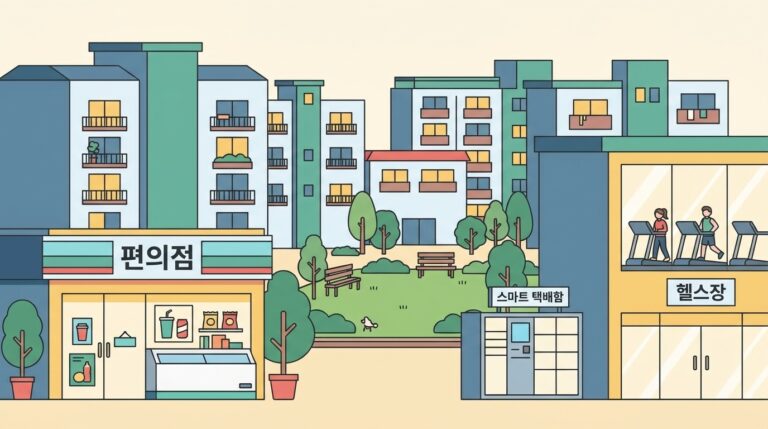
Imagine walking into a modern Korean apartment complex (아파트 단지 – apateu danji). It feels like stepping into a self-contained, futuristic miniature city! Right within a two-minute walk from your elevator, you can find a 24-hour convenience store, a fitness center, a cafe, parcel collection stations, and impeccably organized recycling areas. For foreigners visiting or living in Korea for the first time, this level of residential convenience is often mind-blowing. However, navigating these facilities—from sorting waste correctly to receiving parcel deliveries—can feel overwhelming if you don’t know the proper Korean expressions and social customs.
Based on real feedback from hundreds of intermediate Korean language learners living in Seoul, we have crafted this ultimate guide to help you master apartment complex Korean. By learning these practical expressions and cultural nuances, you will feel confident, independent, and truly at home in Korea!
Phase 2: 핵심 표현 3선 심층 분석
1. 단지 안에 다 있어요
- Pronunciation: [dan-ji a-ne da i-sseo-yo] (Sounds like “Dahn-jee ah-neh dah ee-sseh-yo”)
- Meaning: Literal: “Everything is inside the complex.” vs Nunchi: “This apartment complex has every daily convenience you could possibly need!”
- K-Culture Moment: In K-dramas, real estate agents proudly show clients around modern complexes while highlighting amenities, saying “단지 안에 편의점이랑 헬스장도 다 있어요!”
- Editor’s Insight: “단지” (complex) refers to multi-building residential developments. Combining it with “다 있어요” (everything is here) highlights complete self-sufficiency.
- Situation Spectrum: Casual (단지 안에 다 있어) ✅ / Semi-formal (단지 안에 다 있어요) ✅ / Formal (단지 내에 모두 준비되어 있습니다) ✅
- 🤔 Think About It: How does the high-density “all-in-one” housing complex in Korea reflect urban efficiency compared to residential neighborhoods in your home country?
2. 분리수거장이 어디예요?
- Pronunciation: [boon-ri-soo-geo-jang-i eo-di-ye-yo?] (Sounds like “Boon-ree-soo-geoh-jahng ee oh-dee-yeh-yo?”)
- Meaning: Literal: “Where is the recycling collection area?” vs Nunchi: “Where can I bring my sorted recyclables and garbage?”
- K-Culture Moment: Seeing neighbors in comfortable athletic clothes gathering at the complex recycling zone on Sunday evening to sort plastic and paper.
- Editor’s Insight: Waste separation (분리수거) is taken very seriously in Korean residential communities. Knowing this question prevents awkward neighborly friction.
- Situation Spectrum: Casual (분리수거장 어디야?) ✅ / Semi-formal (분리수거장이 어디예요?) ✅ / Formal (분리수거장이 어디에 있습니까?) ⚠️
- 🤔 Think About It: How does mandatory waste separation promote community accountability in shared residential spaces?
3. 무인 택배함에 넣어 주세요
- Pronunciation: [moo-in taek-bae-ham-e neo-eo joo-se-yo] (Sounds like “Moo-in teck-bae-hahm eh neh-oe joo-seh-yo”)
- Meaning: Literal: “Please put it in the unmanned delivery locker.” vs Nunchi: “Please leave my delivery safely in the smart parcel locker located in the lobby/basement.”
- K-Culture Moment: Receiving a automated delivery notification on your phone while at work and retrieving your package securely with a numeric code.
- Editor’s Insight: 무인 means “unmanned” or “automated.” Modern Korean complexes feature smart lockers to store packages safely when residents aren’t home.
- Situation Spectrum: Casual (무인 택배함에 넣어 줘) ⚠️ / Semi-formal (무인 택배함에 넣어 주세요) ✅ / Formal (무인 택배함에 보관해 주시기 바랍니다) ✅
- 🤔 Think About It: How does contactless delivery infrastructure reflect Korea’s fast-paced (빨리빨리) high-tech culture?
Phase 3: 교과서 한국어 vs 진짜 한국어
Situation 1: Asking about complex stores
- 📖 교과서 한국어: 이 아파트 단지 근처에 상점이 있습니까? (Are there shops near this apartment complex?)
- 🗣️ 진짜 한국어: 단지 안에 상가나 편의점이 다 있어요. (Shops and convenience stores are right inside the complex.)
- 💡 왜 다를까?: Native speakers refer to on-site commercial buildings as “상가” rather than generic “상점”.
Situation 2: Asking about trash disposal
- 📖 교과서 한국어: 쓰레기를 어떻게 버려야 합니까? (How should I throw away garbage?)
- 🗣️ 진짜 한국어: 일반 쓰레기랑 음식물 쓰레기는 따로 분리해서 버려야 돼요. (General trash and food waste must be separated and thrown away individually.)
- 💡 왜 다를까?: Waste disposal in Korea is strictly categorized into general (일반), food waste (음식물), and recyclables (재활용), so Koreans explicitly emphasize 분리해서 버리다 (separate before throwing).
Phase 4: K-Culture 딥다이브 & 비언어적 매너
4-1. 눈치(Nunchi) & Elevator Etiquette
When taking the elevator in a Korean apartment complex, holding the open button (열림) for neighbors with a slight 15-degree head nod and a soft “안녕하세요” (Hello) or “먼저 내리세요” (Please go ahead) demonstrates excellent residential manners (아파트 예절).
4-2. Culture Code: The Danji Life
Korean Danji culture combines high-density modern living with unmatched security and convenience. Popular reality TV shows like I Live Alone (나 혼자 산다) regularly show celebrities enjoying their local complex amenities—such as walking dogs in shared courtyards, using basement fitness facilities, or picking up packages at smart lockers.
Phase 5: 실전 롤플레이 시나리오
Setting: Minjun (resident) helping Alex (new international resident) near the apartment entrance.
- Minjun: 안녕하세요! 이사 오신 분이죠? 아파트 시설은 좀 둘러보셨어요?
[An-nyeong-ha-se-yo! I-sa o-sin boon-i-jo? A-pa-teu si-seol-eun jom dool-leo-bo-syeoss-eo-yo?]
(Hello! You are the new resident, right? Have you had a chance to look around the complex facilities?)
🎭 Smiles warmly while holding the entrance door. -
Alex: 네, 안녕하세요! 아직 잘 몰라서요. 단지 안에 어떤 시설이 있나요?
[Ne, an-nyeong-ha-se-yo! A-jik jal mol-ra-seo-yo. Dan-ji a-ne eot-teon si-seol-i in-na-yo?]
(Yes, hello! I am not very familiar yet. What facilities are inside the complex?)
🎭 Scratches head with a shy smile. -
Minjun: 101동 옆에 편의점이랑 헬스장이 있고요, 무인 택배함도 지하 1층에 있어요.
[Bael-go-il-dong yeop-e pyeon-ui-jeom-i-rang hel-seu-jang-i iss-go-yo, moo-in taek-bae-ham-do ji-ha il-층-e iss-eo-yo.]
(Next to Building 101, there is a convenience store and gym, and unmanned parcel lockers are on Basement Level 1.)
🎭 Points towards Building 101. -
Alex: 와, 진짜 단지 안에 다 있네요! 분리수거장은 어디에 있어요?
[Wa, jin-jja dan-ji a-ne da in-ne-yo! Bun-ri-su-geo-jang-eun eo-di-e iss-eo-yo?]
(Wow, everything really is inside the complex! Where is the recycling area?)
🎭 Looks pleasantly surprised. -
Minjun: 103동 뒤쪽에 있어요. 일반 쓰레기랑 음식물 쓰레기 봉투는 편의점에서 사시면 돼요.
[Bael-gob-sam-dong dwi-jjok-e iss-eo-yo. Il-ban sseu-re-gi-rang meog-sim-mul sseu-re-gi bong-tu-neun pyeon-ui-jeom-e-seo sa-si-myeon dwae-yo.]
(It is behind Building 103. You can buy general trash and food waste bags at the convenience store.)
🎭 Explains patiently. -
Alex: 아하, 그렇군요! 혹시 택배 받을 때는 주소를 어떻게 써야 하나요?
[A-ha, geu-reoh-goon-yo! Hok-si taek-bae bat-eul ttae-neun joo-so-reul eot-teoh-ke sseo-ya ha-na-yo?]
(Ah, I see! By the way, how should I write my address when ordering deliveries?)
🎭 Takes out smartphone to note it down. -
Minjun: 아파트 이름 뒤에 동이랑 호수를 쓰시면 돼요. 예: 101동 502호!
[A-pa-teu i-reum dwi-e dong-i-rang ho-soo-reul sseo-si-myeon dwae-yo. Ye: Bael-go-il-dong o-baek-i-ho!]
(After the apartment name, just write the Dong building number and Ho room number. Example: Building 101, Room 502!)
🎭 Shows address format on smartphone screen. -
Alex: 친절하게 설명해 주셔서 정말 감사합니다!
[Chin-jeol-ha-ge seol-myeong-hae joo-syeo-seo jeong-mal gam-sa-ham-ni-da!]
(Thank you so much for explaining everything so kindly!)
🎭 Bows politely in gratitude.
🔀 Interactive Branching Point
If Alex wants to ask how to sign up for the apartment community gym, what should he say?
* Choice A: “헬스장 등록은 경비실이나 관리사무소에서 하나요?” (Is gym registration done at the security office or management office?)
* Feedback: 🏆 BEST! Polite, clear, and natural.
* Choice B: “헬스장 그냥 들어가서 써도 돼요?” (Can I just walk in and use the gym?)
* Feedback: ⚠️ RISK! Sounds like you want to skip community rules.
* Choice C: “헬스장 무료예요?” (Is the gym free?)
* Feedback: 🚫 BAD! Too blunt and informal with a neighbor you just met.
Phase 6: 10초 감정 섀도잉 드릴
[😊 Amazed & Happy]단지 안에 / 편의점이랑 / 헬스장이 / 다 있어요![🤔 Curious & Polite]혹시 / 분리수거장이 / 어디에 / 있나요?[🙏 Grateful & Friendly]친절하게 / 설명해 주셔서 / 정말 / 감사합니다!
Phase 7: K-Culture 미니 사전
- 동 (Dong): Building number within an apartment complex (e.g., 101동).
- 호 (Ho): Room/Unit number inside a building (e.g., 502호).
- 관리사무소 (Gwalli-samuso): Management Office — handles complex maintenance, parking passes, and facility access.
- 종량제 봉투 (Jongryangje Bongtu): Standardized government-issued prepaid garbage bags required for general household waste.
Phase 8: 여행자를 위한 생존 키트
Top 3 Survival Phrases
- 경비실이 어디예요? (Where is the security office?) — [Pro Tip: Security offices are great if you lose a keycard or need help finding a building.]
- 비밀번호를 잊어버렸어요. (I forgot the passcode.) — [Pro Tip: Essential if your electronic digital door lock locks you out!]
- 종량제 봉투 주세요. (Please give me standard garbage bags.) — [Pro Tip: Ask for 10L or 20L sizes at convenience store checkouts.]
Editor’s Travel Note
Before moving into your apartment, download the Naver Map Application to quickly locate complex management offices and recycling hubs nearby!
Phase 9: 한 발 더 깊이
Although multi-story concrete apartment towers might look impersonal from the outside, Korean apartment complexes are vibrant communities. Features like shared gardens, senior centers (경로당), playground gatherings, and designated recycling hours recreate traditional village solidarity (정 – Jeong). Living in a Danji offers a unique lens into modern Korean urban culture where high efficiency and community spirit live side-by-side.
💬 Your Turn: What is the most unique amenity in apartment complexes in your home country? Share your stories in the comments below!
Phase 10: FAQ & 오해 방지
Q: Can I throw away recyclable trash any day of the week in Korean apartments?
A: It depends on the complex! Major complexes often have 24/7 designated recycling bays, whereas smaller complexes assign specific days (e.g., Sunday evenings only). Check with your 관리사무소 (Management Office).
Q: What happens if I use ordinary plastic grocery bags for general garbage?
A: Using non-official bags is illegal and subject to fines up to 100,000 KRW. Always buy official 종량제 봉투 at convenience stores or supermarkets.
Q: How do delivery drivers locate individual apartments in large complexes?
A: Delivery drivers rely strictly on the 동 (Building) and 호 (Unit) numbers. Make sure your address clearly lists both!
🚨 Common Mistakes
- Mistake: Mixing food waste into general garbage bags. -> Correct Action: Separate food waste into dedicated yellow food waste bags or automated disposal bins.
- Mistake: Calling apartment unit numbers “룸 번호” (Room number). -> Correct Action: Use “호수” or “호” (e.g., 502호).
- Mistake: Discarding unflattened cardboard boxes. -> Correct Action: Flatten boxes and remove tape before placing them in the cardboard recycling bin.
Phase 11: 액션 미션 & 참여 유도
- Bronze Mission: Speak out loud 3 times: “단지 안에 다 있어요!”
- Silver Mission: Share a picture or video of a Korean apartment facility on social media tagging #DailyHangul.
- Gold Mission: Visit a local convenience store and successfully purchase a trash bag by saying “종량제 봉투 10리터 주세요”!
- 🎮 K-Culture Mission: Watch a Korean Vlog or K-Drama house tour and spot the smart doorlock or unmanned delivery locker!
Phase 12: 인터랙티브 퀴즈 챌린지
-
Situation Quiz: Where should you go if you need help getting a parking sticker or registering keycards?
a) 편의점
b) 관리사무소
c) 분리수거장Click to view Answer & Explanation
Answer: b) 관리사무소 (The apartment management office oversees resident registrations and parking!)
-
Fill in the blanks:
아파트 주소를 적을 때는 ___동 ___호를 써야 합니다.Click to view Answer & Explanation
Answer: 동 (Building), 호 (Unit number)
-
True or False:
You can throw general household garbage in any plastic bag in Korea. (True / False)Click to view Answer & Explanation
Answer: False! You must use official prepaid garbage bags (종량제 봉투).







