

Master Korean Ssireum Idioms and Power Moves Like a Grand Champion
Phase 1: Empathy (Story-driven Opening)
안녕하세요! 매일한글 에디터입니다. Have you ever been watching a Korean variety show or reading news about a high-stakes business negotiation, only to hear someone dramatically yell, “완전 판을 뒤집었어!” (They completely flipped the board!) or refer to someone as a “천하장사” (Grand Champion)? You might know the literal dictionary definitions of Korean words, but when it comes to Ssireum (씨름)—Korea’s traditional folk wrestling—the terminology branches into deep, high-level metaphors used daily in Korean politics, business, and pop culture.
At the C1 level, your goal is no longer just being understood; it’s capturing nuance, rhetoric, and cultural weight. Imagine discussing a dramatic plot twist in a K-drama or describing a miraculous corporate comeback using authentic Ssireum imagery. Based on real learner feedback from our premium tutoring sessions, mastering these expressions instantly elevates your fluency from “grammatically correct” to “culturally sharp.” Let’s dive into the sand ring and master the language of Korean power moves!
Phase 2: Core Expressions Deep Dive
1. 판을 뒤집다 (Pan-eul dwijip-da)
- Pronunciation: [Pan-eul dwi-jip-da] (Sounds like “pan” as in frying pan + “dwee-jeep-dah”)
- Meaning: Literal: To flip the wrestling mat/board | Nuance: To completely turn the tables or reverse a losing situation.
- K-Culture Moment: Frequently heard in K-dramas during trial scenes or corporate board meetings when an unexpected piece of evidence shifts the entire balance of power.
- Editor’s Insight: In Ssireum, a wrestler can be inches away from touching the sand, only to execute a counter-throw (dwijipgi). Use this when someone turns a near-defeat into a dramatic victory.
- Situation Spectrum:
- Casual: ✅ | Semi-formal: ✅ | Formal: ✅
- 🤔 Think About It: How does your native language express a sudden dramatic reversal of fortune? Is it tied to sports, card games, or nature?
2. 샅바를 잡다 (Sat-ba-reul jap-da)
- Pronunciation: [Sat-ba-reul jap-da] (Sounds like “sahn-bah-reul jahp-dah”)
- Meaning: Literal: To grab the Satba (thigh/waist strap) | Nuance: To lock horns, engage directly in a serious contest, or initiate a decisive struggle.
- K-Culture Moment: Used in news headlines when two major companies launch competing products: “두 IT 공룡, AI 시장에서 샅바를 잡았다.”
- Editor’s Insight: Before a match begins, wrestlers jockey for position while gripping each other’s waist fabric. “샅바 싸움” (Satba struggle) specifically refers to psychological warfare and pre-negotiation tactics before the actual fight starts.
- Situation Spectrum:
- Casual: ✅ | Semi-formal: ✅ | Formal: ✅
- 🤔 Think About It: In Korean culture, preparation and positioning are considered half the battle. How does pre-negotiation feature in your culture’s communication?
3. 천하장사 (Cheon-ha-jang-sa)
- Pronunciation: [Cheon-ha-jang-sa] (Sounds like “chohn-hah-jahng-sah”)
- Meaning: Literal: Champion under Heaven | Nuance: An insanely strong person or someone who demonstrates invincible, legendary strength.
- K-Culture Moment: TV icon Kang Ho-dong is famously recognized as a former Cheonhajangsa. Whenever someone eats massive portions or lifts something ridiculously heavy, Koreans exclaim this term.
- Editor’s Insight: It’s not just physical! You can call someone’s mental grit or stamina 천하장사급 (Grand Champion level).
- Situation Spectrum:
- Casual: ✅ | Semi-formal: ✅ | Formal: ⚠️
- 🤔 Think About It: What historic title in your culture has transitioned into everyday slang for superhuman effort?
Phase 3: Textbook Korean vs. Real Korean
Situation 1: Describing a sudden dramatic comeback in a project
- 📖 교과서 한국어: 극적으로 상황을 역전시켰어요. (We dramatically reversed the situation.)
- 🗣️ 진짜 한국어: 막판에 완전히 판을 뒤집었죠! (We totally flipped the board at the last minute!)
- 💡 왜 다를까?: While 역전시키다 is clean and formal, 판을 뒤집다 carries vivid visual momentum, making your speech sound dynamic and deeply native.
Situation 2: Talking about intense negotiations before a contract
- 📖 교과서 한국어: 계약 전에 치열하게 협상하고 있습니다. (We are negotiating fiercely before the contract.)
- 🗣️ 진짜 한국어: 지금 양측이 치열하게 샅바 싸움을 하고 있어요. (Both sides are in an intense Satba grip struggle right now.)
- 💡 왜 다를까?: 샅바 싸움 captures the subtle posturing, psychological tension, and tactical leverage that standard words like 협상 miss.
Phase 4: K-Culture Deep Dive & Non-Verbal Manners
4-1. Nunchi & Gestures in Ssireum Culture
When using wrestling metaphors in business or debate, body language matters. When saying “샅바를 바짝 잡아야 해” (We need to tighten our grip), Koreans often clench one fist tightly and bring it close to their waist, mimicking the grip on the Satba. To project confidence without arrogance, maintain direct eye contact and keep a grounded, low stance—just like a wrestler balancing on sand.
4-2. Cultural Code Analysis
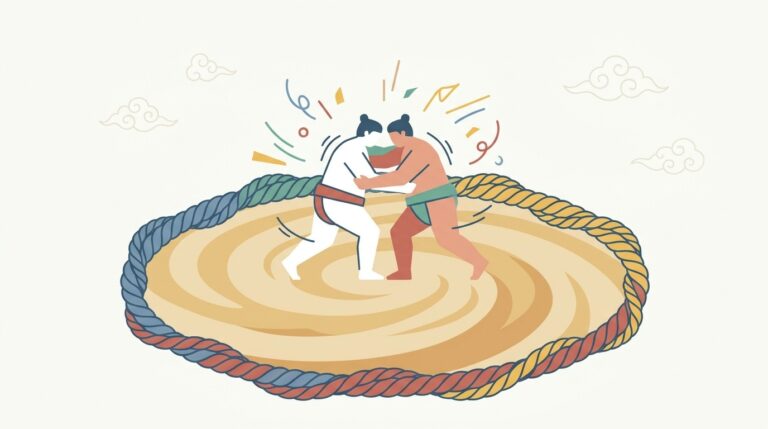
Ssireum is unique among global combat sports because it does not aim to injure or strike the opponent. The sole objective is to force any part of the opponent’s body above the knee to touch the sand using leverage, balance, and force. This reflects a core Korean cultural value: achieving victory through strategic leverage (활용) and center-of-gravity balance rather than outright destruction. This philosophy shines through in variety shows like 1 Night 2 Days or legendary wrestling matches remembered across generations.
Phase 5: Practical Roleplay Scenario
Setting: Sarah (C1 Learner) and Min-jun (Senior Manager) discussing a major client pitch that almost fell through.
- Min-jun: 사라 씨, 어제 B사와의 협상 어떻게 됐어요? 아침까지 분위기 안 좋았잖아요.
(Sarah, how did the negotiation with Company B go yesterday? The mood was bad until this morning.) - Sarah: 🎭 [미소를 지으며 차분하게] 처음엔 좀 밀렸는데, 마지막 제안으로 완전히 판을 뒤집었어요.
(We were pushed back at first, but with our final proposal, we completely flipped the board.) - Min-jun: 정말요? B사가 쉽게 물러서지 않았을 텐데요.
(Really? Company B wouldn’t have backed down easily.) - Sarah: 맞아요. 계약 조건 때문에 초반에 샅바 싸움이 엄청 치열했죠.
(That’s right. The Satba struggle over contract terms was super intense at first.) - Min-jun: 역시 사라 씨네요! 어떻게 설득한 거예요?
(As expected of Sarah! How did you convince them?) - Sarah: 🎭 [지혜로운 눈빛으로] 상대방의 힘을 역이용했어요. 배지기 기술처럼요!
(I used their own force against them. Just like a Baejigi throw technique!) - Min-jun: 와, 완전히 천하장사급 협상력이네요. 수고 많았어요!
(Wow, that’s Grand Champion level negotiation skill. Great job!) - Sarah: 감사해요, 팀장님! 다음에도 판을 깔아주시면 멋지게 성공시킬게요.
(Thank you, Team Lead! Next time you lay out the mat, I’ll make it a success again.)
🔀 Interactive Choice Point
Min-jun asks how you handled the competitor’s sudden price drop. What is your response?
- Option A: “상대방이 공격할 때 오히려 당황하지 않고 판을 뒤집는 카드를 제시했죠.” (Best)
- Option B: “제가 힘이 세서 그냥 눌러버렸습니다.” (Bad)
- Option C: “샅바를 놓치고 그냥 가만히 있었어요.” (Risk)
Feedback:
* Best (Option A): Excellent C1 metaphor usage! Showcases strategic thinking and mastery of 판을 뒤집다 in professional discourse.
* Bad (Option B): Too blunt and misses the leverage-focused spirit of Ssireum idioms.
* Risk (Option C): Implies giving up entirely in a business context.
Phase 6: 10-Second Emotional Shadowing Drill
[🔥 자신감 넘치게]
우리가 / 끝까지 포기하지 않고 / 판을 뒤집었습니다!
(U-ri-ga / kkeut-kka-ji po-gi-ha-ji an-go / pan-eul dwi-jip-eosseum-ni-da!)-
[😲 감탄하며]
초반부터 / 샅바 싸움이 / 정말 치열하네요!
(Cho-ban-bu-teo / sat-ba ssa-um-i / jeong-mal chi-yeol-ha-nae-yo!) -
[😊 유쾌하게]
이 정도 무게를 가볍게 들다니 / 완전 천하장사네요!
(I jeong-do mu-gae-reul ga-byeop-ge deul-da-ni / wan-jeon cheon-ha-jang-sa-nae-yo!)
Phase 7: K-Culture Mini Dictionary
- 샅바 (Satba) | Cloth strap tied around the waist and thigh of Ssireum wrestlers | Used in business/politics as a symbol of leverage and key footing.
- 뒤집기 (Dwijipgi) | Counter-throw technique in Ssireum | Used to describe a sudden, jaw-dropping reversal of results.
- 샅바 싸움 (Satba ssa-um) | Pre-match jockeying for strap grip | Used for tense pre-negotiation strategic power struggles.
- 들배지기 (Deul-baejigi) | Lifting and twisting side throw | Used metaphorically for an overwhelming, decisive move that crushes opposition.
Phase 8: Traveler’s Survival Kit
Top 3 Survival Expressions for Traditional Festivals
- 씨름 경기 언제 시작해요? (Ssireum gyeong-gi eon-je si-jak-hae-yo?) – When does the Ssireum match start?
- 샅바 색깔마다 의미가 있나요? (Sat-ba saek-kkal-ma-da ui-mi-ga in-na-yo?) – Is there meaning behind the different Satba colors?
- 우와, 기술이 정말 화려하네요! (U-wa, gi-sul-i jeong-mal hwa-ryeo-ha-nae-yo!) – Wow, the techniques are truly spectacular!
Editor’s Travel Note
To witness authentic traditional Ssireum in Korea, visit the Gangneung Danoje Festival or major holiday events (Chuseok/Seollal). Search for festival venues directly using the Naver Map App Download to check live schedules and stadium directions.
Phase 9: One Step Deeper
Ssireum is not merely about raw strength; it is a mirror of Korea’s collective philosophy of Eum and Yang (balance and harmony). In Ssireum, an opponent’s force is never blocked head-on with rigid force—it is redirected using core stability and leverage. This philosophy shapes how Koreans handle debate, negotiation, and life challenges: bending without breaking, holding ground during the Satba struggle, and waiting for the precise momentum to turn the board.
💬 Your Turn: Have you ever experienced a moment in work or studies where you had to wait patiently during a
Frequently Asked Questions (FAQ)
Q: What does "판을 뒤집다 (Pan-eul dwijip-da)" mean in Korean and how do you pronounce it?
A: In Korean, "판을 뒤집다 (Pan-eul dwijip-da)" is pronounced [Pan-eul dwi-jip-da] and means: Literal: To flip the wrestling mat/board | Nuance: To completely turn the tables or reverse a losing situation.
Q: What does "샅바를 잡다 (Sat-ba-reul jap-da)" mean in Korean and how do you pronounce it?
A: In Korean, "샅바를 잡다 (Sat-ba-reul jap-da)" is pronounced [Sat-ba-reul jap-da] and means: Literal: To grab the Satba (thigh/waist strap) | Nuance: To lock horns, engage directly in a serious contest, or initiate a decisive struggle.
Q: What does "천하장사 (Cheon-ha-jang-sa)" mean in Korean and how do you pronounce it?
A: In Korean, "천하장사 (Cheon-ha-jang-sa)" is pronounced [Cheon-ha-jang-sa] and means: Literal: Champion under Heaven | Nuance: An insanely strong person or someone who demonstrates invincible, legendary strength.







