

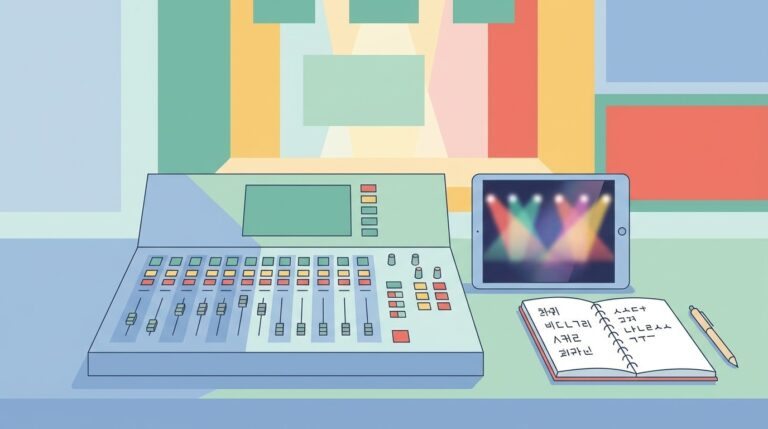
Master Concert Stage Direction & Sound in Korean: The C1 Producer’s Guide
Phase 1: Welcome to the Control Booth!
안녕하세요! 매일한글 Editor here. Picture this: You’re standing in the sound control booth at the KSPO Dome in Seoul. The bass is throbbing, 15,000 lightsticks are glowing in unison, and the K-Pop megastars are about to hit the stage. Suddenly, the stage director turns to you through the comms headset and says, “3번 핀마이크 밸런스가 좀 깨지는데, 메인 큐 들어가기 전에 빨리 잡아봅시다!” If your heart dropped just reading that, you’re not alone. Advanced learners often master everyday conversation, only to feel completely lost when plunged into the high-stakes, fast-paced jargon of Korean performing arts production.
Whether you’re aspiring to direct concerts in Seoul, collaborating with Korean production crews, or analyzing K-Culture BTS footage, understanding concert stage direction and sound mixing requires sharp, professional, and context-nuanced Korean. Today, based on feedback from international production specialists working in Seoul’s music industry, we will equip you with the exact C1-level terminology and cultural finesse needed to run a seamless live show.
Phase 2: Core Expressions Deep Dive
1. 무대 동선을 맞추다
- Pronunciation: [Mu-dae dong-seon-eul mat-chu-da] (Sounds like “moo-dae” + “dong-seon” with a crisp ‘ch’ sound)
- Meaning: Direct Translation: “To match the stage movement line” | Actual Nuance: To coordinate, finalize, or align the artists’ blocking and physical movement across the stage for visual and audio clarity.
- K-Culture Moment: Seen during concert rehearsal behind-the-scenes videos where the stage director pauses choreography to adjust lighting grids.
- Editor’s Insight: ‘동선’ (movement path) is crucial in Korean stagecraft. Saying “동선을 맞추다” implies collaborative coordination among lighting, camera operators, and performers.
- Situation Spectrum: Casual: ⚠️ | Semi-formal: ✅ | Formal: ✅
- 🤔 Think About It: How does your native language distinguish physical blocking from camera tracking, compared to the Korean holistic term ‘동선’?
2. 음향 밸런스를 잡다
- Pronunciation: [Eum-hyang bael-leun-seu-reul jap-da] (Emphasize ‘eum-hyang’ like ‘oom-hyang’)
- Meaning: Direct Translation: “To catch the sound balance” | Actual Nuance: To fine-tune and equalize audio levels across instruments, backing tracks, and vocals.
- K-Culture Moment: The head audio engineer tweaking the digital sound mixing console right before soundcheck.
- Editor’s Insight: Koreans use ‘잡다’ (to catch/hold) for achieving stability or perfection in tech settings (e.g., 톤을 잡다, 밸런스를 잡다).
- Situation Spectrum: Casual: ⚠️ | Semi-formal: ✅ | Formal: ✅
- 🤔 Think About It: Why do you think Korean uses dynamic verbs like ‘잡다’ (to catch) for abstract audio engineering tasks?
3. 큐를 주다 / 큐 사인을 맞추다
- Pronunciation: [Kyu-reul ju-da / Kyu sa-in-eul mat-chu-da]
- Meaning: Direct Translation: “To give a cue / To synchronize cue signals”
- K-Culture Moment: The chief floor director signaling special effects (pyrotechnics) to erupt on the drop of a chorus.
- Editor’s Insight: Precision timing is key. “큐 사인을 맞추다” means every production team (sound, light, FX) acts as one single organism.
- Situation Spectrum: Casual: ⚠️ | Semi-formal: ✅ | Formal: ✅
- 🤔 Think About It: Compare how cue call-outs are communicated in English production versus Korean hierarchy-based stage signals.
Phase 3: Textbook Korean vs. Real-World Korean
Scenario 1: Adjusting audio during soundcheck
- 📖 Textbook: “음향 장비의 소리를 수정해 주십시오.” (Please correct the audio equipment sound.)
- 🗣️ Real Korean: “인이어 모니터 음향 밸런스 좀 다시 잡아 주세요.” (Could you re-balance the sound on the in-ear monitors?)
- 💡 Why the difference? Textbook phrasing sounds robotic. Production sites use precise gear names like ‘인이어’ (in-ear) and professional verbs like ‘잡다’.
Scenario 2: Synchronizing artist positioning
- 📖 Textbook:
Frequently Asked Questions (FAQ)
Q: What does "무대 동선을 맞추다" mean in Korean and how do you pronounce it?
A: In Korean, "무대 동선을 맞추다" is pronounced [Mu-dae dong-seon-eul mat-chu-da] and means: Direct Translation: "To match the stage movement line" | Actual Nuance: To coordinate, finalize, or align the artists' blocking and physical movement across the stage for visual and audio clarity.
Q: What does "음향 밸런스를 잡다" mean in Korean and how do you pronounce it?
A: In Korean, "음향 밸런스를 잡다" is pronounced [Eum-hyang bael-leun-seu-reul jap-da] and means: Direct Translation: "To catch the sound balance" | Actual Nuance: To fine-tune and equalize audio levels across instruments, backing tracks, and vocals.
Q: What does "큐를 주다 / 큐 사인을 맞추다" mean in Korean and how do you pronounce it?
A: In Korean, "큐를 주다 / 큐 사인을 맞추다" is pronounced [Kyu-reul ju-da / Kyu sa-in-eul mat-chu-da] and means: Direct Translation: "To give a cue / To synchronize cue signals"







