

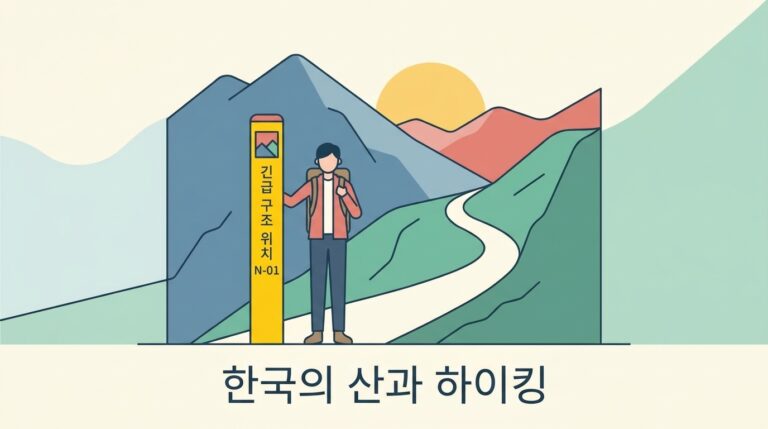
Emergency on the Trail: Requesting Mountain Rescue in Korean Like a Pro
Phase 1: Empathy & Storytelling
안녕하세요! Welcome back to Daily Hangul! I’m your lead editor and your 10-year local culture navigator.
Imagine this: You are hiking the breathtaking, granite peak trail of Bukhansan in northern Seoul. The autumn leaves are a brilliant crimson, and you’re feeling on top of the world. But suddenly, on a steep descent, your foot slips on a damp rock. You twist your ankle badly, and nightfall is fast approaching. You pull out your phone, dial the emergency response line, but panic sets in—how do you clearly explain your exact location on a mountain ridge and describe your physical injury in fluent, precise, high-level Korean under intense stress?
Mountain accidents happen to even seasoned trekkers in Korea. Knowing textbook phrases like “도와주세요!” (Help me!) isn’t enough when rescue teams need your precise landmark, mountain location post number (국가지점번호), and medical status. Today, based on feedback from advanced learners and actual emergency protocols in South Korea, we will master sophisticated, life-saving Korean expressions tailored for mountain emergencies. By the end of this guide, you will feel completely empowered to navigate critical trail situations with calm authority.
Phase 2: Deep Dive into Key Expressions
1. 발목을 질질 끌며 간신히 내려왔는데, 더 이상 자력 하산이 불가능합니다.
- Pronunciation: Bal-mok-eul jil-jil kkeul-myeo gan-sin-hi nae-ryeo-wat-neun-de, deo i-sang ja-ryeok ha-san-i bul-ga-neung-ham-ni-da. (Sounds like: Bahl-mog-eul jeel-jeel kkeul-myuh gahn-seen-hee neh-ryuh-waht-nde, duh ee-sahng jah-ryeok hah-sahn-ee bool-gah-neung-hahm-nee-dah)
- Meaning: Literal: “I barely came down dragging my ankle, but self-descent is no longer possible.” / Nuance: A precise, C1-level status report indicating that you attempted to descend on your own, but your physical injury now completely prevents further unassisted movement.
- K-Culture Moment: In the hit K-drama * Jirisan *, park rangers often listen for technical terms like “자력 하산 불가능” (incapable of self-descent) on radio dispatches to determine whether to deploy a rescue helicopter or ground team.
- Editor’s Insight: Using the formal Sino-Korean term 자력 하산 (自力 下山 – self-reliant descent) instantly conveys to dispatchers (119) that you are rational, calm, and providing a medical/tactical assessment rather than panicking.
- Situation Spectrum:
- Casual: 🚫
- Semi-formal: ⚠️
- Formal / Emergency: ✅
- 🤔 Think About It: Why does Korean emergency communication favor Sino-Korean compound nouns during crisis reports compared to daily spoken Korean?
2. 현 위치 국가지점번호 ‘다사-1234-5678’ 표지판 앞입니다.
- Pronunciation: Hyeon wi-chi guk-ga-ji-jeom-beon-ho ‘da-sa-il-e-sam-sa-o-yuk-chil-pal’ pyo-ji-pan ap-im-ni-da.
- Meaning: Literal: “Current location is in front of the National Grid Number sign ‘Dasa-1234-5678’.” / Nuance: Providing the standardized emergency coordinates printed on yellow metal posts along all Korean hiking trails.
- K-Culture Moment: On popular Korean hiking vlogs (산스타그램), seasoned hikers always point out these yellow markers as essential safety checkpoints.
- Editor’s Insight: Korea’s forest grid system divides the whole country into 10x10m blocks using standardized Korean alphanumeric codes. Stating this code guarantees rescuers pinpoint your location within seconds!
- Situation Spectrum:
- Casual: 🚫
- Semi-formal: ⚠️
- Formal / Emergency: ✅
- 🤔 Think About It: How does Korea’s high-tech infrastructure integrate physical trail signs with GPS rescue dispatching?
3. 경련과 저체온증 증세가 있어서 즉각적인 응급 처치가 필요합니다.
- Pronunciation: Gyeong-ryeon-gwa jeo-che-on-jjeung jeung-se-ga it-seo-seo jeuk-gak-jeok-in eung-geup cheo-chi-ga pyeol-yo-ham-ni-da.
- Meaning: Literal: “I have muscle cramps and hypothermia symptoms, so immediate first aid is required.”
- K-Culture Moment: Experienced Korean mountain guides carry thermal emergency blankets (은박 담요) and instantly recognize the dangers of late-afternoon wind chill on mountain crests.
- Editor’s Insight: Specifying conditions like 저체온증 (hypothermia) or 경련 (spasms/cramps) helps emergency responders bring thermal blankets or specific intravenous supplies right away.
- Situation Spectrum:
- Casual: 🚫
- Semi-formal: ⚠️
- Formal / Emergency: ✅
- 🤔 Think About It: Notice how Korean clinical medical terms combine cleanly to give precise symptoms rapidly.
Phase 3: Textbook Korean vs. Real Korean
Situation 1: Explaining you cannot walk further
- 📖 Textbook Korean: 다리가 아파서 못 걸어가요. 도와주세요. (Da-ri-ga a-pa-seo mot geol-eo-ga-yo. Do-wa-ju-se-yo. – My leg hurts so I can’t walk. Please help.)
- 🗣️ Real Native Korean (C1): 거친 암릉 구간에서 저체온증 증세와 함께 통증이 심해져 조난 상태입니다. (Geo-chin am-reung gu-gan-e-seo jeo-che-on-jjeung jeung-se-wa ham-kke tong-jjeung-i sim-hae-jyeo jo-nan sang-tae-im-ni-da. – Pain worsened alongside hypothermia symptoms on a rugged ridge section, leaving me stranded.)
- 💡 Why the difference?: Expressing concise situational facts (암릉 구간 = rocky ridge section, 조난 = stranded/distressed) allows rescuers to assess terrain severity and equipment needs instantly.
Situation 2: Asking a passing hiker for help
- 📖 Textbook Korean: 119에 전화해 줄 수 있어요? (Eil-eil-gu-e jeon-hwa-hae jul su it-seo-yo? – Can you call 119 for me?)
- 🗣️ Real Native Korean (C1): 죄송하지만 제가 통신 장애로 신고를 못 하고 있습니다. 대신 119에 구조 요청 좀 해주시겠습니까? (Joi-song-ha-ji-man je-ga tong-sin jang-ae-ro sin-go-reul mot ha-go it-seum-ni-da. Dae-sin eil-eil-gu-e gu-jo yo-cheong jom hae-ju-si-get-seum-ni-da? – I’m sorry, but I can’t place a call due to mobile service disruption. Could you request rescue from 119 on my behalf?)
- 💡 Why the difference?: Refined politeness combined with formal medical/technical terms (통신 장애 = network outage, 구조 요청 = rescue request) establishes immediate clarity and urgency.
Phase 4: K-Culture Deep Dive & Non-Verbal Manners
4-1. Nunchi (눈치) & Gestures in Trail Emergencies
- Eye Contact & Demeanor: Maintain steady, clear eye contact with trail responders or fellow hikers. Avoid raising your pitch in panic; keep a low, measured voice tone to demonstrate clarity of mind.
- Hand Gestures: When signaling emergency helicopters or rescuers from afar, raise both arms above your head forming a large ‘Y’ shape (Yes – Need Assistance). Never wave just one arm (which signals ‘No’ or simple greeting in standard aviation SAR protocol).
4-2. Mountain Rescue Culture in Korea
In South Korea, hiking is practically a national sport. Mountain Rescue Services (119 산악구조대) and National Park Officers work with exceptional speed. Furthermore, Korea’s hiking community observes strong camaraderie: if a hiker is injured, passing hikers (등산객) will readily share warm hot-water thermos flasks (보온병), energy bars, or thermal pads (핫팩). Knowing how to state your situation respectfully will rally nearby hikers to assist you immediately!
Phase 5: Real Roleplay Scenario
Setting: On the foggy dusk trail of Seoraksan Mountain. You (Learner) are calling 119 Rescue Dispatch (Dispatcher Kim) while injured.
- Turn 1 (Dispatcher): 🎭 [전화 연결음 후 침착하게] 네, 119 산악구조대입니다. 어떤 상황이신가요?
(Ne, eil-eil-gu san-ak-gu-jo-dae-im-ni-da. Eo-tteon sang-hwang-i-sin-ga-yo? / Yes, 119 Mountain Rescue. What is your emergency?) - Turn 2 (You): 🎭 [단호하고 침착하게] 여보세요! 대청봉 하산길에서 발목을 접질려 자력 하산이 불가능한 상태입니다.
(Yeo-bo-se-yo! Dae-cheong-bong ha-san-gil-e-seo bal-mok-eul jeob-jil-ryeo ja-ryeok ha-san-i bul-ga-neung-han sang-tae-im-ni-da. / Hello! I twisted my ankle on the descent from Daecheongbong and self-descent is impossible.) - Turn 3 (Dispatcher): 🎭 [신속하게] 알겠습니다. 현재 정확한 위치를 파악할 수 있는 표지판이나 국가지점번호가 보입니까?
(Al-get-seum-ni-da. Hyeon-jae jeong-hwak-han wi-chi-reul pa-ak-hal su it-neun pyo-ji-pan-i-na guk-ga-ji-jeom-beon-ho-ga bo-im-ni-ka? / Understood. Do you see any landmark sign or National Grid Number near your current position?) - Turn 4 (You): 🎭 [주변을 살피며] 네, 바로 옆 노란색 표지판에 국가지점번호 ‘바사-9876-5432’라고 적혀 있습니다.
(Ne, ba-ro yeop no-ran-saek pyo-ji-pan-e guk-ga-ji-jeom-beon-ho ‘ba-sa-gu-pal-chil-yuk-o-sa-sam-i’ ra-go jeok-hyeo it-seum-ni-da. / Yes, the yellow sign right beside me reads National Grid Number ‘Basa-9876-5432’.) - Turn 5 (Dispatcher): 🎭 [확인하며] 위치 확인되었습니다. 현재 부상자분의 체온이나 건강 상태는 어떠십니까?
(Wi-chi hwa-kin-doe-ot-seum-ni-da. Hyeon-jae bu-sang-ja-bun-ui che-on-i-na geon-gang sang-tae-neun eo-tteo-sim-ni-ka? / Location confirmed. How is the injured person’s body temperature and general health status?) - Turn 6 (You): 🎭 [떨리는 목소리로] 해가 지면서 저체온증 증세가 오고 있고, 통증이 심해지고 있습니다.
(Hae-ga ji-myeons-eo jeo-che-on-jjeung jeung-se-ga o-go it-go, tong-jjeung-i sim-hae-ji-go it-seum-ni-da. / As the sun sets, hypothermia symptoms are starting, and the pain is worsening.) - Turn 7 (Dispatcher): 🎭 [안심시키며] 구급대가 즉시 출동합니다. 체온 유지를 위해 체온 조절용 옷을 입고 정지된 자세로 기다려 주십시오.
(Gu-geub-dae-ga jeuk-si chul-dong-ham-ni-da. Che-on yu-ji-reul wi-hae che-on jo-jeol-yong ot-eul ip-go jeong-ji-doen ja-se-ro gi-da-ryeo ju-sip-si-o. / Emergency personnel are dispatched immediately. Put on warm clothing to preserve heat and wait in a motionless position.) - Turn 8 (You): 🎭 [감사를 표하며] 네, 알겠습니다. 안내해 주신 대로 체온을 유지하며 기다리겠습니다. 감사합니다.
(Ne, al-get-seum-ni-da. An-nae-hae ju-sin dae-ro che-on-eul yu-ji-ha-myeo gi-da-ri-get-seum-ni-da. Gam-sa-ham-ni-da. / Yes, understood. I will keep warm and wait as instructed. Thank you.)
🔀 Interactive Branching Choice
Scenario Question: Rescuers ask if you can attempt to crawl down 20 meters to a flatter helicopter zone.
* Option A: “아파도 참을 테니 지금 바로 내려가 보겠습니다!” (I’ll endure the pain and start moving down right now!)
* Option B: “2차 부상의 위험이 있고 지형이 험해 움직이기 어렵습니다. 현 위치에서 대기하겠습니다.” (There is a risk of secondary injury and the terrain is rough. I will wait at my current location.)
* Option C: “그냥 알아서 올 때까지 누워 있을게요.” (I’ll just lie down here until you figure it out.)
Detailed Feedback:
* Option A (Risk): Moving with a severe injury on rocky ground can lead to compounding fractures or falls. Always consult rescuers first.
* Option B (BEST): Articulates secondary injury risks (2차 부상 위험) with clear C1 mountain safety reasoning. Excellent choice!
* Option C (Bad): Uncooperative and lacks clear communication during critical response dispatches.
Phase 6: 10-Second Emotion Shadowing Drill
Practice these lines with realistic panic control and emotional cadence (/ denotes pause):
[🚨 긴급하고 단호하게]
현재 위치는 / 국가지점번호 / ‘다사-1234-5678’ 표지판 앞입니다. / 자력 하산이 / 불가능합니다.
(Hyeon-jae wi-chi-neun / guk-ga-ji-jeom-beon-ho / ‘da-sa-il-e-sam-sa-o-yuk-chil-pal’ pyo-ji-pan ap-im-ni-da. / Ja-ryeok ha-san-i / bul-ga-neung-ham-ni-da.)-
[🥶 떨리지만 정중하게]
날씨가 급격히 어두워져 / 저체온증이 우려됩니다. / 신속한 구조를 / 부탁드립니다.
(Nal-ssi-ga geup-gyeok-hi eo-du-wo-jyeo / jeo-che-on-jjeung-i u-ryeo-doem-ni-da. / Sin-sok-han gu-jo-reul / bu-tak-deu-rim-ni-da.)
Phase 7: K-Culture Mini Dictionary
- 국가지점번호 (Guk-ga-ji-jeom-beon-ho) | National Grid Coordinate Number
- Standardized 10-character grid code located on yellow posts across Korean mountains for exact rescue tracking.
- 자력 하산 (Ja-ryeok Ha-san) | Unassisted Descent / Self-descent
- Sino-Korean formal terminology used in medical and SAR reports to indicate ability to walk down unassisted.
- 입산 통제 (Ip-san Tong-je) | Mountain Trail Closure / Hiking Restriction
- Official trail restrictions imposed during high wildfire risks or severe weather alerts.
- 대피소 (Dae-pi-so) | Mountain Shelter / Refuge
- Managed shelter facilities located along major national park routes (e.g., Jirisan, Seoraksan) offering emergency blankets and first aid.
Phase 8: Traveler’s Survival Kit
Survival Phrases TOP 3
- 저체온증 예방을 위해 체온 유지 용품이 필요합니다. (Jeo-che-on-jjeung ye-bang-eul wi-hae che-on yu-ji yong-pum-i pyeol-yo-ham-ni-da.) – Pro Tip: Use this to explicitly ask for heating packs or emergency blankets.
- 통신 상태가 불안정하니 위치를 문자로 전송하겠습니다. (Tong-sin sang-tae-ga bul-an-jeong-ha-ni wi-chi-reul mun-ja-ro jeon-song-ha-get-seum-ni-da.) – Pro Tip: Send SMS if your phone call drops frequently due to poor reception.
- 동반자가 의식을 잃었습니다. (Dong-ban-ja-ga ui-sik-eul ir-ot-seum-ni-da.) – Pro Tip: Critical emergency phrase meaning “My hiking companion has lost consciousness.”
Editor’s Travel Note
Before embarking on Korean hiking adventures, download the National Park Safety App (국립공원 산행안전 앱) to receive instant location tracking, emergency SOS transmission, and trail warning alerts. Make sure your portable battery charger is fully charged as cold mountain air drains phone batteries fast!
Phase 9: One Step Deeper (Reflective Essay)
In South Korea, hiking represents more than recreation—it is a deeply rooted communal ritual where nature, fitness, and solidarity meet. The efficiency of Korea’s 119 Mountain Rescue Service reflects a society built on mutual protection and high technological integration. When emergencies strike on the mountain, language acts as your vital lifeline bridge. Communicating with precision and composure honors both your own safety and the dedication of the rescue teams working tirelessly across Korea’s rugged peaks.
💬 Your Turn: Have you ever hiked in Korea’s national parks like Bukhansan, Seoraksan, or Hallasan? Share your mountain safety stories and favorite trails in the comments below!
Phase 10: FAQ & Common Mistakes
Q: What is the main emergency number for mountain rescue in Korea?
A: Dial 119. It connects directly to Emergency Fire and Rescue Services with location tracking and operator translation assistance.
Q: Can I request emergency rescue if I don’t speak fluent Korean?
A: Yes, 119 dispatches interpreter services (BBB Korea / tourist helpline translation), but stating standard key phrases like “국가지점번호” and your code will speed up rescue significantly.
Q: Are mountain rescue services in Korea free of charge?
A: Public 119 mountain rescues for accidental injuries are generally free in national parks, but reckless hiking in restricted zones (비탐방로) can result in heavy fines.
🚨 Common Mistakes Warning Board
- ❌ Mistake: Saying only “산에서 길을 잃었어요!” (I’m lost in the mountain!) without providing coordinate markers.
- ✅ Correct Action: Locate the nearest yellow trail post and recite the 국가지점번호 alphanumeric code.
- ❌ Mistake: Continuing to walk with severe sprains or disorientation after calling for help.
- ✅ Correct Action: Stay put at your declared checkpoint to prevent rescue teams from searching the wrong coordinates.
- ❌ Mistake: Forgetting to mention pre-existing conditions or signs of hypothermia.
- ✅ Correct Action: Express symptoms clearly using medical terms like 저체온증 or 두통.
Phase 11: Action Mission & Engagement
- 🥉 Bronze Mission: Recite the phrase “자력 하산이 불가능합니다” out loud 3 times with calm tone.
- 🥈 Silver Mission: Open KakaoMap or Naver Maps, find a local Korean mountain trail, and locate the emergency grid marker icons.
- 🥇 Gold Mission: Write down a simulated emergency SMS script in Korean including your coordinates and condition!
🎮 K-Culture Mission: Watch an episode of a Korean mountain documentary or trail vlog on YouTube, and spot at least two yellow location marker posts (국가지점번호)!
Phase 12: Interactive Quiz Challenge
1. Situation Judgment Quiz
You are stranded at dusk and experiencing severe chills. What is the most precise C1 Korean expression to explain your medical state to 119?
🔍 Click to reveal the Answer & Explanation
- Correct Answer: “저체온증 초기 증세가 있어 신속한 체온 유지 조치와 구조가 필요합니다.”
- Explanation: Using terms like ‘저체온증 초기 증세’ (early symptoms of hypothermia) clearly informs dispatches of environmental risks and urgency.
2. Fill-in-the-Blank Quiz
Complete the emergency sentence: “현 위치 ___________ ‘다사-1234-5678’ 표지판 앞입니다.”
🔍 Click to reveal the Answer & Explanation
- Correct Answer: 국가지점번호 (Guk-ga-ji-jeom-beon-ho)
- Explanation: The National Grid Number is essential for exact positioning on mountain trails.
3. True or False Culture Quiz
True or False: In aviation rescue protocols on Korean mountains, waving a single arm in the air is the official signal for helicopter rescue.
🔍 Click to reveal the Answer & Explanation
- Correct Answer: False!
- Explanation: You must raise both arms overhead in a ‘Y’ shape to signal that you need rescue. Waving one arm can be mistaken for a non-emergency greeting.






