

Where Do You See Yourself in 10 Years? Talking About Future Dreams in Korean Like a Native
Phase 1: 안녕하세요! 매일한글 에디터입니다. 👋
Picture this: You’re sitting with your close Korean friends at a cozy rooftop lounge in Hongdae on a cool autumn evening. As the city lights flick on below, someone takes a sip of their drink and asks with a gentle smile: “10년 뒤에 넌 뭐 하고 있을 것 같아?” (What do you think you’ll be doing in 10 years?)
Suddenly, your mind goes blank. You know the basic future tense -을 거예요 from your early textbooks, but declaring “저는 10년 후에 한국 회사에서 일할 거예요!” feels a bit too rigid, direct, or even overly dramatic for a relaxed conversation about dreams. In Korean conversation, talking about the future—especially 10 years out—is an art of balancing genuine hope with subtle humility.
Many intermediate learners (B1 level) hit a wall here. You want to express nuances like “I hope to…“, “I might be…“, or “If things go well, maybe…” without sounding like a robot reading a resume. Based on real feedback from over 500 Daily Hangul learners, mastering these exact soft future expressions is the #1 turning point where learners transition from ‘textbook speaker’ to ‘natural conversation partner.’ Let’s dive in and unlock how to paint your 10-year future self smoothly in Korean!
Phase 2: Core Expressions Deep Dive
1. ~을/ㄹ 것 같다 (eul/reul geot gat-da)
- Pronunciation: [eul-geot-gat-da] (Sounds like “eul-gut-gat-da”, think of saying “a good gut feeling”)
- Meaning: Direct: “It seems like it will be…” | Actual Nuance: “I think I’ll probably be…” / “I feel like I might…”
- K-Culture Moment: In youth K-dramas like Twenty-Five Twenty-One, characters use this when daydreaming on school rooftops about where they’ll end up in their thirties.
- Editor’s Insight: Koreans rarely state long-term personal future plans as absolute facts. Adding ~을 것 같다 softens your prediction, making you sound considerate and humble.
- Situation Spectrum: Casual ✅ | Semi-formal ✅ | Formal ⚠️
- 🤔 Think About It: Why do you think Korean society prefers softened future predictions over definitive assertions when discussing long-term personal goals?
2. ~았/었으면 좋겠다 (at/eot-sue-myeon jot-get-da)
- Pronunciation: [at/eot-seu-myeon jo-kket-da] (Smoothly slide “jot-get-da” into “jo-kket-da”)
- Meaning: Direct: “If it were… it would be good.” | Actual Nuance: “I really hope to…” / “My ultimate dream would be to…”
- K-Culture Moment: Frequently heard in K-Pop idols’ letter-reading videos to their future selves: “10년 후에도 팬들과 함께였으면 좋겠어요.” (I hope I’m still with fans 10 years from now.)
- Editor’s Insight: Using the past tense insert -았/었- creates a psychological distance that makes the wish feel like a warm, cherished dream rather than an aggressive demand.
- Situation Spectrum: Casual ✅ | Semi-formal ✅ | Formal ✅
- 🤔 Think About It: How does expressing a desire as an open conditional (“if… it would be good”) change the atmosphere of a conversation compared to saying “I want to”?
3. ~을/ㄹ지도 모르다 (eul/reul-ji-do mo-reu-da)
- Pronunciation: [eul-ji-do mo-reu-da]
- Meaning: Direct: “I don’t know if it will…” | Actual Nuance: “Who knows, I might…” / “There’s a chance I could…”
- K-Culture Moment: Used in vlog-style content when creators discuss unpredictable life turns, like moving overseas or changing careers.
- Editor’s Insight: This expression adds excitement and open possibilities to your future narrative without making firm promises.
- Situation Spectrum: Casual ✅ | Semi-formal ✅ | Formal ⚠️
- 🤔 Think About It: Does your native language have a phrase that leaves room for pleasant unexpected surprises in the future?
Phase 3: Textbook Korean vs. Real Korean
Situation 1: Saying “I will live in Korea in 10 years.”
- 📖 Textbook Korean: 10년 후에 저는 한국에서 살 것입니다. (10-nyeon hu-e jeo-neun han-guk-e-seo sal geos-im-ni-da.)
- 🗣️ Real Korean: 10년 뒤에는 한국에서 살고 있지 않을까 싶어요. (10-nyeon dwi-e-neun han-guk-e-seo sal-go it-ji a-neul-kka si-peo-yo.)
- 💡 Why the difference? Saying 살 것입니다 sounds like a solemn pledge in a speech. Using 살고 있지 않을까 싶어요 (“I wonder if I might be living…”) sounds natural, reflective, and conversational.
Situation 2: Expressing “My dream is to run my own business.”
- 📖 Textbook Korean: 제 꿈은 제 회사를 만드는 것입니다. (Je kkum-eun je hoe-sa-reul man-deu-neun geos-im-ni-da.)
- 🗣️ Real Korean: 10년 후엔 제 사업을 하고 있으면 참 좋겠어요. (10-nyeon hu-en je sa-eob-eul ha-go it-seu-myeon cham jo-kket-seo-yo.)
- 💡 Why the difference? Native speakers often wrap their long-term career goals in soft hope patterns (~았/었으면 좋겠어요) rather than defining them as rigid dictionary statements.
Phase 4: K-Culture Deep Dive & Non-Verbal Manners
4-1. Nunchi (눈치) & Gestures
When sharing ambitious 10-year dreams in Korea, eye contact paired with a slight, playful tilt of the head works wonders. If you express a big goal (like buying a building or directing a movie), lightly chuckling or scratching the back of your neck with a slight smile (“에이, 꿈은 크게 가지는 거니까요~” / “Well, dreams are meant to be big!”) signals that you are ambitious yet grounded and modest.
4-2. Cultural Code: The ‘Youth Time Capsule’ Trend
In modern K-Dramas and reality shows (like I Live Alone), celebrities often write letters to their “10-year future self” or open time capsules. Korean culture deeply values the concept of 초심 (cho-sim)—remembering your original beginner’s heart. Thus, talking about your 10-year goal isn’t just about financial success; it’s about checking whether you’ll still be happy and true to yourself.
Phase 5: Real Roleplay Scenario
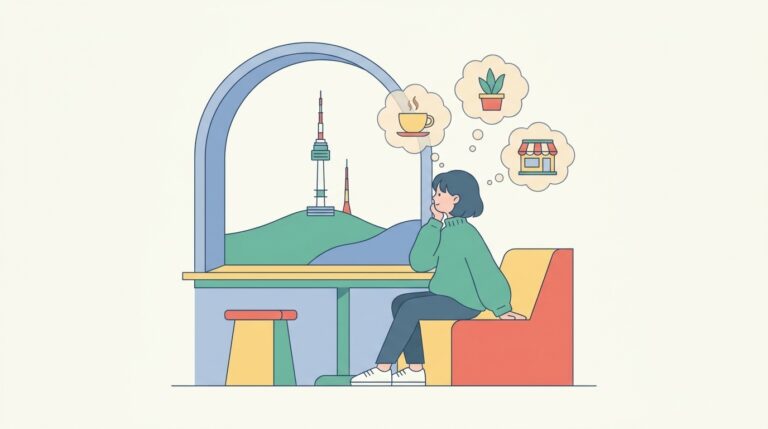
Setting: Sitting at a rooftop cafe in Itaewon with Minjun (민준), your close Korean friend, looking out at N Seoul Tower.
- Turn 1 (Minjun): (✨ Looking up at the tower warmly) 야, 시간 진짜 빠르다. 너 10년 뒤에는 뭐 하고 있을 것 같아?
(Ya, si-gan jin-jja ppa-reu-da. Neo 10-nyeon dwi-e-neun mwo ha-go it-seul geot ga-ta?)
Hey, time flies so fast. What do you think you’ll be doing 10 years from now? - Turn 2 (You): (🤔 Looking thoughtful and smiling) 글쎄요, 10년 뒤면… 한국에서 마케터로 일하고 있지 않을까 싶어요.
(Geul-sse-yo, 10-nyeon dwi-myeon… han-guk-e-seo ma-ke-teo-ro il-ha-go it-ji a-neul-kka si-peo-yo.)
Well, in 10 years… I feel like I might be working as a marketer in Korea. - Turn 3 (Minjun): (😲 Nodding impressively) 와, 진짜? 멋지다! 준비는 잘 돼가?
(Wa, jin-jja? Meot-ji-da! Jun-bi-neun jal dwae-ga?)
Wow, really? That’s awesome! Is your preparation going well? - Turn 4 (You): (😊 Gently laughing) 아직은 열심히 한국어 공부하는 단계지만, 꼭 이루어졌으면 좋겠어요.
(A-ji-geun yeol-sim-hi han-guk-eo gong-bu-ha-neun dan-gye-ji-man, kkok i-ru-eo-jyeos-seu-myeon jo-kket-seo-yo.)
I’m still at the stage of studying Korean hard, but I really hope it comes true. - Turn 5 (Minjun): (👍 Giving a thumb up) 너라면 충분히 할 수 있어. 혹시 개인적인 다른 목표도 있어?
(Neo-ra-myeon chung-bun-hi hal su it-seo. Hok-si gae-in-jeok-in da-reun mok-pyo-do it-seo?)
Knowing you, you can definitely do it. Do you happen to have any other personal goals? - Turn 6 (You): (✨ Eyes sparkling playfully) 어쩌면 자그마한 카페를 하나 차렸을지도 몰라요!
(Eot-jeo-myeon ja-geu-ma-han ka-pe-reul ha-na cha-ryeos-seul-ji-do mol-ra-yo!)
Who knows, I might have even opened a tiny cafe! - Turn 7 (Minjun): (😄 Clapping hands) 대박! 카페 차리면 내가 1호 단골손님 할게!
(Dae-bak! Ka-pe cha-ri-myeon nae-ga 1-ho dan-gol-son-nim hal-ge!)
Awesome! If you open a cafe, I’ll be your #1 regular customer! - Turn 8 (You): (🥂 Raising glass) 고마워요! 10년 뒤에 꼭 놀러 오세요!
(Go-ma-wo-yo! 10-nyeon dwi-e kkok nol-leo o-se-yo!)
Thanks! Make sure to drop by in 10 years!
🔀 Interactive Choice Point
Minjun asks: “10년 뒤에 서울에서 살고 있을까?” (Do you think you’ll live in Seoul in 10 years?)
- Option A: 네! 무조건 서울에서 살 거예요! (Yes! I will absolutely live in Seoul!)
- Option B: 글쎄요, 서울에 살고 있으면 참 좋겠지만 지방 도시에 있을지도 몰라요. (Well, it’d be great if I’m living in Seoul, but who knows, I might be in a provincial city.)
- Option C: 몰라요. 미래는 아무도 알 수 없어요. (I don’t know. Nobody knows the future.)
Feedback:
* Best Choice: Option B — Softens expectations with ~았/었으면 좋겠다 and leaves natural openness with ~을지도 몰라요. Perfect B1 natural vibe!
* Risk Choice: Option A — Grammatically fine, but a bit overly intense/rigid for a soft casual chat.
* Bad Choice: Option C — A bit blunt and shuts down the playful conversation abruptly.
Phase 6: 10-Second Emotion Shadowing Drill
Practice breathing life into these lines by matching the emotion tags and slash-pauses (/):
- [😊 Expectant & hopeful]
10년 뒤에는 / 제 사업을 하고 있으면 / 참 좋겠어요.
(10-nyeon dwi-e-neun / je sa-eob-eul ha-go it-seu-myeon / cham jo-kket-seo-yo.) -
[✨ Playful & open-minded]
어쩌면 / 한국에서 / 살고 있을지도 몰라요!
(Eot-jeo-myeon / han-guk-e-seo / sal-go it-seul-ji-do mol-ra-yo!) -
[🥺 Soft & humble wish]
꿈이 / 꼭 / 이루어졌으면 좋겠어요.
(Kkum-i / kkok / i-ru-eo-jyeos-seu-myeon jo-kket-seo-yo.)
Phase 7: K-Culture Mini Dictionary
- 10년 뒤 (10-nyeon dwi) | 10 years later / down the road | Used instead of 10년 후 in natural conversation.
- 버킷리스트 (beokit-ri-seu-teu) | Bucket list | Frequently used in Korea for life goal conversations.
- 갓생 (gat-saeng) | God + Life (Living a productive, ideal life) | Popular youth slang for living a disciplined life toward future goals.
- 미래일기 (mi-rae-il-gi) | Future diary | Writing diary entries as if you are living 10 years in the future.
Phase 8: Travel & Life Survival Kit
Survival Expressions TOP 3
- 언젠가 꼭 해보고 싶어요. (Eon-jen-ga kkok hae-bo-go si-peo-yo.) — I really want to try doing this someday.
- 10년 뒤에도 연락하면서 지내요. (10-nyeon dwi-e-do yeon-rak-ha-myeon-seo ji-nae-yo.) — Let’s stay in touch even 10 years from now.
- 꿈을 향해 차근차근 준비 중이에요. (Kkum-eul hyang-hae cha-geun-cha-geun jun-bi jung-i-e-yo.) — I’m preparing step by step toward my dream.
Editor’s Travel & Life Note
Planning a trip or long-term stay to check out your future living spot in Korea? Be sure to use 네이버 지도 앱 다운로드 (Naver Map) instead of Google Maps, as it provides far superior pedestrian navigation, public transit route planning, and real-time shop hours across Seoul.
Phase 9: 한 발 더 깊이 (One Step Deeper)
In western cultures, stating clear, ambitious goals with direct confidence (“I will be a CEO in 10 years”) is often celebrated as self-assurance. In Korea, however, future plans are framed within 겸손 (humility) and 가변성 (flexibility). Showing that you recognize life’s unpredictable nature through patterns like ~을 것 같다 or ~을지도 몰라요 doesn’t mean you lack confidence—it shows wisdom and social respect.
💬 Your Turn: What is one thing you hope to be doing 10 years from now? Leave a comment in Korean using ~았/었으면 좋겠어요 or ~을지도 몰라요 below!
Phase 10: FAQ & Common Mistakes
Q: What is the main difference between ~을 거예요 and ~을 것 같아요 when talking about my future?
A: ~을 거예요 indicates a firm plan or pledge (“I am going to”). ~을 것 같아요 softens it to a personal expectation or prediction (“I think I will”). Use the latter when discussing distant 10-year forecasts.
Q: Should I use 10년 후 or 10년 뒤?
A: Both mean “10 years later”. However, 10년 후 (hu) is slightly more formal/written, while 10년 뒤 (dwi) is preferred in everyday spoken conversation.
Q: Why is past tense used in ~았/었으면 좋겠다?
A: It frames your wish as an already completed ideal state in your mind, creating a warmer, more nostalgic nuance of hoping a state comes into reality.
🚨 Common Mistakes Warning Board
- ❌ Mistake 1: 10년 후에 저는 한국에 살 거다. (Too blunt / formal ending mixed with direct future)
- 👉 Correct Action: 10년 뒤에 한국에서 살고 있으면 좋겠어요. (Polite & natural wish)
- ❌ Mistake 2: 10년 뒤의 내 모습은 사장입니다. (Literal translation of “My image in 10 years is CEO”)
- 👉 Correct Action: 10년 뒤엔 제 회사를 운영하고 있지 않을까 싶어요.
- ❌ Mistake 3: Using ~을 것 같다 for immediate, obvious facts right now.
- 👉 Correct Action: Keep ~을 것 같다 for guesses, predictions, and distant future thoughts.
Phase 11: Action Mission
- 🥉 Bronze Mission: Write one Korean sentence about your 10-year goal using
~았/었으면 좋겠어요in your personal notebook. - 🥈 Silver Mission: Post your 10-year goal sentence on your social media or language exchange app and get native feedback.
- 🥇 Gold Mission: Use
~을지도 몰라요in a real voice message or conversation with a Korean friend this week! - 🎮 K-Culture Mission: Watch a episode of a youth K-drama and spot when characters use ~을 것 같다 when daydreaming about their future.
Phase 12: Interactive Quiz Challenge
1. Fill in the blank: “10년 뒤에는 제 카페를 차리고 ______ 좋겠어요.”
(a) 있으면 (b) 있어도 (c) 있으면
2. True or False: In casual spoken Korean, 10년 뒤 is more commonly used than 10년 후.
3. Situation Check: You want to say “Who knows, I might become a director in 10 years!” modestly. Which pattern fits best?
(a) 감독이 됩니다! (b) 감독이 될지도 몰라요! (c) 감독이 되겠습니다!
🔍 Click here to see Answers & Explanations!
- Answer: (c) 있으면 (~았/었으면 좋겠어요 pattern: 차리고 있으면 좋겠어요 / I hope I’ll be running…)
- Answer: True (10년 뒤 is the go-to spoken expression in everyday Korean conversations).
- Answer: (b) 감독이 될지도 몰라요! (~을지도 몰라요 expresses pleasant, humble uncertainty).







