

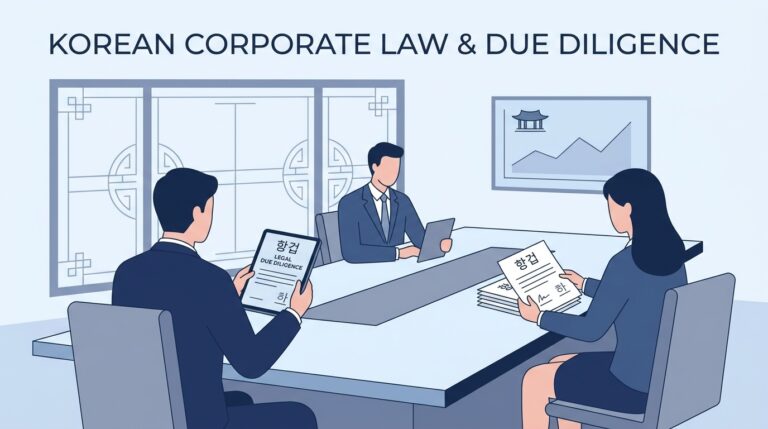
Master Corporate Due Diligence in Korean: Legal Checklists & Strategic Nuances for C2 Executives
안녕하세요! Welcome back to Daily Hangul (매일한글). I’m your lead editor and 10-year local culture navigator. If you have ever watched corporate powerhouse K-dramas like Reborn Rich (재벌집 막내아들) or Vincenzo, you know that high-stakes boardrooms in Seoul are dynamic, intense, and deeply layered with cultural nuances.
Navigating an M&A due diligence (기업 실사) process in Korea goes far beyond translating legal terminology. You might know textbook legal terms, but during actual target company audits, subtle linguistic cues determine whether a deal closes smoothly or hits an unexpected snag. Korean legal and corporate executives rely on a sophisticated blend of formal legal terminology, strategic euphemisms, and indirect contextual cues (눈치).
Whether you are reviewing undisclosed liabilities, checking regulatory compliance, or negotiating indemnification clauses, this guide equips you with C2-level proficiency in Korean M&A legal checklists. Based on real-world cross-border M&A consulting feedback, let’s dive into the exact expressions, cultural strategies, and courtroom-level nuances you need to lead the boardroom with complete confidence!
Phase 2: Top 3 Core Legal Expressions for M&A Due Diligence
1. 우발채무를 전수조사하다
- Pronunciation: [U-bal-chae-mu-reul jeon-su-jo-sa-ha-da] (Pronounced like oo-bal chae-moo reel jun-soo-jo-sa-ha-dah)
- Meaning: Literal: “To conduct a total universe investigation of contingent liabilities.” | Real Nuance: To thoroughly audit all off-balance-sheet or potential hidden liabilities before deal signing.
- K-Culture Moment: Seen frequently in financial thriller dramas when corporate legal counsel discovers hidden guarantees (보증) hidden by a target firm’s subsidiary.
- Editor’s Insight: While basic Korean uses 조사하다 (to investigate), C2 professionals use 전수조사 (complete enumeration/census-style audit) paired with 우발채무 (contingent liabilities) to signal total legal scrutiny.
- Situation Spectrum: Casual: 🚫 | Semi-formal: ⚠️ | Formal Legal Boardroom: ✅
- 🤔 Think About It: How does the emphasis on zero-overlook audits reflect Korean corporate accountability after historical restructuring eras?
2. 진술 및 보증 조항을 구체화하다
- Pronunciation: [Jin-sul mit bo-jeung jo-hang-eul gu-che-hwa-ha-da]
- Meaning: Literal: “To concretize representations and warranties clauses.” | Real Nuance: To draft meticulously detailed Reps & Warranties (R&W) clauses that legally bind the seller.
- K-Culture Moment: In corporate legal disputes, lawyers debate every single qualifier (e.g., “To the best of seller’s knowledge”) in Reps & Warranties agreements.
- Editor’s Insight: Combining 진술 (representations) and 보증 (warranties) with 구체화하다 demonstrates high-level contractual drafting expertise rather than just passive reading.
- Situation Spectrum: Casual: 🚫 | Semi-formal: ⚠️ | Formal Legal Boardroom: ✅
- 🤔 Think About It: Why is precision in written contracts increasingly prioritized over verbal trust (신뢰) in modern Korean corporate governance?
3. 법적 리스크를 소명하다
- Pronunciation: [Beop-jeok ri-seu-keu-reul so-myeong-ha-da]
- Meaning: Literal: “To clarify/substantiate legal risk.” | Real Nuance: To present formal evidence and legal reasoning that mitigates or explains an identified compliance issue.
- K-Culture Moment: During regulatory or tax audits, legal teams present detailed legal briefs (소명자료) to regulators or auditing firms.
- Editor’s Insight: Do not confuse 설명하다 (to explain) with 소명하다 (to legally clarify/justify with supporting evidence). C2 legal practice demands 소명하다.
- Situation Spectrum: Casual: 🚫 | Semi-formal: ⚠️ | Formal Legal Boardroom: ✅
- 🤔 Think About It: How does the legal burden of proof (입증책임) shape the respectful yet firm tone used in Korean administrative explanations?
Phase 3: Textbook Korean vs. Real Boardroom Korean
Situation 1: Expressing the need to audit hidden financial risks
- 📖 Textbook Korean: 우발 채무가 있는지 확인해야 합니다. (We need to check if there are contingent liabilities.)
- 🗣️ Real Boardroom Korean: 숨은 우발채무 및 특수관계인 거래 내역을 우회 조사 없이 전수점검해야 합니다.
- 💡 Why the Difference? C2 legal negotiation demands precision. Using 전수점검 and explicitly specifying 특수관계인 거래 (related-party transactions) establishes professional authority and rigor.
Situation 2: Asking for legal mitigation documents
- 📖 Textbook Korean: 이에 대해 설명하는 자료를 제출해 주세요. (Please submit documents explaining this.)
- 🗣️ Real Boardroom Korean: 해당 이슈에 대한 소명자료 및 손해배상 한도(Cap) 설정안을 조속히 제출하여 주시기 바랍니다.
- 💡 Why the Difference? In senior corporate communications, demanding 소명자료 alongside transaction terms like 손해배상 한도 (Indemnification Cap) sets a formal, action-oriented tone.
Phase 4: K-Culture Deep Dive & Non-Verbal Etiquette
4-1. Boardroom Nunchi (눈치) & Gestures
In Korean M&A due diligence, non-verbal cues carry enormous legal weight:
* Two-Handed Document Exchange: Always hand over legal checklists, deal books, or NDAs using both hands or supporting your right wrist with your left hand. It conveys utmost respect for the counterparty’s legal counsel.
* Maintaining Controlled Tone (수위 조절): Even when pointing out major compliance breaches, avoid aggressive accusations. Use passive or impersonal phrasing (e.g., “~로 해석될 여지가 있습니다” – There is room for this to be interpreted as…) to allow the seller to save face (체면) while still highlighting critical risk.
4-2. Corporate Culture Code in Korean Media
In dramas like Reborn Rich, corporate legal teams act as the ultimate legal shields. When performing due diligence on target affiliates, Korean legal professionals scrutinize not only balance sheets but also tax risks, labor compliance (근로기준법 준수 여부), and intellectual property ownership (지식재산권 양도계약). Understanding this holistic view of corporate risk is central to Korean M&A context.
Phase 5: Live Boardroom Roleplay Scenario
Setting: A high-level due diligence closing meeting between Buyer Legal Counsel (You) and Seller Representative (Director Park).
- Turn 1 (Director Park): (서류를 밀어내며) 실사 요청하신 공장 부지 관련 인허가 서류와 환경 관련 내역입니다.
- Turn 2 (You): (서류를 정밀히 검토하며) 감사합니다, 이사님. 다만 주요 영업자산에 대한 우발채무 및 소송 리스크 소명자료가 일부 누락된 것으로 보입니다.
- Turn 3 (Director Park): (약간 당황하며 손짓을 하고) 아, 그 부분은 현재 진행 중인 소소한 민원 건이라 큰 문제가 되지 않을 것으로 판단했습니다.
- Turn 4 (You): (진지하고 단정한 태도로) M&A 계약 특성상 작은 민원도 진술 및 보증(R&W) 조항에 영향을 미칠 수 있습니다.
- Turn 5 (Director Park): (고개를 끄덕이며) 그렇군요. 그렇다면 어느 수준까지 서류를 보완해 드리면 될까요?
- Turn 6 (You): (체크리스트를 가리키며) 최근 3개년 소송 계류 내역과 손해배상 한도 설정안을 포함한 전수점검 리포트를 요청드립니다.
- Turn 7 (Director Park): (메모를 하며) 알겠습니다. 법무팀에 전달하여 금주 내로 정리해 올리겠습니다.
- Turn 8 (You): (살짝 미소를 지으며 완중하게) 협조에 감사드립니다. 신속한 소명자료 제출이 본 계약 체결을 앞당길 것입니다.
🔀 Interactive Choice Point
Director Park asks if minor pending environmental complaints can be omitted from the final disclosure schedule. How do you respond?
* Option A: “절대 안 됩니다. 당장 모든 서류를 제출하지 않으면 계약은 파기입니다.” (Aggressive/Direct)
* Option B: “법적 리스크 최소화를 위해 미공시 리스크는 진술 및 보증 위반에 해당할 수 있으니, 소명자료에 반드시 포함해 주시기 바랍니다.” (Professional/C2 Level)
* Option C: “이사님 편하신 대로 하세요. 나중에 문제 생기면 알아서 하시면 됩니다.” (Passive-Aggressive)
Feedback:
- Option A (Bad): Too aggressive. Destroys rapport and breaches corporate boardroom courtesy.
- Option B (Best): Excellent! Articulates precise legal consequences using C2 terminology (미공시 리스크, 진술 및 보증) while maintaining executive professionalism.
- Option C (Risk): Unprofessional and relinquishes your legal oversight duty.
Phase 6: 10-Second Emotion Shadowing Drill
Practice these high-stakes executive sentences with rhythm and emotional precision:
[🧐 단호하고 전문적으로]우발채무 / 전수조사 결과를 / 계약서에 반영해 주시기 바랍니다.[🤝 정중하지만 확고하게]해당 법적 리스크에 대한 / 명확한 소명자료 제출이 / 필요합니다.[⚖️ 신중하게]진술 및 보증 조항의 / 손해배상 한도를 / 다시 협의하시죠.
Phase 7: K-Culture Mini Legal Dictionary
- 우발채무 (U-bal-chae-mu) | Contingent Liability | Potential obligation dependent on uncertain future events (e.g., pending lawsuits).
- 소명자료 (So-myeong-ja-ryo) | Legal Clarification/Explanatory Evidence | Formal documentation provided to clear doubts or compliance risks.
- 진술 및 보증 (Jin-sul mit Bo-jeung) | Representations & Warranties (R&W) | Contractual affirmations of fact made by one party to another.
- 손해배상 한도 (Son-hae-bae-sang Han-do) | Indemnification Cap | The maximum monetary limit of liability for contract breaches.
Phase 8: Professional M&A Executive Survival Kit
Top 3 Essential Boardroom Phrases
- 실사 체크리스트를 최신화하여 주십시오. (Please update the due diligence checklist.)
- 미공시 채무에 대한 손해배상 조항을 강화하고자 합니다. (We intend to strengthen indemnification clauses regarding undisclosed liabilities.)
- 법률 자문단의 검토를 거쳐 최종 서명하겠습니다. (We will execute the final signature following review by our legal counsel.)
Editor’s Travel & Business Note
When conducting in-person corporate deal reviews in Seoul, seamlessly access regulatory and business search portals. Learn to navigate resources like the 대한민국 법령정보센터 검색 서비스 to verify statutory compliance on site, ensuring you have real-time legal data during live negotiations.
Phase 9: A Step Deeper (Korean Corporate Governance & Trust)
In Korean business culture, contracts were historically viewed as living frameworks based on mutual business partnership (상호 신뢰). However, modern Korean corporate law has shifted dramatically toward rigorous, Anglo-American style contractual precision. Today’s Korean M&A legal practice strictly balances formal contractual terms with high-context relational dynamics. Recognizing how legal precision intersects with corporate hierarchy will make you an indispensable cross-border leader.
💬 Your Turn: How does due diligence in your home jurisdiction handle undisclosed liabilities compared to Korean legal frameworks? Share your thoughts in the comments below!
Phase 10: FAQ & Mistake Prevention
Q: What is the difference between 조사하다 and 전수조사하다 in M&A context?
A: 조사하다 means simply to investigate or inspect. 전수조사하다 means conducting an exhaustive, 100% complete audit leaving no unexamined sample, crucial for discovering hidden liabilities.
Q: Can I use basic vocabulary like ‘이유 설명’ instead of ‘소명’?
A: In casual conversations, yes. However, in formal legal due diligence, using 이유 설명 sounds amateurish. 소명 explicitly implies presenting evidentiary proof to clear legal doubt.
Q: How do I politely decline a requested clause modification in Korean?
A: Use indirect framing with formal legal grounds: “법률 자문 의견상 해당 조항 수용은 어려우며, 손해배상 한도 조정을 대안으로 제안드립니다.”
🚨 Common Mistakes Top 3
- Mistake: Confusing 손해배상 (Indemnification/Damages for unlawful acts) with 손실보상 (Compensation for lawful loss).
- Correct Action: Ensure you explicitly write 손해배상 in breach-of-contract due diligence schedules.
- Mistake: Using informal honorifics when addressing opposing corporate legal counsel.
- Correct Action: Address counterparts using official job title + 님 (e.g., 법무팀장님, 변호사님).
- Mistake: Over-relying on English terms without knowing Korean legal equivalents.
- Correct Action: Pair terms naturally (e.g., “R&W 조항” -> 진술 및 보증 조항).
Phase 11: Action Mission
- 🥉 Bronze: Record yourself reading the 3 Emotion Shadowing sentences in Phase 6 with crisp executive tone.
- 🥈 Silver: Write 2 sample clauses incorporating 우발채무 and 소명자료 and share them on LinkedIn or language learning platforms.
- 🥇 Gold: Conduct a simulated 3-minute deal negotiation roleplay in Korean with a language tutor or partner using all 3 core expressions!
🎮 K-Culture Mission: Watch an episode of a Korean legal drama (such as Vincenzo or Extraordinary Attorney Woo) and spot how legal professionals present 소명자료 during formal proceedings!
Phase 12: Interactive Quiz Challenge
Question 1: Situation Judgment
Which sentence is most appropriate when requesting full disclosure of hidden financial risks during M&A due diligence?
* A) 우발채무 관련 서류를 대충 보내주세요.
* B) 우발채무 및 계류 소송에 관한 소명자료를 전수점검 요청드립니다.
* C) 채무가 없다고 말로 약속해 주세요.
Question 2: Fill in the Blank
M&A 계약서에서 진술의 진실성을 보증하는 조항을 ‘_______ 및 보증’ 조항이라고 합니다.
Question 3: True / False
In Korean corporate law, ‘소명하다’ means simply stating a personal opinion without supporting documentation. (True / False)
🔍 Click here to reveal Quiz Answers & Explanations
- Answer 1: B. Option B uses appropriate high-level legal terminology (우발채무, 소명자료, 전수점검).
- Answer 2: 진술 (Full phrase: 진술 및 보증 = Representations & Warranties).
- Answer 3: False. 소명하다 specifically means to legally substantiate or clarify facts using evidence and formal legal reasoning.







