

Master Korean Film Discussions: How to Analyze a Director’s Style Like a Native Speaker
Phase 1: 공감 (Story-driven Opening)
안녕하세요! 매일한글 에디터입니다. Have you ever walked out of a movie theater in Hongdae or Seongsu with your Korean friends, feeling completely blown away by the cinematography, only to find yourself saying, “영화 진짜 재미있었어요” (The movie was really fun)?
If you are at a B2 intermediate level, you know the frustration. You want to talk about how the director used shadow work, how subtle clues built up the climax, or why the visual style felt so uniquely melancholic. But suddenly, your mind freezes, and you default to basic words! My student Sarah experienced this exact moment after watching a noir thriller. She wanted to compliment the director’s unique camera angles, but ended up saying “감독님이 카메라를 잘 찍었어요” (The director shot the camera well). Her Korean friend smiled politely, but the rich artistic conversation ended right there.
Expressing artistic critique in Korean doesn’t require a master’s degree in film studies, but it does require specific, nuanced phrasing that native cinephiles use. In this lesson, based on real feedback from film-loving Korean learners, we’ll equip you with sophisticated tools to analyze visual storytelling, narrative tricks, and directorial flair. By the end of this guide, you’ll naturally command film discussions at any Korean movie club or casual café chat!
Phase 2: 핵심 표현 3선 심층 분석 (Top 3 Core Expressions)
1. 연출력이 돋보이다 (Yeonchul-ryeogi dotboida)
- Pronunciation: [Yeon-chul-ryeog-i dot-bo-i-da] (Sounds like “Yohn-chool-ryeok-ee dote-boy-da”)
- Meaning: Literally: “Directorial skill stands out.” | Nuance: Used when the visual staging, pacing, and overall directorial direction are impressively clear and creative.
- K-Culture Moment: You often hear this term on film review broadcasts or YouTube film analysis channels like Movie Triple when analyzing directors like Park Chan-wook or Bong Joon-ho.
- Editor’s Insight: “돋보이다” means to stand out in a positive, luminous way. Pair it with “-력이” (capability/power) to compliment the craft itself rather than just calling the movie “good.”
- Situation Spectrum: Casual ⚠️ | Semi-formal ✅ | Formal ✅
- 🤔 Think About It: In western film talk, people often praise the “cinematography” or “writing” separately. Why do you think Korean cinephiles place so much emphasis on overall “연출” (directing/staging)?
2. 복선을 깔다 (Bokseon-eul kkalda)
- Pronunciation: [Bok-seon-eul kkal-da] (Sounds like “Boke-seon-ool kkal-da” with a strong ‘kk’ like ‘sky’)
- Meaning: Literally: “To lay down foreshadowing.” | Nuance: Setting up subtle visual or narrative clues early on that pay off later in the plot.
- K-Culture Moment: Used continuously when talking about twist-heavy Korean thrillers or K-dramas where fans re-watch episodes just to catch hidden hints.
- Editor’s Insight: The verb “깔다” literally means to lay down a rug or carpet. Imagine the director laying small, hidden rugs across the scene for you to trip over later!
- Situation Spectrum: Casual ✅ | Semi-formal ✅ | Formal ✅
- 🤔 Think About It: How does saying “laying foreshadowing” feel different from simply saying “giving a hint” in your native language?
3. 여운이 남다 (Yeo-un-i namda)
- Pronunciation: [Yeo-un-i nam-da] (Sounds like “Yuh-oon-ee nahm-da”)
- Meaning: Literally: “An lingering echo remains.” | Nuance: Having a profound emotional aftertaste or thought-provoking lingering effect after the lights come up.
- K-Culture Moment: Essential phrase after watching indie Korean art house cinema at CGV Arthouse, where endings are often open-ended or bittersweet.
- Editor’s Insight: “여운” comes from Hanja meaning lingering resonance (like the hum of a struck bell). It refers to the quiet emotional resonance after the film ends.
- Situation Spectrum: Casual ✅ | Semi-formal ✅ | Formal ✅
- 🤔 Think About It: Does your native culture value movies that give clear closure, or ones that leave a lingering resonance (여운)?
Phase 3: 교과서 한국어 vs 진짜 한국어 (Textbook vs. Real Native Korean)
Situation 1: Praising subtle visual details
- 📖 교과서 한국어: 이 감독은 상징적인 연출을 잘 사용합니다. (This director uses symbolic direction well.)
- 🗣️ 진짜 한국어: 이 감독님은 연출에 뼈가 있고, 떡밥을 엄청 잘 회수해요! (This director puts deep meaning into visual cues, and recovers foreshadowing clues so satisfyingly!)
- 💡 왜 다를까? Natives use casual slang like “떡밥” (bait/foreshadowing) and “회수하다” (collect back) when discussing mind-bending plot lines, making the critique sound energetic and authentic.
Situation 2: Describing a moody visual aesthetic
- 📖 교과서 한국어: 화면의 분위기가 매우 어둡고 진지합니다. (The atmosphere of the screen is very dark and serious.)
- 🗣️ 진짜 한국어: 미장센이 진짜 미쳤어요. 분위기가 완전 딥해요. (The mise-en-scène is insane. The mood is super deep.)
- 💡 왜 다를까? Modern Korean film fans freely integrate loanwords like “미장센” (mise-en-scène) and English slangs like “딥하다” (deep/heavy) combined with intense colloquial intensifiers like “미쳤다”.
Phase 4: K-Culture 딥다이브 & 비언어적 매너 (Culture Deep Dive & Non-verbal Manners)
4-1. Nunchi & Film Discussion Gestures
When discussing movies in Korea, polite film enthusiasts rarely shut down another person’s interpretation aggressively. Instead, they use non-verbal cues:
* The Frame Hand Gesture: Framing your fingers like a camera frame while saying “그 장면에서…” (In that scene…) shows high engagement.
* Soft Agreement Nod: Slowly nod while making an expressive “아~” sound before adding a counter-perspective. Say “맞아요, 그런데 저는…” (That’s true, but I felt…).
4-2. Cultural Code: GV (Guest Visit) Culture
In Korea, one of the ultimate cinephile experiences is attending a GV (Guest Visit) event at theaters like Megabox COEX or CGV Yongsan. Directors and actors sit down with the audience post-screening. Questions asked by audience members are expected to be respectful, insightful, and focused on artistic choices rather than personal gossip.
Phase 5: 실전 롤플레이 시나리오 (Interactive Roleplay Scenario)
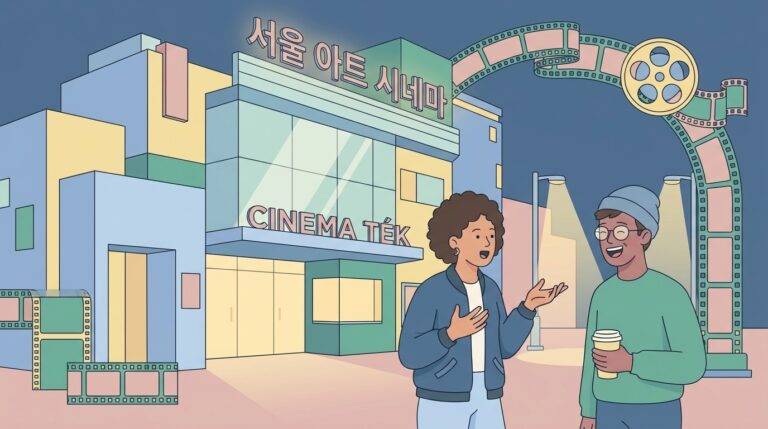
Setting: Outside a cinema in Gwanghwamun. You and your friend Minjun (민준) just finished watching a new psychological thriller by a famous Korean director.
- Turn 1 (Minjun): 🎭 (Staring at the poster thoughtfully) 와, 방금 본 영화 진짜 대박이지 않아? 너는 어떻게 봤어?
(Wow, wasn’t that movie amazing? How did you like it?) - Turn 2 (You): 🎭 (Nodding enthusiastically) 응! 특히 감독의 연출력이 정말 돋보였어.
(Yeah! Especially the director’s skill really stood out.) - Turn 3 (Minjun): 🎭 (Eyes lighting up) 맞지? 초반에 색감을 다르게 쓴 것도 다 이유가 있더라고.
(Right? Even using different color tones early on had a clear reason.) - Turn 4 (You): 🎭 (Framing hand gesture) 맞아. 중반부에 은근슬쩍 복선을 깐 게 소름 돋았어.
(Exactly. How they subtly laid foreshadowing in the middle gave me goosebumps.) - Turn 5 (Minjun): 🎭 (Smiling) 떡밥 회수하는 속도가 장난 아니었지? 엔딩은 어땠어?
(The speed of tying up clues was no joke, right? How was the ending?) - Turn 6 (You): 🎭 (Putting a hand on your chest) 결말이 깔끔하면서도 여운이 많이 남더라고.
(The ending was clean, yet it left a deep lingering impression.) - Turn 7 (Minjun): 🎭 (Checking phone) 역시 너랑 영화 얘기하면 통한다니까! 우리 카페 가서 더 얘기할까?
(I knew talking movies with you would click! Shall we head to a cafe and talk more?) - Turn 8 (You): 🎭 (Walking together) 좋아! 내가 방금 해석 찾아본 뇌피셜도 공유해 줄게!
(Great! I’ll share my personal fan-theory I just looked up too!)
🔀 Interactive Branching Choice:
Minjun asks: “마지막 장면에서 주인공이 웃은 의미가 뭐라고 생각해?” (What do you think the main character’s smile at the last scene meant?)
- Option A: “글쎄요, 그냥 기뻐서 웃은 것 같은데요?” (Best / Bad / Risk?)
- ❌ Feedback (Bad): Too basic and ends the conversation abruptly. Doesn’t show B2 level stylistic critique.
- Option B: “감독님이 일부러 열린 결말로 연출해서 관객에게 여운을 남기려고 한 것 같아요.”
- ✅ Feedback (BEST): Perfect! Demonstrates high-level commentary using “열린 결말” (open ending) and “여운을 남기다” (leave a lingering impression).
- Option C: “몰라요, 영화가 너무 어려워서 졸았어요.”
- ⚠️ Feedback (Risk): Honesty is good, but shuts down a film discussion instantly!
Phase 6: 10초 감정 섀도잉 드릴 (10-Second Emotional Shadowing Drill)
Practice reading these out loud with rhythm (/ = pause point) and emotional commitment!
[🤔 분석적이면서 감탄하듯이]
이 감독님은 / 장면마다 / 복선을 깔아두는 연출력이 / 진짜 대단해요.
(I-gon-nim-eun / jang-myeon-ma-da / bok-seon-eul kkal-a-du-neun yeon-chul-ryeog-i / jin-jja dae-dan-hae-yo.)-
[🥺 아쉽고 깊은 감동을 담아]
영화가 끝나도 / 가슴속에 / 여운이 길게 남아있어요.
(Yeong-hwa-ga kkeut-na-do / ga-seum-so-ge / yeo-un-i gil-ge na-ma-it-seo-yo.)
Phase 7: K-Culture 미니 사전 (Mini Dictionary)
- GV (지비) | Guest Visit | Q&A session with directors and actors after a film screening.
- 미장센 (Mise-en-scène) | Visual Staging | Everything appearing before the camera (lighting, props, set design, framing).
- 떡밥 (Tteok-bab) | Plot Hook / Clue | Literally “fish bait.” Refers to foreshadowing clues dropped intentionally by writers/directors.
- 인생작 (In-saeng-jak) | Masterpiece of Lifetime | A movie or drama that is so life-changing it remains your absolute favorite forever.
Phase 8: 여행자를 위한 생존 키트 (Movie Lovers’ Survival Kit)
Top 3 Cinema Survival Phrases
- GV 회차 표 남아있나요? (G-V hoe-cha pyo na-ma-it-na-yo?) – Are there tickets left for the Guest Visit screening?
- 자막 제공되는 상영관인가요? (Ja-mak je-gong-doe-neun sang-yeong-gwan-in-ga-yo?) – Is this screen offering subtitles?
- 포스터 증정 이벤트 대상이에요? (Po-seu-teo jeung-jeong i-ben-teu dae-sang-i-e-yo?) – Is this screening eligible for the poster giveaway event?
Editor’s Travel Note:
To book indie cinema tickets, skip standard web portals and download native theater applications. You can use the 네이버 지도 앱 다운로드 to locate indie art houses like KT&G Sangsangmadang Cinema or Emu Cinema in Seoul.
Phase 9: “한 발 더 깊이” (A Deeper Perspective)
Korean cinema often blends genre thrills with deep social critique—a technique native critics call “사회고발적 연출” (socially conscious directing). Directors like Bong Joon-ho use spatial architecture (like stairs or basements) as metaphors for social class. When analyzing Korean films, recognizing how visual design reflects social reality will elevate your conversations from mere plot summaries to deep cultural dialogue.
💬 Your Turn: What is your favorite Korean film, and which director’s visual style impressed you the most? Tell us in the comments below!
Phase 10: FAQ & 오해 방지 (FAQ & Mistakes)
Q: Can I use the word ‘미장센’ in casual chat with friends?
A: Yes! Korean moviegoers use “미장센” (mise-en-scène) naturally in casual café conversations without sounding overly academic.
Q: What is the difference between ‘감독’ and ‘감독님’?
A: Always add the honorific suffix ‘-님’ (감독님) when referring to a real director in conversation to show respect, even if they aren’t present!
Q: How do I express that a movie was confusing without sounding rude?
A: Use the phrase “해석이 다양할 것 같아요” (I think there could be diverse interpretations) instead of “이해 못 하겠어요” (I can’t understand it).
🚨 Common Mistakes Warning Board
- ❌ Mistake 1: Saying “감독이 카메라를 잘 찍었어요.”
- ✅ Correct Action: Say “연출력이 돋보였어요” or “영상미가 뛰어났어요.”
- ❌ Mistake 2: Using “힌트” instead of film terms when talking about plot hints.
- ✅ Correct Action: Use “복선” (foreshadowing) or “떡밥” (plot clues).
- ❌ Mistake 3: Forgetting honorifics when asking questions during a GV session.
- ✅ Correct Action: Address questions with polite formal endings (
~습니까?/~궁금합니다).
- ✅ Correct Action: Address questions with polite formal endings (
Phase 11: 액션 미션 & 참여 유도 (Action Missions)
- 🥉 Bronze Mission: Write a 1-sentence film review in Korean using the expression “여운이 남다”.
- 🥈 Silver Mission: Post a picture of your favorite movie poster on Instagram and caption it using “연출력이 돋보이는 작품!”. Tag
@DailyHangul! - 🥇 Gold Mission: Attend a film discussion meetup or leave a movie review on a Korean blog using all 3 core phrases learned today.
- 🎮 K-Culture Mission: Watch a trailer for a newly released Korean film on YouTube and spot 2 comments using the word “떡밥” or “연출”.
Phase 12: 인터랙티브 퀴즈 챌린지 (Quiz Challenge)
- Fill in the blank: 영화가 끝난 후에도 가슴속에 깊은 ( )이/가 남았다.
- True or False: “떡밥을 회수하다” means to give up on a movie storyline halfway through.
🔍 클릭해서 정답과 해설 확인하기 (Click to expand answers)
- 정답: 여운 (Explanation: “여운이 남다” means to leave a lingering aftertaste/emotion).
- 정답: False (Explanation: “떡밥을 회수하다” means to successfully answer or resolve previously dropped foreshadowing clues!)







