

Phase 1: Empathy (Storytelling Opening)
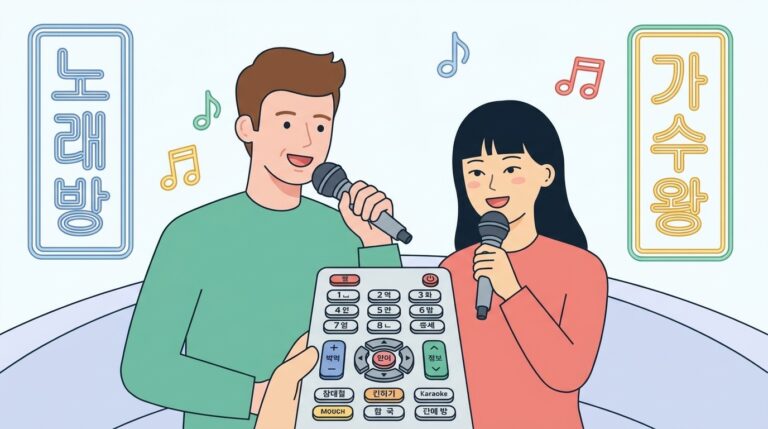
안녕하세요! I’m your Daily Hangul editor. Have you ever been inside a neon-lit Korean Karaoke box (노래방 – Noraebang) with your friends, hyped up to sing your favorite BTS or BLACKPINK track, only to realize the tempo is insanely fast? Your hands sweat as you stare at the huge remote control (리모컨) with dozens of glowing Korean buttons. You want to slow it down, but you panic and miss the entire verse while mumbling incomprehensible lyrics!
Don’t worry—you are definitely not alone. Over 80% of beginner Korean learners tell us that managing the music speed in real-time is one of the most intimidating parts of Noraebang night. In this guide, tailored specifically for A2 learners, you will master exact phrases to speed up or slow down any song effortlessly. Sing with confidence, vibe with your squad, and never lose the beat again!
Phase 2: Core Expressions Deep-Dive
1. 템포 좀 낮춰 주세요 (Tempo jom nachwo juseyo)
- Pronunciation: [Tem-po jom nah-chwo joo-seh-yo] (Analogy: ‘Nachwo’ sounds like ‘not-sure’ said quickly with a soft ‘ch’)
- Meaning: Literal: “Please lower the tempo a bit.” | Nuance: A polite request to slow down the song speed so you can catch your breath.
- K-Culture Moment: In K-dramas, when a character picks an upbeat song but gets overwhelmed by emotion or speed, they frantically yell this while pointing at the remote!
- Editor’s Insight: Adding ‘좀’ (jom – a little/please) makes your request instantly softer and more natural, preventing you from sounding bossy.
- Situation Spectrum: Casual ⚠️ | Semi-formal ✅ | Formal ✅
- 🤔 Think About It: Why do Koreans frequently use softening words like ‘좀’ (jom) even when making simple functional requests?
2. 박자 놓쳤어! (Bakja nochyeosseo!)
- Pronunciation: [Bak-ja noh-chyeot-seo] (Analogy: ‘Bakja’ sounds like ‘box-ah’)
- Meaning: Literal: “I missed the beat!” | Nuance: “Oops, I ruined the timing!”
- K-Culture Moment: Used whenever the music starts too fast after the song intro and you missed the first lyrics.
- Editor’s Insight: Expressing your mistake lightheartedly keeps the party vibe fun and lets others know you might need a quick rewind or tempo adjustment.
- Situation Spectrum: Casual ✅ | Semi-formal ⚠️ | Formal 🚫
- 🤔 Think About It: How does admitting a cute mistake in public help build closer bonds in Korean peer culture?
3. 조금만 더 빠르게 해 봐! (Jogeumman deo ppareuge hae bwa!)
- Pronunciation: [Jo-geum-man deo ppa-reu-ge hae bwa] (Analogy: ‘Ppareuge’ rhymes with quick popping sounds)
- Meaning: Literal: “Try making it a little faster!” | Nuance: “Let’s speed this up for more energy!”
- K-Culture Moment: When a ballad turns out too boring and the room wants to jump around and dance.
- Editor’s Insight: ‘해 봐’ (hae bwa) means ‘try doing it’, which encourages your friend holding the remote to make the song more dynamic.
- Situation Spectrum: Casual ✅ | Semi-formal ⚠️ | Formal 🚫
- 🤔 Think About It: Is fast tempo always associated with high energy and fun in social singing settings?
Phase 3: Textbook Korean vs. Real Korean
Situation 1: Asking to slow down the song
- 📖 교과서 한국어: 노래의 속도를 줄여 주시겠습니까? (Norae-ui sokdo-reul juryeo jusigessneumnika? – Would you please reduce the speed of the song?)
- 🗣️ 진짜 한국어: 템포 좀 낮춰 줘! (Tempo jom nachwo jwo! – Slow down the tempo a bit!)
- 💡 왜 다를까?: In real karaoke, people never say ‘속도’ (sokdo – speed) or formal endings. They use the intuitive loanword ‘템포’ (tempo) and comfortable casual phrasing.
Situation 2: Telling someone they missed the beat
- 📖 교과서 한국어: 당신은 박자를 맞추지 못했습니다. (Dangsineun bakjareul matchuji moshaessseumnida.)
- 🗣️ 진짜 한국어: 아, 박자 놓쳤다! (Ah, bakja nochyeotda! – Ah, I missed the beat!)
- 💡 왜 다를까?: In self-talk or casual banter, Koreans state past actions using exclamation endings like ‘-다’ (-da) to sound natural.
Phase 4: K-Culture Deep Dive & Non-verbal Manners
4-1. Nunchi & Gestures
When the tempo is too fast, don’t just stand motionless! Hold the microphone with one hand and make a soft downward pressing gesture with your open palm toward the person holding the remote. Combine this with wide eyes and a smile to signal “Help me slow it down!” using ‘눈치’ (Nunchi – situational tact).
4-2. Culture Code Analysis
In Korean Noraebang culture, the person sitting nearest to the remote control (리모컨) acts as the designated DJ. They control tempo (템포), key pitch (조절), and verse jumps (간주 점프). Respecting the DJ while shouting out clear requests creates a seamless, high-energy bonding experience.
Phase 5: Real-Life Roleplay Scenario
Setting: A cozy Noraebang in Hongdae. Your Korean friend Minjun (민준) holds the big remote control while you get ready to sing a fast-paced K-pop song.
- 민준: 🎭 (리모컨을 들고 신나게 웃으며) 무슨 노래 부를 거야? 준비됐어?
(Museun norae bureul geoya? Junbidaesseo? / What song are you going to sing? Ready?) - You: 🎭 (살짝 긴장한 표정으로 마이크를 잡으며) 응! 근데 이 노래 너무 빨라.
(Eung! Geunde i norae neomu ppalla. / Yeah! But this song is too fast.) - 민준: 🎭 (버튼을 누르며) 시작한다! 3, 2, 1!
(Sijakhanda! Set, dul, hana! / Starting now! 3, 2, 1!) - You: 🎭 (음악이 터져 나오자 당황하며) 어? 잠깐만! 박자 놓쳤어!
(Eo? Jamkkanman! Bakja nochyeosseo! / Uh? Wait! I missed the beat!) - 민준: 🎭 (눈이 동그래지며) 진짜? 템포 낮춰 줄까?
(Jinjja? Tempo nachwo julkka? / Really? Should I slow down the tempo for you?) - You: 🎭 (손바닥을 아래로 내리며 부탁하듯) 응, 템포 좀 낮춰 주세요!
(Eung, tempo jom nachwo juseyo! / Yes, please slow down the tempo a bit!) - 민준: 🎭 (템포▼ 버튼을 두 번 누르며) 오케이, 두 단계 낮췄어. 이제 괜찮아?
(Okei, du danggye nachweosseo. Ije gwaenchana? / Okay, lowered it by two steps. Good now?) - You: 🎭 (박자에 맞춰 신나게 고개를 끄덕이며) 응, 딱 좋아! 고마워!
(Eung, ttak joha! Gomawo! / Yeah, it’s just right! Thanks!)
🔀 Interactive Branching Choice
What will you say if the tempo is STILL too fast after Minjun lowers it?
* A: 더 천천히! 템포 더 낮춰 줘! (Deo cheoncheonhi! Tempo deo nachwo jwo!)
* B: 취소해 주세요. 안 부를래. (Chwisohae juseyo. An bureullae.)
* C: 너나 불러라. (Neona bulleora.)
Feedback:
* A (Best): Perfect! Clear, casual, and keeps the singing going without breaking the mood.
* B (Risk): A bit buzzkill! Stopping completely might make your friend feel awkward.
* C (Bad): Too blunt and rude! It sounds aggressive in a friendly gathering.
Phase 6: 10-Second Emotion Shadowing Drill
Practice reading these lines with the indicated emotional tempo markers:
[😲 당황하며]어? / 잠깐만! / 박자 놓쳤어!
(Eo? / Jamkkanman! / Bakja nochyeosseo!)[🥺 애교 섞인 목소리로]템포 / 좀만 / 낮춰 주세요~
(Tempo / jomman / nachwo juseyo~)[🥳 신나고 자신감 넘치게]응! / 이제 / 딱 좋아!
(Eung! / Ije / ttak joha!)
Phase 7: K-Culture Mini Dictionary
- 템포 (Tempo) | Tempo / Speed | Used in Noraebang remote settings to speed up (템포▲) or slow down (템포▼) backing tracks.
- 간주 점프 (Ganju Jeompeu) | Interlude Jump | Skipping long instrumental solos between lyrics to save singing time.
- 리모컨 (Rimokon) | Remote Controller | The ultimate power tool in Noraebang; person holding it leads the queue.
- 서비스 (Seobiseu) | Free Bonus Time | Free extra minutes added by the karaoke manager at the end of your session.
Phase 8: Survival Kit for Travelers
Top 3 Survival Expressions
- 템포 낮춰 주세요. (Tempo nachwo juseyo.) – Please slow down the tempo.
- 템포 올려 주세요. (Tempo ollyeo juseyo.) – Please speed up the tempo.
- 취소 버튼 어디 있어요? (Chwiso beoteun eodi isseoyo?) – Where is the cancel button?
Editor’s Travel Note
When navigating to popular karaoke rooms in Seoul (like Coin Noraebang), use smart mapping tools. You can perform a quick search after completing your 네이버 지도 앱 다운로드 to find highly-rated locations nearby. Pay easily with credit cards or T-money transport cards at self-service kiosks!
Phase 9: One Step Deeper (Culture Reflection)
In Korea, Noraebang isn’t just about showing off vocal skill; it’s a shared communal relief valve for stress. Adjusting tempo for a friend shows empathy (정 – Jeong) and consideration. By helping others sing at their comfortable speed, everyone gets their moment in the spotlight.
💬 Your Turn: What song would you adjust the tempo for when visiting a Korean Noraebang? Leave your answer in the comments below!
Phase 10: FAQ & Common Mistakes
Q: Can I ask the staff to change the song tempo?
A: Usually, you adjust it yourself using the big remote control (리모컨) inside your private room! Look for yellow or red buttons marked ‘템포’.
Q: What is the difference between ‘템포’ and ‘키’?
A: ‘템포’ (Tempo) changes the song speed, while ‘키’ (Key) changes the vocal pitch (higher/lower pitch).
Q: Is it rude to press ‘간주 점프’ (Interlude Jump) during someone else’s song?
A: Yes! Always ask the singer first before skipping instrumentals, or let them control the remote.
🚨 Common Mistakes TOP 3
- Mistake: Yelling “속도 줄여!” (Sokdo juryeo! – Reduce speed!)
- Correct Action: Say naturally “템포 좀 낮춰 줘~” (Tempo jom nachwo jwo~).
- Mistake: Pressing the ‘키’ (Key) down button when you meant song speed.
- Correct Action: Make sure you press ‘템포▼’, not ‘키▼’!
- Mistake: Standing silently when falling behind rhythm.
- Correct Action: Shout “박자 놓쳤어!” with a smile so friends can help.
Phase 11: Action Mission
- Bronze Step: Practice saying “템포 좀 낮춰 주세요” out loud 3 times in front of a mirror.
- Silver Step: Record your voice saying the Phase 6 Shadowing Drill lines and listen back.
- Gold Step: Visit a local Korean karaoke room or use a K-pop karaoke app, adjust the tempo by yourself, and sing successfully!
- 🎮 K-Culture Mission: Watch a Korean variety show (e.g., Running Man) and spot the moment someone presses buttons on a karaoke remote!
Phase 12: Interactive Quiz Challenge
Question 1 (Situation Judgment)
You are singing a fast song and cannot keep up with the Korean lyrics. What should you shout to your friend holding the remote?
🔍 Click to reveal Answer & Explanation
Answer: “템포 좀 낮춰 줘!” (Tempo jom nachwo jwo!)
Explanation: This politely and clearly asks your friend to slow down the song speed in a casual setting.
Question 2 (Fill-in-the-Blank)
아, 너무 빨라서 [ ] 놓쳤어! (Ah, it’s too fast so I missed the beat!)
🔍 Click to reveal Answer & Explanation
Answer: 박자 (Bakja – beat/rhythm)
Explanation: ‘박자’ means rhythm or musical beat.
Question 3 (True or False)
True or False: ‘간주 점프’ (Ganju Jeompeu) is used to make the tempo of a song faster.
🔍 Click to reveal Answer & Explanation
Answer: False!
Explanation: ‘간주 점프’ skips long instrumental interlude sections, while ‘템포▲’ speeds up the song.







