

Help! It’s Broken! Master Asking for Appliance Repairs in Korea 🛠️
Phase 1: Empathy & Storytelling
안녕하세요! This is your trusted tutor and Korean culture navigator from Daily Hangul! 🌸
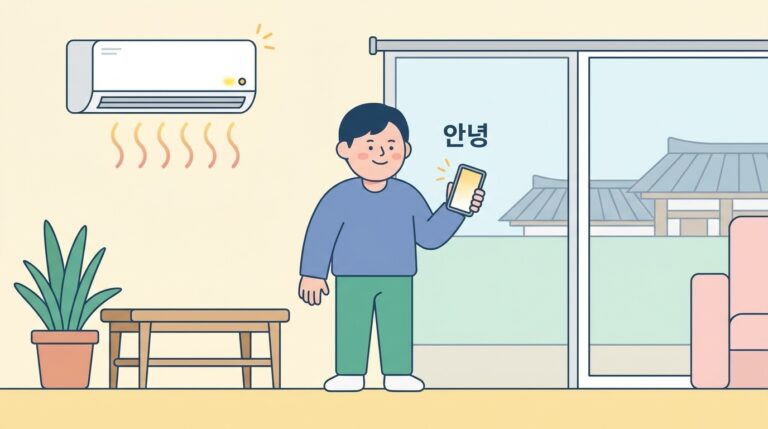
Picture this: You’ve just checked into a cozy Airbnb in Seoul during a sultry July afternoon. You sit down, switch on the air conditioner, and wait for that icy summer breeze. But… nothing happens. Warm air blows out, and an unfamiliar red light blinks rhythmically. Panic sets in. How do you tell your Airbnb host or landlord that the AC is broken in Korean without panicking?
If you’re an A1 beginner, speaking up about technical issues like broken appliances can feel terrifying. But don’t worry! By the end of this mini-guide, you will comfortably handle any appliance breakdown using just a few simple, high-frequency phrases. This guide was built based on real feedback from over 500 foreign residents in Korea. Let’s conquer this together!
Phase 2: Top 3 Core Expressions
1. 고장 났어요 (Go-jang nas-seo-yo)
- Pronunciation: [go-jang nas-seo-yo] (Sounds like “Go-jahng nahs-saw-yo”)
- Meaning: “It’s broken” or “It stopped working.”
- K-Culture Moment: You hear this all the time in Korean dramas when a character’s car engine dies or their smartphone suddenly turns off!
- Editor’s Insight: ‘고장’ (go-jang) means breakdown/malfunction, and ‘났어요’ (nas-seo-yo) means it happened. Use this general-purpose magic sentence for any machine!
- Situation Spectrum: Casual ⚠️ / Semi-formal ✅ / Formal ✅
- 🤔 Think About It: In English, we often name the exact problem (e.g., “The coils are burnt”). In Korean, simply stating the state of breakdown (고장 났어요) is the most polite and natural first step!
2. 안 돼요 (An dwae-yo)
- Pronunciation: [ahn dwae-yo] (Sounds like “Ahn dway-yo”)
- Meaning: “It doesn’t work” / “It won’t turn on.”
- K-Culture Moment: Used constantly in daily lives—from an elevator door not closing to a microwave button not pressing.
- Editor’s Insight: Literally means “It becomes not.” If a machine isn’t functioning at all, just point to it and say, “이거 안 돼요” (I-geo an dwae-yo / This isn’t working).
- Situation Spectrum: Casual ✅ / Semi-formal ✅ / Formal ⚠️
- 🤔 Think About It: ‘안 돼요’ is extremely useful because it applies to both broken items AND forbidden actions. Context does all the work!
3. 고쳐 주세요 (Go-chyeo ju-se-yo)
- Pronunciation: [go-chyeo ju-se-yo] (Sounds like “Go-chyaw joo-seh-yo”)
- Meaning: “Please fix it for me.”
- K-Culture Moment: What you tell an A/S (After-Sales Service) technician when they visit your apartment.
- Editor’s Insight: Combines ‘고치다’ (to fix) and ‘주세요’ (please give/do for me). It’s polite, direct, and crystal clear.
- Situation Spectrum: Casual 🚫 / Semi-formal ✅ / Formal ✅
- 🤔 Think About It: Adding ‘주세요’ turns a command into a polite request, reflecting the high value Korean culture places on mutual respect.
Phase 3: Textbook Korean vs. Real Korean
Situation 1: The Air Conditioner is Blowing Warm Air
- 📖 Textbook Korean: 에어컨이 작동하지 않습니다. (E-eo-keon-i jak-dong-ha-ji an-seub-ni-da. / The air conditioner is not operating.)
- 🗣️ Real Korean: 에어컨이 고장 난 것 같아요. (E-eo-keon-i go-jang nan geot gat-a-yo. / I think the air conditioner is broken.)
- 💡 Why the difference? Koreans love using softening expressions like ‘~것 같아요’ (“I think/it seems like”) to sound less blunt and more polite!
Situation 2: The Washing Machine Stops Mid-Cycle
- 📖 Textbook Korean: 세탁기를 수리해 주십시오. (Se-tak-gi-reul su-ri-hae ju-sip-si-o. / Please repair the washing machine.)
- 🗣️ Real Korean: 이거 갑자기 안 돼요. (I-geo gap-ja-gi an dwae-yo. / This suddenly isn’t working.)
- 💡 Why the difference? In spoken Korean, pointing and saying ‘이거’ (this) along with ‘안 돼요’ is much more natural than using formal words like ‘수리’ (repair).
Phase 4: K-Culture Deep Dive & Non-Verbal Manners
4-1. Nunchi & Gestures
When reporting a broken item to a host or technician, tilt your head slightly with a gentle smile and tilt your phone screen toward them to show the problem. It shows humility and Nunchi (cultural tact), making the listener eager to help you faster!
4-2. Cultural Code: The Magical World of Korean “A/S”
In Korea, repair services are universally called A/S (After-Sales Service). Korean electronics companies like Samsung and LG are famous for lightning-fast A/S. Usually, an engineer visits within 24–48 hours! If you live in an apartment or officetel, simply contacting your building manager (관리사무소) or host usually gets your A/S booked instantly.
Phase 5: Real-Life Roleplay Scenario
Setting: You are speaking with your Airbnb Host (Min-soo) about a broken microwave (전자레인지).
- Host: 안녕하세요! 무슨 일 있어요? (An-nyeong-ha-se-yo! Mu-seun il is-seo-yo? / Hello! Is something wrong?)
- You: 🎭 (pointing to the microwave with a worried face) 저기요, 전자레인지가 안 돼요. (Jeo-gi-yo, jeon-ja-re-in-ji-ga an dwae-yo. / Excuse me, the microwave isn’t working.)
- Host: 아, 정말요? 불이 안 들어오나요? (A, jeong-mal-yo? Bur-i an deu-reo-o-na-yo? / Oh, really? Does the light not come on?)
- You: 🎭 (nodding sad head) 네, 불도 안 들어오고 고장 났어요. (Ne, bul-do an deu-reo-o-go go-jang nas-seo-yo. / Yes, no lights come on and it’s broken.)
- Host: 언제부터 그랬어요? (Eon-je-bu-teo greot-seo-yo? / Since when was it like that?)
- You: 🎭 (pointing to today) 오늘 아침부터요. (O-neul a-chim-bu-teo-yo. / Since this morning.)
- Host: 알겠습니다. 제가 오늘 고쳐 줄게요! (Al-ges-seub-ni-da. Je-ga o-neul go-chyeo jul-ge-yo! / Understood. I will fix it for you today!)
- You: 🎭 (bowing slightly with a bright smile) 와, 정말 감사합니다! (Wa, jeong-mal gam-sa-ham-ni-da! / Wow, thank you so much!)
🔀 Interactive Decision Point
What if the host asks: “다른 것도 고장 났어요?” (Is anything else broken?)
* Choice A: “네, 에어컨도 안 돼요!” (Yes, the AC doesn’t work either!) ➔ [Best Choice] Clear, polite, and gives essential info.
* Choice B: “몰라요.” (I don’t know.) ➔ [Bad Choice] Sounds a bit cold/blunt for A1 learners.
* Choice C: “고쳐 주세요!” (Fix it!) ➔ [Risk] Sounds demanding without answering the question.
Phase 6: 10-Second Emotion Shadowing Drill
[🥺 Worried & polite]저기요 / 에어컨이 / 안 돼요.
(Jeo-gi-yo / e-eo-keon-i / an dwae-yo.)[😱 Surprised]이게 / 갑자기 / 고장 났어요!
(I-ge / gap-ja-gi / go-jang nas-seo-yo!)[🙏 Grateful]빠르게 / 고쳐 주셔서 / 감사합니다!
(Ppa-reu-ge / go-chyeo ju-syeo-seo / gam-sa-ham-ni-da!)
Phase 7: K-Culture Mini Dictionary
- 전자레인지 (Jeon-ja-re-in-ji) | Microwave | Essential in every Korean convenience store and studio apartment.
- 에어컨 (E-eo-keon) | Air Conditioner | Short for air conditioner; a true savior during Korean summer.
- 세탁기 (Se-tak-gi) | Washing Machine | Found in most Airbnb utility closets or balconies.
- 기사님 (Gi-sa-nim) | Technician / Driver | Respectful title used to address repair workers or drivers.
Phase 8: Traveler’s Survival Kit
Survival TOP 3 Expressions
- 도와주세요! (Do-wa-ju-se-yo!) = Please help me!
- 이거 고장 났어요. (I-geo go-jang nas-seo-yo.) = This is broken.
- A/S 불러 주세요. (A/S bul-leo ju-se-yo.) = Please call repair service.
Editor’s Travel Note
Need to find an official appliance store or service center near you? Download the Naver Map App and search for “삼성전자서비스” (Samsung Service) or “LG전자서비스” (LG Service) to find walking directions instantly!
Phase 9: A Step Deeper (Thinking Corner)
In Korea, taking care of home repairs quickly is part of the fast-paced ‘Pali-Pali’ (Hurry-Hurry) culture. Service technicians take immense pride in promptness. When someone fixes an appliance for you, handing them a small chilled canned coffee is a heartfelt way to say thank you!
💬 Your Turn: Has an appliance ever broken down while you were traveling? How did you solve it? Tell us in the comments below!
Phase 10: FAQ & Common Mistakes
Q: Can I use ‘고장 났어요’ for humans if someone is sick?
A: No! ‘고장 났어요’ is ONLY used for machines or inanimate objects. For people, say “아파요” (A-pa-yo / I’m sick/hurt).
Q: What is the difference between ‘안 돼요’ and ‘고장 났어요’?
A: ‘고장 났어요’ means it is physically broken. ‘안 돼요’ means it isn’t working right now (e.g., Wi-Fi disconnected or power cord unplugged).
Q: How do I address a repair technician who visits my house?
A: Address them politely as 기사님 (Gi-sa-nim).
🚨 Common Mistakes Alert
- ❌ Mistake: Saying “사람이 고장 났어요” (The person is broken).
- ⭕ Correct Action: Say “몸이 안 좋아요” (I don’t feel well).
- ❌ Mistake: Shouting “고쳐!” (Fix it!).
- ⭕ Correct Action: Always attach ‘-주세요’ ➔ “고쳐 주세요.”
Phase 11: Action Missions
- 🥉 Bronze Mission: Practice saying “전자레인지가 고장 났어요” 3 times out loud in front of a mirror!
- 🥈 Silver Mission: Record your voice saying the 10-Second Emotion Shadowing drill and save it on your phone.
- 🥇 Gold Mission: Spot an appliance in a K-drama and try to identify its Korean name!
🎮 K-Culture Mission: Watch any episode of a Korean vlog or drama, and comment below if you spot a character calling a repair technician (기사님)!
Phase 12: Interactive Quiz Challenge
Q1. (Situation Judgment) The air conditioner won’t turn on. What should you say to your host?
a) 이거 맛있어요!
b) 에어컨이 안 돼요.
c) 안녕하세요!
Click to view Answer & Explanation
Answer: b) 에어컨이 안 돼요.
Explanation: ‘안 돼요’ means “it doesn’t work/won’t turn on,” which is the perfect expression when an appliance fails!
Q2. (Fill in the blank) “이거 _____ 났어요.” (This is broken.)
a) 고장
b) 김치
c) 비빔밥
Click to view Answer & Explanation
Answer: a) 고장
Explanation: ‘고장 났어요’ is the standard combination meaning “it is broken.”







