

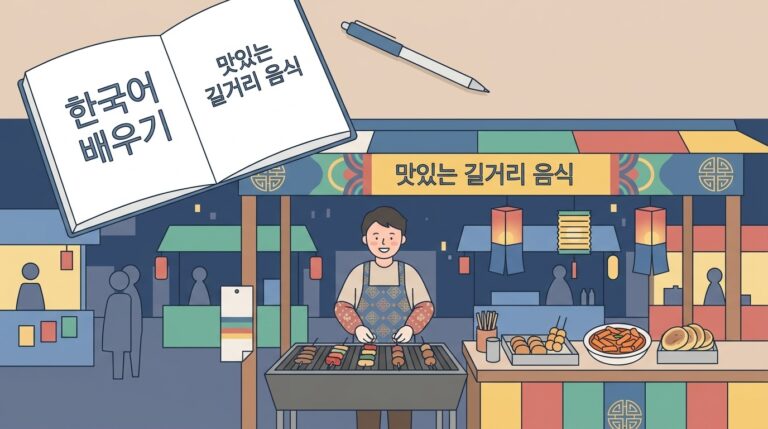
Phase 1: Empathy – Story-Driven Opening
안녕하세요! This is your Daily Hangul tutor. Imagine walking down the bustling streets of Hongdae late at night. The cold air is filled with the mouth-watering aroma of grilled chicken skewers glazed in sweet and spicy sauce—Dakkochi (닭꼬치). You step up to the vibrant food cart, ready to order. But suddenly, your mind goes blank. The owner asks you a lightning-fast question: “맵기 얼마나 해드릴까요?” (How spicy would you like it?), and you freeze! Should you ask to cut it with scissors? How do you ask for extra sauce without sounding impolite?
Don’t worry! This is a super common hurdle for Korean learners. Ordering street food isn’t just about vocabulary; it’s about navigating quick, friendly exchanges in a fast-paced environment. Based on feedback from hundreds of our A2 learners, mastering just a few core phrases will turn that panic into complete confidence. Let’s make sure you get your delicious Dakkochi exactly how you like it!
Phase 2: Core Expressions Deep Dive
1.덜 매운 맛으로 주세요 (Deol mae-un mas-euro ju-se-yo)
- Pronunciation: [Deol mae-un mas-euro ju-se-yo] (Sounds like: ‘Dull’ + ‘May-oon’ + ‘Mas-uro’ + ‘Ju-say-yo’)
- Meaning: “Please give it to me less spicy.” (Literal: Less spicy flavor to please give)
- K-Culture Moment: You’ll see this all the time in K-Dramas when characters who can’t handle spicy food (called 맵찔이 – Maep-jjil-i) order food at street stalls or K-BBQ shops.
- Editor’s Insight: Korean ‘spicy’ can often exceed expectations! Using 덜 (Deol – less) is a polite way to enjoy the authentic flavor without torturing your tastebuds.
- Situation Spectrum: Casual: ✅ | Semi-formal: ✅ | Formal: ⚠️
- 🤔 Think About It: In Korea, food is deeply tied to shared warmth. Why do you think asking for adjusted spice levels is totally accepted and welcomed by vendors?
2. 손잡이 잘라 주세요 (Son-jab-i jal-la ju-se-yo)
- Pronunciation: [Son-jab-i jal-la ju-se-yo] (Sounds like: ‘Son-jahb-ee’ + ‘Jal-lah’ + ‘Ju-say-yo’)
- Meaning: “Please cut the wooden handle/stick for me.”
- K-Culture Moment: As you eat down a long chicken skewer, the exposed sharp stick becomes dangerous to your cheeks! Vendors use giant pliers or scissors to snip off the top stick as you eat.
- Editor’s Insight: You can hold out your half-eaten skewer and say this phrase with a gentle nod. It’s practical street-food etiquette!
- Situation Spectrum: Casual: ✅ | Semi-formal: ✅ | Formal: 🚫
- 🤔 Think About It: How does this custom of clipping the stick show the quick, problem-solving nature of Korean Pali-Pali (hurry-hurry) street culture?
3. 소스 많이 뿌려 주세요 (So-seu man-i ppeu-ryeo ju-se-yo)
- Pronunciation: [So-seu man-i ppeu-ryeo ju-se-yo] (Sounds like: ‘Saw-seu’ + ‘Mahn-ee’ + ‘Ppur-yo’ + ‘Ju-say-yo’)
- Meaning: “Please put plenty of sauce on it.”
- K-Culture Moment: Seen in food vlogs (Mukbang) when creators ask for extra glaze or mayo drizzled over their street snacks for maximum flavor.
- Editor’s Insight: Koreans love sauce! Asking for extra (많이 – Mani) shows you truly appreciate the vendor’s signature seasoning.
- Situation Spectrum: Casual: ✅ | Semi-formal: ✅ | Formal: ⚠️
- 🤔 Think About It: How does expressing your specific taste preferences build a warm connection (Jeong) with street vendors?
Phase 3: Textbook Korean vs. Real Korean
Situation 1: Choosing Spice Level
- 📖 Textbook Korean: “이것은 매운가요?” (Is this spicy?)
- 🗣️ Real Korean: “이거 많이 매워요?” (Is this super spicy?) or “덜 매운 맛도 돼요?” (Can I get a less spicy one?)
- 💡 Why the difference? Textbooks use formal, declarative forms. Native speakers use conversational tone and soft questions to sound natural and polite.
Situation 2: Asking for an Adjustment
- 📖 Textbook Korean: “꼬챙이를 잘라 주십시오.” (Please cut the skewer.)
- 🗣️ Real Korean: “이것 좀 잘라 주시겠어요?” or simple “잘라 주세요!”
- 💡 Why the difference? Direct formal endings sound like a command from a manual. Spoken Korean relies on soft requesting endings like
-해 주세요.
Phase 4: K-Culture Deep Dive & Mannerisms
4-1. Nunchi & Street Food Gestures
When eating at a street stand, watch the vendor’s body language. If they hold up a pair of heavy-duty scissors and look at your skewer, that’s your cue! Hold your half-eaten chicken skewer out steady and say “감사합니다!” as they snip the bare wood stick.
4-2. Cultural Code: The Art of Street Food Jeong (정)
Street carts (포장마차 – Pojangmacha) are places of warmth. Showing enthusiasm with expressions like “진짜 맛있어요!” (It’s really delicious!) often earns you extra sauce, a warm smile, or even a free cup of hot fish-cake broth (Eomuk Gukmul).
Phase 5: Real-Life Roleplay Scenario
Setting: A popular Dakkochi stand in Myeongdong on a chilly evening. The vendor (이모님 – Imo-nim) is grilling skewers over hot charcoal.
- Turn 1 (Vendor): 어서 오세요! 닭꼬치 하나 드려요? (Welcome! Would you like one chicken skewer?)
- 🎭 Smiling while turning chicken over charcoal
- Turn 2 (You): 네, 닭꼬치 하나 주세요! (Yes, one chicken skewer please!)
- 🎭 Nodding cheerfully
- Turn 3 (Vendor): 소스는 어떤 걸로 해줄까? 매운 거? 소금? (Which sauce would you like? Spicy? Salt?)
- 🎭 Holding sauce brush ready
- Turn 4 (You): 덜 매운 맛으로 주세요. (Please make it less spicy.)
- 🎭 Making a small distance gesture with fingers
- Turn 5 (Vendor): 오케이, 덜 매운 양념! 소스 많이 뿌려줄까? (Okay, less spicy sauce! Want lots of sauce?)
- 🎭 Drizzling sauce expertly
- Turn 6 (You): 네, 소스 많이 뿌려 주세요! (Yes, please put plenty of sauce!)
- 🎭 Smiling with bright eyes
- Turn 7 (You eat halfway and hand it back): 저기요, 손잡이 잘라 주세요! (Excuse me, please snip the stick for me!)
- 🎭 Carefully offering the skewer handle
- Turn 8 (Vendor): 그래, 조심해서 먹어요~! (Sure, enjoy and eat carefully~!)
- 🎭 Snips stick cleanly with scissors
🔀 Interactive Choice Point
The vendor asks if you want mustard on top:
* Option A: “네, 머스터드도 넣어 주세요!” (Best: Polite and clear)
* Option B: “아니, 싫어.” (Bad: Too blunt/informal for an elder vendor)
* Option C: “머스터드… 몰라요.” (Risk: Awkward phrasing, might leave vendor confused)
Phase 6: 10-Second Emotion Shadowing Drill
[😊 Excitingly & Politely]덜 매운 맛으로 / 주세요! (Deol mae-un mas-euro / ju-se-yo!)[😋 Eagerly]소스 / 많이 / 뿌려 주세요! (So-seu / man-i / ppeu-ryeo ju-se-yo!)[🥺 Polite Request]손잡이 / 조금만 / 잘라 주세요! (Son-jab-i / jo-geum-man / jal-la ju-se-yo!)
Phase 7: K-Culture Mini Dictionary
- 닭꼬치 (Dak-kko-chi): Grilled chicken skewer. A staple Korean street food item served with various glazes.
- 이모님 (I-mo-nim): Literally ‘aunt’, but affectionately used to call middle-aged female food stall owners.
- 양념 (Yang-nyeom): Seasoned sauce, usually a sweet, garlic-infused chili glaze.
- 휴지 (Hyu-ji): Tissues/napkins. Always snag a couple before taking your first bite of juicy skewer!
Phase 8: Traveler’s Survival Kit
Top 3 Survival Phrases
- 휴지 어디 있어요? (Hyu-ji eo-di is-seo-yo?) – Where are the tissues?
- 얼마예요? (Eol-ma-ye-yo?) – How much is it?
- 계좌이체 돼요? (Gye-jwa-i-che dwae-yo?) – Can I bank transfer? (Great if you run out of cash at cash-only stalls!)
Editor’s Travel Note
Make sure to navigate your street food journey using the Naver Map App to locate top-rated night markets and street food alleys across Seoul!
Phase 9: A Step Deeper
In Korea, food stands aren’t just commercial spaces—they are social hubs. Using polite requests like “-해 주세요” shows respect for the vendor’s hard work, instantly bridging the gap between tourist and local. Small manners create unforgettable human connections on your travel path.
💬 Your Turn: What street food are you most excited to order in Korean? Drop a comment below!
Phase 10: FAQ & Mistake Prevention
Q: Can I pay with a credit card at street food stalls?
A: Major tourist spots accept cards, but small vendors often prefer cash or local bank transfers. Always keep 5,000 to 10,000 KRW cash handy!
Q: Is it rude to eat while walking on the street?
A: It’s better to eat right near the stall or near trash cans. Walking while eating messy skewers can lead to sauce spills on others!
Q: What if I can’t eat spicy food at all?
A: Simply ask for “소금구이로 주세요” (So-geum-gu-i-ro ju-se-yo – Salt grill please) to skip spicy sauce entirely.
🚨 Common Mistakes
- Using 반말 (Informal language): Saying “잘라 줘” to an older vendor. (Correct Action: Always use “잘라 주세요”)
- Holding the sharp stick pointing outward: Risking poking someone in a crowd. (Correct Action: Point stick downwards or get it clipped)
- Not grabbing napkins beforehand: Street sauce drops fast! (Correct Action: Grab tissues from the box at the stall front)
Phase 11: Action Mission
- Bronze: Practice saying “덜 매운 맛으로 주세요” 3 times in front of the mirror.
- Silver: Record your voice shadowing the sentences from Phase 6 and compare with native audio.
- Gold: Visit a local Korean snack bar or street vendor and order food entirely in Korean!
🎮 K-Culture Mission: Watch a street food vlog video on YouTube and spot when the customer asks to cut their skewer stick!
Phase 12: Interactive Quiz Challenge
Q1. How do you ask the vendor to cut the long stick of your skewer?
* A) 소스 많이 주세요
* B) 손잡이 잘라 주세요
* C) 이거 얼마예요?
Click to view Answer & Explanation
Correct Answer: B) 손잡이 잘라 주세요
Explanation: ‘손잡이’ refers to the handle/stick, and ‘잘라 주세요’ means ‘please cut it’.
**Q2. True or False: Saying







