

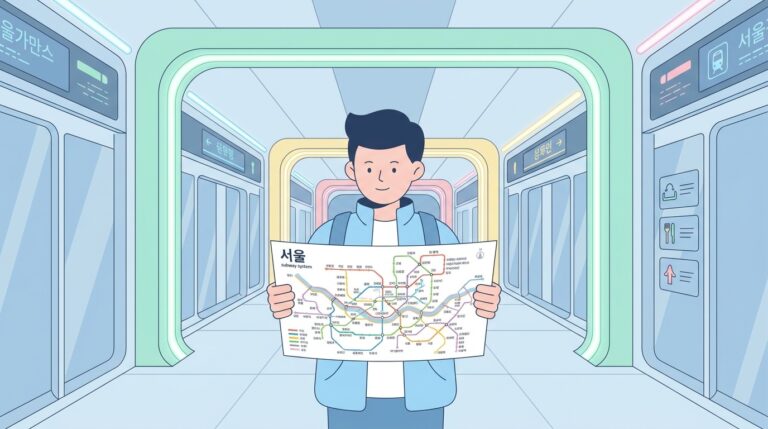
Riding the K-Subway: How to Read the Seoul Metro Map Like a Local!
Phase 1: Empathy (Welcome, Explorer! 🚇)
안녕하세요! (An-nyeong-ha-se-yo!) Hello! I’m your Daily Hangul editor and your personal cultural navigator.
Imagine this: You’ve just landed in Seoul. The energy is buzzing, the lights are bright, and you are ready to explore. You head down to the subway station, eager to catch a train to Myeongdong. But suddenly, you are standing in front of a massive, multi-colored, spiderweb-like subway map. Over 20 different lines are overlapping! A rush of commuters zips past you. You feel lost, a little overwhelmed, and your heart beats faster.
Don’t worry at all! We have all been there. Even locals sometimes have to stop and double-check the map. In this guide, we are going to master the absolute basics of reading the subway map and asking for directions in simple Korean. By the end of this post, you’ll feel confident enough to navigate the Seoul metro system with your head held high. Let’s dive in! 🌟
Phase 2: Deep-Dive into 3 Essential Expressions
Let’s learn three super simple, high-impact expressions you can use when looking at a subway map.
1. 어디예요? (eo-di-yeo-yo?)
- Pronunciation: eo-dee-yeo-yo? (Sounds like “eo-de” + “yo-yo” without the first ‘y’)
- Meaning: Where is it? / Where is…?
- K-Culture Moment: In K-Dramas, you often see characters pointing at a map or looking around frantically on the street, asking “어디예요?” to kind strangers.
- Editor’s Insight: This is your ultimate magic word. Just say the name of your destination and add 어디예요?.
- Situation Spectrum: Casual ✅ | Semi-formal ✅ | Formal ⚠️
- 🤔 Think About It: In Korean, we often drop the subject (“I” or “it”) when the context is clear. Why do you think Korean culture values this kind of context-heavy communication?
2. 이 선이 뭐예요? (i seon-i mwo-yeo-yo?)
- Pronunciation: ee-seon-ee mwo-yeo-yo? (Sounds like “E-sun-E mwah-yo-yo?”)
- Meaning: What line is this?
- K-Culture Moment: Seoul subway lines are heavily color-coded (Line 1 is dark blue, Line 2 is green, etc.). You might point at the green line on the map and ask this to confirm.
- Editor’s Insight: 이 (i) means “this,” 선 (seon) means “line,” and 뭐예요? (mwo-yeo-yo?) means “what is it?”.
- Situation Spectrum: Casual ✅ | Semi-formal ✅ | Formal ⚠️
- 🤔 Think About It: Colors play a huge role in Korean design. How does your hometown transit system identify different routes compared to Korea’s color system?
3. 멀어요? (meol-eo-yo?)
- Pronunciation: muhl-uh-yo? (Sounds like “mer-uh-yo?”)
- Meaning: Is it far?
- K-Culture Moment: Before deciding whether to take the subway or just walk, Koreans always ask if the destination is 멀어요? to save energy!
- Editor’s Insight: If someone points to a station on the map, look at them and ask 멀어요? with rising intonation.
- Situation Spectrum: Casual ✅ | Semi-formal ✅ | Formal ⚠️
- 🤔 Think About It: Koreans value fast-paced efficiency (called the “Pali-Pali” culture). Asking if something is far helps them plan their time perfectly.
Phase 3: Textbook Korean vs. Real Korean
Let’s compare what textbooks teach you versus how real Koreans talk in the station!
Situation 1: Asking where the subway line is
- 📖 Textbook Korean: 지하철 노선도가 어디에 있습니까? (Ji-ha-cheol no-seon-do-ga eo-di-e is-seup-ni-ka? – “Where is the subway map located?”)
- 🗣️ Real Korean: 노선도 어디 있어요? (No-seon-do eo-di is-seo-yo? – “Where is the map?”)
- 💡 Why is it different? The textbook version is extremely formal and stiff. Real Koreans drop unnecessary particles (like 가 and 에) and use the friendly 있어요? ending.
Situation 2: Asking if this is the correct line
- 📖 Textbook Korean: 이것은 2호선이 맞습니까? (I-geos-eun i-ho-seon-i mat-seup-ni-ka? – “Is this Line 2?”)
- 🗣️ Real Korean: 이거 2호선 맞아요? (I-geo i-ho-seon ma-ja-yo? – “Is this Line 2?”)
- 💡 Why is it different? 이것은 becomes the shorter, warmer 이거. 맞습니까 becomes 맞아요, which is much friendlier and easier to pronounce.
Phase 4: K-Culture Deep-Dive & Non-Verbal Manners
4-1. Nunchi (눈치) & Subway Etiquette
When standing in front of a big map in Seoul, you might feel self-conscious. Here’s a tip: use Nunchi (눈치 – tact/situational awareness). If the map is near a busy ticket gate, try not to block the flow of busy commuters. Step slightly to the side, look at the map, and if you need help, look for a subway staff member or a friendly peer. Simply pointing at the map with an open palm (not a single index finger, which can sometimes look aggressive) while saying “Excuse me” (실례합니다 – sil-lye-ham-ni-da) is a very polite gesture.
4-2. The Design Magic of Seoul Subway Maps
Did you know the Seoul subway map was redesigned to help colorblind travelers and foreigners navigate more easily? The lines are thick, color-coded, and every station has a unique 3-digit number. If you get confused by Korean letters, look for the station number (e.g., Myeongdong is 424, on Line 4!).
Phase 5: Real-Life Roleplay Scenario
Meet Ji-won, a friendly local college student waiting near the ticket machine at Hongik University Station. You are trying to find the green line (Line 2) on the big map.
🎭 The Dialogue
- You: 저기요… 실례합니다.
(Jeo-gi-yo… sil-lye-ham-ni-da.)
“Excuse me… over there…” -
Ji-won: (Smiling) 네, 무슨 일 있으세요?
(Ne, mu-sun il is-seu-se-yo?)
“Yes, is something the matter?” -
You: (Pointing to the map) 노선도… 어디예요?
(No-seon-do… eo-di-yeo-yo?)
“The map… where is it?” -
Ji-won: 아! 노선도는 바로 여기 화면에 있어요! 어디 가세요?
(Ah! No-seon-do-neun ba-ro yeo-gi hwa-myeon-e is-seo-yo! Eo-di ga-se-yo?)
“Ah! The map is right here on this screen! Where are you going?” -
You: 강남역… 멀어요?
(Gang-nam-yeok… meol-eo-yo?)
“Gangnam Station… is it far?” -
Ji-won: 조금 멀어요. 40분 정도 걸려요.
(Jo-geum meol-eo-yo. Sa-sip-bun jeong-do geol-ryeo-yo.)
“A little far. It takes about 40 minutes.” -
You: 아, 네! 이거 2호선 맞아요?
(Ah, ne! I-geo i-ho-seon ma-ja-yo?)
“Ah, yes! Is this Line 2?” -
Ji-won: 네, 맞아요! 녹색 선을 타시면 돼요.
(Ne, ma-ja-yo! Nok-saek seon-eul ta-si-myeon dway-yo.)
“Yes, correct! You just need to take the green line.”
🔀 Interactive Choice Point
Now, how will you respond to Ji-won to show your gratitude?
* Choice A: “고마워!” (Go-ma-wo!)
* Choice B: “감사합니다!” (Gam-sa-hap-ni-da!)
* Choice C: No words, just run toward the train.
💡 Feedback on Your Choice
- Choice A (Risk): 고마워 is casual language (Banmal). Since Ji-won is a stranger, using casual language might sound a bit rude! Keep it polite.
- Choice B (BEST!): Perfect! 감사합니다 is the standard, polite way to say thank you. You’ll make Ji-won smile!
- Choice C (Bad): Walking away without saying anything might make you seem cold. A quick bow and a “Thank you” goes a long way!
Phase 6: 10-Second Emotion Shadowing Drill
Let’s practice speaking naturally with the right emotional rhythm. Pause at the slashes /.
- [🥺 Confused & Asking for Help]
저기요… / 노선도 / 어디예요?
(Jeo-gi-yo… / no-seon-do / eo-di-yeo-yo?) -
[😮 Surprised & Curious]
강남역… / 멀어요?
(Gang-nam-yeok… / meol-eo-yo?) -
[😊 Relieved & Double-Checking]
이거 / 2호선 / 맞아요?
(I-geo / i-ho-seon / ma-ja-yo?)
Phase 7: K-Culture Mini Dictionary
- 노선도 (No-seon-do) | Subway Map | The visual map showing all lines and stations. It’s usually placed near ticket gates and on platforms.
- 호선 (Ho-seon) | Line (Number) | Placed after a number to indicate the subway line (e.g., 1호선 = Line 1, 2호선 = Line 2).
- 역 (Yeok) | Station | Placed after a place name (e.g., 서울역 = Seoul Station, 홍대입구역 = Hongdae Univ. Station).
- 환승 (Hwan-seung) | Transfer | Changing from one subway line to another. Look for the yellow and blue paperwheel-like icons!
Phase 8: Survivor Kit for Travelers
Survival Expressions TOP 3
- 길을 잃었어요. (Gil-eul il-eot-seo-yo.)
- Meaning: I’m lost.
- Pro Tip: Say this to a station guard if you can’t find the exit.
- 카드 충전 어디서 해요? (Ka-deu chung-jeon eo-di-seo hae-yo?)
- Meaning: Where do I top up my transport card?
- Pro Tip: Look for the ticket/card machines near the gates.
- 도와주세요. (Do-wa-ju-se-yo.)
- Meaning: Please help me.
- Pro Tip: A universal phrase for any emergency.
Editor’s Travel Note 🗺️
Before you ride, do not rely solely on Google Maps in Korea—it doesn’t work perfectly for walking or public transit directions due to local security regulations. Instead, make sure to download the Naver Map App or KakaoMetro. They provide real-time train arrivals and tell you exactly which carriage to board for the fastest transfer!
(Disclaimer: Subway fares and schedules are subject to change. Please check official station information during your travels.)
Phase 9: “Going Deeper” (A Touch of Culture)
In Korea, public transportation is more than just utility; it is a shared public space where quietness and respect are deeply valued. You will notice that even during rush hour, people rarely speak loudly on their phones or play music without headphones. This collective silence is a form of respect for others’ personal space.
💬 Your Turn: Does your country have a similar unspoken rule on trains, or is it a place for lively conversations? Let me know in the comments below!
Phase 10: FAQ & Common Mistakes
Q: Can I use my credit card to ride the subway directly?
A: Generally, international credit cards cannot be tapped at the gates. You need to purchase a physical T-money Card at a convenience store and load cash onto it, or buy a single-use ticket at the station.
Q: What should I do if I board the train going in the wrong direction?
A: Don’t panic! Simply get off at the next station. At many stations, you can cross over to the opposite platform without tagging your card again. If you do need to pass through a gate, look for the “Help” gate with a bell button and explain to the staff.
Q: How do I know which side the train door will open?
A: Listen to the announcement or look at the digital screens above the doors. It will say “왼쪽” (oen-jjok – left) or “오른쪽” (o-reun-jjok – right).
🚨 Common Mistakes Alert!
- Mistake 1: Standing in front of the gate trying to find your transport card.
- Correct Action: Have your T-money card ready in your hand before you reach the yellow gate lines!
- Mistake 2: Accidentally sitting in the pink seats.
- Correct Action: The pink seats at the ends of each carriage are strictly reserved for pregnant women. Even if they are empty, locals usually leave them vacant.
- Mistake 3: Saying “Where is subway map?” in English slowly to older seniors.
- Correct Action: Use our simple keyword: “노선도 어디예요?” with a polite smile.
Phase 11: Action Mission & K-Culture Challenge
Action Mission 3-Steps
- 🥉 Bronze: Record yourself saying “노선도 어디예요?” 3 times in front of your mirror.
- 🥈 Silver: Download the KakaoMetro app and find the station number for “Gangnam Station.”
- 🥇 Gold: The next time you see a Korean tourist in your city, politely ask them if they need help navigating!
🎮 K-Culture Mission
Watch your favorite K-drama today and see if you can spot a scene inside a subway train or near a subway entrance. Look at the signs in the background—can you spot the word 역 (Yeok)?
Phase 12: Interactive Quiz Challenge
Test your skills! Can you get 3/3?
1. Match the Phrase!
What does “멀어요?” mean?
* A) Is it close?
* B) Is it far?
* C) What line is this?
2. Fill in the Blank
Complete the sentence to ask “Where is the subway map?”:
“노선도 ____________?”
3. True or False?
In Korea, it is polite to talk loudly on the phone while riding the subway.
* True / False
🔍 Click here to see the answers and explanations!
- Answer: B) Is it far?
Explanation: “멀어요?” is used to ask if a destination on the map is far away. - Answer: 어디예요? (eo-di-yeo-yo?)
Explanation: Combining “노선도” (subway map) with “어디예요?” (where is it?) makes a perfect question! - Answer: False
Explanation: Keeping your voice down on public transport is a key sign of respect and good manners in Korea.







