

Finding Your Way in Seoul: How to Master “Go Left” and “Go Right” in Korean (A1 Guide)
Phase 1: Empathy (Welcome, My Friend!)
안녕하세요! (An-nyeong-ha-se-yo!) Welcome back to Daily Hangul, your friendly neighborhood guide to mastering Korean culture and language. I’m your chief editor and local navigator!
Imagine this: You’ve just stepped out of a gorgeous, trendy Hanok cafe in Insadong. You need to find the nearest subway station, but your phone’s GPS is spinning wildly because of the tall buildings. You muster up the courage to ask a friendly local, and they smile, point down the street, and say a bunch of fast-paced words. You catch something like “o-reun-jjeok” or “oen-jjeok”… but which one is left and which one is right?
Don’t panic! We have all been there. Getting lost is part of the adventure, but knowing how to understand and ask for basic directions is an absolute superpower in Korea. Today, we are going to master the ultimate survival phrases for navigating the streets of Seoul like a local. Grab your banana milk, and let’s dive in!
Phase 2: Deep Dive into Top 3 Essential Direction Phrases
Let’s break down the three most crucial expressions you need to know when navigating.
1. 왼쪽으로 가세요 (Oen-jjeok-eu-ro ga-se-yo)
- Pronunciation: Oen-jjeok-eu-ro ga-se-yo (Think of “Oen” as in “When“, “jjeok” like “juck“, “eu-ro” like “oo-ro“, and “ga-se-yo” as “gah-seh-yo“)
- Meaning: Please go to the left. / Go left.
- K-Culture Moment: You will hear this constantly in modern K-Dramas when characters are giving taxi drivers directions to their secret late-night snack spots.
- Editor’s Insight: “왼쪽” (oen-jjeok) means “left side.” The tiny particle “으로” (eu-ro) acts like a compass needle pointing “toward” that direction. “가세요” (ga-se-yo) is the polite way of saying “please go.”
- Situation Spectrum: Casual (⚠️) / Semi-formal (✅) / Formal (✅)
- 🤔 Think About It: In Korean, we attach direction markers directly to the noun. How does this compare to your language where we usually say “to the” left?
2. 오른쪽으로 가세요 (O-reun-jjeok-eu-ro ga-se-yo)
- Pronunciation: O-reun-jjeok-eu-ro ga-se-yo (Think of “O-reun” like “Oh-ryoon“, “jjeok” like “juck“)
- Meaning: Please go to the right. / Go right.
- K-Culture Moment: Think of K-Pop dance practice videos! Choreographers always shout “Right! Left!” to align the members’ perfect angles.
- Editor’s Insight: “오른쪽” (o-reun-jjeok) means “right side.” An easy trick to remember: “오른” (o-reun) sounds a bit like “own”—as in, “My own right hand is the one I write with!”
- Situation Spectrum: Casual (⚠️) / Semi-formal (✅) / Formal (✅)
- 🤔 Think About It: Why do you think direction words are among the first things we learn in any culture? How does it connect to human survival?
3. 똑바로 가세요 (Ttok-ba-ro ga-se-yo)
- Pronunciation: Ttok-ba-ro ga-se-yo (Think of “Ttok” as a sharp “Tok“, and “ba-ro” like “bah-ro“)
- Meaning: Please go straight.
- K-Culture Moment: In romance dramas, when the main lead tells the taxi driver to “just drive straight” without looking back.
- Editor’s Insight: “똑바로” (ttok-ba-ro) means “straight” or “correctly.” It conveys a sense of moving forward with no detours.
- Situation Spectrum: Casual (⚠️) / Semi-formal (✅) / Formal (✅)
- 🤔 Think About It: “Ttok-ba-ro” is also used figuratively in Korean to mean “behave properly” or “do it right.” Isn’t it fascinating how physical directions translate into moral behaviors?
Phase 3: Textbook Korean vs. Real-Life Korean
Let’s compare what standard textbooks teach you versus how Koreans actually speak in the bustling streets of Hongdae or Gangnam.
Situation 1: Giving directions casually
- 📖 Textbook Korean: 왼쪽으로 가십시오. (Oen-jjeok-eu-ro ga-sip-si-o.) – “Please head toward the left side.”
- 🗣️ Real-Life Korean: 왼쪽으로 가세요. (Oen-jjeok-eu-ro ga-se-yo.) – “Just go left!”
- 💡 Why the difference? The textbook version is highly formal and sounds like a robotic subway announcement. Real people use “-세요” (-se-yo) because it is polite yet warm and friendly.
Situation 2: Telling someone to go straight ahead
- 📖 Textbook Korean: 직진하십시오. (Jik-jin-ha-sip-si-o.) – “Proceed straight forward.”
- 🗣️ Real-Life Korean: 쭉 가세요. (Ttuk ga-se-yo.) – “Go straight/Keep going.”
- 💡 Why the difference? “직진” (jik-jin) is a Sino-Korean technical road term. In daily life, locals prefer the lively sound “쭉” (ttuk), which mimics the action of pulling a straight line.
Phase 4: K-Culture Deep Dive & Non-Verbal Manners
4-1. Nunchi (눈치) & Body Language
When asking for directions in Korea, non-verbal cues are just as important as the words themselves:
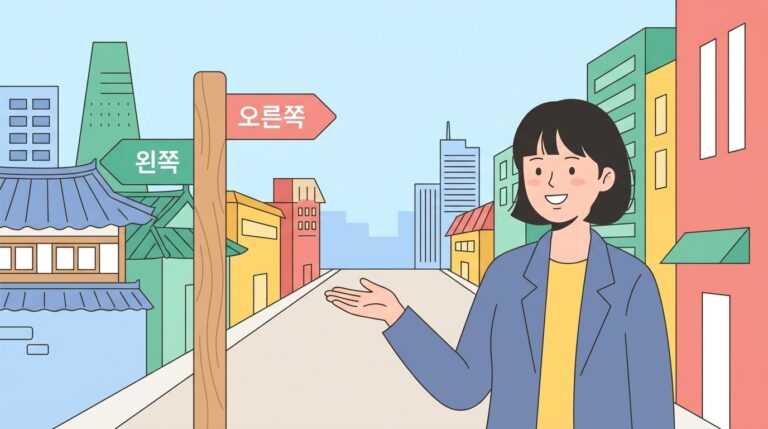
* The Two-Hand Point: When pointing toward a direction to help someone, try not to use a single pointing finger, which can sometimes look aggressive. Instead, use an open palm facing upward—it looks extremely polite and welcoming!
* Nodding & Eye Contact: Keep soft eye contact and nod slightly while saying “아, 네, 감사합니다!” (Ah, ne, gam-sa-ham-ni-da! – Ah, yes, thank you!) to show you are actively processing their help.
4-2. Map Culture in Korea
Did you know that Google Maps doesn’t work well for walking directions in Korea due to national security regulations? Locals use specialized local map apps instead. If you want to navigate like a true resident, you must download local transit apps before your trip!
Phase 5: Real-Life Roleplay Scenario
Setting: You are at exit 4 of Hongik University Station, trying to find a famous K-beauty store. You approach a friendly college student (Min-ji) holding a cute mascot tote bag.
Characters:
- You (The Lost Explorer)
- Min-ji (The Kind Local Student)
The Conversation:
- You: 저기요… 실례합니다.
(Jeo-gi-yo… sil-rye-ham-ni-da.)
“Excuse me… sorry to bother you.” - Min-ji: 🎭 [Smiling warmly] 네! 무슨 일 있으세요?
(Ne! Mu-sun il is-seu-se-yo?)
“Yes! Is something the matter?” - You: 올리브영 어디에 있어요?
(Ol-ri-beu-yeong eo-di-e is-seo-yo?)
“Where is Olive Young (K-beauty store)?” - Min-ji: 아! 올리브영이요? 저기서 오른쪽으로 가세요.
(Ah! Ol-ri-beu-yeong-i-yo? Jeo-gi-seo o-reun-jjeok-eu-ro ga-se-yo.)
“Ah! Olive Young? Over there, please go to the right.” - You: 아, 오른쪽이요?
(Ah, o-reun-jjeok-i-yo?)
“Ah, to the right?” - Min-ji: 네, 그리고 똑바로 쭉 가세요.
(Ne, geu-ri-go ttok-ba-ro ttuk ga-se-yo.)
“Yes, and then go straight ahead.” - You: 아! 감사합니다!
(Ah! Gam-sa-ham-ni-da!)
“Ah! Thank you!” - Min-ji: 🎭 [Waving gently] 네, 좋은 여행 되세요!
(Ne, jo-eun yeo-haeng doe-se-yo!)
“Yes, have a great trip!”
🔀 Interactive Choice Point
Min-ji pointed to the right, but you see two different paths. What do you do?
- Option A: You pointing to the left path and ask: “왼쪽이요?” (Oen-jjeok-i-yo?)
- Feedback (Bad): Oh no! Min-ji said right (o-reun-jjeok), but you pointed left. She might get confused and try to redirect you, costing you time.
- Option B: You point straight ahead along the right path and say: “이쪽으로 똑바로 가요?” (I-jjeok-eu-ro ttok-ba-ro ga-yo? – Do I go straight this way?)
- Feedback (Best!): Perfect! You confirmed both the rightward path and the straight direction with high accuracy. Min-ji will nod enthusiastically!
- Option C: You walk away silently because you are too shy to ask for confirmation.
- Feedback (Risk): You might end up walking in circles for 20 minutes! Don’t be afraid to double-check.
Phase 6: 10-Second Emotion Shadowing Drill
Try reading these sentences aloud by following the pause markers (/) and feeling the emotions!
- [😊 Politely & Hopefully]
저기요… / 실례합니다. / 길 좀 물어볼게요.
(Jeo-gi-yo… / sil-rye-ham-ni-da. / gil jom mul-eo-bol-ge-yo.)
“Excuse me… / pardon me. / Let me ask for directions.” -
[💡 Bright realization]
아! / 오른쪽으로 / 가세요! / 알겠습니다!
(Ah! / o-reun-jjeok-eu-ro / ga-se-yo! / al-get-seum-ni-da!)
“Ah! / To the right / go! / I understand!” -
[🥺 Confused but trying hard]
왼쪽… / 아니요, / 오른쪽으로요?
(Oen-jjeok… / a-ni-yo, / o-reun-jjeok-eu-ro-yo?)
“Left… / no, / to the right?”
Phase 7: K-Culture Mini Dictionary
- 길치 (Gil-chi) | Directionally Challenged | Used jokingly to describe someone who gets lost easily even with a map. “나 진짜 길치야” means “I’m such a bad navigator.”
- 출구 (Chul-gu) | Exit | Essential for subways. Station meetings are always designated by exits (e.g., “Meet at Exit 9”).
- 편의점 (Pyeon-ui-jeom) | Convenience Store | Great landmarks! If you are lost, look for a GS25 or CU and ask the clerk.
- 신호등 (Sin-ho-deung) | Traffic Light | Used often in directions: “Turn right at the traffic light.”
Phase 8: Survivor’s Travel Kit
Survival Phrases TOP 3
- 여기 어디예요? (Yeo-gi eo-di-yeo-yo?)
- Meaning: Where am I right now?
- Pro Tip: Show your map screen to a local while saying this.
- 도와주세요! (Do-wa-ju-se-yo!)
- Meaning: Please help me!
- Pro Tip: Use this when you are completely lost or in urgent need.
- 지도 보여주세요. (Ji-do bo-yeo-ju-se-yo.)
- Meaning: Please show me the map.
- Pro Tip: Use this when asking someone to point out your destination on their phone screen.
Editor’s Travel Note
For the best navigation experience in Korea, make sure to search and use the KakaoMap App or the Naver Map App. These local apps are updated in real-time with the most accurate bus routes, subway transfer times, and walking paths. Disclaimer: App interfaces and local transit policies may update; check app stores for the latest version.
Phase 9:
Frequently Asked Questions (FAQ)
Q: What does "왼쪽으로 가세요 (Oen-jjeok-eu-ro ga-se-yo)" mean in Korean and how do you pronounce it?
A: In Korean, "왼쪽으로 가세요 (Oen-jjeok-eu-ro ga-se-yo)" is pronounced [Oen-jjeok-eu-ro ga-se-yo (Think of "Oen" as in "When", "jjeok" like "juck", "eu-ro" like "oo-ro", and "ga-se-yo" as "gah-seh-yo"] and means: Please go to the left. / Go left.
Q: What does "오른쪽으로 가세요 (O-reun-jjeok-eu-ro ga-se-yo)" mean in Korean and how do you pronounce it?
A: In Korean, "오른쪽으로 가세요 (O-reun-jjeok-eu-ro ga-se-yo)" is pronounced [O-reun-jjeok-eu-ro ga-se-yo (Think of "O-reun" like "Oh-ryoon", "jjeok" like "juck"] and means: Please go to the right. / Go right.
Q: What does "똑바로 가세요 (Ttok-ba-ro ga-se-yo)" mean in Korean and how do you pronounce it?
A: In Korean, "똑바로 가세요 (Ttok-ba-ro ga-se-yo)" is pronounced [Ttok-ba-ro ga-se-yo (Think of "Ttok" as a sharp "Tok", and "ba-ro" like "bah-ro"] and means: Please go straight.






