

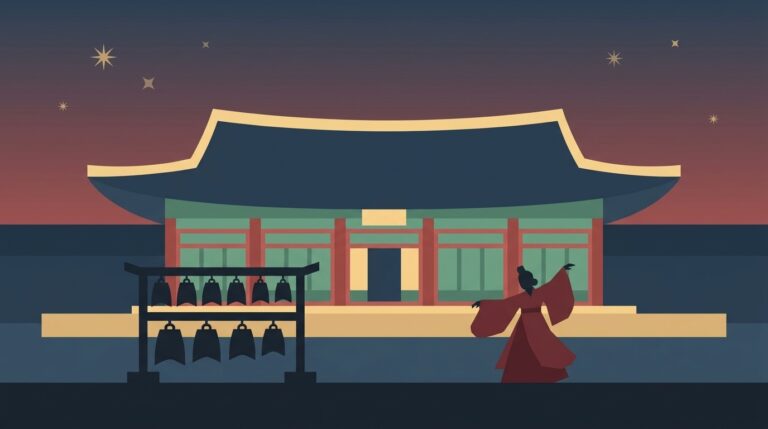
The Echo of Ancestral Souls: Decoding the Solemn Beauty and Philosophy of Jongmyo Jeryeak
안녕하세요! Welcome back, language adventurers! It’s your K-Culture Navigator and Korean bestie from Daily Hangul (매일한글).
Have you ever stood in the middle of a bustling, futuristic Seoul, only to step into a secluded stone courtyard where time suddenly stands still? That is the magic of the Jongmyo Shrine (종묘). If you have ever listened to the slow, heavy strike of the bronze bells and the deep, breathy sigh of the bamboo flutes during the Jongmyo Jeryeak (종묘 제례악) ritual, you know it is not just music. It is a portal to the Joseon Dynasty’s spiritual core: Ye-ak Sasang (예악 사상)—the philosophy that ritual (Ye) and music (Ak) must harmonize to keep the universe from falling into chaos.
For advanced learners, discussing this level of traditional art is the ultimate milestone. Today, we are moving beyond simple greetings to explore the profound linguistic nuances that describe the sublime, solemn, and transcendental beauty of Korea’s most sacred musical ritual.
Phase 2: Deep-Dive into 3 Essential Expressions
To speak like a true cultural connoisseur, you need words that capture the weight of centuries. Let’s dissect three high-level concepts that Koreans use when describing this solemn art.
1. 엄숙함이 깃들다 (Eomsukhami gitdeulda)
- Pronunciation: Eom-sook-ha-mee geet-deul-da (Sounds like “um-sook” + “ha” + “me” + “geet” + “deul-da”)
- Meaning: To be imbued with solemnity / A sacred gravity settles in.
- K-Culture Moment: In historical dramas (Sajuk), when the King walks into the ancestral hall and all whispering ceases, this is the exact phrase used to describe the heavy, respectful silence that fills the air.
- Editor’s Insight: The verb 깃들다 (gitdeulda) is beautiful. It doesn’t just mean “to exist”; it means to gently nestle, seep into, or dwell within something—like twilight settling over a valley. When combined with 엄숙함 (solemnity), it suggests a sacred gravity that isn’t oppressive, but deeply respectful and natural.
- Situation Spectrum: Casual 🚫 | Semi-formal ⚠️ | Formal ✅
- 🤔 Think About It: Does your native language have a word that describes seriousness as something that “dwells” or “settles” like a bird in a nest?
2. 정중동의 미학 (Jeongjungdong-ui mihak)
- Pronunciation: Jeong-joong-dong-uy mee-hak (Rhymes with “young” + “joong” + “dong” + “we” + “me-hak”)
- Meaning: The aesthetics of movement within stillness (Stillness in motion).
- K-Culture Moment: Often used by art critics to describe the traditional Korean dance Ilmu (일무) performed during the ritual, where dancers make slow, deliberate movements that seem frozen yet continuous.
- Editor’s Insight: This Hanja idiom (靜中動) captures the paradox of Korean art. It’s not static, nor is it hyperactive. It is the tense, beautiful balance of a bow fully drawn but not yet released.
- Situation Spectrum: Casual 🚫 | Semi-formal ⚠️ | Formal ✅
- 🤔 Think About It: How does this contrast with the high-energy “dynamic Korea” image of K-Pop? How do they actually complete each other?
3. 예악으로 다스리다 (Ye-ak-euro daseurida)
- Pronunciation: Ye-ak-eu-ro da-seu-ri-da (“Yeah-ack” + “eu-ro” + “da-seu-ree-da”)
- Meaning: To govern/harmonize through ritual and music.
- K-Culture Moment: Used in historical debates or philosophical texts to explain how Joseon kings sought to rule not by raw power or laws alone, but by cultivating their citizens’ inner morality through beautiful, orderly music.
- Editor’s Insight: 다스리다 (daseurida) usually means to govern or rule. But when paired with 예악 (Ye-ak), it means to heal, soothe, and bring emotional order to the state and individual mind.
- Situation Spectrum: Casual 🚫 | Semi-formal ⚠️ | Formal ✅
- 🤔 Think About It: Imagine a society where music is considered a vital political tool for social harmony. How would our modern world change?
Phase 3: Textbook Korean vs. Real Korean
When talking about traditional art, textbook phrases can sound sterile and academic. Let’s see how native connoisseurs actually express these feelings.
- Situation 1: Describing the overwhelming feeling of the ritual
- 📖 Textbook: 종묘 제례악은 매우 조용하고 엄숙한 음악입니다. (Jongmyo Jeryeak is a very quiet and solemn music.)
- 🗣️ Real Korean: 가슴을 울리는 무거운 타악기 소리에서 말을 잃게 만드는 압도적인 엄숙함이 느껴져요. (You feel an overwhelming solemnity that leaves you speechless in the deep, chest-striking percussion sounds.)
- 💡 Why the difference? Advanced speakers don’t just call music “quiet”; they describe the physical and emotional impact (가슴을 울리는 – chest-striking/soul-stirring, 말을 잃게 만드는 – leaving one speechless).
- Situation 2: Expressing the slow tempo of the dance
- 📖 Textbook: 무용수들이 아주 천천히 움직입니다. (The dancers move very slowly.)
- 🗣️ Real Korean: 느린 몸짓 속에 엄청난 긴장감이 팽팽하게 차 있는 정중동의 극치를 보여주네요. (It shows the pinnacle of ‘stillness in motion,’ where an immense tension is tautly filled within the slow gestures.)
- 💡 Why the difference? To capture the philosophy of Korean traditional dance, using literary terms like 극치 (pinnacle/epitome) and 정중동 elevates your commentary to academic and poetic heights.
Phase 4: K-Culture Deep-Dive & Non-Verbal Manners
4-1. The Body Language of Reverence
When attending a performance of Jongmyo Jeryeak (whether at the actual shrine in May or at the National Gugak Center), non-verbal cues are highly valued:
* The “Low-Gaze” (시선 처리): Avoid pointing aggressively or staring blankly. Keep your gaze slightly lowered and soft, mimicking the respectful posture of the ritual officials.
* The Mindful Step (디딤걸음): When walking on the stone courtyard of Jongmyo, walk slowly. The center path (Sindo – 신도) is reserved solely for the spirits of the ancestors. Always walk on the side paths to show respect.
4-2. Cultural Code: The Royal Ancestral Spirit
In K-Dramas like Under the Queen’s Umbrella or The King’s Affection, you often see scenes of royal ancestral rituals. For the Joseon royal family, music was not entertainment; it was a cosmic telephone wire. They believed that the bronze bells (Pyeonjong) and stone chimes (Pyeongyeong) produced frequencies so pure that they could bridge the gap between Heaven, Earth, and the Underworld, inviting the ancestral spirits down to bless the nation.
Phase 5: Real-Life Roleplay Scenario
Imagine you are visiting the Jongmyo Shrine with Professor Min-woo, a cultural heritage expert who is guiding you through the annual Royal Ancestral Ritual.
🎭 Cast:
- Min-woo (민우): A passionate cultural scholar who speaks with academic grace.
- You (학습자): An advanced Korean learner deeply moved by the spiritual atmosphere.
민우: 드디어 제례악이 시작되는군요. 저 첫 축(Chuk) 소리가 울릴 때의 느낌을 어떻게 표현해야 할까요?

You: 첫 박자가 울리자마자 이 넓은 사당에 엄청난 엄숙함이 깃드는 기분이에요.
     (Cheot bakjaga ullijamaja i neolbeun sadange eomcheongnan eomsukhami gitdeuneun gibunieyo.)
     "As soon as the first beat sounds, I feel an immense solemnity settling over this vast shrine."

민우: 정확히 보셨습니다. 일무(Ilmu) 무용수들의 저 느린 팔동작은 어떻게 보이시나요?

You: 단순한 춤이 아니라, 정중동의 미학을 그대로 보여주는 예술이네요. 숨이 멎을 것 같아요.
     (Dansunhan chumi anira, jeongjungdong-ui mihageul geudaero boyeojuneun yesurineyo. Sumi meojeul geot gatayo.)
     "It's not just a dance; it's art showing the very aesthetics of 'stillness in motion'. It takes my breath away."

민우: 예와 악으로 나라를 다스리려 했던 선조들의 철학이 바로 여기에 녹아 있습니다.

You: 예악 사상이 단순히 옛날 이론인 줄 알았는데, 음악을 들으니 가슴으로 이해가 가네요.
     (Ye-ak sasangi dansunhi yennal ironin jul aranneunde, eumageul deureuni gaseumeuro ihaega ganeyo.)
     "I thought the Ye-ak philosophy was just an ancient theory, but hearing the music, I understand it with my heart."

민우: 전통을 이렇게 깊이 이해해 주시니 제가 다 감동적입니다. 다음 의식은 어떻게 보시겠어요?
🔀 Choose Your Next Response:
- A) “제례악의 느린 템포 속에 담긴 내면의 평화를 더 느껴보고 싶어요.”
- Feedback (Best): Beautifully poetic! You are connecting the musical tempo to internal mindfulness. Min-woo will be deeply impressed by your cultural sensitivity.
- B) “음악이 좀 지루한데, 좀 더 신나는 국악 공연은 없나요?”
- Feedback (Bad): Oops! While honest, asking for “exciting” music right in the middle of a sacred ancestral ceremony is culturally insensitive and ruins the solemn mood.
- C) “이 악기들 진짜 비싸 보이는데, 얼마쯤 하나요?”
- Feedback (Risk): Too materialistic for this profound moment. Asking about the price of sacred instruments ruins the spiritual atmosphere.
Phase 6: 10-Second Emotional Shadowing Drill
Practice speaking with the deep, slow resonance of a scholar. Pause at the / and let your voice descend softly at the end.
- [🥺 Deeply moved, filled with awe]
*
Frequently Asked Questions (FAQ)
Q: What does "엄숙함이 깃들다 (Eomsukhami gitdeulda)" mean in Korean and how do you pronounce it?
A: In Korean, "엄숙함이 깃들다 (Eomsukhami gitdeulda)" is pronounced [Eom-sook-ha-mee geet-deul-da (Sounds like "um-sook" + "ha" + "me" + "geet" + "deul-da"] and means: To be imbued with solemnity / A sacred gravity settles in.
Q: What does "정중동의 미학 (Jeongjungdong-ui mihak)" mean in Korean and how do you pronounce it?
A: In Korean, "정중동의 미학 (Jeongjungdong-ui mihak)" is pronounced [Jeong-joong-dong-uy mee-hak (Rhymes with "young" + "joong" + "dong" + "we" + "me-hak"] and means: The aesthetics of movement within stillness (Stillness in motion).
Q: What does "예악으로 다스리다 (Ye-ak-euro daseurida)" mean in Korean and how do you pronounce it?
A: In Korean, "예악으로 다스리다 (Ye-ak-euro daseurida)" is pronounced [Ye-ak-eu-ro da-seu-ri-da ("Yeah-ack" + "eu-ro" + "da-seu-ree-da"] and means: To govern/harmonize through ritual and music.







