

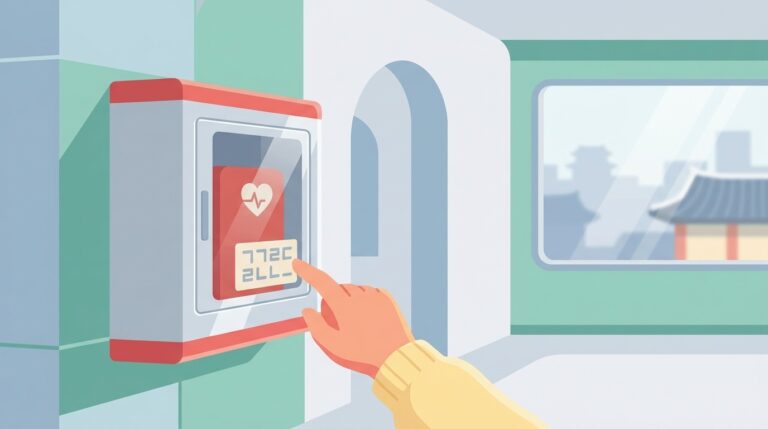
Saving Lives in Korean: Mastering AED Pad Placement and Emergency Protocols
Phase 1: Empathy (An Open Letter from Your Korean Bestie)
안녕하세요! It’s your favorite Daily Hangul editor and cultural navigator here.
Imagine this: You are watching a high-intensity medical K-Drama like Hospital Playlist (슬기로운 의사생활) or Dr. Romantic (낭만닥터 김사부). The alarms are blaring, a patient is in cardiac arrest, and the lead doctor shouts, “제세동기 가져오세요!” (Bring the defibrillator!) It’s a scene that grips your heart. But what if this happened in real life right next to you on the streets of Seoul—perhaps at a bustling subway station or a crowded Han River park?
An emergency situation is terrifying in your native language, let alone in Korean. Many of our advanced (C1) students have shared their deepest anxiety: “What if I want to help, but I can’t understand the AED voice prompts or instruct someone else in Korean?” Today, we are conquering that fear. We are diving deep into the highly practical, life-saving vocabulary of 자동 제세동기 (AED) 패드 부착 (Attaching AED Pads).
By the end of this guide, you won’t just understand these terms; you will have the linguistic confidence to take charge, follow voice prompts, and potentially save a life in Korea. Let’s do this together.
Phase 2: Deep-Dive into 3 Essential Emergency Expressions
In emergency situations, clarity and speed are everything. Here are the three most critical expressions you need to know, broken down with absolute precision.
1. 오른쪽 빗장뼈 아래와 왼쪽 겨드랑이 아래에 패드를 붙이세요. (orun-jjok bit-jang-ppyeo a-rae-wa oen-jjok gyeo-deu-rang-i a-rae-e pae-deu-reul but-i-se-yo.)
- Pronunciation Analogies: Bit-jang-ppyeo sounds like “beet-jang-pyuh” (collarbone), and gyeo-deu-rang-i sounds like “gyuh-deu-rang-ee” (armpit).
- Meaning: “Attach the pads below the right collarbone and below the left armpit.”
- K-Culture Moment: This is the standard, literal audio prompt you will hear from any Korean-manufactured AED (자동심장충격기) once you open the lid.
- Editor’s Insight: The word 빗장뼈 (collarbone) is the pure Korean anatomical term, though in casual beauty contexts, Koreans often use the Sino-Korean term 쇄골 (swaegol) (e.g., “쇄골 미인” – collarbone beauty). However, medical and emergency devices strictly use 빗장뼈 for clear, standardized Korean.
- Situation Spectrum: Casual 🚫 | Semi-formal ⚠️ | Formal/Instructional ✅
- 🤔 Think About It: Why does Korean use pure anatomical terms (빗장뼈 – lock-bolt bone) over Sino-Korean ones in public emergency devices? It’s designed so that even children can immediately recognize the body parts during a panic.
2. 패드가 피부에 밀착되도록 꾹 눌러 주세요. (pae-deu-ga pi-bu-e mil-chak-doe-do-rok kkuk nul-reo ju-se-yo.)
- Pronunciation Analogies: Mil-chak (“meel-chahk”) means pressing closely, and kkuk (“kook”) is an onomatopoeic word for pressing down firmly.
- Meaning: “Press down firmly so that the pads adhere closely to the skin.”
- K-Culture Moment: You will hear first responders or instructors in civil defense drills (민방위 훈련) emphasizing this step to ensure the electrical shock is delivered effectively.
- Editor’s Insight: 밀착 (mil-chak) is a gorgeous C1-level word. Outside of medicine, you’ll see it in K-Beauty! “밀착력 좋은 파운데이션” refers to foundation that adheres seamlessly to your skin.
- Situation Spectrum: Casual ⚠️ | Semi-formal ✅ | Formal ✅
- 🤔 Think About It: How does your native language express the intensity of “pressing down firmly” compared to the cute yet intense Korean sound-effect word 꾹 (kkuk)?
3. 환자에게서 손을 떼고 접촉하지 마세요. (hwan-ja-e-ge-seo son-eul tte-go jeop-chok-ha-ji ma-se-yo.)
- Pronunciation Analogies: Jeop-chok (“jup-chohk”) means physical contact or touch.
- Meaning: “Step away from the patient and do not touch them.”
- K-Culture Moment: As the AED analyzes the heart rhythm (심전도 분석), this loud warning plays. In medical dramas, this is the exact moment everyone raises their hands and steps back.
- Editor’s Insight: The verb 손을 떼다 (son-eul tte-da) literally means “to take off one’s hands,” but in business contexts, it also means to wash one’s hands of a project or retire from an industry.
- Situation Spectrum: Casual 🚫 | Semi-formal ⚠️ | Formal ✅
Phase 3: Textbook Korean vs. Real-World Korean
In textbooks, emergency Korean is grammatically pristine but can feel too slow or detached when seconds count.
Situation 1: Requesting someone to bring the AED
- 📖 Textbook Korean: “저기 있는 자동 제세동기를 이쪽으로 가져다 주시겠습니까?” (Would you please bring the automatic external defibrillator that is over there to this location?)
- 🗣️ Real-World Korean: “거기 빨간 상자, 제세동기 빨리 가져다주세요!” (You, with the red box, bring the AED quickly!)
- 💡 Why the difference? In a crisis, using long honorific sentences causes cognitive overload. Real-world Korean utilizes short, direct commands and points out visual cues (like the red box) to eliminate bystander hesitation.
Situation 2: Telling someone to stop touching the patient during shock delivery
- 📖 Textbook Korean: “감전의 위험이 있으니 환자체 접촉을 금해 주시기 바랍니다.” (Please refrain from contacting the patient’s body due to danger of electric shock.)
- 🗣️ Real-World Korean: “모두 물러서세요! 손 떼세요!” (Everyone step back! Hands off!)
- 💡 Why the difference? Urgent imperatives like “물러서세요!” (Step back!) and “손 떼세요!” (Hands off!) are much faster to process than administrative terms like “접촉을 금하다” (prohibit contact).
Phase 4: K-Culture Deep Dive & Non-Verbal Etiquette
4-1. Nunchi (눈치) & Body Language in Korean Emergencies
In Korea, during an emergency, 눈치 (Nunchi – situational quick-wittedness) is about stepping up without waiting for a formal hierarchy, but doing so respectfully.
* Direct Pointing: The “bystander effect” is combated in Korea by pointing directly at someone and identifying them by their clothing: “거기 파란색 셔츠 입으신 분, 119에 신고해 주세요!” (You in the blue shirt, please call 119!).
* Physical Touch and Respect: While saving a life bypasses standard physical touch boundaries, Korean medics will still verbally announce actions before performing them (e.g., “옷을 자르겠습니다” – I will cut the clothes) to maintain dignity and mental preparation for bystanders.
4-2. The Cultural Footprint: South Korea’s Safety Net
If you travel through Seoul’s subway stations, you will notice bright yellow or silver cabinets labeled 자동심장충격기 (AED). Under the “Emergency Medical Service Act” in Korea, public facilities, subway stations, and apartment complexes housing over 500 units are legally required to have AEDs. Koreans are highly trained in this via school, university, or military service, making the community highly responsive if you shout for help.
Phase 5: Real-Life Roleplay Scenario
Setting: You are at Gangnam Subway Station. An elderly man suddenly collapses. You and a bystander, Min-woo (민우), rush to help. You have run to fetch the AED and are now applying the pads under stress.
Characters:
- You (민우의 조력자 / Assistant)
- Min-woo (민우 – A brave citizen doing chest compressions)
- AED (자동 제세동기 – Voice prompts)
1. 민우: (급박하게) 심폐소생술 계속하고 있을 테니까, 빨리 제세동기 패드 좀 꺼내주세요!
   (Sim-pye-so-saeng-sul gye-sok-ha-go is-seul te-ni-kka, ppal-li je-se-dong-gi pae-deu jom kkeo-nae-ju-se-yo!)
   "I’ll keep doing CPR, so please get the AED pads out quickly!"

2. You: (침착하려고 애쓰며) 네, 여기 패드 꺼냈습니다. 어디에 붙여야 하죠?
   (Ne, yeo-gi pae-deu kkeo-naet-seum-ni-da. Eo-di-e but-iyeo-ya ha-jyo?)
   "Yes, I got the pads out. Where should I attach them?"

3. AED: "패드 커넥터를 장비에 연결하고, 패드를 그림과 같이 부착하세요."
   ("Pae-deu keo-nek-teo-reul jang-bi-e yeon-gyeol-ha-go, pae-deu-reul geu-rim-gwa gat-i bu-chak-ha-se-yo.")
   "Connect the pad connector to the device, and attach the pads as shown in the picture."

4. 민우: (이마에 땀이 흐르며) 오른쪽 빗장뼈 아래랑, 왼쪽 겨드랑이 아래에 붙여주세요! 꾹 누르셔야 해요!
   (O-run-jjok bit-jang-ppyeo a-rae-rang, oen-jjok gyeo-deu-rang-i a-rae-e but-iyeo-ju-se-yo! Kkuk nu-reu-syeo-ya hae-yo!)
   "Attach it below the right collarbone, and below the left armpit! You have to press down firmly!"

5. You: (패드를 밀착시키며) 네! 오른쪽이랑 왼쪽 맞게 붙였습니다. 꽉 밀착시켰어요!
   (Ne! O-run-jjok-i-rang oen-jjok mat-ge but-yeot-seum-ni-da. Gwak mil-chak-si-kyeot-seo-yo!)
   "Yes! Attached correctly to the right and left sides. I made sure they adhere tightly!"

6. AED: "분석 중입니다. 환자에게서 떨어지세요."
   ("Bun-seok jung-im-ni-da. Hwan-ja-e-ge-seo tteol-eo-ji-se-yo.")
   "Analyzing. Step away from the patient."

7. You: (민우를 당기며) 분석한대요! 물러서세요! 손 떼세요!
   (Bun-seok-han-dae-yo! Mul-reo-seo-se-yo! Son tte-se-yo!)
   "It says it's analyzing! Step back! Hands off!"

8. 민우: (숨을 몰아쉬며) 네, 다들 비키세요! 접촉 금지입니다!
   (Ne, da-deul bi-ki-se-yo! Jeop-chok geum-ji-im-ni-da!)
   "Yes, everyone step aside! No contact!"
🔀 Interactive Decision Point
The AED voice suddenly says: “전기 충격이 필요합니다. 오렌지색 버튼을 누르세요.” (Electric shock needed. Press the orange button.) What do you do?
- A) Press the button immediately while Min-woo is checking the patient’s pulse.
- B) Shout “모두 물러서세요!” (Everyone step back!), visually check that no one is touching the patient, and then press the button.
- C) Wait for the 119 paramedics to arrive because pressing the button yourself feels too scary.
📢 Feedback:
- Choosing A (Bad/Risk): 🚨 Dangerous! If Min-woo is touching the patient, he will be electrocuted. You must ensure absolute isolation before pushing that button.
- Choosing B (Best): 🌟 Perfect! You practiced excellent verbal warning and ensured physical safety before delivering the shock. This saves lives!
- Choosing C (Bad): ⚠️ In cardiac arrest, every second reduces survival rates by 10%. The machine is fully automated and safe—do not hesitate to push it when prompted!
Phase 6: 10-Second Emotional Shadowing Drill
Let’s practice speaking these emergency phrases with realistic urgent intonations. The slash / represents a slight pause.
- [😱 Panic-stricken but Urgent]
제세동기 패드! / 오른쪽이랑 / 왼쪽에 / 빨리 붙여주세요!
(Je-se-dong-gi pae-deu! / o-run-jjok-i-rang / oen-jjok-e / ppal-li but-iyeo-ju-se-yo!) -
[🗣️ Decisive and Commanding]
기계가 분석 중입니다! / 모두 / 손 떼고 / 물러서세요!
(Gi-gye-ga bun-seok jung-im-ni-da! / mo-du / son tte-go / mul-reo-seo-se-yo!)
Phase 7: K-Culture Mini-Dictionary
- 자동심장충격기 (Ja-dong-sim-jang-chung-gyeok-gi) | Automated External Defibrillator (AED)
- While “제세동기” is the common medical jargon, “자동심장충격기” is the official, easier-to-understand Korean name printed on all public safety boxes.
- 심폐소생술 (Sim-pye-so-saeng-sul) | CPR (Cardiopulmonary Resuscitation)
- Often abbreviated as CPR in daily speech, but officially written everywhere in Korea as 심폐소생술.
- 밀착 (Mil-chak) | Close adherence / Seamless contact
- Used both in emergency situations (making sure pads stick to skin) and in beauty/fashion (foundation sticking perfectly to the face).
- 골든타임 (Gol-deun-ta-im) | The Golden Time / Golden Hour
- A hugely popular Konglish phrase in Korea referring to the critical 4 minutes in cardiac arrest where intervention can prevent brain death.
Phase 8: The Traveler’s Emergency Survival Kit
Survival Phrases TOP 3
- “여기 119에 신고해 주시고 제세동기 좀 찾아주세요!” (Yeo-gi il-il-gu-e sin-go-hae ju-si-go je-se-dong-gi jom cha-ja-ju-se-yo!)
- Pro Tip: Shout this to a specific bystander to assign them a concrete task.
- “기계 켜졌습니다. 음성 안내 지시대로 하세요.” (Gi-gye kyeo-jeot-seum-ni-da. Eum-seong an-nae ji-si-dae-ro ha-se-yo.)
- Pro Tip: Tell this to your partner so they know to stop and listen to the voice prompt.
- “맥박이 돌아왔는지 확인하세요!” (Maek-bak-i do-ra-wat-neun-ji hwa-gin-ha-se-yo!)
- Pro Tip: Use this after the shock is delivered and CPR needs to be reassessed.
📝 Editor’s Travel Note
When traveling in South Korea, you don’t need to feel lost in an emergency. Download the Emergency Ready App (안전디딤돌) run by the Korean government. It provides real-time shelter locations, English emergency support, and locations of nearby AEDs based on your GPS. Note: App specifications and interface may change over time without prior notice.
Phase 9: “One Step Deeper” (Reflections on Korean Collectivism)
In many Western cultures, citizens are sometimes hesitant to perform CPR or use AEDs due to the fear of being sued if something goes wrong. However, in Korea, there is a strong collectivist urge to protect the community. Korea has implemented the ‘Good Samaritan Law’ (선한 사마리아인 법) under Article 5-2 of the Emergency Medical Service Act, which protects citizens who provide emergency care from civil or criminal liability. This legal safety net encourages Koreans to step forward immediately during a crisis. Helping someone is seen not just as a choice, but as an essential duty of being a member of society.
💬 Your Turn: Does your country have a similar ‘Good Samaritan Law’? How would you feel performing CPR in a public space back home versus in Korea?
Phase 10: FAQ & Common Mistakes
Q: Can I use a Korean AED if I don’t speak fluent Korean?
A: Yes! All Korean AEDs have very clear visual diagrams on the packaging and on the pads themselves showing exactly where to place them. Furthermore, modern AEDs installed in high-traffic tourist areas like Myeongdong, Incheon Airport, and major subway stations have a “Language” button (usually marked Language or 언어) that toggles the voice prompts into English.
Q: What is the difference between 제세동기 (Je-se-dong-gi) and 심장충격기 (Sim-jang-chung-gyeok-gi)?
A: They refer to the exact same device. 제세동기 is a Sino-Korean medical term (meaning “eliminator of fibrillation”), while 심장충격기 is a purified pure-Korean term (meaning “heart shocker”) introduced to make the device easier for the general public to identify instantly.
Q: Can the pads be attached through clothing?
A: Absolutely not. The pads must make direct contact with bare skin. If the patient is wearing thick winter clothes, you must rip, cut, or open the clothes to expose the chest.
🚨 THE COMMON MISTAKES BOARD 🚨

❌ Mistake 1: Placing pads on top of clothing or wet skin.
👉 Correct Action: Always dry the chest area and ensure the pads stick directly to bare skin.

❌ Mistake 2: Forgetting to plug the pad connector cable into the actual AED machine.
👉 Correct Action: Placing pads on the chest does nothing if you don't plug the flashing yellow/green connector cable into the AED unit!

❌ Mistake 3: Touching the patient when the AED says "분석 중" (Analyzing).
👉 Correct Action: Let go of the patient entirely. If you touch them, the machine might analyze your heart rhythm instead of theirs!
Phase 11: Action Mission & Engagement
🏆 The 3-Step Challenge
- Bronze (Solo): Read the Phase 6 Shadowing Drill out loud 5 times, mimicking the urgency of an emergency responder.
- Silver (Share): Screenshot the “Survival Phrases” from Phase 8, save them on your phone, and post about them on your Instagram Story tagging
#DailyHangulto raise safety awareness! - Gold (Real-Life): Next time you are in a Korean subway station, find the 자동심장충격기 box. Take a picture, read the instructions on the cover, and verify where the Language switch is.
Phase 12: Interactive Quiz Challenge
Test your life-saving Korean skills! Can you score a perfect 3/3?
1. Where should you place the AED pads according to Korean emergency guidelines?
- A) Both on the center of the chest.
- B) Right collarbone below (오른쪽 빗장뼈 아래) and left armpit below (왼쪽 겨드랑이 아래).
- C) On the lower abdomen.
2. Translate this AED voice prompt: “분석 중입니다. 환자에게서 떨어지세요.”
- A) “Ready for shock. Press the button.”
- B) “Analyzing. Step away from the patient.”
- C) “Perform chest compressions now.”
3. [True or False] In Korea, you can be sued for damages if you perform CPR on an unconscious stranger and things go wrong.
- True
- False
👉 Click here for Answers & Explanations!
- Answer: B
- Explanation: Standard AED placement is under the right collarbone (오른쪽 빗장뼈 아래) and under the left armpit (왼쪽 겨드랑이 아래).
- Answer: B
- Explanation: “분석 중입니다” means “Analyzing (electrocardiogram) in progress”, and “떨어지세요” means “Step away/Detach yourself”.
- Answer: False
- Explanation: Under Korea’s Good Samaritan Law (선한 사마리아인 법), citizens are legally protected from civil and criminal liabilities when performing good-faith emergency aid.







