

How to Master Food Delivery Payments in Korea Like a Local (Without the Panic!)
Phase 1: Empathy (Your K-Delivery Payment Panic Ends Here!)
안녕하세요! (Annyeonghaseyo!) It’s your Daily Hangul editor and trusty cultural navigator here.
Imagine this: You are cozying up in your Seoul Airbnb after a long day of sightseeing. Your favorite K-Drama character is happily slurping on black bean noodles (jajangmyeon), and your stomach starts to growl. You bravely download a Korean delivery app, pick the ultimate crispy fried chicken, and hit checkout.
Then… the dread sets in. A pop-up asks you how you want to pay. “Meet-the-rider payment? Card? Cash? Pre-payment?” Your heart races. You might be thinking, “What if my foreign credit card doesn’t work online? Can I just pay the delivery rider directly? What do I say when they hand me the food?”
Don’t close the app! This is the exact moment many of our A2 learners freeze up, but today, we are going to turn that payment anxiety into complete confidence. With just a few simple phrases, you’ll be able to pay for your food effortlessly, whether online or at your doorstep. Let’s get cooking!
Phase 2: Deep Dive into 3 Essential Payment Phrases
1. 카드로 결제할게요 (Kadeu-ro gyeolje-halgeyo)
- Pronunciation: Kah-deu-ro gyul-jeh-hal-geh-yo (Sounds like “car-do” + “gyul-jay-hal-kay-yo”)
- Meaning: I will pay by card.
- K-Culture Moment: In countless Korean dramas, when characters order late-night snacks (yasik), you will see them standing at the door handing a sleek plastic card to the friendly rider. This phrase is the golden key to that exact moment.
- Editor’s Insight: The particle “~로 (~ro)” means “by” or “using.” So you are literally saying “Using card, I will pay.” It’s polite, clear, and the most common way to pay in modern, cash-free Korea.
- Situation Spectrum: Casual 🚫 | Semi-formal ✅ | Formal ⚠️
- 🤔 Think About It: In many Western countries, cash or online pre-payment is standard. In Korea, paying the delivery rider directly with a physical card at the door (man-nam-gyeol-je) is extremely common. Why do you think face-to-face card payment remains so popular in Korea?
2. 현금으로 할게요 (Hyeongeum-euro halgeyo)
- Pronunciation: Hyun-gum-euro hal-geh-yo (Think of “hyun” as in Hyundai + “gum” like chewing gum + “euro-hal-kay-yo”)
- Meaning: I will pay with cash.
- K-Culture Moment: You might hear this in retro-themed dramas or when students pool small bills together to pay for a mountain of tteokbokki.
- Editor’s Insight: “현금 (Hyeongeum)” means cash. Since Korea is rapidly becoming a cashless society, paying by cash is slightly less common today, but still fully accepted by riders. Keep exact change ready if you can!
- Situation Spectrum: Casual 🚫 | Semi-formal ✅ | Formal ⚠️
- 🤔 Think About It: How does paying with cash change your interaction with the rider compared to a quick card tap?
3. 영수증은 버려주세요 (Yeongsujeung-eun beoryeo-juseyo)
- Pronunciation: Yung-su-jung-eun buh-ryuh-ju-seh-yo (Sounds like “young-sue-jung-oon” + “buh-ryuh-joo-say-yo”)
- Meaning: Please throw away the receipt for me.
- K-Culture Moment: Watch any Korean reality show where celebrities buy food; they almost always say this in a fast, rhythmic flow to save the worker’s time.
- Editor’s Insight: “영수증 (Yeongsujeung)” is receipt, and “버려주세요 (beoryeo-juseyo)” means “please throw it away.” Koreans love speed and efficiency (bbali-bbali culture). Saying this keeps the interaction short and sweet!
- Situation Spectrum: Casual 🚫 | Semi-formal ✅ | Formal ⚠️
- 🤔 Think About It: Why do you think Koreans prefer discarding receipts immediately rather than keeping them? How does this reflect the “Bbali-Bbali” (fast-paced) lifestyle?
Phase 3: Textbook Korean vs. Real Korean
Let’s compare the stiff textbook phrases with what Koreans actually say at the door.
Situation 1: Choosing Card Payment at the Door
- 📖 Textbook Korean: “신용카드로 결제해 주시기 바랍니다.” (Sinyong-kadeu-ro gyeolje-hae jusigi baramni-da.)
- Why it’s stiff: This sounds like a robotic computer prompt or an official announcement.
- 🗣️ Real Korean: “카드로 결제할게요.” (Kadeu-ro gyeolje-halgeyo.)
- 💡 Why it’s better: It is natural, polite, and instantly understood by any delivery rider.
Situation 2: Asking for the Receipt to be Thrown Away
- 📖 Textbook Korean: “영수증은 필요하지 않습니다.” (Yeongsujeung-eun piryohaji ansumnida.)
- Why it’s stiff: It sounds overly formal, like saying “Receipt is not required” in a business meeting.
- 🗣️ Real Korean: “영수증은 괜찮아요 / 버려주세요.” (Yeongsujeung-eun gwaenchanayo / beoryeo-juseyo.)
- 💡 Why it’s better: “괜찮아요 (It’s okay)” or “버려주세요 (Please throw it away)” is much warmer and more natural for a quick doorstep interaction.
Phase 4: K-Culture Deep Dive & Non-verbal Manners
4-1. Nunchi & Doorstep Gestures
When the doorbell rings (Ding-dong!), don’t panic! Here are the unspoken golden rules:
* The Two-Handed Hand-off: When handing your card or cash to the delivery rider, always use two hands (or support your right elbow with your left hand). This is a vital sign of respect in Korea. Do the same when receiving your food and card back!
* The Head Bow: A slight, quick bow of the head while saying “감사합니다 (Gamsahabnida)” goes a long way.
4-2. The Evolution of K-Delivery Culture
Did you know that Korea’s delivery culture is one of the most advanced in the world? In the past, riders would deliver food in metal containers (cheolgabang) and return later to collect the empty dishes left outside your door. Today, everything is eco-friendly disposables, and payments are super streamlined. If you use foreign apps like Shuttle or global versions of local apps, you can pay online, but knowing how to pay at the door is a superpower if your foreign card gets rejected online!
Phase 5: Real-Life Roleplay Scenario
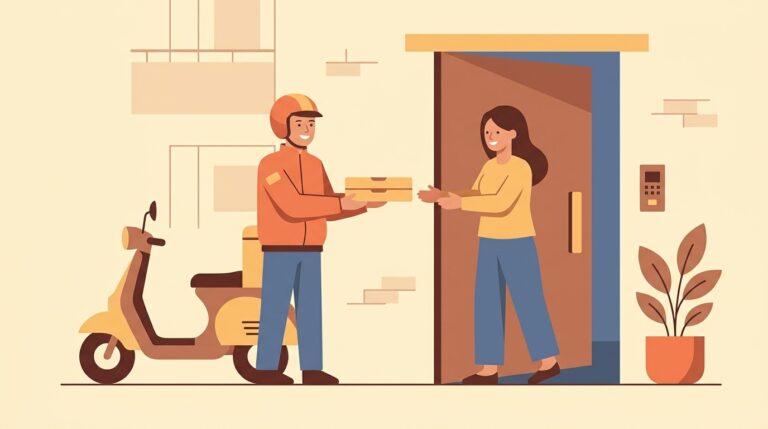
Setting: You are standing at the entrance of your officetel (studio apartment). The delivery rider has just arrived with a warm, steaming box of garlic soy fried chicken.
NPC Character: 배달원 (Baedalwon – Delivery Rider): A friendly, busy rider wearing a motorcycle helmet, eager to make a quick delivery.
Dialogue
- 배달원 (Rider): 🎭 [Hands over the chicken box] 안녕하세요! 주문하신 치킨 배달왔습니다.
(Annyeonghaseyo! Jumunhasin chikin baedal-wasseumnida.)
“Hello! I’m here with the chicken you ordered.” -
You: 🎭 [Smiles and holds the door] 아, 감사합니다!
(Ah, gamsahabnida!)
“Oh, thank you!” -
배달원 (Rider): 🎭 [Holds up a small mobile payment terminal] 결제는 어떻게 하세요?
(Gyeolje-neun eotteoke haseyo?)
“How would you like to pay?” -
You: 카드로 결제할게요. 🎭 [Hands over your credit card with both hands]
(Kadeu-ro gyeolje-halgeyo.)
“I’ll pay by card.” -
배달원 (Rider): 🎭 [Taps the card on the machine, then hands the card back] 네, 결제 되셨습니다. 영수증 드릴까요?
(Ne, gyeolje doesyeosseumnida. Yeongsujeung deurilkkayo?)
“Yes, payment is complete. Would you like a receipt?” -
You: 영수증은 버려주세요. 🎭 [Gently bows head]
(Yeongsujeung-eun beoryeo-juseyo.)
“Please throw away the receipt.” -
배달원 (Rider): 🎭 [Pockets the receipt and smiles] 네, 맛있게 드세요!
(Ne, masitge deuseyo!)
“Sure, enjoy your meal!” -
You: 감사합니다! 수고하세요!
(Gamsahabnida! Sugohaseyo!)
“Thank you! Keep up the hard work!”
🔀 Interactive Choice Point
The rider asks: “결제는 어떻게 하세요? (How would you like to pay?)” How do you respond?
- Choice A: “현금으로 할게요.” (Hyeongeum-euro halgeyo.) and hand over a 10,000 won bill.
- Choice B: “카드로 할게요!” (Kadeu-ro halgeyo!) while handing over your card with one hand while looking at your phone.
- Choice C: “여기 카드가 있습니다.” (Yeogi kadeu-ga isseumnida.)
Feedback:
- Choice A (Best/Safe): Excellent! Paying with cash is smooth, and using “현금으로 할게요” is natural and highly polite for A2 level.
- Choice B (Risk/Manner Warning): Language is good, but check your manners! Handing a card with one hand while distracted is considered slightly rude in Korea. Try to use both hands and make eye contact.
- Choice C (Stiff/Awkward): Correct grammar, but a bit robotic. It sounds like “Here is the card.” It’s better to use “카드로 할게요” to express your action politely.
Phase 6: 10-Second Emotion Shadowing Drill
Let’s practice the rhythm! Pay attention to the pauses (/) and try to express the emotion inside the brackets.
- [😊 Friendly and polite]
- 카드로 / 결제할게요.
- Ka-deu-ro / gyul-jeh-hal-geh-yo.
- [⚡ Fast and polite – to save the rider’s time]
- 영수증은 / 버려주세요.
- Yung-su-jung-eun / buh-ryuh-ju-seh-yo.
- [💖 Warm and appreciative – a great phrase for departing workers]
- 감사합니다! / 수고하세요!
- Gam-sa-hab-ni-da! / Su-go-ha-seh-yo!
- (Thank you! Keep up the great work!)
Phase 7: K-Culture Mini Dictionary
- 만남결제 (Mannam-gyeolje) | Pay-on-delivery (literally “Meet-and-pay”)
The app option that allows you to pay the driver face-to-face using cash or card instead of putting your card details into the app. - 수고하세요 (Sugohaseyo) | Keep up the good work
A warm, polite phrase used to say goodbye to service workers, delivery drivers, or taxi drivers. - 영수증 (Yeongsujeung) | Receipt
The slip of paper showing your payment details. You’ll hear this word at every shop in Korea. - 빨리빨리 (Bbali-bbali) | Hurry-hurry / Fast-fast
The famous Korean cultural concept of speed and efficiency, which is why food delivery is incredibly fast!
Phase 8: Survival Kit for Travelers
Survival Phrases TOP 3
- 카드 돼요? (Kadeu dwaeyo?)
- Do you accept cards? (Great to ask if you aren’t sure if their mobile terminal is working.)
- 현금 영수증 해주세요. (Hyeongeum yeongsujeung hae-juseyo.)
- Please give me a cash receipt. (Useful if you need a tax receipt for cash purchases.)
- 앞에 두고 가주세요. (Ape dugo ga-juseyo.)
- Please leave it at the door. (Perfect for contactless delivery!)
Editor’s Travel Note
When ordering food in Korea, local apps like Baedal Minjok (배달의민족) or Coupang Eats (쿠팡이츠) usually require a Korean phone number for online payments. If you are a traveler without a local ID, we highly recommend downloading the Shuttle Delivery App which accepts international credit cards smoothly, or selecting 만남결제 (Pay-on-delivery) on local apps so you can pay the rider directly at the door with your physical international card!
Phase 9:
Frequently Asked Questions (FAQ)
Q: What does "카드로 결제할게요 (Kadeu-ro gyeolje-halgeyo)" mean in Korean and how do you pronounce it?
A: In Korean, "카드로 결제할게요 (Kadeu-ro gyeolje-halgeyo)" is pronounced [Kah-deu-ro gyul-jeh-hal-geh-yo (Sounds like "car-do" + "gyul-jay-hal-kay-yo"] and means: I will pay by card.
Q: What does "현금으로 할게요 (Hyeongeum-euro halgeyo)" mean in Korean and how do you pronounce it?
A: In Korean, "현금으로 할게요 (Hyeongeum-euro halgeyo)" is pronounced [Hyun-gum-euro hal-geh-yo (Think of "hyun" as in Hyundai + "gum" like chewing gum + "euro-hal-kay-yo"] and means: I will pay with cash.
Q: What does "영수증은 버려주세요 (Yeongsujeung-eun beoryeo-juseyo)" mean in Korean and how do you pronounce it?
A: In Korean, "영수증은 버려주세요 (Yeongsujeung-eun beoryeo-juseyo)" is pronounced [Yung-su-jung-eun buh-ryuh-ju-seh-yo (Sounds like "young-sue-jung-oon" + "buh-ryuh-joo-say-yo"] and means: Please throw away the receipt for me.






