

NAVIGATING KOREA’S VEGAN SCENE: How to Find Plant-Based Eats Like a Local!
Phase 1: Empathy (Welcome to the Green Side of Seoul!)
안녕하세요! (Annyeonghaseyo!) I’m your Daily Hangul editor and your personal K-culture navigator.
Imagine this: You’re standing in the middle of Hongdae, your stomach is growling, and you’re surrounded by the irresistible smell of Korean BBQ. But here is the catch—you are vegetarian or vegan. You open your standard global maps, but they aren’t showing the small, hidden temple-food gems or the trendy new plant-based cafes nearby. You try to ask around, but saying “I don’t eat meat” often gets met with a confused “So, you eat chicken and seafood, right?”
We’ve all been there! Many of our intermediate learners have shared how stressful it can be to navigate food preferences in meat-loving Korea. But don’t worry! Today, we are going to master the exact Korean phrasing you need to find vegan spots using local apps like Chae-sik-han-guk (채식한구) or Naver Maps, and how to politely but clearly communicate your dietary needs. Let’s dive in!
Phase 2: Deep-Dive into 3 Essential Expressions
1. 혹시 비건 메뉴 따로 있나요? (Hoksi bigeon menyu ttaro innayo?)
- Pronunciation: Hok-shee bee-gun meh-nyoo ttah-roh een-nah-yo? (Sounds like “hope-she” + “vegan menu” + “tah-ro” + “in-nah-yo”)
- Meaning: “By any chance, is there a separate vegan menu?”
- K-Culture Moment: You’ll hear this in trendy areas like Yeonnam-dong or Itaewon. When entering a cute cafe featured in K-Dramas, asking this politely saves you from scanning a massive menu.
- Editor’s Insight: The word 혹시 (hoksi – by any chance) is the magic lubricant of Korean politeness. It softens the question, making you sound incredibly natural and polite.
- Situation Spectrum: Casual ⚠️ | Semi-formal ✅ | Formal ✅
- 🤔 Think About It: In your culture, do you usually ask for a separate menu, or do you just customize existing items? Why do you think having a separate “vegan” label is still relatively new in Korea?
2. 육수나 소스에 고기가 들어가나요? (Yuksunah soseue gogiga deoreoganayo?)
- Pronunciation: Yook-soo-nah soh-seu-eh go-gee-gah deul-uh-gah-nah-yo? (Yook-soo sounds like “yook-soo”, soseue like “sauce-eh”)
- Meaning: “Is there meat in the broth or the sauce?”
- K-Culture Moment: Essential for ordering classic dishes like Kalguksu (knife-cut noodles) or Doenjang-jjigae (soybean paste stew) which often use anchovy or beef broth secretly.
- Editor’s Insight: In Korea, “no meat” sometimes just means no visible chunks of meat. Broth (육수 – yuksu) and fish sauce are often overlooked, so asking about the base is crucial!
- Situation Spectrum: Casual ⚠️ | Semi-formal ✅ | Formal ✅
- 🤔 Think About It: How does the concept of “vegetarian” differ between your home country and Korea, where fish-based broth is considered a basic seasoning rather than “meat”?
3. 혹시 비건 옵션으로 변경 가능한가요? (Hoksi bigeon opsyeoneuro byeongyeong ganeunghanayo?)
- Pronunciation: Hok-shee bee-gun op-shyun-eu-roh byung-gyung gah-neung-hahn-ah-yo?
- Meaning: “Is it possible to change this to a vegan option?”
- K-Culture Moment: Commonly used when ordering Gimbap (asking to remove ham and egg) or Bibimbap.
- Editor’s Insight: 변경 (byeongyeong) means modification or change. Adding ~이/가 가능한가요? (~i/ga ganeunghanayo? – Is it possible?) is a highly useful intermediate structure for any request.
- Situation Spectrum: Casual 🚫 | Semi-formal ✅ | Formal ✅
- 🤔 Think About It: Why is customization sometimes harder in traditional Korean restaurants compared to Western ones? (Hint: It’s related to the communal ‘sharing’ food culture!)
Phase 3: Textbook Korean vs. Real-Life Korean
Situation 1: Explaining you don’t eat meat
- 📖 Textbook Korean: 저는 채식주의자입니다. (Jeoneun chaesikjuuija-imnida.) – “I am a vegetarian.”
- 🗣️ Real-Life Korean: 저 고기 못 먹어서 그러는데, 채식 메뉴 있을까요? (Jeo gogi mot meogeoseo geureonende, chaesik menyu isseulkkayo?) – “I can’t eat meat, so… do you have vegetarian options?”
- 💡 Why the difference? Declaring “I am a vegetarian” can sometimes feel a bit overly formal and stiff. Saying “I can’t eat meat, so…” is a much softer, socially smoother way to ask for accommodations without sounding demanding.
Situation 2: Asking to remove ingredients
- 📖 Textbook Korean: 계란과 햄을 빼 주세요. (Gyerangwa haemeul ppae juseyo.) – “Please subtract egg and ham.”
- 🗣️ Real-Life Korean: 혹시 계란이랑 햄은 빼고 주실 수 있나요? (Hoksi gyeran-irang haemeun ppaego jusil su innayo?) – “By any chance, could you give it to me without the egg and ham?”
- 💡 Why the difference? “~빼 주세요” is correct, but it sounds like a direct command. Using “~빼고 주실 수 있나요?” (Can you give it to me omitting…?) sounds much gentler and is more likely to get a happy “yes” from the kitchen staff!
Phase 4: K-Culture Deep-Dive & Non-Verbal Manners
4-1. The Subtle Art of “Nunchi” (눈치) When Modifying Orders
In Korea, kitchens are highly streamlined and fast-paced. Requesting complex modifications can sometimes stress the staff.
* The Gesture: When asking for a modification, slightly tilt your head and clasp your hands together slightly in front of you (a mini-pleading posture) while saying Hoksi (혹시). This non-verbal cue shows you know you are asking for a favor, which instantly triggers the staff’s desire to help!
4-2. The Temple Food (사찰음식) Revolution
If you want the ultimate vegan dining experience in Korea, look up 사찰음식 (Sachal Eumsik – Temple Food). Rooted in Korean Buddhist traditions, it is naturally completely vegan (no meat, no seafood) and also excludes the Osinchae (오신채 – five pungent vegetables: garlic, green onions, wild chives, onions, and leeks). It’s incredibly healthy, deeply flavorful, and highly respected!
Phase 5: Real-Life Roleplay Scenario
Setting: A cozy, modern Korean bistro in Insadong. You are talking to Min-ho (민호), the young, friendly server.
- Min-ho (Server): 어서 오세요! 몇 분이세요?
(Welcome! How many people?) - You: 두 명이요. 저 혹시 비건 메뉴 따로 있나요?
(Two people. By any chance, do you have a separate vegan menu?) - Min-ho (Server): 아, 저희가 따로 비건 메뉴판은 없는데, 몇 가지 메뉴는 조절해 드릴 수 있어요.
(Ah, we don’t have a separate vegan menu board, but we can adjust a few dishes for you.) - You: 아, 정말요? 감사합니다! 그럼 이 비빔밥에 고기랑 계란은 빼고 주실 수 있나요?
(Oh, really? Thank you! Then, could you make this Bibimbap without meat and egg?) - Min-ho (Server): 네, 가능합니다! 고추장 소스는 괜찮으세요?
(Yes, that’s possible! Is the red pepper paste sauce okay?) - You: 소스에 혹시 육수나 액젓이 들어가나요?
(Does the sauce happen to have meat broth or fish sauce in it?) - Min-ho (Server): 아, 저희 소스에는 약간의 액젓이 들어가요. 간장 소스로 바꿔 드릴까요?
(Ah, our sauce has a bit of fish sauce. Shall I swap it to soy sauce for you?) - You: 와, 네! 간장 소스로 변경해 주세요. 정말 감사합니다!
(Wow, yes! Please change it to soy sauce. Thank you so much!)
🔀 Interactive Choice Point
Min-ho asks: “기본 반찬으로 나오는 김치는 젓갈이 들어가는데, 빼 드릴까요?” (The kimchi served as a basic side dish contains salted seafood, should I leave it out?)
- Option A: “아니요, 그냥 주세요.” (No, just give it to me.)
- 🔴 Feedback (Risk): If you are strictly vegan, remember traditional Korean Kimchi almost always contains fish sauce (jeotgal). Accepting it means you might not be able to eat it, leading to food waste.
- Option B: “아, 네! 김치 대신 다른 반찬이 있을까요?” (Ah, yes! Is there another side dish instead of Kimchi?)
- 🟢 Feedback (Best): Polite and smart! Many restaurants have non-fermented side dishes like pickled radish (danmuji) or seasoned tofu that are naturally vegan.
- Option C: “김치 먹으면 안 돼요. 빼요.” (I can’t eat Kimchi. Take it away.)
- 🟡 Feedback (Bad): While grammatically correct, “빼요” sounds blunt and slightly rude to service staff. Stick to “빼 주세요” or “안 주셔도 괜찮아요” (It’s okay if you don’t give it to me).
Phase 6: 10-Second Emotion Shadowing Drill
Practice these with the designated emotions to master local flow!
- [🥺 Polite & Hoping for help]
저 혹시… / 고기 빼고 / 주문할 수 있을까요?
(Jeo hoksi… / gogi ppaego / jumunhal su isseulkkayo?) - [😊 Relieved & Expressing Gratitude]
간장 소스로 / 변경해 주셔서 / 정말 감사합니다!
(Ganjang soseuror / byeongyeonghae jusyeoseo / jeongmal gamsahamnida!)
Phase 7: K-Culture Mini Dictionary
- 채식 (Chaesik) | Vegetarian diet / Plant-based food.
- 비건 (Bigeon) | Vegan (completely free of animal products).
- 액젓 (Aekjeot) | Fish sauce. The secret non-vegan ingredient hidden in many Korean stews, kimchi, and seasoned vegetables.
- 반찬 (Banchan) | Side dishes. Note that while they look like vegetables, many are seasoned with fish sauce or cooked in dashi broth.
Phase 8: Survivor Kit for Travelers
Survival Expressions TOP 3
- 이거 고기 들어있나요? (Igeo gogi deureo-innayo?) – Does this contain meat? (Pro Tip: Use this when buying snacks at convenience stores!)
- 젓갈 빼 주세요. (Jeotgal ppae juseyo.) – Please exclude fish sauce.
- 맹물로 끓여 주세요. (Maengmullo kkeuryeo juseyo.) – Please boil it using plain water (instead of meat/fish broth). Useful at noodle soup places!
Editor’s Travel Note
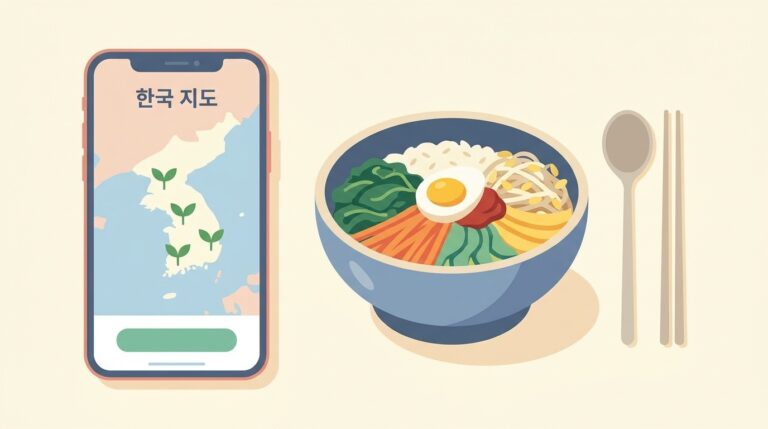
Make sure to download Naver Map before arriving! Search for “채식” (Chaesik) or “비건 식당” (Vegan Restaurant) directly in the app. For community-driven reviews, use HappyCow, but double-check with Naver Map reviews to ensure the shop hasn’t changed its menu recently.
Phase 9: “A Step Deeper” (Thoughtful Reflection)
Korea’s food culture is historically rooted in communal eating. Sharing a large pot of stew (jjigae) or grilling meat at the center of the table is a symbol of bonding and friendship. Because of this, “customizing” an individual plate has historically been uncommon. However, the younger generation is rapidly embracing veganism for health, ethical, and environmental reasons.
💬 Your Turn: Have you ever tried modifying a menu at a restaurant in your country? How did the staff react? Let us know in the comments below!
Phase 10: FAQ & Common Mistakes
Q: Can I find vegan food in traditional Korean markets?
A: Yes, but be cautious! Dishes like Nokdu-jeon (mung bean pancakes) are naturally vegetarian, but they are sometimes fried in lard (pig fat). Always ask: “혹시 식용유로 구우시나요?” (Do you fry this in vegetable oil?)
Q: Is Kimchi always vegetarian?
A: No. Traditional Korean Kimchi almost always uses fermenting agents like fermented shrimp (saeujeot) or fish sauce (aekjeot). Look for specifically certified vegan Kimchi in supermarkets.
🚨 Common Mistakes Alert!
- Saying “채소만 주세요” (Give me only vegetables): This can confuse staff. They might still use fish broth because they don’t view broth as “solid meat.”
- Confusing “Vegetarian” (채식) and “Vegan” (비건): In Korea, Chaesik is an umbrella term. If you eat no animal products at all, clarify with: “완전 비건이에요” (I am completely vegan).
Phase 11: Action Mission
- 🥉 Bronze: Open Naver Maps and search “비건 식당” in Seoul. Bookmark 3 spots you want to visit!
- 🥈 Silver: Practice saying “혹시 비건 옵션으로 변경 가능한가요?” out loud 5 times in front of the mirror.
- 🥇 Gold: Next time you visit a Korean restaurant, ask the server if they use fish sauce in their vegetable dishes using today’s phrases!
Phase 12: Interactive Quiz Challenge
Q1. How do you politely ask if a separate vegan menu is available?
a) 비건 메뉴 내놔. (Bigeon menyu naenwa.)
b) 혹시 비건 메뉴 따로 있나요? (Hoksi bigeon menyu ttaro innayo?)
c) 나 채식주의자야. (Na chaesikjuuijaya.)
👉 Click to see the Answer & Explanation
Correct Answer: b
Explanation: ‘b’ is the most polite and natural way to ask. ‘a’ is highly impolite, and ‘c’ is informal/blunt.
Q2. True or False: “Yuksu” (육수) refers to vegetarian broth.
👉 Click to see the Answer & Explanation
Correct Answer: False
Explanation: Yuksu (육수) literally translates to “meat water” and refers to animal-based broth (beef, pork, chicken, or anchovy). Vegetable broth is usually called Chaesu (채수).







