

Sending Love to Korea: How to Write a Korean Address Like a Local 📮
Phase 1: Empathy (Welcome, My Friend!)
안녕하세요! (An-nyeong-ha-se-yo!) Welcome back to Daily Hangul, your cozy corner for mastering real-life Korean. I’m your resident editor and cultural navigator, and I’m so excited to help you tackle a milestone today!
Imagine this: You’ve found the perfect K-beauty products, a cute character plushie from Kakao Friends, or a handwritten letter for your favorite friend (or even a fan letter to a K-pop idol!). You walk into a bustling Korean post office (우체국 – U-che-guk). You have the box, the tape is ready, but then you look at the shipping label.
“Wait… do I write the street name first or the country? What is a ‘gil’? And where on earth does the postal code go?”
If your heart skipped a beat, don’t worry! Writing a Korean address can feel like solving a puzzle because Korea writes addresses in the exact opposite order of most Western countries (from biggest to smallest). Today, we’ll demystify this process step-by-step so you can send your packages with absolute confidence. Let’s make sure your love arrives at the right doorstep!
Phase 2: Deep Dive into 3 Essential Expressions
To write an address in Korea, you need to know what the words on the label actually mean. Let’s look at three essential terms.
1. 주소 (Ju-so)
- Pronunciation: Joo-so (sounds like “juice” but with an “oh” sound at the end)
- Meaning: Address
- K-Culture Moment: In K-Dramas, when a character wants to send a surprise flower bouquet or food delivery to their crush, they always text: “주소 좀 보내줘” (Ju-so jom bo-nae-jwo – “Please send me your address”).
- Editor’s Insight: ‘주소’ is a general term. At the post office, the staff might ask, “보내는 사람 주소 쓰셨어요?” (Bo-nae-neun sa-ram ju-so sseu-shyeot-eo-yo? – “Did you write the sender’s address?”).
- Situation Spectrum: Casual ✅ | Semi-formal ✅ | Formal ✅
- 🤔 Think About It: In Korea, sharing your address is a sign of close friendship. How does address sharing feel in your culture?
2. 받는 사람 (Ban-neun Sa-ram)
- Pronunciation: Ban-neun Sah-ram (rhymes with “on-noon sah-rum”)
- Meaning: Recipient / Receiver (Literally: “The person who receives”)
- K-Culture Moment: When K-Pop idols unbox fan mail during live streams, they often point to the label and read the “받는 사람” section to show it was delivered safely to them.
- Editor’s Insight: On shipping labels, you will see two main sections: 보내는 사람 (Bo-nae-neun sa-ram – Sender) and 받는 사람 (Recipient). Never mix these up, or your package will come right back to you!
- Situation Spectrum: Casual ✅ | Semi-formal ✅ | Formal ✅
- 🤔 Think About It: Korean labels focus on the action (“the person receiving”) rather than just the noun “Recipient.” Isn’t that dynamic?
3. 우편번호 (U-pyeon-beon-ho)
- Pronunciation: Oo-pyeon-beon-ho (sounds like “ooh-pyeon” + “bun-ho”)
- Meaning: Postal Code / Zip Code (5 digits in Korea)
- K-Culture Moment: When online shopping on Korean sites like Coupang, the checkout page always starts by asking for your 5-digit 우편번호 to calculate shipping fees instantly.
- Editor’s Insight: Korea modernized its postal code system to a 5-digit format in 2015. Always use this new 5-digit code to avoid delivery delays!
- Situation Spectrum: Casual ✅ | Semi-formal ✅ | Formal ✅
- 🤔 Think About It: Why do you think numbers are the most universal language for postal systems worldwide?
Phase 3: Textbook Korean vs. Real-Life Korean
Let’s compare how textbooks teach address-asking versus how Koreans actually say it in real life.
Situation 1: Asking where to write the address
- 📖 Textbook Korean: “주소를 어디에 기록해야 합니까?” (Ju-so-reul eo-di-e gi-rok-hae-ya hap-ni-ka?)
- Translation: “Where must I record the address?” (Very stiff and robotic!)
- 🗣️ Real-Life Korean: “주소 어디에 써요?” (Ju-so eo-di-e sseo-yo?)
- Translation: “Where do I write the address?”
- 💡 Why the difference? Real Koreans prefer the short verb 쓰다 (sseu-da – to write) over the formal 기록하다 (gi-rok-ha-da – to record) in everyday service encounters.
Situation 2: Asking for a postal code
- 📖 Textbook Korean: “우편번호를 기입해 주시기 바랍니다.” (U-pyeon-beon-ho-reul gi-ip-hae ju-si-gi ba-ram-ni-da.)
- Translation: “It is hoped that you fill in the postal code.”
- 🗣️ Real-Life Korean: “우편번호도 써 주세요.” (U-pyeon-beon-ho-do sseo ju-se-yo.)
- Translation: “Please write the postal code, too.”
- 💡 Why the difference? “~해 주시기 바랍니다” is for official written signs. In person, staff will use the friendly and polite “~해 주세요” (Please do…) form.
Phase 4: K-Culture Deep Dive & Non-Verbal Manners
4-1. Post Office Etiquette: The Two-Handed Pass
When handing your package or the address slip to the postal clerk, always use two hands (or support your right elbow with your left hand). This is a vital sign of respect in Korean culture. Also, nodding your head slightly while saying “감사합니다” (Gam-sa-hap-ni-da) will immediately make the clerk smile and offer extra help!
4-2. Understanding the Korean Address Logic
Western addresses go from small to big: Name → Apartment → Street → City → Country.
Korea goes from BIG to SMALL:
1. Country (대한민국 – South Korea)
2. Province/City (서울특별시 – Seoul)
3. District (구 – Gu)
4. Street/Road (로/길 – Ro/Gil)
5. Building/Apartment Number (동/호 – Dong/Ho)
6. Name (이름 – I-reum)
Think of it as zooming in on a map! 🗺️
Phase 5: Interactive Roleplay Scenario
Meet Ji-won, a friendly neighborhood post office clerk. You want to ship a box to your friend Min-su in Seoul, but you are confused about where to write the street name.
Dialogue (8 Turns)
- Ji-won (Clerk): “안녕하세요! 오늘 어떤 일로 오셨어요?”
(An-nyeong-ha-se-yo! O-neul eo-tteon il-lo o-shyeot-eo-yo?)
“Hello! What brings you here today?”
🎭 Smiling warmly behind the counter -
You: “택배 보내고 싶어요. 그런데 주소를 잘 모르겠어요.”
(Taek-bae bo-nae-go ship-eo-yo. Geon-de ju-so-reul jal mo-reu-get-eo-yo.)
*”I want to send a parcel. But I don’t really know how to write the address.”
🎭 Holding up a blank shipping label with a puzzled face -
Ji-won (Clerk): “아, 걱정 마세요! 여기에 받는 사람 주소 쓰시면 돼요. 받는 사람 주소가 어떻게 되죠?”
(Ah, gok-jeong ma-se-yo! Yeo-gi-e ban-neun sa-ram ju-so sseu-shi-myeon dwae-yo. Ban-neun sa-ram ju-so-ga eo-tteo-ke dwe-jo?)
*”Ah, don’t worry! You can write the receiver’s address here. What is the receiver’s address?”
🎭 Pointing gently to the right side of the label -
You: “서울시 마포구 신촌로… 여기요.”
(Seoul-shi Ma-po-gu Shin-chon-ro… yeo-gi-yo.)
*”Seoul-shi Ma-po-gu Shin-chon-ro… here it is.”
🎭 Showing the address written on your phone screen -
Ji-won (Clerk): “네, 맞아요. 큰 것부터 쓰면 돼요. 서울시, 마포구, 신촌로 순서대로 쓰세요.”
(Ne, ma-ja-yo. Keun geot-bu-teo sseo-myeon dwae-yo. Seoul-shi, Ma-po-gu, Shin-chon-ro sun-seo-dae-ro sseo-se-yo.)
*”Yes, that’s right. You write from the biggest to smallest. Write in the order of Seoul-shi, Ma-po-gu, Shin-chon-ro.”
🎭 Nodding encouragingly -
You: “아하! 큰 것부터요. 우편번호는 어디에 써요?”
(A-ha! Keun geot-bu-teo-yo. U-pyeon-beon-ho-neun eo-di-e sseo-yo?)
*”Ah! From biggest to smallest. Where do I write the postal code?”
🎭 Searching the red boxes at the bottom of the label -
Ji-won (Clerk): “우편번호는 여기 빨간 칸 다섯 개에 한 글자씩 적어주시면 됩니다.”
(U-pyeon-beon-ho-neun yeo-gi ppal-gan kan da-seot gae-e han geul-ja-ssik jeok-eo-ju-shi-myeon deom-ni-da.)
*”You can write the postal code digit by digit in these five red boxes here.”
🎭 Tapping the 5 red squares on the label -
You: “아, 알겠습니다! 정말 감사합니다.”
(Ah, al-get-seum-ni-da! Jeong-mal gam-sa-hap-ni-da.)
*”Ah, I understand! Thank you so much.”
🎭 Bowing slightly with a relieved smile
🔀 Interactive Choice Point
Now, the clerk asks you for the package contents. What do you say?
- A: “그냥 선물이에요.” (Geu-nyang seon-mul-i-e-yo. – “It’s just a gift.”)
- B: “화장품이랑 책이에요.” (Hwa-jang-pum-i-rang chaek-i-e-yo. – “It’s cosmetics and a book.”)
- C: “아무것도 없어요.” (A-mu-geot-do eops-eo-yo. – “There is nothing inside.”)
Feedback:
- Select A (Risk): ⚠️ Saying “just a gift” is too vague. The post office needs to know the exact contents to make sure there are no restricted items (like batteries or liquids).
- Select B (Best): ✅ Perfect! Giving specific categories like cosmetics (화장품) or books (책) helps the clerk process your shipping smoothly.
- Select C (Bad): 🚫 If there is nothing inside, you are shipping an empty box! The clerk will be very confused.
Phase 6: 10-Second Emotion Shadowing Drill
Practice speaking like a native! Mimic the rhythm and emotion using the breath pauses (/).
- [😊 Relieved & Happy]
- “아, / 다행이다! / 이제 / 다 썼어요!”
- (Ah, / da-haeng-i-da! / i-je / da sseot-eo-yo!)
- “Ah, what a relief! Now I’ve finished writing it all!”
- [🥺 Polite & Slightly Worried]
- “저기… / 우편번호를 / 잘 모르겠는데, / 찾아주실 수 있나요?”
- (Jeo-gi… / u-pyeon-beon-ho-reul / jal mo-reu-get-neun-de, / cha-ja-ju-shil su in-na-yo?)
- “Excuse me… I don’t know the postal code, could you help me find it?”
Phase 7: K-Culture Mini-Dictionary
- 택배 (Taek-bae) | Parcel / Courier Service. Koreans use this daily. Korea has one of the fastest courier networks in the world!
- 지번 주소 (Ji-beon Ju-so) | The old land-lot based address system. Many older people still use this.
- 도로명 주소 (Do-ro-myeong Ju-so) | The newer road-name address system introduced in 2014. It is much easier for GPS to find!
- 등기 (Deung-gi) | Registered mail. Use this if you want to track your letter and ensure the recipient signs for it.
Phase 8: Survivor Kit for Travelers
Survival Expressions TOP 3
- “이거 미국으로 보내고 싶어요.” (I-geo mi-guk-eu-ro bo-nae-go ship-eo-yo.)
- Meaning: “I want to send this to the USA.”
- Pro Tip: Replace “미국” (USA) with your country, like “영국” (UK) or “캐나다” (Canada).
- “상자 주세요.” (Sang-ja ju-se-yo.)
- Meaning: “Please give me a box.”
- Pro Tip: Korean post offices sell boxes in different sizes (numbered 1 to 5). Ask for “1호 상자” (Size 1 box) if you need a small one.
- “저울 위에 올려놓으세요.” (Jeo-ul wi-e ol-ryeo-no-seu-yo.)
- Meaning: “Please put it on the scale.”
- Pro Tip: The clerk will say this to weigh your package. Just place your box on the metal scale next to the counter.
✈️ Editor’s Travel Note
Need to find your exact Korean address in English or Korean? Open Naver Map (네이버 지도) or download the app. Search your hotel or hostel name in English, and it will show you both the road-name address and the 5-digit postal code. Copy and paste it exactly onto your postal label!
(Note: App features and layouts are subject to change by Naver Corporation.)
Phase 9: “Going One Step Deeper” (Thoughtful Reflection)
In many Western cultures, addresses are centered around individual buildings and numbers. In Korea, addresses historically represented communal land blocks (지번). Even with the transition to the road-name system (도로명), Korean addresses still feel like a zoom-out journey: starting from the grand identity of the city down to the tiny apartment unit. It reflects how Korean society values the collective whole before looking at the individual.
💬 Your Turn: Does your country write addresses from smallest-to-biggest, or biggest-to-smallest? Let me know in the comments below!
Phase 10: FAQ & Avoiding Mistakes
Q: Can I write the recipient’s name and address in English?
A: Yes! For international mail leaving Korea, write the destination country in bold Korean (e.g., 미국 or 영국) so local sorters know where to direct it, and write the rest of the address in English.
Q: What happens if I write the postal code wrong?
A: The package might be delayed significantly as staff will have to manually check the street address. Always double-check the 5-digit code!
Q: Do I need to buy my own tape and bubble wrap before going to the post office?
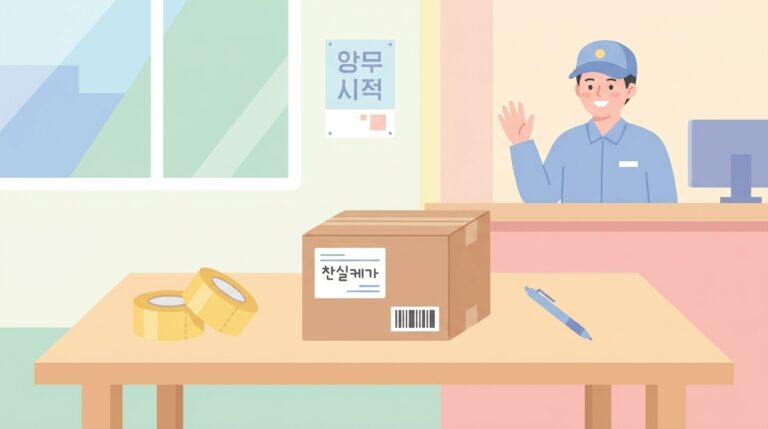
A: No! Korean post offices have a packing zone equipped with tape, scissors, markers, and bubble wrap that you can use for free. You only pay for the box and postage.
🚨 Common Mistakes Alert!
- Mistake 1: Writing the Sender (보내는 사람) info in the Recipient (받는 사람) box.
- Correct Action: The sender’s info usually goes on the top left or top, and the recipient’s info goes on the bottom right or bottom.
- Mistake 2: Forgetting to write the phone number.
- Correct Action: Korean couriers always text the recipient when delivery is complete. A local phone number is highly recommended!
- Mistake 3: Not writing the apartment building number and unit number (e.g., 101-dong 502-ho).
- Correct Action: Make sure you write “동” (building) and “호” (apartment unit number) clearly.
Phase 11: Action Mission!
- 🥉 Bronze Mission: Write down your current accommodation’s Korean address on a piece of paper using the BIG to SMALL format.
- 🥈 Silver Mission: Take a photo of your practice shipping label (blur any private info!) and share it on Instagram. Tag us #DailyHangul so we can check it for you!
- 🥇 Gold Mission: Go to a real Korean Post Office, buy a postcard for 500 KRW, write your home address, and mail it to yourself as a souvenir!
Phase 12: Interactive Quiz Challenge!
1. Match the term to its meaning:
- A. 주소 (Ju-so)
- B. 우편번호 (U-pyeon-beon-ho)
- C. 받는 사람 (Ban-neun sa-ram)
🔍 Show Answer
* A – Address
* B – Postal Code (Zip Code)
* C – Recipient
2. Fill in the blank:
When writing a Korean address, you must start from the ____________ area and go to the ____________ area.
🔍 Show Answer
Biggest (Country/City) to Smallest (Apartment unit/Name)
3. True or False:
Korean post offices do not provide tape or scissors, so you must bring your own.
🔍 Show Answer
False! Korean post offices are famous for their well-stocked packaging zones where tape, scissors, and markers are provided for free.







