

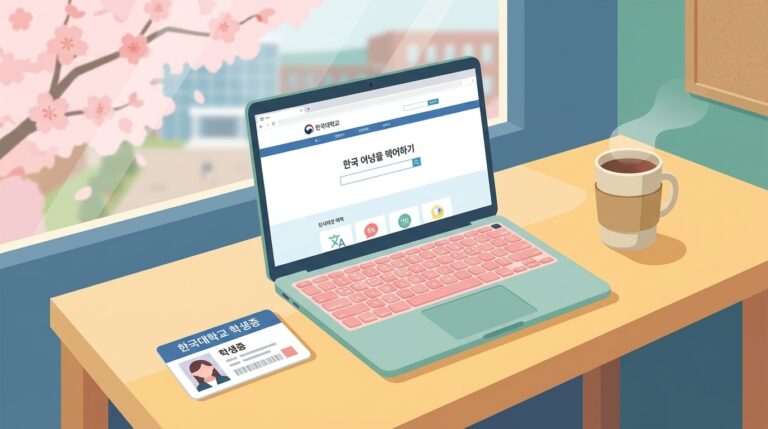
Hello, Book Lovers! Welcome to Your Sweet Oasis of Learning
안녕하세요! (An-nyeong-ha-se-yo!) Daily Hangul Editor here, your trusty Korean bestie and local culture guide! 🇰🇷✨
Imagine this: You are on a beautiful university campus in Seoul. The cherry blossoms are gently falling, or perhaps a cool autumn breeze is rustling the leaves. You have a stack of books, and you want to find that perfect, quiet spot in the university library (도서관 – do-seo-gwan) to study. But as you walk through those grand revolving doors, you freeze.
“Where do I tap my student ID? How do I ask for a study room? What if my phone makes a loud noise?”
If you’ve ever felt a wave of anxiety just thinking about stepping into a Korean library, you are absolutely not alone! Many of my students have shared how intimidating the quiet atmosphere of a Korean library can be for a beginner. But don’t worry! Today, we are going to master the absolute basics of library life in Korea. By the end of this guide, you will stroll into any library like a seasoned local. Let’s dive in!
Phase 2: Three Magical Sentences for Your Library Adventure
Let’s start with three super simple, high-yield sentences that will solve 90% of your problems in a Korean library.
1. 학생증 어디에 찍어요? (Hak-saeng-jeung eo-di-e jjik-eo-yo?)
- Pronunciation: Huck-saeng-jeung uh-dee-eh jjeek-uh-yo? (Sounds like “jeung” as in “jung-le”, “jjik” with a sharp, crisp ‘jj’ sound like the ‘j’ in ‘jeep’ but tighter!)
- Meaning: “Where do I scan my student ID?”
- K-Culture Moment: In K-Dramas like Cheese in the Trap or Our Beloved Summer, you often see students rushing through high-tech library turnstiles. To pass, you must ‘jjik’ (scan/tap) your ID card.
- Editor’s Insight: The verb 찍다 (jjik-da) literally means “to stamp” or “to take a photo,” but in modern Korea, it is universally used for tapping or scanning any card (ID card, transit card, credit card).
- Situation Spectrum: Casual ⚠️ | Semi-formal ✅ | Formal ✅
- 🤔 Think About It: In your home country, do you scan a physical card, or do you use a mobile app to enter the library?
2. 책 어디에 반납해요? (Chaek eo-di-e ban-nap-hae-yo?)
- Pronunciation: Chek uh-dee-eh bahn-nahp-heh-yo?
- Meaning: “Where do I return books?”
- K-Culture Moment: Think of a cozy scene where the main leads accidentally touch hands while returning books at the front desk. That desk is the 반납 (ban-nap) counter!
- Editor’s Insight: 반납 (ban-nap) specifically means returning something you borrowed to an institution. If you are returning a favor or a gift to a friend, you wouldn’t use this word!
- Situation Spectrum: Casual ⚠️ | Semi-formal ✅ | Formal ✅
- 🤔 Think About It: Why do you think Korean has different words for “returning a borrowed book” (반납) and “returning a purchased item to a store” (반품 – ban-pum)?
3. 여기 와이파이 돼요? (Yeo-gi wa-i-pa-i dwae-yo?)
- Pronunciation: Yuh-ghee wah-ee-pah-ee dweh-yo?
- Meaning: “Does Wi-Fi work here?” / “Is there Wi-Fi here?”
- K-Culture Moment: Korea is the land of ultra-fast internet. The moment a Korean sits down at a cafe or a library, their fingers automatically search for the Wi-Fi settings.
- Editor’s Insight: 돼요? (dwae-yo?) is a magical beginner verb meaning “Is it okay?” or “Does it work?”. You can use it in so many situations!
- Situation Spectrum: Casual ⚠️ | Semi-formal ✅ | Formal ✅
- 🤔 Think About It: How central is internet access to your daily study routine?
Phase 3: Textbook Korean vs. Real-Life Korean
In textbooks, sentences are often too long and overly polite. Let’s look at how Koreans actually talk in a casual library setting.
Situation 1: Asking if a seat is taken
- 📖 Textbook Korean: 여기 자리가 비어 있습니까? (Yeo-gi ja-ri-ga bi-eo it-seup-ni-ka?) – “Is this seat vacant?” (Very stiff and robotic!)
- 🗣️ Real-Life Korean: 여기 자리 있어요? (Yeo-gi ja-ri it-eo-yo?) – “Is someone sitting here?” / “Is this seat taken?”
- 💡 Why is it different? Koreans prefer short, active verbs. Asking “Is there a seat?” is much warmer and more natural.
Situation 2: Asking someone to be a bit quieter
- 📖 Textbook Korean: 조금만 조용히 해 주시겠습니까? (Jo-geum-man jo-yong-hi hae ju-si-get-seup-ni-ka?) – “Would you please be a little quiet?”
- 🗣️ Real-Life Korean: (With a polite smile) 조금만 살살 말씀해 주세요. (Jo-geum-man sal-sal mal-sseum-hae ju-se-yo.) – “Could you speak a little softer, please?”
- 💡 Why is it different? Directly telling someone to “be quiet” (조용히 하다) can sound a bit harsh. Saying 살살 (sal-sal – gently/softly) sounds much softer and avoids conflict!
Phase 4: K-Culture Deep Dive & Library Manners
4-1. The Art of “Nunchi” (눈치) in the Library
In Korea, Nunchi (눈치)—the art of reading the room and sensing others’ feelings—is everything. In a library, this means:
* Keyboard Covers: Many Korean university libraries have strict rules about laptop noise. You will see students using silicone keyboard covers and silent mice. If you don’t have one, you might get some quiet, intense glances (눈치 주기)!
* No Phone Vibration on Desks: Putting your phone on “vibrate” is good, but leaving it on a wooden desk where it goes BZZZZZ loudly is a big no-no. Keep it on a notebook or in your lap!
4-2. The “Ticketing” Culture (좌석 발급기)
Unlike many Western libraries where you just find any open chair, many Korean university and public libraries use a computerized ticketing system (좌석 발급기 – jwa-seok bal-geup-gi). You must scan your ID, select a specific seat on a screen, and print a slip. If you just sit down without ticketing, someone might politely tap your shoulder and say, “My seat!”
Phase 5: Real-Life Roleplay Challenge
Let’s practice! You are at the Yonsei University Library front desk. You want to ask the student librarian (Min-ji) how to enter and find a seat.
🎭 Scene: The Library Lobby
- You: 저기요… 학생증 어디에 찍어요?
(Jeo-gi-yo… hak-saeng-jeung eo-di-e jjik-eo-yo?)
🎭 (Shyly holding up your physical student card)
“Excuse me… where do I scan my student ID?” -
Min-ji: 아, 저기 게이트 앞 단말기에 찍으시면 돼요!
(Ah, jeo-gi ge-i-teu ap dan-mal-gi-e jji-geu-si-myeon dwae-yo!)
🎭 (Smiling and pointing toward the turnstiles)
“Ah, you can just scan it on the terminal in front of the gate over there!” -
You: 아, 감사합니다! 그런데 책은 어디에 반납해요?
(Ah, gam-sa-hap-ni-da! Geon-de chaek-eun eo-di-e ban-nap-hae-yo?)
🎭 (Pointing to a stack of books in your bag)
“Ah, thank you! By the way, where do I return books?” -
Min-ji: 반납은 저쪽 무인 반납기 이용해 주세요.
(Ban-nap-eun jeo-jjok mu-in ban-nap-gi i-yong-hae ju-se-yo.)
🎭 (Gesturing to a machine on the left)
“For returns, please use the automatic return machine over there.” -
You: 혹시 노트북실은 어디에 있어요?
(Hok-si no-teu-buk-sil-eun eo-di-e it-eo-yo?)
🎭 (Holding up your laptop laptop bag)
“By any chance, where is the laptop room?” -
Min-ji: 노트북실은 3층에 있어요. 거기서 와이파이도 잘 돼요.
(No-teu-buk-sil-eun sam-cheung-e it-eo-yo. Geo-gi-seo wa-i-pa-i-do jal dwae-yo.)
🎭 (Tapping on a floor map on the desk)
“The laptop room is on the 3rd floor. The Wi-Fi works well there, too.” -
You: 정말 감사합니다! 공부 열심히 할게요!
(Jeong-mal gam-sa-hap-ni-da! Gong-bu yeol-sim-hi hal-ge-yo!)
🎭 (Bow your head slightly with a big grin)
“Thank you so much! I’ll study hard!” -
Min-ji: 네, 화이팅! 열공하세요!
(Nae, hwa-i-ting! Yeol-gong-ha-se-yo!)
🎭 (Giving you a cute little fist pump)
“Yes, fighting! Study hard!”
🔀 Your Turn: Choose Your Path!
Min-ji asks you: “노트북 타이핑 많이 하실 건가요?” (Are you going to do a lot of laptop typing?)
- Choice A: “네, 많이 해요!” (Yes, I do it a lot!)
- Choice B: “아니요, 그냥 눈으로 책만 봐요.” (No, I’m just reading books with my eyes.)
- Choice C: (Silence…) “Uh… WiFi…?”
💡 Feedback on Your Choice:
- Best (Choice B): Excellent! Min-ji will direct you to the super quiet General Reading Room (일반열람실).
- Risk (Choice A): Good honesty! But if you go to the regular reading room and type loudly, you will get some serious Nunchi eyes. Make sure to go to the designated 노트북실 (Laptop Room)!
- Bad (Choice C): Oh no! Don’t freeze up. Even just saying “노트북실 (Laptop room)” with a questioning tone works wonders!
Phase 6: 10-Second Emotion Shadowing Drill
Let’s practice speaking with real Korean feelings! Try saying these out loud, pausing at the / marks.
- [🥺 Confused and polite] 저기요… / 학생증 어디에 / 찍어요?
(Jeo-gi-yo… / hak-saeng-jeung eo-di-e / jjik-eo-yo?) - [😊 Bright and relieved] 아! / 와이파이 / 잘 돼요!
(Ah! / wa-i-pa-i / jal dwae-yo!) - [🔥 Super motivated!] 오늘 / 진짜 / 열공할 거예요!
(O-neul / jin-jja / yeol-gong-hal-geo-yeo-yo!)
Phase 7: K-Culture Mini Dictionary
- 열공 (Yeol-gong): Short for 열정적인 공부 (Yeol-jeong-jeok-in gong-bu – passionate studying). It means “Study hard!” or “To hit the books hard.”
- 노트북실 (No-teu-buk-sil): Literally “Notebook (Laptop) Room.” A designated space in libraries where typing noise is allowed.
- 사물함 (Sa-mul-ham): Lockers. Korean students rent these to keep their heavy textbooks so they don’t have to carry them every day.
- 연체료 (Yeon-che-ryo): Overdue library book fines. Keep track of your return dates!
Phase 8: Traveler & Student Survival Kit
Survival Phrases Top 3
- 여기 화장실 어디예요? (Yeo-gi hwa-jang-sil eo-di-yeo-yo?) – “Where is the restroom here?” (Pro Tip: Essential for long study sessions!)
- 이 자리 비었어요? (I ja-ri bi-eot-eo-yo?) – “Is this seat empty?” (Pro Tip: Ask this before pulling out a chair at a shared table.)
- 조금만 조용히 해주세요. (Jo-geum-man jo-yong-hi hae-ju-se-yo.) – “Please be a little quiet.” (Pro Tip: Use a soft whisper and a polite head nod!)
📌 Editor’s Travel Note: If you want to study at beautiful public libraries in Seoul (like the stunning Starfield Library in COEX or the historical Seoul Metropolitan Library), download the Naver Map App to find directions easily. (Note: Library opening hours may vary on public holidays.)
Phase 9: “One Step Deeper” (Thinking Corner)
In Korea, the library is not just a place to borrow books; it is a battleground of dreams. From high school students preparing for college exams to college graduates studying for employment tests (취준생 – chwi-jun-saeng), the intense quiet of a Korean library represents the deep respect Koreans have for hard work and education. When you enter a Korean library, you are sharing in this beautiful, collective quiet energy.
💬 Your Turn: Do you prefer studying in absolute silence, or do you need some white noise like cafe music? Let me know in the comments below!
Phase 10: FAQ & Common Mistakes
Q: Can anyone enter a university library in Korea?
A: Generally, no. Most Korean university libraries require a student ID card scanned at the gate. However, some libraries allow community members or visitors to get a temporary pass at the main information desk if they show a passport or residency card.
Q: What happens if I return a book late?
A: You will have to pay a small fine (연체료) or, more commonly, your borrowing privileges will be suspended for the same number of days the book was overdue.
Q: Can I bring food or coffee into the study rooms?
A: Most libraries allow drinks with secure lids (like a Starbucks cup or a water bottle), but food is strictly forbidden inside the study areas. You must eat snacks in the designated lounge or cafeteria!
🚨 Common Mistake Alert!
- Wrong: Calling a laptop a “laptop” in Korea.
- Correct: Koreans call laptops 노트북 (no-teu-buk). If you ask for a “laptop room,” people might not understand you immediately. Ask for the 노트북실 (No-teu-buk-sil)!
Phase 11: Action Mission!
- 🥉 Bronze Mission: Say “여기 와이파이 돼요?” out loud to yourself 3 times in front of your computer.
- 🥈 Silver Mission: Write down “열공!” on a sticky note and stick it on your study desk.
- 🥇 Gold Mission: Go to a local library or cafe, and study for 30 minutes without making any keyboard noise!
Phase 12: Interactive Quiz Challenge
Test your library survival skills!
Q1. Which word means “student ID card” in Korean?
- A) 사물함 (Sa-mul-ham)
- B) 학생증 (Hak-saeng-jeung)
- C) 노트북 (No-teu-buk)
🔍 Click here for the Answer!
Correct Answer: B) 학생증 (Hak-saeng-jeung)
* Explanation: 학생증 is your Student ID. 사물함 means locker, and 노트북 means laptop!
Q2. True or False: You can type loudly on your mechanical keyboard in the general reading room in Korea.
- A) True
- B) False
🔍 Click here for the Answer!
Correct Answer: B) False
* Explanation: Doing this will get you many intense stares of “Nunchi.” You must use the designated 노트북실 (Laptop Room) for typing!







