

Navigating the Ripple Effects: How Korea’s Minimum Wage Hikes Shake Up the Job Market
Phase 1: Empathy (An Immersive Storytelling Opening)
안녕하세요! Welcome back, language adventurers! It’s your K-culture navigator and chief editor at Daily Hangul (매일한글).
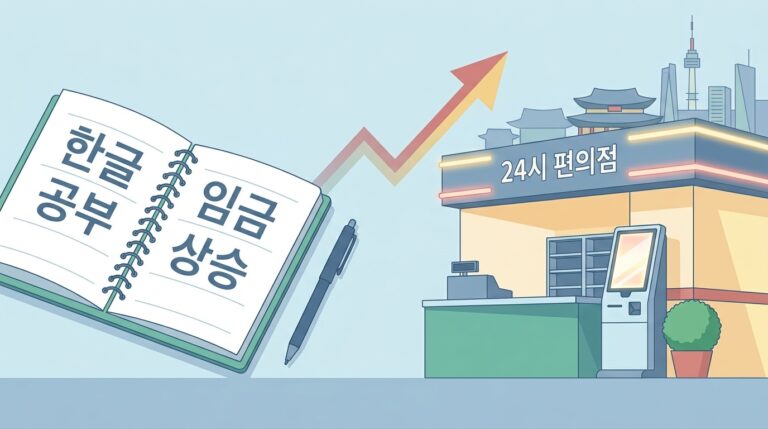
Imagine you are sitting in a cozy, neon-lit convenience store in Mapo-gu, Seoul, sipping on a warm pouch coffee. Behind the counter, instead of a bustling part-timer (알바생), you see a sleek, automated kiosk and a slightly stressed shop owner (사장님) running the register alone. This scene isn’t just a random backdrop; it is the literal frontline of one of Korea’s most fiercely debated socio-economic topics: the ripple effects of the minimum wage hike (최저임금 인상).
For advanced learners aiming for C2 fluency, understanding this issue is your golden ticket. It transitions you from someone who merely speaks Korean to someone who can confidently debate economic policies with native speakers, understand late-night news panel discussions, and grasp the subtle underlying tensions in office politics or contemporary K-dramas like My Mister (나의 아저씨) or Start-Up. Let’s dive deep into the sophisticated vocabulary and cultural nuances that define Korea’s labor landscape today!
Phase 2: Deep Dive into 3 Essential Expressive Terms
1. 고용 축소 (Goyong Chukso)
- Pronunciation: Go-yong Chuk-so (Sounds like “go-young” + “chook-so” as in ‘shrink’)
- Meaning: Downsizing employment / Reduction of hiring
- K-Culture Moment: Often heard on SBS or JTBC news debates where small business owners complain that due to rising labor costs, they have no choice but to opt for 고용 축소 and turn to automation.
- Editor’s Insight: While ‘감원’ (layoff) refers to firing existing staff, 고용 축소 represents a broader, more structural decline in creating new job openings. It is a highly formal, academic term perfect for writing essays or participating in business meetings.
- Situation Spectrum: Casual 🚫 | Semi-formal ⚠️ | Formal ✅
- 🤔 Think About It: Does your home country prioritize raising wages even if it temporarily leads to 고용 축소, or does it focus on job volume? How do the cultural expectations of job security differ?
2. 알바생의 역설 (Albaseong-ui Yeokseol)
- Pronunciation: Al-ba-saeng-ui Yeok-seol (Sounds like “Al-bah-saeng” + “yeok-seol” as in ‘paradox’)
- Meaning: The Part-Timer’s Paradox
- K-Culture Moment: Discussed in YouTube economy vlogs and podcasts analyzing why university students cannot find part-time jobs (알바) despite the hourly wage being historically high.
- Editor’s Insight: This is a modern sociological term. It refers to the phenomenon where a higher minimum wage makes part-time jobs incredibly lucrative on paper, but in reality, owners split shifts (“쪼개기 알바”) to avoid paying mandatory weekly holiday allowances (주휴수당), leaving workers with less overall income.
- Situation Spectrum: Casual ✅ | Semi-formal ✅ | Formal ⚠️
- 🤔 Think About It: In Korean work culture, the concept of ‘주휴수당’ (weekly holiday allowance) heavily impacts hiring. Does a similar regulatory system exist in your country?
3. 상생 협력 (Sangsaeng Hyeopryeok)
- Pronunciation: Sang-saeng Hyeop-ryeok (Sounds like “sahng-saeng” + “byup-ryeok”)
- Meaning: Win-win cooperation / Co-existence
- K-Culture Moment: Frequently used by politicians, corporate social responsibility (CSR) statements, and labor union representatives proposing compromises between employers and employees.
- Editor’s Insight: 상생 (co-existence) is a deeply rooted Confucian-adjacent value in Korea, emphasizing that businesses and workers must survive together. When discussing economic friction, proposing 상생 협력 as a solution shows a high level of cultural empathy.
- Situation Spectrum: Casual ⚠️ | Semi-formal ✅ | Formal ✅
- 🤔 Think About It: Why is collective survival (상생) often favored over individualistic ‘survival of the fittest’ in Korean corporate discourse?
Phase 3: Textbook Korean vs. Real-World Korean
Situation 1: Expressing that a business is struggling due to labor costs.
- 📖 Textbook Korean: “최저임금 인상으로 인해 인건비 부담이 가중되었습니다.” (Due to the minimum wage hike, the burden of labor costs has aggravated.)
- 🗣️ Real-World Korean: “최저임금 오르고 나니까 솔직히 남는 게 없어요. 인건비 대기도 벅차네요.” (Honestly, after the minimum wage went up, there’s nothing left. Just covering labor costs is overwhelming.)
- 💡 Why is it different? Real owners rarely use academic terms like ‘가중되었습니다’ (aggravated) in casual conversations. They use physical expressions like ‘벅차다’ (to be beyond one’s capacity/breathless) to emphasize their personal, emotional struggle.
Situation 2: Explaining why someone got let go or had hours cut.
- 📖 Textbook Korean: “고용주는 근로 시간을 단축하기로 결정했습니다.” (The employer decided to shorten working hours.)
- 🗣️ Real-World Korean: “사장님이 주휴수당 안 주려고 알바 시간 쪼개기 하더라고요.” (The boss is splitting my part-time hours just to avoid paying the weekly holiday allowance.)
- 💡 Why is it different? ‘쪼개기’ (splitting/slicing) is the highly colloquial and realistic term for the corporate tactic of cutting hours below 15 hours a week to bypass legal benefits.
Phase 4: K-Culture Deep Dive & Non-Verbal Etiquette
4-1. Nunchi & Gestures: Navigating Sensitive Wage Debates
When discussing wages or employment with a Korean colleague, employer, or business partner, keep these subtle non-verbal cues in mind:
* The Head Tilt (고개 갸웃하기): If a partner tilts their head slightly while discussing wage structures, they are expressing polite disagreement without saying “No” (아니요). Do not push; instead, offer a compromise emphasizing 상생.
* Sighing with a Smile (쓴웃음과 한숨): Small business owners often chuckle wryly while sighing (“하아~ 정말 쉽지 않네요”). This is not a sign of weakness; it’s an invitation to acknowledge their hardship. Acknowledge it by saying, “요즘 다들 힘들다고 하시더라고요” (I hear everyone is having a tough time lately).
4-2. Cultural Analysis: The Rise of K-Unmanned Stores (무인 매장)
Take a walk through Gangnam or Hongdae, and you’ll see unmanned ice cream shops, self-photo booths, and automated cafes. The rapid rise of Korea’s minimum wage has accelerated this transition. While it represents technological progress, it also reflects a bittersweet shift away from the traditional, warm interaction (정, Jeong) between shopkeepers and neighborhood regulars, replacing it with hyper-convenient digital isolation.
Phase 5: Real-World Roleplay Scenario
Background & Characters
- Mr. Park (박 사장님): A pragmatic convenience store owner in his late 50s. He is worried about rising operational costs.
- Ji-woo (지우): A sharp, empathetic 20-something graduate student who works part-time but is concerned about her future shifts.
- 박 사장님: (머리를 긁적이며 걱정스러운 표정으로) 지우 씨, 다음 달부터 최저임금 또 오른다는 뉴스 봤어요? 진짜 걱정이 태산이네.
- 지우: (고개를 끄덕이며 공감하듯) 아, 네, 사장님. 기사 봤어요. 사장님처럼 자영업 하시는 분들은 인건비 걱정이 진짜 크시겠어요.
- 박 사장님: (한숨을 쉬며) 응, 맞아. 솔직히 말해서 고용 축소를 해야 하나 고민 중이야. 알바 시간을 좀 줄여야 할지도 몰라.
- 지우: (차분하게 받아치며) 아… 시간 쪼개기를 하시면 저 같은 알바생도 주휴수당을 못 받게 되니까 타격이 좀 크긴 하네요.
- 박 사장님: (미안한 기색으로) 나도 참 마음이 안 좋아. 서로 상생 협력을 해야 하는데, 현실적으로 가게 유지가 힘드니까 어쩔 수가 없네.
- 지우: (제안하듯) 사장님, 차라리 피크 타임에만 제가 집중해서 일하고, 매장 홍보를 SNS로 도와드려서 매출을 올리는 방향은 어떨까요?
- 박 사장님: (눈이 번쩍 뜨이며) 오, SNS 홍보? 그것도 방법이겠네. 매출만 오르면 나야 고용 유지하고 싶지!
- 지우: (미소를 지으며) 네! 같이 방법을 찾아봐요. 우리 상생해야죠!
🔀 Interactive Choice Point
How should Ji-woo react if Mr. Park suddenly proposes cutting her shifts to under 15 hours next week?
* Option A: “사장님, 그건 근로기준법상 너무 가혹한 처사 아닌가요? 법대로 해주세요.”
* Option B: “많이 어려우시군요, 사장님. 하지만 갑작스러운 시간 감축은 제 생활비 계획에도 지장이 있어서요. 조율할 수 있는 대안이 있을까요?”
* Option C: “네, 알겠습니다. 어쩔 수 없죠. 그냥 다음 주부터 안 나올게요.”
Feedback:
- Best (Option B): 🌟 Excellent! This response shows C2-level diplomatic skill. It acknowledges the employer’s hardship while firmly asserting personal boundaries and inviting a constructive compromise.
- Bad (Option A): ⚠️ Risk of conflict. While legally valid, quoting the Labor Standards Act (근로기준법) so aggressively right away completely breaks the rapport and the spirit of 상생.
- Worst (Option C): 🚫 Passive-aggressive and unprofessional. Abruptly quitting without notice ruins your relationship and reference potential.
Phase 6: 10-Second Emotion Shadowing Drill
Practice these sentences out loud to master the emotional flow and professional cadence of native speakers. / represents a natural pause.
- [🥺 Worried & Confiding]
“최저임금이 / 또 오른다는데… / 솔직히 / 인건비 감당하기가 / 벅차네요.”
(Choi-jeo-im-geum-i / tto o-reun-da-neun-de… / sol-jik-hi / in-geon-bi gam-dang-ha-gi-ga / beok-cha-ne-yo.) -
[🤝 Cooperative & Hopeful]
“서로 조금씩 / 양보해서 / 상생 협력할 수 있는 / 방안을 / 찾아봤으면 좋겠습니다.”
(Seo-ro jo-geum-ssik / yang-bo-hae-seo / sang-saeng hyeop-ryeok-hal su in-neun / bang-an-eul / cha-ja-bwat-seu-myeon jo-ket-seum-ni-da.)
Phase 7: K-Culture Mini-Dictionary
- 자영업자 (Jayeongeopja) | Independent Business Owner
- Small shop owners, restaurant managers, or cafe operators. They form the backbone of Korea’s service sector and are most sensitive to wage policy shifts.
- 주휴수당 (Juhyu-sudang) | Weekly Holiday Allowance
- A unique Korean labor law clause: if an employee works more than 15 hours a week, the employer must pay them for an extra day off. This is a primary driver behind ‘hour-splitting’ (시간 쪼개기).
- 무인화 (Muinhwa) | Automation / Going Unmanned
- The technological trend of replacing human workers with kiosks, robots, or self-checkout counters.
- 소상공인 (Sosang-gongin) | Micro-enterprise / Small Merchant
- Very small businesses, usually with fewer than 5 to 10 employees. They are often protected by government subsidies during drastic minimum wage shifts.
Phase 8: The Traveler’s Survival Kit
Survival Expressions for Working Holiday Makers & Expats
- “근로 계약서 작성해야 하나요?” (Geun-ro gye-yak-seo jak-seong-hae-ya ha-na-yo?)
- Meaning: Do I need to sign a labor contract? (Crucial for legal protection in Korea!)
- “주휴수당도 포함된 시급인가요?” (Ju-hyu-su-dang-do po-ham-doen si-geup-in-ga-yo?)
- Meaning: Is the weekly holiday allowance included in this hourly wage?
- “수습 기간이 따로 있나요?” (Su-seup gi-gan-i tta-ro in-na-yo?)
- Meaning: Is there a probationary period?
💡 Editor’s Travel & Work Note:
If you are working or traveling in Korea, download the official Ministry of Employment and Labor App to calculate your exact wages, or use Alba Heaven (알바천국) to look up certified, legally compliant part-time jobs. Note: Labor laws change annually; always check the latest criteria for the current year.
Phase 9: “One Step Deeper” (Reflective Question)
Korea’s rapid economic growth was built on a culture of intense labor and collective sacrifice. Today, the debate over the minimum wage highlights a deep generational and social shift: younger workers demand fair compensation for every minute of their labor, while older business owners struggle under traditional operating models. It’s a fascinating clash between capitalistic modernization and traditional communitarian values.
💬 Your Turn: How does your country balance worker rights with business viability? Let’s talk in the comments below! (한국어로 남겨주시면 피드백해 드릴게요!)
Phase 10: FAQ & Avoiding Common Pitfalls
Q: Does the minimum wage in Korea apply to foreign workers too?
A: Yes, absolutely. Under the Korean Labor Standards Act, foreign nationals (holding valid working visas like H-1, D-2, F-series, etc.) are legally entitled to the exact same minimum hourly wage as Korean citizens.
Q: What is the maximum probationary period deduction?
A: Employers can pay 90% of the minimum wage for up to 3 months only if the labor contract is for one year or longer. If your contract is shorter, they must pay 100% from day one.
Q: How is the minimum wage determined each year?
A: It is negotiated annually by the Minimum Wage Commission (최저임금위원회), which consists of representatives from the public interest, labor unions, and business groups.
🚨 Common Mistakes Warning Board
- Mistake 1: Confusing ‘시급’ (hourly wage) with ‘월급’ (monthly salary) when discussing minimum pay structures. Always clarify which one you are negotiating.
- Mistake 2: Assuming ‘주휴수당’ applies automatically. You must work at least 15 hours a week and have perfect attendance on your scheduled days.
- Mistake 3: Believing verbal contracts are sufficient. In Korea, not writing a physical labor contract (근로계약서) is illegal, and employers can face heavy fines.
Phase 11: Action Missions
- 🥉 Bronze Mission: Write a 3-sentence journal entry using the word 고용 축소 in the context of global economic news.
- 🥈 Silver Mission: Share this post on your SNS with a caption using 상생 협력 to describe how businesses and workers should cooperate.
- 🥇 Gold Mission: Watch a Korean news debate on YouTube regarding “최저임금” (Minimum Wage) and summarize two opposing arguments using the key terms learned today.
Phase 12: Interactive Quiz Challenge
Test your knowledge below! Click on the toggle to check your answers.
1. Situation Analysis
Which of the following is the most culturally tactful way to suggest a compromise when your work hours are reduced?
* A) 법대로 노동청에 신고하겠다고 협박한다. (Threaten to report them to the Labor Ministry.)
* B) 상생할 수 있는 유연한 교대 근무 일정을 제안한다. (Propose a flexible shift schedule to co-exist/cooperate.)
💡 Click here for the Answer & Explanation
Correct Answer: B
Explanation: Proposing a flexible schedule based on 상생 (co-existence) maintains mutual respect and displays high-level diplomatic business Korean.
2. Fill in the Blanks
“최저임금 인상 이후, 많은 매장들이 아르바이트생 채용 대신 키오스크를 도입하는 [ ______ ]을/를 선택하고 있다.”
* Hint: Think of “employment reduction/downsizing”.
💡 Click here for the Answer & Explanation
Correct Answer: 고용 축소 (Goyong Chukso)
Explanation: The sentence translates to: “Since the minimum wage hike, many stores are choosing to downsize hiring (고용 축소) instead of employing part-timers by introducing kiosks.”







