

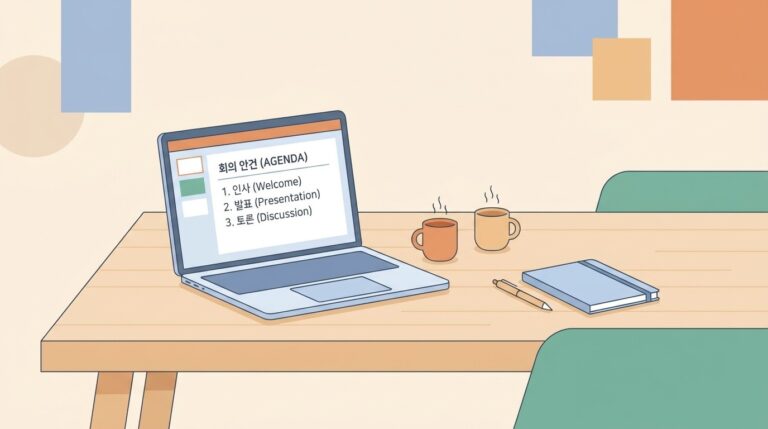
Master Your Korean Business Meetings: How to Kick Off and Introduce the Agenda Like a Pro
Phase 1: Empathy (스토리 몰입형 오프닝)
안녕하세요! Daily Hangul editor and your trusted native culture navigator here!
Picture this: You are sitting in a sleek, glass-walled conference room in Yeouido (Seoul’s bustling financial district), or perhaps you’ve just logged into a high-stakes Zoom meeting with your Korean partner company. The atmosphere is quiet, respectful, and slightly tense. Everyone is looking at you, waiting for the meeting to begin. You want to sound professional, respectful, yet confident—not like a rigid textbook robot, but like an active, culturally aware business partner.
Many intermediate (B2) learners tell us: “I know how to say hello, but how do I transition the casual chit-chat into the official meeting without sounding awkward or too aggressive?” In Korean corporate culture, setting the right tone at the very beginning of a meeting is crucial. It shows respect for everyone’s time and establishes your authority. Today, we will unlock the exact phrases, cultural nuances, and non-verbal cues that will make your Korean colleagues nod in approval. Let’s dive in!
Phase 2: Key Expressions Deep Dive (핵심 표현 3선 심층 분석)
1. 오늘 회의는 ~ 건으로 모였습니다. (Oneul hoe-ui-neun ~ geon-euro moyeot-seumnida.)
- Pronunciation: Oh-neul hway-ee-neun [Insert Topic] geon-eu-ro mo-yeot-seum-nee-da. (Sounds like “mo-yut-seum-nee-da” with a soft ‘u’ sound.)
- Meaning: “Today’s meeting is gathered regarding the matter of [Topic].”
- K-Culture Moment: You will hear this in almost every Korean office K-drama (like Misaeng or Start-Up) when the team leader stands in front of the whiteboard to initiate a brainstorming session.
- Editor’s Insight: The word 건 (geon) means “case,” “matter,” or “issue.” It is a highly efficient business term that instantly signals to your team that you are focusing on a specific agenda item. It sounds much more professional than just saying “~에 대해 이야기해요” (Let’s talk about ~).
- Situation Spectrum: Casual: 🚫 | Semi-formal: ⚠️ | Formal: ✅
- 🤔 Think About It: Why do you think Korean business culture prefers stating the “group’s purpose” (we gathered) rather than the individual’s purpose (I want to tell you)? How does this reflect Korea’s collectivist business roots?
2. 먼저 오늘 다룰 안건을 소개해 드리겠습니다. (Meon-jeo oneul darul angeon-eul sogae-hae deuriget-seumnida.)
- Pronunciation: Mun-juh oh-neul da-rul ahn-gun-eul so-gae-hae deu-ri-get-seum-nee-da.
- Meaning: “First, I will introduce the agenda we will be covering today.”
- K-Culture Moment: Used by a project manager sharing their screen on a video call, right before clicking onto the PowerPoint slide containing the bullet points.
- Editor’s Insight: 드리겠습니다 (deuriget-seumnida) is the humble form of “to give.” By using this, you are showing deep respect to the attendees by framing the agenda presentation as a service or polite offering to them.
- Situation Spectrum: Casual: 🚫 | Semi-formal: ⚠️ | Formal: ✅
- 🤔 Think About It: How does using humble verbs like 드리다 (deurida) alter the power dynamic in a meeting compared to English, where directness (“Here is the agenda”) is favored?
3. 본격적으로 시작하기 전에, [이름/직책]님께서 기조 발언을 해 주시겠습니다. (Bon격jeog-euro sijak-hagi jeone, [Name/Title]nim-kkeseo gijo bareon-eul hae jusiget-seumnida.)
- Pronunciation: Bon-gyuk-juh-guro she-jahk-ha-gi juh-neh, [Name]nim-kkeh-suh gee-jo ba-run-eul hae joo-she-get-seum-nee-da.
- Meaning: “Before we begin in earnest, [Name/Title] will deliver the opening remarks.”
- K-Culture Moment: Typically heard in large-scale corporate briefings or cross-departmental meetings where a high-ranking director (상무님 or 부장님) is invited to set the vision.
- Editor’s Insight: 기조 발언 (gijo bareon) refers to keynotes or opening remarks. Adding 님 (nim) and kkeseo (께서 – the honorific subject marker) is non-negotiable here to maintain corporate harmony.
- Situation Spectrum: Casual: 🚫 | Semi-formal: ⚠️ | Formal: ✅
- 🤔 Think About It: In your culture, who usually speaks first in a meeting? Is it the facilitator or the highest-ranking executive?
Phase 3: Textbook Korean vs. Real-World Korean (교과서 한국어 vs. 진짜 한국어)
Situation 1: Getting everyone’s attention to start the meeting
- 📖 Textbook Korean: 이제 회의를 시작하겠습니다. 모두 조용히 해주세요. (Ije hoe-ui-reun sijak-haget-seumnida. Modu joyong-hi hae-juseyo. – “I will start the meeting now. Everyone please be quiet.”)
- 🗣️ Real-World Korean: 자, 다들 자리해 주셨으니 이제 회의 시작해 볼까요? (Ja, dadeul jari-hae jusyeot-seuni ije hoe-ui sijak-hae bol-kkayo? – “Now that everyone is seated, shall we start the meeting?”)
- 💡 Why is it different? The textbook version sounds overly authoritarian and cold. The real-world version softly acknowledges that everyone has taken their seats (자리해 주셨으니) and uses the soft, collaborative ending (~볼까요? – “shall we?”) to build team alignment.
Situation 2: Introducing the first topic on the slide
- 📖 Textbook Korean: 첫 번째 안건을 말하겠습니다. (Cheot beon-jae angeon-eul mal-haget-seumnida. – “I will say the first agenda.”)
- 🗣️ Real-World Korean: 그럼, 첫 번째 안건부터 짚어보도록 하겠습니다. (Geureom, cheot beon-jae angeon-buteo jipeo-bodorok haget-seumnida. – “Then, let us go over/pinpoint the first agenda item.”)
- 💡 Why is it different? 짚어보다 (jipeo-boda, literally “to point/touch and look”) is a beautiful idiomatic business verb meaning “to examine closely” or “to address.” It sounds incredibly natural, proactive, and professional.
Phase 4: K-Culture Deep Dive & Non-verbal Etiquette (비언어적 매너)
4-1. The Art of the “Nunchi” Nod and Sitting Order
In Korean business culture, non-verbal cues carry as much weight as spoken words. When starting a meeting:
* The Sitting Hierarchy: If meeting in person, the seat closest to the door is for the lowest-ranking staff. The seat furthest from the door (usually facing the view or screen) is for the highest-ranking person (상석 – sangseok). Do not sit there unless invited!
* The Agenda Handout: If you are passing out physical paper agendas, always hand them over with two hands. Offering something with one hand can look dismissive.
* Eye Contact: While speaking, maintain steady but soft eye contact with the key decision-maker, but remember to nod gently whenever they speak—this shows active listening (Nunchi in action).
4-2. Corporate Culture Code: The “Coffee Order” Ritual
Before a meeting formally kicks off in Korea, there is almost always a coffee run. If you are hosting, ordering coffee for your guests via Naver Map or a local delivery app is a massive plus. Showing up to the meeting table with a tray of iced Americanos (아아 – Ah-Ah) instantly melts the icy corporate atmosphere.
Phase 5: Real-World Roleplay Scenario (실전 롤플레이 시나리오)
Background & Characters
- Ji-hoon (지훈): Senior Marketing Manager at a Korean tech company. Respectful but values efficiency.
- Sarah (사라): Global Partner Representative (You! B2 level Korean speaker).
[Scene: A Zoom screen connects. Ji-hoon sits in a bright office in Gangnam. Sarah is in her home office.]

지훈: (😊 Waves politely) 아, 사라 씨! 안녕하세요. 잘 지내셨어요?

사라: (😊 Smiles) 네, 지훈 부장님! 덕분에 잘 지냈습니다. 부장님도 건강히 잘 지내셨죠?

지훈: 네, 덕분에요. 자, 이제 다른 팀원분들도 다 접속하신 것 같네요.

사라: (📝 Straightening her notes) 네, 다들 시간 맞춰 와주셔서 감사합니다. 자, 다들 자리해 주셨으니 이제 회의 시작해 볼까요?

지훈: (👍 Nodding) 좋습니다. 바로 시작하시죠.

사라: 오늘 회의는 다음 달에 진행할 'K-Beauty 팝업 스토어 프로모션' 건으로 모였습니다.

지훈: 아, 아주 중요한 안건이네요. 기대가 큽니다.

사라: 감사합니다. 먼저 오늘 다룰 구체적인 안건부터 화면으로 소개해 드리겠습니다. (💻 Clicks to share screen)
🔀 Interactive Choice Point
How should Sarah introduce the first slide? Choose your path:
- A) “그럼 첫 번째 안건을 말하겠습니다.” (Textbook Style)
- B) “그럼 첫 번째 안건부터 짚어보도록 하겠습니다.” (Pro Business Style)
- C) “이제 첫 번째 안건을 봐라.” (Commanding Style)
Feedback:
- Choice A (Risk): Not bad, but sounds slightly stiff. Your colleagues will understand, but you will miss the chance to sound like a native professional.
- Choice B (Best): Excellent choice! Jipeo-bodorok haget-seumnida shows high-level business proficiency and flows perfectly.
- Choice C (Bad): Dangerous! Bwara (봐라) is an informal command. Using this with business partners, especially high-ranking ones, is highly disrespectful.
Phase 6: 10-Second Emotion Shadowing Drill (감정 섀도잉 드릴)
Let’s practice the rhythm of professional Korean. Pay attention to the pauses (/) and emotions!
- [😊 Confident & Welcoming]
- “자, / 다들 자리해 주셨으니 / 이제 회의 시작해 볼까요?”
- Ja, / dadeul jari-hae jusyeot-seuni / ije hoe-ui sijak-hae bol-kkayo?
- [👔 Clear & Professional]
- “오늘 회의는 / 신제품 마케팅 협업 건으로 / 모였습니다.”
- Oneul hoe-ui-neun / sin-jepum maketing hyeob-eop geon-euro / moyeot-seumnida.
- [🤝 Humble & Respectful]
- “먼저 / 오늘 다룰 안건을 / 소개해 드리겠습니다.”
- Meon-jeo / oneul darul angeon-eul / sogae-hae deuriget-seumnida.
Phase 7: K-Culture Mini-Dictionary (K-Culture 미니 사전)
- 안건 (An-geon) | Agenda / Item
- Essential for any business meeting. Used to specify what is on the table.
- 공유하다 (Gong-yu-hada) | To Share
- “화면 공유할게요” (I will share my screen) or “자료 공유해 주세요” (Please share the materials).
- 피드백 (Pi-deu-baek) | Feedback
- Directly borrowed from English but used constantly in Korean workplaces. Pronounced with a distinct Korean accent.
- 의견 (Ui-gyeon) | Opinion / Thoughts
- “좋은 의견 감사합니다” (Thank you for your great opinion/input) is a great phrase to wrap up an agenda item.
Phase 8: Traveler’s & Business Survival Kit
Survival Phrases TOP 3
- 회의실이 어디에 있죠? (Hoe-ui-sil-i eo-di-e it-jyo?)
- “Where is the meeting room?”
- 와이파이 비밀번호가 어떻게 되나요? (Wa-i-pa-i bi-mil-beon-ho-ga eo-tteo-ke doe-na-yo?)
- “What is the Wi-Fi password?”
- 오늘 회의 자료는 이메일로 보내드렸습니다. (Oneul hoe-ui ja-ryo-neun i-me-il-lo bo-nae-deuryeot-seumnida.)
- “I have sent today’s meeting materials via email.”
💡 Editor’s Travel Note:
If you are visiting a partner company in Seoul, make sure to download Kakao T (for taxi calling) and Naver Map beforehand. Google Maps is often outdated in Korea due to security laws. Note: Information current as of mid-2024; app interfaces and local transport guidelines may vary slightly over time.
Phase 9: “Going Deeper” – Cultural Reflection (한 발 더 깊이)
In western corporate environments, meetings often jump straight to the point to maximize efficiency. However, in Korea, meetings are not just about exchanging data; they are about maintaining relational harmony (관계 – Gwangye).
This is why meetings always start with a brief inquiry about one’s well-being or a soft acknowledgment of everyone’s physical arrival. When you say “다들 자리해 주셨으니” (Since everyone has taken their seat), you are showing appreciation for their physical presence and effort to be there. It creates a collective “we” rather than just a group of individuals.
💬 Your Turn: How does your home culture handle the transition from small talk to business? Let us know in the comments below!
Phase 10: FAQ & Common Mistakes (FAQ & 오해 방지)
Q: Can I use “안건” to mean personal plans or personal schedule?
A: No. “안건” (agenda) is strictly a business/academic term. For personal plans, use “일정” (il-jeong – schedule) or “계획” (gye-hoek – plan).
Q: Is it okay to use “너” (you) when addressing partners in a meeting?
A: Absolutely not! Never use “너” in a business setting. Address colleagues by their Title + 님 (e.g., 부장님, 과장님, 대리님) or Name + 씨/님.
Q: What is the difference between 회의 (meeting) and 미팅 (meeting)?
A: “회의” usually refers to formal internal/external discussions or decisions. “미팅” often refers to sales meetings, initial client introductions, or casual networking.
🚨 Common Mistakes Alert!
- Mistake 1: Starting a meeting with “내 말 들어봐.” (Listen to my words).
- Correct Action: Use “자, 이제 회의 시작하겠습니다.” (Now, we will begin the meeting.)
- Mistake 2: Forgetting honorific particles when introducing a boss.
- Correct Action: Say “부장님께서 말씀하시겠습니다” instead of “부장님이…”
- Mistake 3: Saying “회의를 열다” literally.
- Correct Action: While grammatically correct, “회의 시작하다” or “회의를 진행하다” sounds much more natural in an office setting.
Phase 11: Action Mission & Participation (액션 미션)
- 🥉 Bronze: Read the three key phrases from Phase 2 aloud 5 times in front of a mirror with a polite posture.
- 🥈 Silver: Leave a comment below introducing a mock agenda topic using the phrase: “오늘 회의는 [Topic] 건으로 모였습니다.”
- 🥇 Gold: In your next real-life Zoom call with a Korean speaker, try using: “다들 자리해 주셨으니 이제 시작해 볼까요?”
🎬 K-Culture Mission: Watch an episode of a Korean office drama (like Misaeng or Agency). Try to spot the exact moment the lead presenter shares their agenda, and write down the phrase they used!
Phase 12: Interactive Quiz Challenge (인터랙티브 퀴즈 챌린지)
1. Which phrase is the most natural and professional way to kick off a meeting when everyone is ready?
- A) 이제 조용히 하세요. 회의합니다.
- B) 다들 자리해 주셨으니 이제 회의 시작해 볼까요?
- C) 회의를 준비해라.
2. Fill in the blank: “오늘 회의는 마케팅 프로모션 ( )으로 모였습니다.”
- A) 때
- B) 건
- C) 물건
3. True or False: It is polite to pass agenda documents to your business partners with one hand.
- A) True
- B) False
🔍 Click here to reveal the Answers & Explanations!
- Answer: B
- Explanation: Option B is polite, warm, and highly professional. Option A is rude/bossy, and Option C is an informal command.
- Answer: B (건)
- Explanation: “건” (geon) means “matter” or “case” in business terms.
- Answer: B (False)
- Explanation: Always use two hands when offering items or business cards to show respect in Korean culture.
- Explanation: Always use two hands when offering items or business cards to show respect in Korean culture.







