

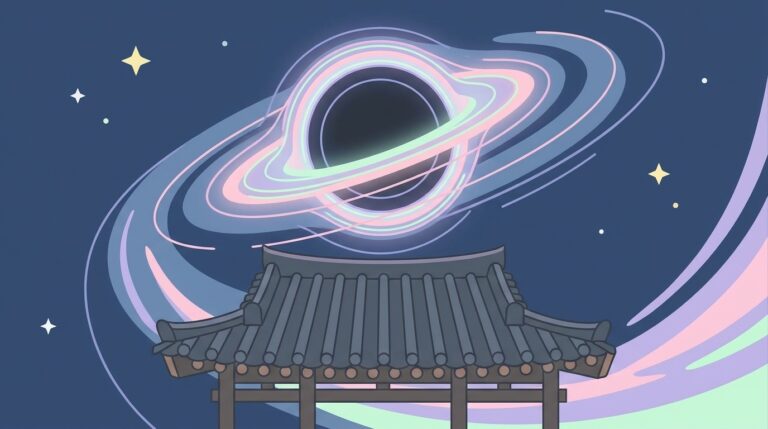
과학을 넘어선 인생의 진리: 블랙홀과 상대성 이론으로 배우는 고급 한국어 (Beyond Science: Learning Advanced Korean through Black Holes & Relativity)
Phase 1: 공감 (스토리 몰입형 오프닝)
안녕하세요! Your favorite Korean study buddy and cultural navigator from 매일한글 (Daily Hangul) is back!
Imagine watching the masterpiece sci-fi movie Interstellar (인터스텔라) with your Korean friends. You’re deep into discussing the mind-bending reality of black holes and Einstein’s relativity theory. You want to say, “Time flows differently depending on gravity, and that deeply resonates with how we perceive our busy lives.” But suddenly, your tongue gets tied. You end up saying something overly simplistic like “시간이 달라요” (Time is different), leaving your profound, C1-level thoughts trapped inside your head.
We’ve all been there! Discussing high-level scientific concepts in a second language can feel like trying to escape a black hole’s event horizon. Based on feedback from our advanced learners, we’ve designed this guide to bridge the gap between heavy physics and deep, poetic conversational Korean. Today, you’ll learn how to express complex cosmic phenomena while weaving them into beautiful life metaphors—just like they do in K-Dramas! Let’s dive deep into the cosmos together!
Phase 2: 핵심 표현 3선 심층 분석
1. 시공간이 왜곡되다 (Sigonggany waegokdoeda)
- Pronunciation: She-gong-gan-ee wae-gok-doe-da (Sounds like “she-gong-gan-ee” + “way-gok” + “do-ee-da”)
- Meaning: Spacetime is warped / distorted
- K-Culture Moment: Often used in mystery or fantasy K-Dramas like Signal (시그널) or The King: Eternal Monarch (더 킹: 영원의 군주) when characters travel through time or parallel universes.
- Editor’s Insight: Beyond physics, Koreans use this poetically to describe moments when they lose track of time because they are so deeply focused or in love. For example, “너와 있을 때면 시공간이 왜곡되는 기분이야” (When I’m with you, I feel like spacetime is warped).
- Situation Spectrum: Casual (⚠️) | Semi-formal (✅) | Formal (✅)
- 🤔 Think About It: How does viewing time and space as a single warped fabric (“시공간”) shift your understanding of “waiting” in Korean culture?
2. 사건의 지평선 (Sajeonui jipyeongseon)
- Pronunciation: Sah-geon-ui jee-pyeong-seon (Think of “Sah-geon” as in ‘event’ + “jee-pyeong-seon” as in ‘horizon’)
- Meaning: Event Horizon (The boundary of a black hole from which nothing can escape)
- K-Culture Moment: This is the exact title of the viral, chart-topping song “사건의 지평선” (Event Horizon) by singer Younha (윤하). She beautifully compared the bittersweet ending of a relationship to crossing an event horizon—a point of no return where memories remain but you cannot go back.
- Editor’s Insight: Use this term when discussing irreversible life decisions or monumental shifts in history. It signals that you are entering a completely new phase of life.
- Situation Spectrum: Casual (✅) | Semi-formal (✅) | Formal (✅)
- 🤔 Think About It: In English, we say “point of no return.” Why do you think the Korean poetic sensibility adopted “사건의 지평선” to describe the emotional weight of a breakup?
3. 상대성 이론에 대입하다 (Sangdaeseong irone daeiphada)
- Pronunciation: Sahng-dae-seong ee-ron-ae dae-eep-hada (Sounds like “Sahng-dae-sung” + “ee-ron” + “at” + “dae-eep-ha-da”)
- Meaning: To apply (something) to the Theory of Relativity
- K-Culture Moment: Used in scientific variety shows like Alssinjap (알쓸신잡 – The Dictionary of Useless Knowledge) where intellectuals discuss how human relationships can also be explained by relativity.
- Editor’s Insight: This is a highly sophisticated C1 idiom. Use it when you want to argue that “everything is relative.” For instance, “행복의 기준도 상대성 이론에 대입해 볼 수 있어요” (The standard of happiness can also be applied to the theory of relativity).
- Situation Spectrum: Casual (🚫) | Semi-formal (✅) | Formal (✅)
- 🤔 Think About It: How does applying a rigid scientific theory to subjective human emotions reflect the intellectual curiosity of modern Koreans?
Phase 3: 교과서 한국어 vs 진짜 한국어
Let’s look at how textbook phrasing compares to natural, high-level conversational Korean.
Situation 1: Explaining how fast time flies when you are having fun.
- 📖 교과서 한국어: “즐거울 때는 시간이 아주 빠르게 지나갑니다.” (Time passes very quickly when you are happy.)
- 🗣️ 진짜 한국어: “진짜 재미있을 때는 시간 흐름이 거의 블랙홀급이에요. 시공간이 순간 이동한 것 같다니까요!” (When it’s really fun, the flow of time is practically black-hole level. I’m telling you, it feels like spacetime just teleported!)
- 💡 왜 다를까?: Native Koreans love using the suffix “-급” (level/class) to exaggerate situations dramatically, making “블랙홀급” a perfect modern slang hybrid.
Situation 2: Expressing that reality depends on one’s perspective.
- 📖 교과서 한국어: “사람마다 상황이 다르게 느껴질 수 있습니다.” (Each person may perceive the situation differently.)
- 🗣️ 진짜 한국어: “결국 모든 건 상대적이잖아요. 아인슈타인의 상대성 이론이 우리 삶에도 딱 들어맞는 것 같아요.” (In the end, everything is relative, isn’t it? I feel like Einstein’s theory of relativity fits our lives perfectly.)
- 💡 왜 다를까?: Instead of using flat vocabulary like “다르게” (differently), advanced speakers elevate their speech by using Hanja-based terms like “상대적” (relative) to sound intellectually engaging.
Phase 4: K-Culture 딥다이브 & 비언어적 매너
4-1. 비언어적 매너 (Gestures & Demeanor)
When discussing deep topics like space and relativity in Korean, balance your high-level vocabulary with polite listening gestures. Keep eye contact steady but soft, and nod slowly (고개 끄덕이기) to show you are processing their complex thoughts. Avoid pointing aggressively; instead, use open-palm gestures when explaining cosmic concepts to keep the atmosphere intellectual yet warm.
4-2. 문화 코드 분석 (The Younha Phenomenon)
In Korea, science is not just for textbooks; it is a major pop culture muse. Singer Younha’s mega-hit “사건의 지평선” proved that scientific jargon could be transformed into a national healing anthem. Koreans love finding emotional resonance (공감) in cold, physical laws. Linking cosmic theories to human fate, destiny (인연), and parting is a deeply embedded artistic trope in K-content.
Phase 5: 실전 롤플레이 시나리오
Here is a conversation between 민우 (Minwoo), a physics enthusiast, and 지선 (Jiseon), a philosophy major, chatting at a rooftop cafe in Seoul under the stars.
- 민우: 지선 씨, 저 하늘을 보면 어떤 생각이 들어요? 저는 우주가 참 신비로워요.
- 지선: 🎭 (하늘을 올려다보며 미소 짓는다) 음, 저는 우주를 보면 아인슈타인의 상대성 이론이 떠올라요. 우리 삶도 비슷하잖아요.
- 민우: 오, 상대성 이론이요? 구체적으로 어떻게 비슷하다고 생각하세요?
- 지선: 🎭 (커피 잔을 만지작거리며) 예를 들어, 좋아하는 사람과 있을 때는 시공간이 왜곡된 것처럼 1시간이 1초 같잖아요.
- 민우: 🎭 (눈을 반짝이며) 와, 정확한 비유네요! 그럼 슬픈 이별은 블랙홀 같은 걸까요?
- 지선: 맞아요. 이별하는 순간 우리는 사건의 지평선을 넘는 거죠. 돌이킬 수 없는 선을요.
- 민우: 듣고 보니 과학과 인생은 정말 닮아 있네요. 오늘 대화 정말 흥미로워요.
- 지선: 저도요. 민우 씨랑 얘기하면 늘 지적 자극을 받아서 좋아요.
🔀 인터랙티브 선택지
If Minwoo asks: “우리 다음 주에 있을 물리 학회 같이 갈래요?” (Would you like to go to the physics conference with me next week?)
- A) “좋아요! 학회에 가서 시공간의 왜곡을 직접 경험해 보고 싶네요!” (Sarcastic/Witty)
- B) “어머, 학회요? 거긴 사건의 지평선 같아서 한 번 들어가면 지루해서 못 나올 것 같아요.” (Playful/Teasing)
- C) “시간이 상대적이라 다음 주까지 기다리기 너무 힘들 것 같아요!” (Romantic/Flirty)
💡 선택지별 피드백:
- Selection A (Best): Perfect balance of wit and intelligence! It shows you can apply the newly learned concept playfully.
- Selection B (Risk): Very funny and uses the vocabulary correctly, but make sure your tone is lighthearted so you don’t offend the speaker’s passion for physics!
- Selection C (Bad): A bit cheesy for a professional physics talk, but highly effective if you are trying to turn a study buddy into a romantic partner!
Phase 6: 10초 감정 섀도잉 드릴
Practice saying these lines with the indicated emotional pauses (/) and tone maps!
[🪐 지적이면서도 신비로운 톤으로]
“우리가 지금 느끼는 시간은 / 각자의 중력에 따라 / 모두 다르게 흐르고 있어요.”
(The time we feel right now / depending on each person’s gravity / is flowing differently for everyone.)-
[💔 아련하고 쓸쓸한 톤으로]
“이미 사건의 지평선을 / 넘어가 버렸으니, / 더 이상 되돌릴 수는 없겠죠.”
(Since we have already crossed / the event horizon, / we probably cannot turn back anymore.)
Phase 7: K-Culture 미니 사전
- 상대성 (Sangdaeseong) | Relativity. Used to describe how values change depending on contexts.
- 왜곡 (Waegok) | Distortion/Warping. Commonly used when discussing media manipulation (언론 왜곡) or physical warping.
- 중력 (Jungryeok) | Gravity. Often metaphorically used to describe someone’s irresistible charm: “너의 중력에 이끌려” (Pulled by your gravity).
- 시공간 (Sigonggan) | Spacetime. A neat contraction of 시간 (time) and 공간 (space).
Phase 8: 여행자를 위한 생존 키트
Survival Expressions for Tech/Science Lovers
- “여기 와이파이 속도가 거의 빛의 속도네요!” (Yeogi Wi-Fi sokdoga geoui bichui sokdoneyo!)
- Pro Tip: “The Wi-Fi here is practically at the speed of light!” A great compliment to use in Korean internet cafes (PC방).
- “이 천문대 별 보기 좋은 명소인가요?” (I cheonmundae byeol bogi joeun myeongsoingayo?)
- Pro Tip: Use this when traveling to famous stargazing locations like Gangwon-do.
- “우주 과학 박물관 매표소가 어디예요?” (Uju gwahak bangmulgwan maepyosoga eodiyeyo?)
- Pro Tip: Handy when navigating local science centers.
Editor’s Travel Note
If you want to experience Korea’s state-of-the-art scientific infrastructure, search for “국립과천과학관” (Gwacheon National Science Museum) on 네이버 지도 앱 (Naver Map App). It’s incredibly easy to reach by subway and features world-class space exhibits!
(Note: Always check the official website for updated operating hours before visiting.)
Phase 9: “한 발 더 깊이” (생각 질문)
In Korean culture, the concept of relativity is deeply tied to human connections (인연). Unlike Western individualism, Koreans often perceive their own identity in relation to others. We don’t just exist in a vacuum; our gravity pulls on others, and their gravity shapes our timeline. This is why the phrase “덕분에” (thanks to you) is so common—it acknowledges that my positive state of being was made possible by your orbit around me.
💬 Your Turn: How does your culture view the flow of time? Do you think time is absolute, or is it relative to who you are with? Share your thoughts in the comments below!
Phase 10: FAQ & 오해 방지 (FAQ Schema)
Q: Is “사건의 지평선” only used in physics discussions?
A: No! Ever since Younha’s song became a massive hit, Koreans use it colloquially to mean “the point of no return” in relationships, career decisions, or even diet cheat days!
Q: What is the difference between “상대적” and “비교적”?
A: “상대적” (Sangdaejeok) means “relative” (the opposite of absolute), while “비교적” (Bigyojeok) is an adverb meaning “comparatively” or “relatively speaking” in a simpler context (e.g., “오늘 날씨는 비교적 따뜻하네요”).
Q: Can I use “왜곡되다” to mean someone is lying?
A: Yes, you can say “사실이 왜곡되었다” (The facts have been distorted/twisted) when discussing fake news or misunderstandings.
🚨 흔한 실수 (Common Mistakes) 경고판
- Using “시간이 상대적이에요” when you just mean you are busy.
- Correct Action: If you are busy, say “정신이 없어요” (I have no peace of mind). Use “상대적” only for conceptual comparisons.
- Pronouncing “시공간” as “시공간” with a long ‘shiii’ sound.
- Correct Action: Keep the “시” short and crisp to avoid sounding unnatural.
- Using “우주” (space/universe) to refer to a physical outdoor space.
- Correct Action: “우주” is outer space. For physical room or space, use “공간” (gonggan) or “자리가 없다” (no seats left).
Phase 11: 액션 미션 & 참여 유도
- 🥉 Bronze: Listen to Younha’s “사건의 지평선” (Event Horizon) and write down one sentence that uses the word “지평선” in the comments below!
- 🥈 Silver: Share a story on your Instagram about a time you felt “시공간이 왜곡되다” (spacetime warped) and tag
@DailyHangul. - 🥇 Gold: Use “상대성 이론” in a real conversational debate with a Korean speaker this week!
🎮 K-Culture Mission: Watch the lyrics video of Younha’s “Event Horizon” and try to spot how she visually represents the concept of space and time in her lyricism!
Phase 12: 인터랙티브 퀴즈 챌린지
1. 빈칸 채우기 (Fill in the Blank)
- Q: 이별을 한 후 우리는 다시 돌아갈 수 없는
__________의 지평선을 넘었다.
정답 및 해설 보기
- 정답: 사건
- 해설: ‘사건의 지평선’ (Event Horizon)은 물리학적 개념뿐만 아니라 감정적인 한계선을 넘었음을 뜻합니다.
2. OX 문화 퀴즈 (True or False)
- Q: 한국어에서 ‘중력’은 오직 과학적인 힘을 설명할 때만 쓰이며, 사람 사이의 매력을 묘사할 때는 절대로 쓸 수 없다. (O / X)
정답 및 해설 보기
- 정답: X
- 해설: ‘중력’은 누군가의 강력한 매력이나 이끌림을 묘사하는 문학적인 표현으로 자주 애용됩니다.







