

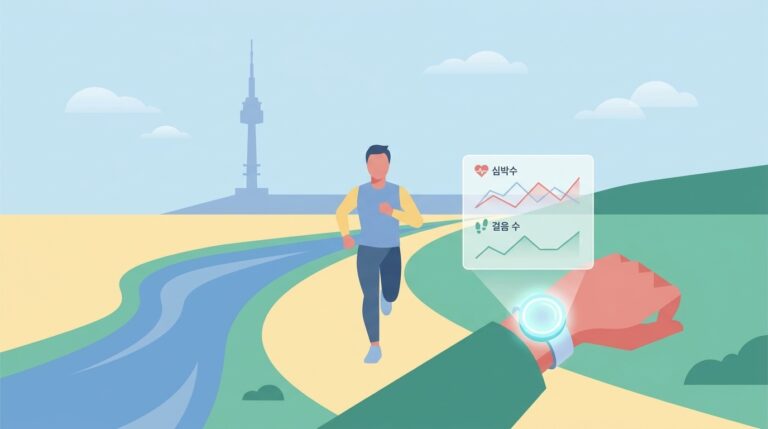
Stay Connected, Stay Healthy: Navigating Korea’s Wearable Healthcare Scene Like a Native
Phase 1: Empathy (Your Smart Health Companion)
안녕하세요! (An-nyeong-ha-se-yo!) Your friendly Korean culture navigator and Daily Hangul editor is here!
Imagine this: You are hiking up the beautiful trails of Bukhansan (북한산) on a crisp Saturday morning. You glance down at your smartwatch, and it alerts you: “Heart rate is rising rapidly. Take a breather!” Or maybe you are trying to sync your new Korean smart ring with a local fitness app, but you are not sure how to describe your daily biometrics, sleep cycles, or ‘bio-data’ to a personal trainer or a doctor in natural Korean.
In highly digitalized South Korea—where nearly everyone from tech-savvy college students to grandmas hiking in colorful outdoor gear wears some form of smart band—IoT healthcare is not just a trend; it is a lifestyle. Today, we are going to dive deep into advanced (C1-level) Korean expressions that will help you seamlessly discuss wearable healthcare, biometric syncing, and IoT health monitoring like a local. Whether you are chatting with a tech-savvy friend or explaining your health data at a local clinic, this guide is your ultimate digital companion!
Phase 2: Deep-Dive into 3 Essential Expressions
1. 연동하다 (Yeon-dong-ha-da)
- Pronunciation: Yuhn-dong-ha-da (Sounds like “Yawn-dong” but with a soft ‘d’)
- Meaning: To link / To sync / To interlock (devices or data)
- K-Culture Moment: You will hear this constantly in Korean tech vlogs or when setting up smart home apps. If your smart scale doesn’t talk to your phone, a Korean friend will ask: “스마트폰이랑 연동했어?” (Did you sync it with your smartphone?)
- Editor’s Insight: While ‘동기화하다’ (dong-gi-hwa-da) means “to synchronize” in a purely technical IT sense, 연동하다 is much more common in daily life when referring to two different systems or devices working together interactively.
- Situation Spectrum: Casual (✅) | Semi-formal (✅) | Formal (✅)
- 🤔 Think About It: In English, we “sync” everything. In Korean, “연동” implies a mutual connection where one action triggers another. How does this reflect the highly integrated, interconnected nature of Korean society?
2. 수치를 모니터링하다 (Su-chi-reul Mo-ni-teo-ring-ha-da)
- Pronunciation: Soo-chee-reul Mo-nee-tuh-ring-ha-da
- Meaning: To monitor numerical values / data metrics
- K-Culture Moment: Used extensively in Korean medical dramas when doctors review wearable biosensor data, or by premium personal trainers analyzing a client’s body composition over time.
- Editor’s Insight: 수치 (Su-chi) refers to numerical data or readings (like blood pressure, heart rate, or blood sugar). Instead of just saying “데이터를 보다” (looking at data), using “수치를 모니터링하다” elevates your speech to a professional, C1-level.
- Situation Spectrum: Casual (⚠️ – sounds a bit clinical) | Semi-formal (✅) | Formal (✅)
- 🤔 Think About It: Koreans love precision. Why do you think tracking exact numerical progress (수치) is so highly valued in Korean self-care and fitness trends?
3. 기계 오작동 (Gi-gye O-jak-dong)
- Pronunciation: Gee-gyeh Oh-jak-dong (Think of “Oh” as in surprise, and “jack-dong” like the name Jack with ‘dong’)
- Meaning: Device malfunction / glitch
- K-Culture Moment: When your smartwatch suddenly says your resting heart rate is 190 bpm while you’re just eating tteokbokki, you joke about a device glitch.
- Editor’s Insight: Combining ‘기계’ (machine/device) and ‘오작동’ (malfunction/misoperation) is the perfect, sophisticated way to complain about tech issues without sounding childish.
- Situation Spectrum: Casual (✅) | Semi-formal (✅) | Formal (✅)
- 🤔 Think About It: How does your native language handle tech glitches? Do you “blame the machine” directly, or do you say “it’s acting up”?
Phase 3: Textbook Korean vs. Real-Life Korean
Situation 1: Explaining that your watch tracks your sleep
- 📖 Textbook Style: “이 시계는 제 수면을 기록합니다.” (I si-gye-neun je su-myeon-eul gi-rok-ham-ni-da.)
- Translation: This watch records my sleep. (Accurate, but sounds like an instruction manual.)
- 🗣️ Real-Life Native Style: “이 스마트워치가 제 수면 패턴을 실시간으로 잡아줘요.” (I seu-ma-teu-wo-chi-ga je su-myeon pae-teon-eul sil-si-gan-eu-ro jap-ah-jwo-yo.)
- Translation: This smartwatch catches/tracks my sleep patterns in real-time.
- 💡 Why the difference? Natives prefer active, descriptive verbs like “잡아주다” (to catch/detect for someone) over passive technical terms like “기록하다” when describing smart features.
Situation 2: Asking if the app is connected to the wearable
- 📖 Textbook Style: “애플리케이션이 스마트 밴드와 연결되어 있습니까?” (Ae-peul-ri-kei-syeon-i seu-ma-teu baen-deu-wa yeon-gyeol-doe-eo it-seup-ni-ka?)
- Translation: Is the application connected to the smart band?
- 🗣️ Real-Life Native Style: “앱이랑 밴드랑 서로 연동되어 있어요?” (Aep-i-rang baen-deu-rang seo-ro yeon-dong-doe-eo it-seo-yo?)
- Translation: Are the app and the band synced up with each other?
- 💡 Why the difference? “앱” (Aep) is the universal shorthand for application, and “연동되다” sounds much more naturally integrated than the generic “연결되다” (physically or digitally connected).
Phase 4: K-Culture Deep-Dive & Non-Verbal Manners
4-1. Gestures & Tech Etiquette in Korea
When showing someone your wearable data (like progress on an app or a high heart rate), it is polite to turn the screen fully toward them so they don’t have to squint or crane their neck. If you are sharing health data with a doctor or a fitness trainer, hand over your unlocked smartphone using two hands as a sign of respect, pointing out the relevant graph with your index finger gently.
4-2. The “갓생” (God-saeng) Culture and Wearables
Have you heard of 갓생 (God-saeng)? It’s a compound word of “God” and “인생” (Life), meaning living a highly productive, healthy, and exemplary life. In Korea, tracking your steps (만보기 – Man-bo-gi), monitoring your sleep hygiene, and analyzing stress levels via smart devices are massive parts of the God-saeng trend. Sharing screenshots of your daily workout rings or sleep scores on Instagram with hashtags like #오운완 (Today’s Workout Complete) is a major social phenomenon!
Phase 5: Interactive Roleplay Scenario
Characters:
- 민우 (Min-woo): Your fitness-obsessed Korean friend who loves the latest tech.
- You: A smart health enthusiast trying to optimize your workout routine.
[Scene: A trendy cafe near Han River after a light jog]

민우: 야, 너 그 스마트 링 새로 산 거야? 디자인 진짜 예쁘다!
      (Ya, neo geu seu-ma-teu ring sae-ro san geo-ya? Di-ja-in jin-jja ye-ppeu-da!)
      "Hey, is that a new smart ring you bought? The design is gorgeous!"

You: 🎭 [Smiling proudly, showing your finger]
     응, 이번에 건강 관리 좀 제대로 해보려고 하나 장만했어.
     (Eung, i-beon-e geon-gang gwan-ri jom jae-dae-ro hae-bo-ryeo-go ha-na jang-man-haet-seo.)
     "Yeah, I treated myself to one to manage my health properly this time."

민우: 오, 부럽다. 스마트폰 앱이랑 연동은 잘 돼?
      (Oh, bu-reop-da. Seu-ma-teu-pon aep-i-rang yeon-dong-eun jal dwae?)
      "Oh, jealous! Does it sync well with your smartphone app?"

You: 🎭 [Nodding and opening your phone app]
     어, 실시간으로 심박수랑 수면 수치 모니터링하기 진짜 편해.
     (Eo, sil-si-gan-eu-ro sim-bak-su-rang su-myeon su-chi mo-ni-teo-ring-ha-gi jin-jja pyeon-hae.)
     "Yeah, it's super convenient to monitor heart rate and sleep metrics in real-time."

민우: 대박이다. 가끔 기계 오작동 같은 건 없어?
      (Dae-bak-i-da. Ga-kkeum gi-gye o-jak-dong gat-eun geon eops-eo?)
      "Amazing. Do you ever get device malfunctions or glitches?"

You: 🎭 [Shrugging gently]
     가끔 수면 분석할 때 약간 버그가 있긴 한데, 전반적으로는 대만족이야.
     (Ga-kkeum su-myeon bun-seok-hal ttae ya-kan beo-geu-ga it-gin han-de, jeon-ban-jeok-eu-ro-neun dae-man-jok-i-ya.)
     "Sometimes there's a tiny bug when analyzing sleep, but overall, I'm super satisfied."

민우: 나도 하나 살까 고민되네. 그거 있으면 '갓생' 살기 딱 좋겠다!
      (Na-do ha-na sal-kka go-min-doe-ne. Geu-geo it-seu-myeo 'gat-saeng' sal-gi ttak jo-ket-da!)
      "Now I'm tempted to buy one too. It'd be perfect for living a 'God-saeng' life!"

You: 🎭 [Laughing and nudging him]
     당장 질러! 우리 같이 매일 건강 데이터 공유하면서 운동하자.
     (Dang-jang jil-reo! U-ri gat-i mae-il geon-gang de-i-teo gong-yu-ha-myeon-seo un-dong-ha-ja.)
     "Just buy it already! Let's work out while sharing our health data every day."
🔀 Choose Your Next Move!
Min-woo asks you, “Which health metric do you care about the most?”
* A: “저는 칼로리 소모량 수치를 제일 신경 써요.” (I care about burned calories data the most.)
* B: “기계가 고장 나서 아무것도 안 떠요.” (The machine is broken, so nothing shows up.)
* C: “그냥 시계가 예뻐서 샀어요.” (I just bought it because the watch looks pretty.)
Feedback:
- Selection A (Best): Excellent! You used the C1-level term ‘수치’ (numerical value/metric) naturally to describe your fitness goals. Perfect native flow!
- Selection B (Bad): A bit dramatic! While grammatically correct, using ‘고장 나다’ (broken) is too simple. For smart device errors, “오작동이 있다” or “동기화 오류가 났다” sounds much more professional.
- Selection C (Risk): Honest, but it completely derails the healthcare conversation! Keep the focus on the IoT functions to practice your target vocabulary.
Phase 6: 10-Second Emotional Shadowing Drill
Master the natural rise and fall of Korean sentences with emotional context! Pause briefly at /.
- [😊 Excited & Satisfied]
- “이 스마트 밴드 / 진짜 대박이에요! / 연동이 엄청 빨라요!”
- Pronunciation: I seu-ma-teu baen-deu / jin-jja dae-bak-i-e-yo! / Yeon-dong-i eom-cheong ppal-ra-yo!
- Meaning: This smart band is amazing! The syncing is incredibly fast!
- [😩 Slightly Frustrated]
- “아… / 또 기계 오작동인가 봐요. / 수치가 안 잡혀요.”
- Pronunciation: Ah… / tto gi-gye o-jak-dong-in-ga bwa-yo. / Su-chi-ga an jap-hyeo-yo.
- Meaning: Ah… seems like a device malfunction again. The metrics aren’t registering.
Phase 7: K-Culture Mini-Dictionary
- 동기화 (Dong-gi-hwa) | Synchronization
- Usage: Used when manually syncing files, accounts, or cloud backups. (e.g., “아이클라우드 동기화 완료” – iCloud sync complete).
- 헬스케어 (Hel-seu-ke-eo) | Healthcare (IoT context)
- Usage: Very common in corporate, medical, and wellness tech fields. (e.g., “맞춤형 헬스케어 서비스” – Customized healthcare service).
- 스펙 (Seu-paek) | Specifications / Specs
- Usage: Borrowed from “specifications,” Koreans use this to describe both gadget features and a job applicant’s qualifications. (e.g., “이 워치 스펙 진짜 좋다” – This watch’s specs are really good).
- 웨어러블 (We-eo-reo-beul) | Wearable device
- Usage: Officially used in tech articles and product categories. (e.g., “웨어러블 기기 시장” – Wearable device market).
Phase 8: Traveler’s Survival Kit
Top 3 Survival Phrases:
- “블루투스 연결이 안 돼요.” (Beul-ru-tu-seu yeon-gyeol-i an dwae-yo.)
- Pro Tip: Use this at an electronics store or when asking a hotel staff member for help with smart speakers or IoT room controls.
- “이거 한글 지원 되나요?” (I-geo Han-geul ji-won doe-na-yo?)
- Pro Tip: Essential when buying global tech gadgets in Korea to check if they support the Korean language interface.
- “배터리가 너무 빨리 닳아요.” (Bae-teo-ri-ga neo-mu ppal-ri dal-ha-yo.)
- Pro Tip: Use this at service centers like Samsung or LG if your wearable device’s battery drains too fast.
Editor’s Travel Note:
When traveling in Seoul, you can download the Seoul Bike (따릉이 – Ttareungi) App to easily rent city bikes. Many travelers pair their smartwatches with this app to map their rides along the Han River while monitoring their heart rate. Note: App interface and local rental pricing details may vary over time.
Phase 9: “Going Deeper” (Societal Insight)
In Korea, health tracking is deeply tied to the collective desire for self-improvement and social responsibility. During health trends, it is common for Korean companies to run “Step Challenges” where employees sync their wearables to a corporate app to raise money for charity or win team prizes. This blends Korea’s famous 우리 (Uri – We/Our) collective culture with modern IoT technology. Healthcare is not just a personal journey; it is a shared social experience.
💬 Your Turn: Do you prefer tracking your health metrics alone, or do you like sharing your data with friends to stay motivated? Let us know in the comments below!
Phase 10: FAQ & Common Mistakes
Q: Can I use “연결하다” instead of “연동하다”?
A: Yes, but they have different nuances. 연결하다 (yeon-gyeol-ha-da) means simply joining two things physically or digitally (like plugging in a cable or joining Wi-Fi). 연동하다 (yeon-dong-ha-da) means the systems are sharing data and interacting with each other dynamically.
Q: What is the difference between “심박수” and “맥박”?
A: 심박수 (sim-bak-su) translates to “heart rate” (measured in beats per minute by devices), while 맥박 (maek-bak) refers to “pulse” (which you feel physically on your wrist or neck).
Q: How do I tell a technician my smart watch screen is frozen?
A: You can say “화면이 멈췄어요” (Hwa-myeon-i meom-chwot-seo-yo) or “터치가 안 돼요” (Teo-chi-ga an dwae-yo).
🚨 Common Mistakes Alert!
- Mistake 1: Saying “핸드폰이랑 워치를 싱크했어요” instead of “연동했어요”. While understood, “연동” is much more natural and sophisticated.
- Mistake 2: Using “고장” (go-jang) for minor software lag. If the app just needs a restart, say “앱이 버벅거려요” (The app is lagging/stuttering) instead of “고장 났어요” (It is broken).
- Mistake 3: Saying “수면을 봐요” (I look at sleep). Correct Action: Use “수면 패턴을 분석해요” (I analyze sleep patterns).
Phase 11: Action Mission!
- 🥉 Bronze: Open your phone’s health app, change the language setting to Korean, and locate the word ‘동기화’ or ‘연동’.
- 🥈 Silver: Screenshot your daily step count or sleep graph, and post it on your social media with the hashtag: #오늘의수치 (Today’s Metric) or #갓생.
- 🥇 Gold: Next time you talk to a Korean friend or trainer, use the sentence: “제 스마트워치랑 앱을 연동해서 건강 수치를 모니터링하고 있어요.”
🎮 K-Culture Mission:
Watch a modern K-Drama (like Start-Up or My Holo Love) and spot how characters interact with wearable AI or smart health devices. Write down one tech-related phrase you hear!
Phase 12: Interactive Quiz Challenge
Test your knowledge! Can you get 3/3?
1. Which word best describes ‘data syncing’ between your smart ring and your phone?
* A) 연동 (Yeon-dong)
* B) 연결 (Yeon-gyeol)
* C) 연설 (Yeon-seol)
2. Fill in the blank: “스마트워치 덕분에 일일 활동
______를 모니터링할 수 있어요.” (Thanks to the smartwatch, I can monitor daily activity ______.)
* A) 기계 (Gi-gye)
* B) 수치 (Su-chi)
* C) 오작동 (O-jak-dong)
3. True or False: ‘갓생’ (God-saeng) refers to a lazy, relaxed lifestyle.
* A) True
* B) False
🎉 Click here to reveal the Answers & Explanations!
- Correct Answer: A (연동). While ‘연결’ means connection, ‘연동’ refers specifically to interlocked data syncing between smart devices.
- Correct Answer: B (수치). ‘수치’ means numerical values/metrics, making it the perfect fit for tracking activity data.
- Correct Answer: B (False). ‘갓생’ means a highly productive, diligent, and healthy lifestyle (doing workouts, tracking health, studying hard)!







