

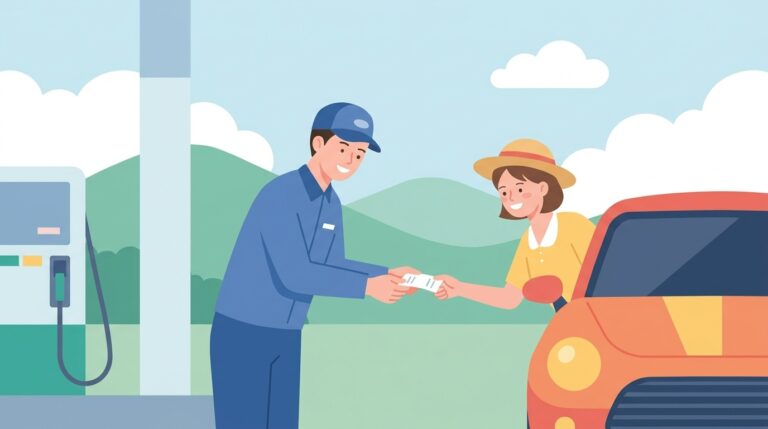
Gas Station Survival: How to Ask for a Receipt in Korean Without Fumbling
Phase 1: Empathy (Hello, Daily Hangul Friends!)
안녕하세요! (Annyeong-haseyo!) Welcome back to your favorite Korean learning space, Daily Hangul! I’m your Lead Editor and Local Culture Navigator.
Imagine this: You’ve successfully rented a sleek car to drive along Jeju Island’s beautiful coastal roads. You pull into a gas station (주유소 – juyuso), fill up the tank, and now you need to get a receipt for your rental car company or business expenses. You stand in front of the machine or the friendly cashier, and suddenly, your mind goes blank. How do you ask for that piece of paper?
If you have ever felt your heart race just thinking about interacting at a Korean gas station, don’t worry! This is a very common “pain point” for many of our A2 learners. Today, we are going to master the exact, natural phrases to ask for a receipt. By the end of this guide, you will sound like a confident local driver!
Phase 2: Deep Dive into 3 Key Expressions
Let’s learn the three most important phrases you need.
1. 영수증 주세요. (Yeongsujeung juseyo.)
- Pronunciation: Yuhng-soo-jeung joo-seh-yo (Sounds like “young-sue-jung” + “joo-say-yo”)
- Meaning: Please give me a receipt. (Direct & Polite)
- K-Culture Moment: You will hear this everywhere in Korea! From local convenience stores to trendy cafes in Hongdae. Cashiers will often ask you first, “영수증 필요하세요?” (Do you need a receipt?), and you can reply with this phrase.
- Editor’s Insight: This is the absolute gold standard for beginners. It is polite, clear, and works 100% of the time.
- Situation Spectrum: Casual (⚠️) / Semi-formal (✅) / Formal (✅)
- 🤔 Think About It: In many Western countries, receipts are printed automatically. In Korea, cashiers often ask to save paper. How does your home country handle paper receipts?
2. 영수증 받을 수 있을까요? (Yeongsujeung badeul su isseulkayo?)
- Pronunciation: Yuhng-soo-jeung bah-deul soo ee-seul-kah-yo? (Sounds like “bah-deul soo” + “is-sool-kah-yo”)
- Meaning: Can I get a receipt? (Softer, more polite)
- K-Culture Moment: Used when you want to sound extra polite, perhaps to an older gas station attendant (주유원 – juyuwon) who helped you pump gas.
- Editor’s Insight: The ending “~을 수 있을까요?” is like saying “Would it be possible to…?”. It shows great respect and polite manners.
- Situation Spectrum: Casual (🚫) / Semi-formal (✅) / Formal (✅)
- 🤔 Think About It: Showing respect to older service workers is a huge part of Korean culture. Using softer endings makes a great impression!
3. 영수증 안 나왔어요. (Yeongsujeung an nawasseoyo.)
- Pronunciation: Yuhng-soo-jeung ahn nah-wah-ssuh-yo
- Meaning: The receipt didn’t come out.
- K-Culture Moment: Many Korean gas stations are self-service (셀프 주유소). Sometimes, the machine runs out of paper and doesn’t print your receipt. You have to tell the staff inside the office!
- Editor’s Insight: “안” (an) means “not”, and “나왔어요” (nawasseoyo) means “came out”. Use this when the self-service machine is acting up.
- Situation Spectrum: Casual (⚠️) / Semi-formal (✅) / Formal (✅)
- 🤔 Think About It: Self-service machines are everywhere in Korea now. Being able to explain a minor technical issue is a great survival skill!
Phase 3: Textbook Korean vs. Real-Life Korean
Let’s compare what textbooks teach you versus what real Koreans actually say at the pump.
Situation 1: Asking for the receipt
- 📖 Textbook Korean: “저에게 영수증을 주십시오.” (Joege yeongsujeungeul jusipsio. – Please give the receipt to me.)
- Why it’s unnatural: This sounds like a military command or a robot from a 1990s movie!
- 🗣️ Real-Life Korean: “영수증 주세요~” (Yeongsujeung juseyo~ – Receipt, please~)
- 💡 Why it’s better: It is short, natural, polite, and flows easily.
Situation 2: When the machine is broken/out of paper
- 📖 Textbook Korean: “기계가 영수증 인쇄를 완료하지 않았습니다.” (Gigyoga yeongsujeung inswaereul wanryohaji anasseumnida. – The machine has not completed printing the receipt.)
- Why it’s unnatural: Way too technical! You sound like a software engineer diagnosing a bug.
- 🗣️ Real-Life Korean: “영수증이 안 나와요.” (Yeongsujeungi an nawayo. – The receipt isn’t coming out.)
- 💡 Why it’s better: Simple, conversational, and immediately gets the point across to the staff.
Phase 4: K-Culture Deep Dive & Non-Verbal Manners
4-1. Two-Handed Respect (두 손 매너)
When the gas station attendant hands you your card and receipt, always receive them with both hands. Or, place your left hand gently under your right forearm/wrist as you take it with your right hand. This is a crucial sign of respect in Korea. Making eye contact and giving a slight head nod (인사 – insa) makes you look incredibly polite!
4-2. The “Self” (셀프) Culture
If you see a sign that says 셀프 (Self), it means it is a self-service gas station. These are usually cheaper! If you get confused, don’t worry. There is almost always a small office with a staff member inside. Just walk over and politely ask for help.
Phase 5: Real-Life Roleplay Scenario
Setting: A sunny afternoon at a self-service gas station in Jeju Island. You pumped gas, but the machine screen says “Receipt Error.” You walk into the small office to talk to the friendly owner, Mr. Kim.
- Characters:
- You (A2 Learner)
- 김 사장님 (Mr. Kim – Gas Station Owner, friendly local in his 50s)
1. You: 안녕하세요! (Annyeong-haseyo!)
   🎭 (Smile politely and bow your head slightly)

2. Mr. Kim: 네, 안녕하세요! 무슨 일이세요? (Ne, annyeong-haseyo! Museun iriseyo?)
   🎭 (Wipes his hands on a towel and smiles warmly)
   Translation: Yes, hello! What's going on?

3. You: 저기... 3번 기계에서 영수증이 안 나왔어요. (Jeogi... sambeon gigye-eseo yeongsujeungi an nawasseoyo.)
   🎭 (Point towards pump number 3 outside)
   Translation: Uh... the receipt didn't come out from machine number 3.

4. Mr. Kim: 아, 진짜요? 종이가 다 떨어졌나 보네요. 잠시만요! (Ah, jinjja-yo? Jong-i-ga da tteoreojyeonna boneyo. Jamsimanyo!)
   🎭 (Nods quickly and taps on his computer screen)
   Translation: Oh, really? It looks like it ran out of paper. Just a moment!

5. You: 감사합니다. (Gamsahamnida.)
   🎭 (Wait patiently while he prints it)

6. Mr. Kim: 여기요. 카드랑 영수증 여기 있습니다! (Yeogiyo. Kadeurang yeongsujeung yeogi isseumnida!)
   🎭 (Hands over the card and receipt with both hands)
   Translation: Here you go. Here is your card and receipt!

7. You: 아, 영수증 받을 수 있어서 다행이에요. 감사합니다! (Ah, yeongsujeung badeul su isseoseo dahaeng-ieyo. Gamsahamnida!)
   🎭 (Take the receipt with both hands and bow gratefully)
   Translation: Oh, I'm glad I could get the receipt. Thank you!

8. Mr. Kim: 네, 조심히 가세요! 즐거운 여행 되시고요! (Ne, josimhi gaseyo! Jeolgeoun yeohaeng doesigoyo!)
   🎭 (Waves cheerily as you walk out)
   Translation: Yes, drive safely! Have a great trip!
🔀 Interactive Choice Point
What do you do if Mr. Kim asks you: “영수증 버려 드릴까요?” (Shall I throw the receipt away for you?)
- A) “네, 버려 주세요.” (Ne, beoryeo juseyo.)
- Feedback (Best if you don’t need it): Great! This means “Yes, please throw it away.” Super natural and polite.
- B) “아니요, 주세요!” (Aniyo, juseyo!)
- Feedback (Best if you need it): “No, please give it to me!” Very clear and effective.
- C) “영수증 필요 없어요.” (Yeongsujeung piryo eopseoyo.)
- Feedback (Risk): “I don’t need a receipt.” It’s correct, but if he already printed it, saying this with a flat tone can sound slightly blunt. Pair it with a polite smile!
Phase 6: 10-Second Emotion Shadowing Drill
Speak like a native by practicing these pauses (/) and emotional cues!
[😊 Politely & Clearly]
“영수증 / 주세요!”
(Yeongsujeung / juseyo!)-
[🥺 Slightly worried, needing help]
“저기… / 영수증이 / 안 나와요.”
(Jeogi… / yeongsujeungi / an nawayo.) -
[💖 Super polite & soft]
“영수증 / 받을 수 / 있을까요?”
(Yeongsujeung / badeul su / isseulkayo?)
Phase 7: K-Culture Mini Dictionary
- 영수증 (Yeongsujeung) | Receipt
- Crucial for tax refunds, rental car returns, or tracking your travel budget.
- 셀프 주유소 (Self Juyuso) | Self-service Gas Station
- Very common in Korea. Look for the yellow or blue “SELF” signs.
- 주유원 (Juyuwon) | Gas Station Attendant
- The helpful staff members who pump gas at full-service stations.
- 가득이요 (Gadeugi-yo) | Fill it up, please!
- The magic phrase when you want a full tank. Literally translates to “Full, please!”
Phase 8: Traveler’s Survival Kit
survival Phrases TOP 3
- 휘발유 주세요. (Hwibalyu juseyo.) – Gasoline, please. (For standard petrol cars)
- 경유 주세요. (Gyeong-yu juseyo.) – Diesel, please. (Double-check your rental car fuel type!)
- 화장실 어디예요? (Hwajangsil eodiyeyo?) – Where is the restroom?
💡 Editor’s Travel Note: Before renting a car, download the Naver Map App or KakaoMap App. These Korean GPS apps show the exact daily gas prices for every station along your route, helping you save money! Disclaimer: Gas prices and station operations are subject to change depending on local market conditions.
Phase 9: “Going Deeper” (Cultural Reflection)
In Korea, there is a strong culture of quick, efficient service called 빨리빨리 (Ppalli-ppalli – Hurry, hurry). This is why self-service gas stations are so popular, and why card payments are processed in less than two seconds! When asking for a receipt, keeping your phrase short (like “영수증 주세요”) aligns perfectly with this fast-paced lifestyle. However, notice how Koreans still maintain deep politeness through non-verbal gestures (using two hands) even during these rapid, 10-second interactions.
💬 Your Turn: Does your country value “speedy service” as much as Korea, or do people prefer a slower, chatty interaction at gas stations? Let us know in the comments below!
Phase 10: FAQ & Common Mistakes
Q: Can I pay with an international credit card at self-service pumps?
A: Yes, most modern Korean gas stations accept international Visa and Mastercard. However, some older machines might struggle with foreign chips. If it fails, just walk to the office and say, “카드 결제 해 주세요” (Kadeu gyeolje hae juseyo – Please process my card payment).
Q: What is the difference between 휘발유 (Hwibalyu) and 경유 (Gyeong-yu)?
A: This is a critical mistake travelers make! 휘발유 is Regular Petrol/Gasoline (usually the yellow/red pump nozzle), and 경유 is Diesel (usually the green or blue nozzle). Always check your rental agreement to avoid damaging the engine!
Q: How do I ask for a receipt if I paid with cash?
A: You can say “현금영수증 주세요” (Hyeon-geum yeongsujeung juseyo), but note that this usually refers to a “Cash Receipt for Tax Deduction” for Korean residents. As a tourist, simply saying “영수증 주세요” (Yeongsujeung juseyo) is perfect.
🚨 Common Mistakes Warning Board
- Mistake 1: Grabbing the receipt with one hand while looking away.
- Correct Action: Receive it with both hands and say “감사합니다” (Gamsahamnida) with a friendly nod.
- Mistake 2: Confusing “주유소” (gas station) with “주차장” (parking lot).
- Correct Action: Remember “주유” (juyu) means oiling/fueling, while “주차” (jucha) means parking!
Phase 11: Action Mission
- 🥉 Bronze Mission: Write “영수증 주세요” on a sticky note and practice saying it out loud 3 times before your next trip.
- 🥈 Silver Mission: Share this post on your social media with the hashtag
#DailyHanguland tell us your favorite rental car destination in Korea! - 🥇 Gold Mission: Next time you visit a Korean restaurant, cafe, or store, use “영수증 주세요” with a polite two-handed gesture. Report back to us in the comments on how it went!
Phase 12: Interactive Quiz Challenge
Test your skills! Can you get a perfect score?
1. Situation Quiz
You pumped gas, but the machine screen has an error and no paper comes out. What do you say to the staff?
* A) 영수증 필요 없어요. (Yeongsujeung piryo eopseoyo.)
* B) 영수증이 안 나와요. (Yeongsujeungi an nawayo.)
* C) 영수증 주세요. (Yeongsujeung juseyo.)
2. Match the Fuel
Match the Korean word to its correct English meaning:
* 1) 휘발유 (Hwibalyu)
* 2) 경유 (Gyeong-yu)
3. True or False?
In Korea, it is considered perfectly normal and polite to receive your receipt and card with just one hand while looking at your phone.
* True / False
🔍 Click here to reveal the answers!
- Answer: B
- Explanation: “영수증이 안 나와요” specifically tells the staff that the receipt didn’t print out, which is the exact problem.
- Answer: 1 = Gasoline, 2 = Diesel
- Explanation: Filling your petrol car with “경유” (Diesel) can ruin the engine, so memorize this before renting a car!
- Answer: False
- Explanation: To show polite manners, always use both hands (or support your right arm) and make polite eye contact with a small nod.
- Explanation: To show polite manners, always use both hands (or support your right arm) and make polite eye contact with a small nod.
See you in the next lesson! 항상 화이팅! (Always fighting!)






