

Phase 1: Empathy (Welcome to Daily Hangul!)
안녕하세요! (An-nyeong-ha-se-yo!) Hello! I am your lead editor and your personal Korean culture navigator from Daily Hangul.
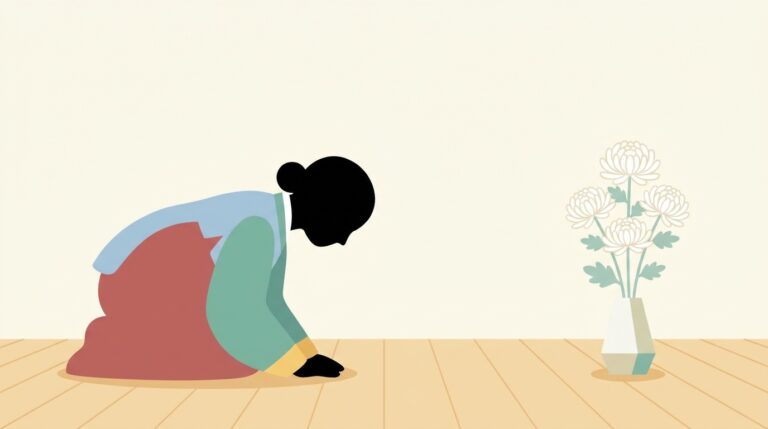
Imagine this: You are watching a touching K-Drama, and a character enters a funeral hall. They wear black, stand before a portrait surrounded by white chrysanthemums, and then… they bow deeply to the floor. But wait! They don’t just bow once. They bow exactly twice (and add a small half-bow at the end).
If you have ever wondered, “Why do they bow twice?” or “What do I do if I attend a Korean funeral?”—you are in the right place! Attending a funeral in a foreign country can feel intimidating because you want to show respect without making mistakes. Today, we will learn the essential phrase for paying respects and understand the unique cultural etiquette of bowing twice (절 두 번, Jeol du beon) in a super simple, A1-friendly way. Let’s dive in together, step by step!
Phase 2: Top 3 Essential Expressions
Here are the three most important, beginner-friendly expressions you need to know for a Korean funeral.
1. 삼가 고인의 명복을 빕니다 (Sam-ga go-in-ui myeong-bok-eul bim-ni-da)
- Pronunciation: Sahm-gah go-een-wee myeong-bohk-eul beem-nee-dah (Think: “Sahm-gah” like the musical scale ‘Sol-La-Si-Do‘ but softer, and “beem-nee-dah” like a gentle hum)
- Meaning: “Please accept my deepest condolences” (Literally: “I humbly pray for the deceased’s happiness in the next world.”)
- K-Culture Moment: This is the ultimate formal phrase you will see written on funeral wreaths or spoken quietly to the grieving family in every K-drama.
- Editor’s Insight: This is a highly formal, respectful phrase. When you say it, lower your head slightly. It is best spoken in a low, gentle voice.
- Situation Spectrum: Casual: 🚫 | Semi-formal: ⚠️ | Formal: ✅
- 🤔 Think About It: In Korean culture, wishing peace for someone in the afterlife is a deep form of respect. How does your culture wish peace to those who have passed away?
2. 절 두 번 (Jeol du beon)
- Pronunciation: Jol doo boon (Think: “Jol” like ‘jolt’ without the ‘t’, and “du” like the number ‘two’)
- Meaning: Bowing twice
- K-Culture Moment: In Korean tradition, we bow twice to the deceased person (as they belong to the spirit world) and once to the living family members.
- Editor’s Insight: Remember this golden rule: 2 bows for the deceased, 1 bow for the living. Doing it wrong (like bowing twice to the living) is a major social slip-up, so take a deep breath and keep this in mind!
- Situation Spectrum: Casual: 🚫 | Semi-formal: ⚠️ | Formal: ✅
- 🤔 Think About It: Why do you think Korean culture separates customs for the living and the deceased so strictly?
3. 위로해 드립니다 (Wi-ro-hae deu-rim-ni-da)
- Pronunciation: Wee-roh-hae deu-reem-nee-dah (Think: “Wee-roh” like ‘hero’ with a ‘W’)
- Meaning: “I offer my condolences / I comfort you.”
- K-Culture Moment: A simpler, heartfelt phrase you can say while looking gently into the eyes of a grieving friend.
- Editor’s Insight: This is easier to pronounce than “삼가 고인의 명복을 빕니다” and feels very warm and personal.
- Situation Spectrum: Casual: ⚠️ | Semi-formal: ✅ | Formal: ✅
- 🤔 Think About It: Sometimes, a simple and sincere word of comfort is more powerful than a long, complex speech.
Phase 3: Textbook Korean vs. Real Korean
Let’s compare how textbooks teach condolences versus how Koreans actually express them to keep it natural.
Situation 1: Offering official condolences to the family
- 📖 Textbook Korean: 축하합니다 (Chuk-ha-ham-ni-da – Congratulations) ❌ Never use this! This is a common beginner mix-up with sad events!
- 🗣️ Real Korean: 삼가 고인의 명복을 빕니다 (Sam-ga go-in-ui myeong-bok-eul bim-ni-da) ✅
- 💡 Why the difference? Beginners sometimes panic and blurt out the only formal phrase they know (which is often ‘congratulations’). Always pause and use the correct condolence phrase.
Situation 2: Comforting a close friend who lost a loved one
- 📖 Textbook Korean: 슬퍼하지 마세요 (Seul-peo-ha-ji ma-se-yo – Don’t be sad) ❌
- 🗣️ Real Korean: 힘내세요. 마음이 많이 아프시겠어요. (Him-nae-se-yo. Ma-eum-i man-i a-peu-si-get-eo-yo. – Stay strong. Your heart must hurt so much.) ✅
- 💡 Why the difference? Telling someone “don’t be sad” can feel dismissive. Acknowledging their pain (“your heart must hurt”) shows true empathy (정, Jeong).
Phase 4: K-Culture Deep Dive & Non-Verbal Manners
4-1. Nunchi (눈치) & Gesture Guide
- Hand Placement (Gongsu – 공수): When bowing at a funeral, put your hands together in front of your waist. For men: The right hand goes over the left hand. For women: The left hand goes over the right hand. (Note: This is the opposite of happy occasions like New Year’s!).
- The Half Bow: After doing your two deep bows (kneeling down on the floor), stand up straight and finish with a small, respectful half-bow (bending your waist about 30 degrees).
4-2. Cultural Code: Why Two Bows?
In traditional Korean culture (influenced by Confucianism and Yin-Yang philosophy), the number one represents Yang (the living, active world), and the number two represents Yin (the yin world of the deceased). Therefore, we bow twice to honor the spirit of the deceased, but only once to the living family members when we greet them afterward.
Phase 5: Real-Life Roleplay Scenario
Setting: You are attending the funeral of your Korean friend Minjun’s grandmother to show your respects.
Characters:
- You (A1 Learner) (Polite, quiet, and trying your best)
- Minjun (Korean Friend) (Grieving, but deeply touched that you came)
- Turn 1 (Minjun): (With a tired, sad face) 와줘서 고마워요.
(Wa-jwo-seo go-ma-wo-yo.)
“Thank you for coming.” - Turn 2 (You): 🎭 (Bow head slightly) 삼가 고인의 명복을 빕니다.
(Sam-ga go-in-ui myeong-bok-eul bim-ni-da.)
“Please accept my deepest condolences.” - Turn 3 (Minjun): (Nods gratefully) 정말 큰 힘이 돼요. 저기서 절 하시면 돼요.
(Jeong-mal keun him-i dwae-yo. Jeo-gi-seo jeol ha-si-myeon dwae-yo.)
“It really gives me strength. You can bow over there.” - Turn 4 (You): 🎭 (Walk to the portrait, burn a piece of incense, and prepare your hands) 절 두 번 할게요.
(Jeol du beon hal-ge-yo.)
“I will bow twice.” - Turn 5 (Minjun): (Watches respectfully as you perform the two deep bows and the half-bow) 감사합니다.
(Gam-sa-ham-ni-da.)
“Thank you.” - Turn 6 (You): 🎭 (Turn to Minjun and perform one bow to him) 많이 힘들지요? 힘내세요.
(Man-i him-deul-ji-yo? Him-nae-se-yo.)
“It must be very hard, right? Stay strong.” - Turn 7 (Minjun): (Wipes a tear) 고마워요. 진짜 고마워요.
(Go-ma-wo-yo. Jin-jya go-ma-wo-yo.)
“Thank you. Thank you so much.” - Turn 8 (You): 위로해 드립니다.
(Wi-ro-hae deu-rim-ni-da.)
“I offer my comfort to you.”
🔀 Choose Your Action!
- Option A: You bow twice to the portrait, and then bow twice to your friend Minjun.
- Option B: You do one bow to the portrait, and then two bows to Minjun.
- Option C: You do two bows to the portrait, and then one bow to Minjun.
Feedback:
- If you chose A (Risk): Oh no! Bowing twice to a living person is considered very unlucky (as if wishing death upon them). Minjun might feel shocked!
- If you chose B (Bad): This is the exact opposite of the custom! Remember: 2 for the deceased, 1 for the living.
- If you chose C (Best!): Perfect! You nailed the Korean funeral etiquette. You showed great cultural respect!
Phase 6: 10-Second Emotion Shadowing Drill
Practice saying these with the correct emotion and pauses (/ marks a short pause for breath).
[🥺 Deeply sincere and quiet]
삼가 / 고인의 / 명복을 / 빕니다.
(Sam-ga / go-in-ui / myeong-bok-eul / bim-ni-da)-
[😔 Comforting and warm]
많이 / 힘들지요? / 힘내세요.
(Man-i / him-deul-ji-yo? / Him-nae-se-yo)
Phase 7: K-Culture Mini Dictionary
- 조문 (Jo-mun): Paying condolences / attending a funeral.
- 절 (Jeol): A traditional formal bow.
- 향 (Hyang): Incense (used to purify the space before bowing).
- 상주 (Sang-ju): The chief mourner (usually the eldest son or close family member hosting the funeral).
Phase 8: Traveler’s Survival Kit
Survival Vocab TOP 3
- 장례식장 (Jang-rye-sik-jang): Funeral hall / Funeral home
- 부의금 (Bu-ui-geum): Condolence money (usually put in a white envelope with your name written vertically on the back)
- 검은색 옷 (Geom-eun-saek ot): Black clothes (The standard dress code)
Editor’s Travel Note 📌
If you need to find a funeral hall in Korea, they are usually located in the basement levels of large hospitals. You can easily search for hospital locations using Naver Map App.
Note: Funeral details can change quickly; always double-check with close friends before visiting.
Phase 9:
Frequently Asked Questions (FAQ)
Q: What does "삼가 고인의 명복을 빕니다 (Sam-ga go-in-ui myeong-bok-eul bim-ni-da)" mean in Korean and how do you pronounce it?
A: In Korean, "삼가 고인의 명복을 빕니다 (Sam-ga go-in-ui myeong-bok-eul bim-ni-da)" is pronounced [Sahm-gah go-een-wee myeong-bohk-eul beem-nee-dah (Think: "Sahm-gah" like the musical scale 'Sol-La-Si-Do' but softer, and "beem-nee-dah" like a gentle hum] and means: "Please accept my deepest condolences" (Literally: "I humbly pray for the deceased's happiness in the next world.")
Q: What does "절 두 번 (Jeol du beon)" mean in Korean and how do you pronounce it?
A: In Korean, "절 두 번 (Jeol du beon)" is pronounced [Jol doo boon (Think: "Jol" like 'jolt' without the 't', and "du" like the number 'two'] and means: Bowing twice
Q: What does "위로해 드립니다 (Wi-ro-hae deu-rim-ni-da)" mean in Korean and how do you pronounce it?
A: In Korean, "위로해 드립니다 (Wi-ro-hae deu-rim-ni-da)" is pronounced [Wee-roh-hae deu-reem-nee-dah (Think: "Wee-roh" like 'hero' with a 'W'] and means: "I offer my condolences / I comfort you."







