

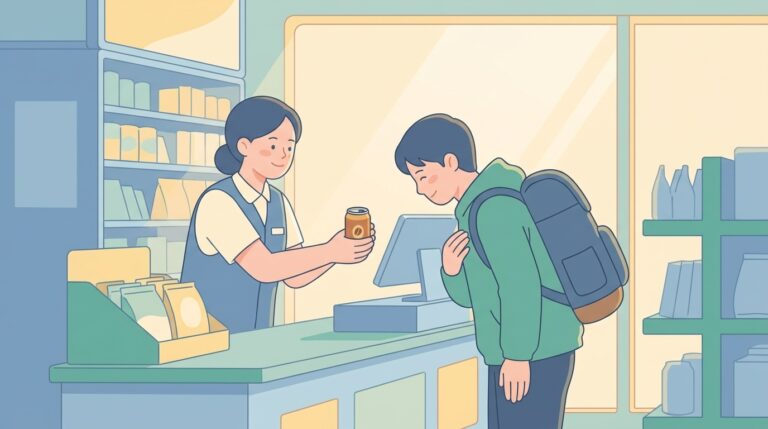
Helping Hands: How to Say “Thank You for Your Help” in Korean Like a True Native
Phase 1: Empathy (An Open Letter from Your Korean Bestie)
안녕하세요! (Annyeonghaseyo!) It’s your K-culture navigator and Daily Hangul editor here!
Imagine this: You are at a bustling train station in Seoul, staring blankly at the ticketing machine. Your train leaves in five minutes, and you are completely lost. Suddenly, a kind passerby notices your panic, steps in, taps the screen a few times, and secures your ticket. Your heart swells with gratitude. You want to say something much warmer than a simple, textbook “Kamsa-hamnida,” but your mind goes blank.
We’ve all been there! Many of our intermediate learners tell us, “I know how to say thank you, but I don’t know how to express deep gratitude when someone actually goes out of their way to help me.”
Today, we are moving past the basic “thank you” and diving into the art of expressing sincere gratitude and appreciation (감사와 보답). By the end of this guide, you’ll know exactly how to make a Korean helper smile and feel genuinely appreciated. Let’s dive in!
Phase 2: Deep-Dive into 3 Essential Expressions
1. 도와주셔서 진심으로 감사합니다 (Do-wa-ju-syeo-seo jin-sim-eu-ro gam-sa-ham-ni-da)
- Pronunciation: Doh-wah-joo-shyeo-seo jeen-sheem-eu-roh gahm-sah-hahm-nee-dah (Think of “jin-sim” as “jean-seam” which means “sincerity”).
- Meaning: “Thank you from the bottom of my heart for helping me.”
- K-Culture Moment: You hear this constantly in K-Dramas when a main character gets rescued from a difficult legal or financial situation by a mentor or a lawyer. It’s polished, deeply respectful, and incredibly warm.
- Editor’s Insight: The magic word here is 진심으로 (jin-sim-eu-ro), which means “with my whole heart” or “sincerely.” Adding this before “thank you” elevates your gratitude from a polite reflex to a heartfelt confession.
- Situation Spectrum: Casual (🚫) | Semi-formal (⚠️) | Formal (✅)
- 🤔 Think About It: In your culture, do you usually specify how someone helped you when thanking them, or do you keep it general? Korean appreciation often highlights the specific act of help.
2. 덕분에 살았어요 (Deok-bun-e sal-as-eo-yo)
- Pronunciation: Deok-boon-eh sahl-as-uh-yoh (Sounds like “Duck-boon-eh” + “sahl-us-yo”).
- Meaning: “You saved my life!” / “Thanks to you, I survived.”
- K-Culture Moment: Think of variety shows like Running Man or 2 Days & 1 Night. When one member shares food or gives a hint to another struggling member, the receiver dramatically sighs, “덕분에 살았어요!”
- Editor’s Insight: While it literally translates to “I survived thanks to you,” it is used in everyday, non-life-threatening situations. It’s a wonderful, slightly dramatic way to show huge relief and gratitude to coworkers, classmates, or friends.
- Situation Spectrum: Casual (✅ – 덕분에 살았어) | Semi-formal (✅) | Formal (⚠️)
- 🤔 Think About It: Why do you think Koreans use survival metaphors (“I lived!”) to show appreciation? It shows how deeply we value communal support!
3. 어떻게 보답해야 할지 모르겠어요 (Eo-tteoh-ge bo-dap-hae-ya hal-ji mo-reu-ges-eo-yo)
- Pronunciation: Uh-ttuh-keh boh-dahp-hae-yah hahl-jee moh-roo-get-suh-yoh.
- Meaning: “I don’t know how to repay your kindness.”
- K-Culture Moment: This is the ultimate line when someone receives an unexpected, generous gift or a life-changing favor in a drama.
- Editor’s Insight: 보답 (Bo-dap) means “repayment” or “returning a favor.” In Korea’s relationship-centric society, receiving help means you acknowledge the debt of kindness and wish to return it in the future. Saying you “don’t know how to repay” actually shows great manners!
- Situation Spectrum: Casual (🚫) | Semi-formal (✅) | Formal (✅)
- 🤔 Think About It: Is “paying back” a favor considered polite or transactional in your home country? In Korea, keeping the cycle of favors going is the glue of relationships.
Phase 3: Textbook Korean vs. Real Korean
Let’s compare what the old textbooks teach you versus how modern Koreans actually speak.
Scenario A: Your classmate helped you study for a tough exam.
- 📖 Textbook Korean: 도와주어서 감사합니다. (Do-wa-ju-eo-seo gam-sa-ham-ni-da. – Too stiff for classmates.)
- 🗣️ Real Korean: 아, 진짜 고마워! 너 아니었으면 큰일 날 뻔했다. (Ah, jin-jja go-ma-wo! Neo a-ni-eot-seu-myeon keun-il nal ppeon-haet-da. – “Ah, thank you so much! If it weren’t for you, I would’ve been in huge trouble!”)
- 💡 Why it’s different: Close friends emphasize how much trouble they would have been in without the other person, which sounds much more affectionate than a formal “thank you.”
Scenario B: A colleague stayed late to help you finish a project.
- 📖 Textbook Korean: 당신의 원조에 감사드립니다. (Dang-sin-ui won-jo-e gam-sa-deu-rim-ni-da. – Sounds like a translation of “Thank you for your aid” and is incredibly unnatural.)
- 🗣️ Real Korean: 선배님, 바쁘신데 도와주셔서 진짜 감사해요. 제가 조만간 커피 한잔 살게요! (Seon-bae-nim, ba-ppeu-sin-de do-wa-ju-syeo-seo jin-jja gam-sa-hae-yo. Je-ga jo-man-gan keo-pi han-jan sal-ge-yo! – “Senior, thank you so much for helping me even though you are busy. I’ll buy you a coffee soon!”)
- 💡 Why it’s different: Real Koreans almost always couple a thank-you with a concrete promise of small hospitality, usually coffee or a meal.
Phase 4: K-Culture Deep-Dive & Non-Verbal Etiquette
4-1. Bowing and the “Soft Smile”
When saying “도와주셔서 진심으로 감사합니다,” your body language does 70% of the talking.
* The Angle: A slight 15-to-30-degree bow from the waist is perfect. Keep your hands neatly folded in front of you or down at your sides.
* The Eye Contact: Do not lock eyes while bowing. Look down slightly, and as you rise, make soft eye contact and smile warmly.
4-2. The “Coffee/Meal” Reciprocity
In Korea, “Thank you” is rarely just verbal. If someone helped you move, helped you study, or assisted you with office work, the golden rule of Jeong (정 – affection/bonding) dictates that you buy them coffee. Sending a small KakaoTalk gift coupon (like a Starbucks Americano) with a message saying “덕분에 살았어요!” is the ultimate modern Korean way to show gratitude.
Phase 5: Real-Life Roleplay Scenario
The Setup: You are at a trendy cafe in Seoul. You accidentally dropped your wallet under a heavy, immovable wooden table. Min-ho, a kind cafe barista, notices your struggle, moves the heavy furniture, and retrieves your wallet.
Character
- Min-ho (민호): A helpful, friendly barista in his mid-20s.
Script
- You: 🎭 (Anxiously searching under the table) 저기요, 죄송한데 지갑이 이 밑으로 들어갔어요.
(Jeo-gi-yo, joe-song-han-de ji-gap-i i mit-eu-ro deul-eo-gat-eo-yo.)
“Excuse me, I’m sorry, but my wallet went under here.” - Min-ho: 🎭 (Smiling warmly, rolling up his sleeves) 아, 진짜요? 제가 테이블 한번 밀어볼게요. 잠시만요!
(Ah, jin-jja-yo? Je-ga te-i-beul han-beon mir-eo-bol-ge-yo. Jam-si-man-yo!)
“Oh, really? Let me try pushing the table. Just a moment!” - You: 🎭 (Watching him pull the heavy table) 헉, 너무 무거운데… 조심하세요!
(Heok, neo-mu mu-geoun-de… jo-sim-ha-se-yo!)
“Oh, it’s so heavy… please be careful!” - Min-ho: 🎭 (Grunting slightly, picking up the wallet and handing it to you) 자, 여기 있습니다. 다행히 먼지만 좀 묻었네요.
(Ja, yeo-gi is-seup-ni-da. Da-haeng-hi meon-ji-man jom mud-eot-nae-yo.)
“Here you go. Fortunately, it just got a little dusty.” - You: 🎭 (Bowing deeply, holding the wallet) 도와주셔서 진심으로 감사합니다!
(Do-wa-ju-syeo-seo jin-sim-eu-ro gam-sa-ham-ni-da!)
“Thank you from the bottom of my heart for helping me!” - Min-ho: 🎭 (Waving hands dismissively, smiling) 아닙니다, 당연한 일을 한 걸요. 지갑 안 잃어버리셔서 다행이에요.
(An-ip-ni-da, dang-yeon-han il-eul han geol-yo. Ji-gap an il-eo-beo-ri-syeo-seo da-haeng-i-e-yo.)
“No worries, I just did what anyone would do. I’m glad you didn’t lose your wallet.” - You: 🎭 (Sighing with relief, smiling) 진짜 바쁘신 와중에… 덕분에 살았어요!
(Jin-jja ba-ppeu-sin wa-jung-e… deok-bun-e sal-as-eo-yo!)
“Seriously, in the middle of your busy hours… you saved my life!” - Min-ho: 🎭 (Laughing cheerfully) 별말씀을요. 남은 하루 좋은 시간 보내세요!
(Byeol-mal-sseum-eul-yo. Nam-eun ha-ru jo-eun si-gan bo-nae-se-yo!)
“Don’t mention it. Have a great rest of your day!”
🔀 Choose Your Next Move!
What will you say to Min-ho next to solidify your friendship?
* A. “저… 번호 좀 주실래요?” (Can I have your phone number?)
* B. “정말 감사합니다. 이거 마시면서 일하세요!” (Thank you so much. Please drink this while working! – while handing him an unopened beverage you just bought)
* C. “아니요, 괜찮습니다.” (No, it’s fine.)
Feedback on Your Choice:
- Selection A (Risk): Bold! Unless you want to turn this into a K-drama romance right away, asking for a number directly might startle a working barista.
- Selection B (Best): Excellent! Handing a small treat or ordering another drink as a gesture of thanks is the absolute peak of polite Korean culture.
- Selection C (Bad): Uh-oh. “No, it’s fine” is used to decline offers. Saying this after he helped you sounds extremely cold and dismissive.
Phase 6: 10-Second Emotion Shadowing Drill
To sound natural, you need to practice your intonation. The / indicates a micro-pause, and the bracket indicates the emotion you must channel.
- [🥺 Exhausted but deeply grateful]
아… / 진짜 / 덕분에 / 살았어요.
(Ah… / jin-jja / deok-bun-e / sal-as-eo-yo.) -
[😊 Bright, polite, and energetic]
바쁘실 텐데 / 도와주셔서 / 진심으로 / 감사합니다!
(Ba-ppeu-sil ten-de / do-wa-ju-syeo-seo / jin-sim-eu-ro / gam-sa-ham-ni-da!)
Phase 7: K-Culture Mini Dictionary
- 은혜 (Eun-hye) | Grace / Favour / Debt of Gratitude | Used when someone does something life-altering for you. You “repay an eun-hye” (은혜를 갚다).
- 생명의 은인 (Saeng-myeong-ui eun-in) | Life Saver | Dramatically used to describe someone who helped you in a tight spot, like passing you a cheat sheet (jokingly) or finding your passport.
- 한턱 쏘다 (Han-teok sso-da) | To treat someone to a meal/drink | The universal way of saying “I will pay for your food/drink as a thank you!”
- 꾸벅 (Kku-beok) | Sound/visual of bowing deeply | Frequently used in text messages as a cute emoji-like word: “감사합니다 꾸벅 (-_-)(____-__-)”.
Phase 8: Survivor Kit for Travelers
If you are on a short trip to Korea, memorize these three phrases to use when locals help you on the street:
- 길 알려주셔서 정말 감사해요!
- Gil al-lyeo-ju-syeo-seo jeong-mal gam-sa-hae-yo!
- Pro Tip: Use this when a local guides you to your destination.
- 덕분에 잘 찾았어요!
- Deok-bun-e jal chat-as-eo-yo!
- Pro Tip: Use this when you finally find a restaurant or shop with someone’s help.
- 도와주셔서 감동받았어요.
- Do-wa-ju-syeo-seo gam-dong-bad-as-eo-yo.
- Pro Tip: Means “I’m touched by your help.” Perfect for when someone goes above and beyond.
📌 Editor’s Travel Note: To navigate Korea like a pro, skip Google Maps (which doesn’t work well) and use Naver Map App instead. If you get lost and a local helps you navigate, use the phrases above!
Phase 9: “Going One Step Deeper”
In many Western cultures, a simple “thank you” is enough to balance the ledger of social interactions. In Korea, however, relationships are seen as ongoing and interconnected. When you say “도와주셔서 진심으로 감사합니다,” you are not just closing a transaction; you are opening a door. Asking for someone’s help and showing deep gratitude is actually a key way of building Jeong (정). By showing that you rely on others and deeply appreciate them, you transition from a “foreigner” to a “friend.”
💬 Your Turn: Have you ever received unexpected help from a stranger in Korea or elsewhere? How did you react? Leave a comment below!
Phase 10: FAQ & Common Mistakes
Q: Can I use “도와줘서 고마워” (Do-wa-jwo-seo go-ma-wo) to older people?
A: Absolutely not! This is casual language (반말). Using this with someone older, a boss, or a stranger will make you sound incredibly rude. Always stick to “도와주셔서 감사합니다” for people you aren’t close with.
Q: How do I reply when someone says “감사합니다” to me?
A: You can say “아닙니다. 별말씀을요” (No problem, don’t mention it) or a simple “천만에요” (You’re welcome, though this is a bit textbook-ish). A simple “아니에요~” (Oh, it’s nothing) with a smile is the most common modern reply!
Q: What is the difference between 고맙습니다 (Go-map-seup-ni-da) and 감사합니다 (Gam-sa-ham-ni-da)?
A: Both are polite! However, “감사합니다” (derived from Chinese characters) is slightly more formal and official, while “고맙습니다” (pure Korean) sounds a bit warmer and softer.
🚨 Common Mistakes Alert!
- Saying “감사해요” (Gam-sa-hae-yo) to your company CEO: It’s polite, but slightly too casual for high-ranking corporate settings. Use “감사드립니다” instead.
- Bowing while shaking hands: Do not bow while holding someone’s hand. Bow first, then extend your hand for a handshake, or vice versa!
- Translating “Thank you for your trouble” as “당신의 수고에 감사합니다”: This sounds very awkward. Use “수고하셨습니다” instead!
Phase 11: Action Mission
- Bronze Medal: Write down “도와주셔서 진심으로 감사합니다” in your notebook three times while saying it out loud with a soft bow.
- Silver Medal: Head to Instagram or Twitter, find a post of your favorite Korean actor or idol, and leave a comment thanking them for their hard work: “항상 좋은 에너지 주셔서 진심으로 감사합니다!” (Thank you from the bottom of my heart for always giving us good energy!)
- Gold Medal: The next time you order food or buy something from a convenience store in Korea, look the worker in the eyes, bow slightly, and say: “감사합니다, 수고하세요!” (Thank you, keep up the good work!).
Phase 12: Interactive Quiz Challenge
Test your knowledge! Click on the toggle to check your answers.
1. Which phrase is best used when a colleague stayed up late to help you finish a heavy workload?
- A) 도와줘서 고마워
- B) 덕분에 살았어요! 진짜 감사합니다.
- C) 은혜를 갚으세요.
🔍 Show Answer & Explanation
Correct Answer: B
* Explanation: B expresses both intense relief (“덕분에 살았어요”) and polite gratitude (“진짜 감사합니다”). A is too casual for work, and C actually commands the other person to repay you, which is completely backward!
2. True or False: “진심으로” (jin-sim-eu-ro) means “with professional courtesy.”
- True
- False
🔍 Show Answer & Explanation
Correct Answer: False
* Explanation: “진심으로” means “with all my heart” or “sincerely,” indicating emotional depth, not just professional courtesy.







