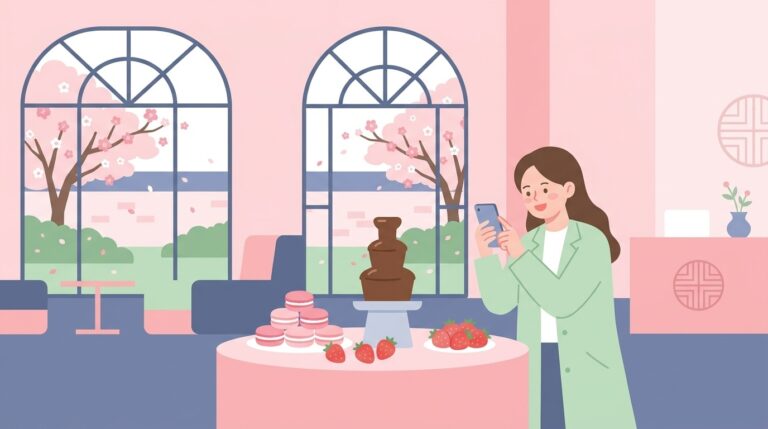
Welcome to Daily Hangul! 🌸 Strawberry Buffet Edition
안녕하세요! I’m your Korean cultural navigator and senior editor at Daily Hangul.
Spring in Korea is not just about cherry blossoms—it’s also about strawberry overload! From late February to May, Korea goes absolutely crazy for strawberries (딸기 – ttal-gi). The pinnacle of this spring craze is the luxurious Hotel Strawberry Buffet (딸기 뷔페).
Have you ever dreamed of booking a table at a fancy Seoul hotel, surrounded by towering strawberry towers, macarons, and chocolate fountains, only to feel anxious about making the reservation or talking to the staff? “Do I need to pay in advance?” “How do I ask for more coffee?” If these questions make you sweat, don’t worry! Today, we’ll master the exact expressions you need to confidently conquer a Korean strawberry buffet like a true local.
Phase 2: Top 3 Must-Know Expressions
1. 예약하기 진짜 하늘의 별 따기예요 (ye-yak-ha-gi jin-jja ha-neul-ui byeol tta-gi-yeo-yo)
- Pronunciation: ye-yakh-a-gi jin-jja ha-neul-eui byeol tta-gi-yeo-yo (Sounds like: “ye-yak-ha-gee jin-ja han-ul-phee byeol tta-gee-yo”)
- Meaning: Making a reservation is like plucking a star from the sky (extremely difficult).
- K-Culture Moment: You will hear this expression in lifestyle K-Dramas or YouTube vlogs when characters try to book popular concert tickets, hot restaurants, or yes, the famous hotel strawberry buffets that sell out in seconds!
- Editor’s Insight: ‘하늘의 별 따기’ is a beautiful Korean idiom. When you add ‘진짜’ (really) and ‘예약하기’ (making a reservation), it perfectly captures the extreme competitiveness of Korean reservation culture (티켓팅 – ticketing).
- Situation Spectrum: Casual ✅ | Semi-formal ✅ | Formal ⚠️
- 🤔 Think About It: In your country, what idiom do you use when something is incredibly hard to book or buy? Is it also related to nature like “plucking stars”?
2. 본전 뽑아야죠! (bon-jeon ppop-a-ya-jyo)
- Pronunciation: bon-jeon ppob-ah-yah-jyo (Sounds like: “bon-jeon pwo-ba-yah-jyo”)
- Meaning: We have to get our money’s worth! / We must make it worth the cost!
- K-Culture Moment: On Korean food variety shows (like Tasty Guys), guests shout this right before entering an all-you-can-eat buffet.
- Editor’s Insight: ‘본전’ means the principal or original cost, and ‘뽑다’ means to pull out or extract. Saying “본전 뽑아야죠!” shows a playful, determined attitude to eat enough delicious food to justify the expensive buffet ticket.
- Situation Spectrum: Casual ✅ | Semi-formal ✅ | Formal 🚫
- 🤔 Think About It: How does your culture view the concept of “getting your money’s worth” at a feast? Is it spoken about openly and playfully like in Korea?
3. 디저트 배는 따로 있어요 (di-jeo-teu bae-neun tta-ro is-seo-yo)
- Pronunciation: dee-juh-teu bae-neun tta-ro eet-suh-yo (Sounds like: “de-juh-teu bae-neun tta-ro ee-so-yo”)
- Meaning: I have a separate stomach for dessert.
- K-Culture Moment: After a heavy meal of Korean BBQ, your Korean friends will inevitably say this while dragging you to a trendy dessert cafe.
- Editor’s Insight: ‘배’ (bae) means stomach in this context. Koreans firmly believe that no matter how full you are from savory food, your body magically creates space when sweets appear!
- Situation Spectrum: Casual ✅ | Semi-formal ✅ | Formal ⚠️
- 🤔 Think About It: Does your native language have a funny anatomical excuse for eating sweets after a full meal?
Phase 3: Textbook Korean vs. Real-Life Korean
Situation 1: Asking if a reservation is required
- 📖 Textbook: 예약을 해야 합니까? (ye-yak-eul hae-ya hap-ni-kka? – Is it mandatory to make a reservation?)
- 🗣️ Real-Life: 예약 필수예요? (ye-yak pil-su-yeo-yo? – Is a reservation required/essential?)
- 💡 Why the difference? Textbook Korean uses heavy, formal grammatical structures. In real life, Koreans combine ‘예약’ (reservation) and ‘필수’ (essential/must) into a punchy, conversational phrase.
Situation 2: Asking the staff to clear empty plates
- 📖 Textbook: 빈 접시를 치워 주십시오. (bin jeop-si-reul chi-wo ju-sip-si-o. – Please clear the empty plate.)
- 🗣️ Real-Life: 이것 좀 치워 주시겠어요? (i-geot jom chi-wo ju-si-ges-seo-yo? – Could you clear this for me, please?)
- 💡 Why the difference? Directly ordering someone to do something sounds too cold. Using ‘좀’ (softener) and ‘-주시겠어요?’ (polite request) sounds much warmer and naturally polite to service workers.
Phase 4: K-Culture Deep Dive & Non-Verbal Etiquette
4-1. The “Nunchi” of Buffet Photography 📸
At a premium Korean strawberry buffet, the aesthetics are just as important as the taste. The moment the buffet opens, there is an unwritten rule: Photo Time first, Eating second.
* The Gesture: Do not immediately grab the tongs and ruin the pristine tower of strawberry cakes. Instead, stand politely in line, take your aesthetic Instagram photos or videos, and wait until everyone has had a chance to capture the “unopened” beauty. When you are ready to take food, use both hands to hold the plate and tongs as a subtle sign of mindfulness.
4-2. The “Small Luxury” (소확행) Culture
Strawberry buffets in Seoul hotels usually cost between 80,000 to 130,000 KRW (approx. $60–$100 USD) per person. Why do young Koreans queue up for this? It’s called 소확행 (so-hwak-haeng – small but certain happiness) and 스몰 럭셔리 (Small Luxury). Instead of saving up for distant big purchases, Gen Z and Millennials in Korea treat themselves to a high-end afternoon tea experience to destress and feel pampered.
Phase 5: Real-Life Roleplay Scenario
Setting: The gorgeous lounge of a luxury hotel in Yeouido, Seoul. Pink decorations are everywhere. You are meeting your Korean friend, Minji, who managed to get a highly competitive slot.
Characters:
- 민지 (Minji): Your enthusiastic K-friend who loves taking photos.
- 직원 (Staff): The ultra-polite hotel server.
- You: A passionate foodie ready to experience your first strawberry buffet.
Dialogue:
- 민지: 와! 여기 진짜 예쁘죠? 예약하기 진짜 하늘의 별 따기였어요!
(Wa! yeo-gi jin-jja ye-ppeu-jyo? ye-yak-ha-gi jin-jja ha-neul-ui byeol tta-gi-yeot-seo-yo!)
(Wow! Isn’t this place so pretty? Getting this reservation was seriously like plucking stars!) - You: 🎭 (Clasping your hands in excitement)
민지 씨 덕분에 드디어 왔네요! 오늘 진짜 본전 뽑아야죠!
(Min-ji ssi deok-bun-e deu-di-eo wat-nae-yo! o-neul jin-jja bon-jeon ppop-a-ya-jyo!)
(Thanks to you, I’m finally here! Today, we seriously have to get our money’s worth!) - 민지: 🎭 (Laughs and points at the chocolate fountain)
당연하죠! 자, 음식 가져오기 전에 사진부터 먼저 찍을까요?
(Dang-yeon-ha-jyo! ja, eum-sik ga-jeo-o-gi jeon-e sa-jin-bu-teo meon-jeo jji-geul-kka-yo?)
(Of course! Now, shall we take photos first before grabbing the food?) - You: 좋아요! 저 딸기 타워 앞에서 한 장 찍어 주세요.
(Jo-a-yo! jeo ttal-gi ta-wo ap-e-seo han jang jji-geo ju-se-yo.)
(Great! Please take a picture of me in front of that strawberry tower.) - 직원: 🎭 (Approaching with a smile)
고객님, 식사 먼저 도와드리겠습니다. 웰컴 드링크는 어떤 것으로 하시겠습니까?
(Go-gaek-nim, sik-sa meon-jeo do-wa-deu-ri-ges-seup-ni-da. wel-keom deu-ring-keun-eun eo-tteon geot-eu-ro ha-si-ges-seup-ni-da?)
(Guests, I will assist you with your meal. Which welcome drink would you prefer?) - You: 딸기 에이드로 두 잔 주세요. 감사합니다!
(Ttal-gi e-i-deu-ro du jan ju-se-yo. gam-sa-hap-ni-da!)
(Two strawberry ades, please. Thank you!) - 민지: 🎭 (After eating 3 plates of desserts)
아… 배불러서 이제 더 못 먹겠어요.
(Ah… bae-bul-leo-seo i-je deo mot meok-ges-seo-yo.)
(Ah… I’m so full, I can’t eat anymore.) - You: 에이, 왜 그래요? 디저트 배는 따로 있어요! 케이크 한 조각 더 하실래요?
(E-i, wae geu-rae-yo? di-jeo-teu bae-neun tta-ro is-seo-yo! ke-i-keu han jo-gak deo ha-sil-rae-yo?)
(Hey, come on! We have a separate stomach for dessert! Want another slice of cake?)
🔀 Interactive Choice Point
The staff member comes to clear the table, but you still have one last premium strawberry macaron on your plate. What do you say?
- Choice A: “이거 치우지 마세요!” (i-geo chi-u-ji ma-se-yo!)
- Choice B: “아직 먹고 있어요. 그냥 두세요.” (a-jik meok-go is-seo-yo. geu-nyang du-se-yo.)
- Choice C: “아, 이건 아직 먹는 중이라서요. 감사합니다!” (a, i-geon a-jik meok-neun jung-i-ra-seo-yo. gam-sa-hap-ni-da!)
Feedback:
- Choice A (Risk): Too blunt! It translates to “Don’t clear this!” and can sound demanding or angry to service staff.
- Choice B (Bad): While grammatically correct, “Just leave it” (그냥 두세요) sounds cold and a bit dismissive.
- Choice C (Best! 🎉): Perfectly polite! It gently explains, “Ah, I am still eating this. Thank you!” showing supreme respect to the server.
Phase 6: 10-Second Emotion Shadowing Drill
Practice speaking like a native speaker by focusing on natural pauses (/) and emotional delivery!
- [😊 Expressing excited determination]
오늘 / 진짜 / 본전 / 뽑아야죠!
(o-neul / jin-jja / bon-jeon / ppop-a-ya-jyo!) -
[😜 Teasingly energetic]
에이, / 걱정 마세요! / 디저트 배는 / 따로 있어요!
(e-i, / geok-jeong ma-se-yo! / di-jeo-teu bae-neun / tta-ro is-seo-yo!)
Phase 7: K-Culture Mini-Dictionary
- 생딸기 (Saeng-ttal-gi) | Fresh Strawberries | Unlike processed flavorings, Korean buffets pride themselves on serving premium, organic fresh strawberries.
- 인증샷 (In-jeung-syat) | Proof Shot / Photo Evidence | A slang word for taking a photo to prove you visited a cool place or did something fun to share on social media.
- 대기 (Dae-gi) | Waiting / Standby | The waiting list status you will encounter if you don’t book your buffet ticket in advance.
- 시즌 한정 (Si-jeun Han-jeong) | Seasonal Limited Edition | Since strawberries only peak in spring, these buffets are strictly seasonal and close by late spring.
Phase 8: Survivor Kit for Travelers
Top 3 Survival Phrases
- 이거 예약금 있어요? (i-geo ye-yak-geum is-seo-yo?) | Is there a deposit fee for this reservation?
- Pro Tip: Most high-end hotel buffets in Seoul require a deposit via booking apps.
- 주차 등록 되나요? (ju-cha deung-rok doe-na-yo?) | Can I register my car for free parking?
- 접시 좀 치워 주시겠어요? (jeop-si jom chi-wo ju-si-ges-seo-yo?) | Could you please clear the plates?
🗺️ Editor’s Travel Note
Booking these buffets can be tricky for foreign travelers because many hotels use local apps like Catch Table (캐치테이블). To make your life easier, download the Catch Table Global App which supports English and foreign phone registration. Make sure to check reservation opening dates, which are usually announced on the hotel’s official Instagram pages 1 month in advance!
Phase 9:
Frequently Asked Questions (FAQ)
Q: What does "예약하기 진짜 하늘의 별 따기예요 (ye-yak-ha-gi jin-jja ha-neul-ui byeol tta-gi-yeo-yo)" mean in Korean and how do you pronounce it?
A: In Korean, "예약하기 진짜 하늘의 별 따기예요 (ye-yak-ha-gi jin-jja ha-neul-ui byeol tta-gi-yeo-yo)" is pronounced [ye-yakh-a-gi jin-jja ha-neul-eui byeol tta-gi-yeo-yo (Sounds like: "ye-yak-ha-gee jin-ja han-ul-phee byeol tta-gee-yo"] and means: Making a reservation is like plucking a star from the sky (extremely difficult).
Q: What does "본전 뽑아야죠! (bon-jeon ppop-a-ya-jyo)" mean in Korean and how do you pronounce it?
A: In Korean, "본전 뽑아야죠! (bon-jeon ppop-a-ya-jyo)" is pronounced [bon-jeon ppob-ah-yah-jyo (Sounds like: "bon-jeon pwo-ba-yah-jyo"] and means: We have to get our money's worth! / We must make it worth the cost!
Q: What does "디저트 배는 따로 있어요 (di-jeo-teu bae-neun tta-ro is-seo-yo)" mean in Korean and how do you pronounce it?
A: In Korean, "디저트 배는 따로 있어요 (di-jeo-teu bae-neun tta-ro is-seo-yo)" is pronounced [dee-juh-teu bae-neun tta-ro eet-suh-yo (Sounds like: "de-juh-teu bae-neun tta-ro ee-so-yo"] and means: I have a separate stomach for dessert.