

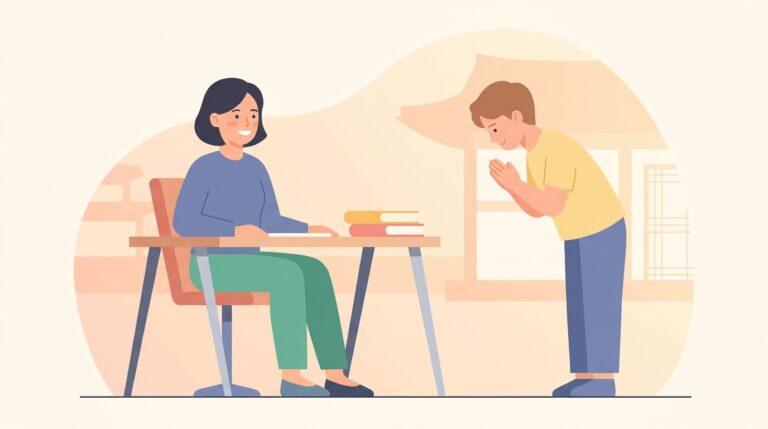
Talk to Your Teacher in Korean Like a True Local! 🌸
Phase 1: Empathy (Your First Big Challenge!)
안녕하세요! (Annyeonghaseyo!) I’m your Daily Hangul editor and your personal cultural navigator. 👋
Imagine this: You are standing in front of your Korean teacher (선생님 – seon-saeng-nim). You want to ask a simple question, like “Did you have lunch?” or “Can you help me?” You know some Korean, but suddenly your brain freezes. You ask yourself: “If I say ‘밥 먹었어?’ (Bap meogeosseo?), will I sound too rude? Is ‘밥 드셨어요?’ (Bap deushyeosseoyo?) correct?”
If you have ever felt your heart race before speaking to a teacher or an older person in Korea, you are not alone! Many of my students at the A2 level tell me they are terrified of making mistakes with honorifics (존댓말 – jondaetmal).
But don’t worry! Using honorifics isn’t about memorizing scary grammar rules; it’s about showing respect and warmth. Today, we will learn 3 magical expressions that will make your Korean teacher smile and say, “Wow, your Korean is so polite!” Let’s dive in! 🚀
Phase 2: Top 3 Must-Know Honorific Expressions
1. 질문이 있습니다 (Jil-mun-i is-seup-ni-da)
- Pronunciation: Jeel-moon-ee eet-seub-nee-da (Sounds like “Jeel-moon-ee” + “it-sub-nida”)
- Meaning: I have a question.
- K-Culture Moment: You see this in every high school K-Drama! A student raises their hand politely in class and says this phrase before asking for help.
- Editor’s Insight: While “질문 있어요” (jil-mun isseo-yo) is polite, ending with “-습니다” (-seup-ni-da) shows the highest level of respect to a teacher in a classroom setting.
- Situation Spectrum: Casual (🚫) | Semi-formal (⚠️) | Formal (✅)
- 🤔 Think About It: In English, we just say “I have a question” to anyone. Why do you think Korean has different levels of politeness depending on who you talk to?
2. 가르쳐 주셔서 감사합니다 (Ga-reu-chyeo ju-shyeo-seo gam-sa-hap-ni-da)
- Pronunciation: Gah-leu-chyeo joo-shyeo-seo gahm-sah-hahp-nee-da
- Meaning: Thank you for teaching me.
- K-Culture Moment: On Teacher’s Day (스승의 날 – Seuseung-ui Nal) in Korea, students sing a special song and write this exact phrase on letters with carnation flowers.
- Editor’s Insight: This is much more personal than a simple “감사합니다” (Thank you). It acknowledges the teacher’s effort to help you grow.
- Situation Spectrum: Casual (🚫) | Semi-formal (⚠️) | Formal (✅)
- 🤔 Think About It: How do you thank teachers in your culture? Is there a special day or phrase you use?
3. 먼저 가보겠습니다 (Meon-jeo ga-bo-get-seup-ni-da)
- Pronunciation: Meon-jeo gah-boh-get-seub-nee-da (Sounds like “Mun-juh gah-boh-get-sub-nida”)
- Meaning: I will leave first. / Goodbye (literally: “I will go first”).
- K-Culture Moment: In K-Dramas, when office workers or students leave the room before their boss or teacher, they bow and say this phrase.
- Editor’s Insight: In Korea, leaving a room without announcing it can seem abrupt. Saying this shows you respect their time and are politely taking your leave.
- Situation Spectrum: Casual (🚫) | Semi-formal (⚠️) | Formal (✅)
- 🤔 Think About It: Why is leaving a room politely so important in community-focused cultures like Korea?
Phase 3: Textbook Korean vs. Real Korean
Let’s compare the rigid sentences from old textbooks with how cool, modern students actually speak to their teachers!
Situation 1: Asking if the teacher is busy
- 📖 Textbook Korean: 지금 시간이 있습니까? (Ji-geum shi-gan-i it-seup-ni-kka? – Do you have time now? – Too formal, sounds like a military interview!)
- 🗣️ 진짜 (Real) Korean: 선생님, 혹시 지금 잠깐 시간 괜찮으세요? (Seon-saeng-nim, hok-shi ji-geum jam-kkan shi-gan gwaen-chan-eu-seo-yo? – Teacher, by any chance, do you have a quick moment?)
- 💡 Why the difference?: Adding “혹시” (by any chance) and “잠깐” (a moment) softens the question, making you sound extremely polite and considerate of your teacher’s busy schedule.
Situation 2: Saying you don’t understand
- 📖 Textbook Korean: 이해하지 못했습니다. (I-hae-ha-ji mot-haet-seup-ni-da. – I did not understand. – A bit cold and stiff.)
- 🗣️ 진짜 (Real) Korean: 죄송한데, 잘 모르겠어요. 다시 한번만 말씀해 주실 수 있으세요? (Joe-song-han-de, jal mo-reu-get-seo-yo. Da-shi han-beon-man mal-sseum-hae ju-shil su is-seu-se-yo? – I’m sorry, I don’t quite understand. Could you please tell me one more time?)
- 💡 Why the difference?: Saying “잘 모르겠어요” (I don’t quite know) is softer than “I didn’t understand.” Asking “말씀해 주실 수 있으세요?” is the golden standard of polite requests.
Phase 4: K-Culture Deep Dive & Non-Verbal Manners
4-1. Bowing & Eye Contact (The Silent Language)
- The 30-Degree Bow: When greeting your teacher, do not just nod your head. Bow your upper body at about a 30-degree angle. Keep your hands neatly folded in front of you or down at your sides.
- Two Hands Rule: When handing a book, homework, or a cup of coffee to your teacher, always use two hands. Handing something with one hand is considered disrespectful in Korea.
- Eye Contact: Avoid staring intensely into your teacher’s eyes while they speak; instead, look slightly down or at their collarbone area from time to time to show humility.
4-2. Teacher’s Day in Korea (스승의 날)
In Korea, teachers are highly respected. May 15th is Teacher’s Day (스승의 날). On this day, students express gratitude to their teachers by giving them red carnations and writing heartfelt cards using the honorific phrases we are learning today!
Phase 5: Real-Life Roleplay Scenario
Meet Mrs. Kim (김 선생님), your kind but traditional Korean language teacher. You want to ask her about a difficult homework question after class.
🎭 [You approach Mrs. Kim's desk with your notebook in both hands.]

You: 선생님, 혹시 지금 잠깐 시간 괜찮으세요?
     (Seon-saeng-nim, hok-shi ji-geum jam-kkan shi-gan gwaen-chan-eu-seo-yo?)
     "Teacher, do you have a quick moment by any chance?"

Mrs. Kim: 😊 어머, 민우 씨! 네, 괜찮아요. 무슨 일이에요?
          (Omo, Min-woo ssi! Ne, gwaen-chan-a-yo. Mu-seun il-i-e-yo?)
          "Oh, Min-woo! Yes, I'm free. What's going on?"

You: 🎭 [Pointing to a page in your notebook]
     공부하다가 질문이 있어서 왔어요. 이 단어 뜻을 잘 모르겠어요.
     (Gong-bu-ha-da-ga jil-mun-i is-seo-seo was-seo-yo. I dan-eo tteut-eul jal mo-reu-get-seo-yo.)
     "While studying, I had a question so I came. I don't quite know this word's meaning."

Mrs. Kim: 아, 이 단어는 '배려'라는 뜻이에요. 남을 생각하는 마음이죠.
          (Ah, i dan-eo-neun 'bae-ryeo'-ra-neun tteut-i-e-yo. Nam-eul saeng-gak-ha-neun ma-eum-i-jyo.)
          "Ah, this word means 'consideration'. It means thinking of others."

You: 아! 그렇군요! 자세히 가르쳐 주셔서 감사합니다.
     (Ah! Geu-reoh-gun-yo! Ja-se-hi ga-reu-chyeo ju-shyeo-seo gam-sa-hap-ni-da.)
     "Ah! I see! Thank you for teaching me in detail."

Mrs. Kim: 😊 아니에요, 언제든 편하게 물어보세요.
          (An-i-e-yo, eon-je-deun pyeon-ha-ge mul-eo-bo-se-yo.)
          "No problem, feel free to ask anytime."

You: 감사합니다. 먼저 가보겠습니다!
     (Gam-sa-hap-ni-da. Meon-jeo ga-bo-get-seup-ni-da!)
     "Thank you. I will leave first!"

Mrs. Kim: 네, 조심히 가요, 민우 씨!
          (Ne, jo-shim-hi ga-yo, Min-woo ssi!)
          "Yes, go safely, Min-woo!"
🔀 Interactive Choice!
Now, you want to leave the classroom, but you also want to tell her to have a good lunch. What do you say?
- A) “선생님, 밥 먹어!” (Seon-saeng-nim, bap meog-eo!)
- B) “선생님, 맛있는 점심 드세요!” (Seon-saeng-nim, mas-it-neun jeom-shim deu-se-yo!)
- C) “점심 먹었습니다.” (Jeom-shim meog-eot-seup-ni-da.)
Feedback on your choice:
- If you chose A: 🚫 Bad! “밥 먹어” is casual language (반말 – banmal) used only with close friends. Saying this to a teacher is highly rude!
- If you chose B: ✅ Best! “맛있는 점심 드세요” means “Please have a delicious lunch” in highly polite honorifics. Your teacher will adore you!
- If you chose C: ⚠️ Risk! This means “I ate lunch.” It doesn’t wish the teacher a good meal, so it sounds a bit random!
Phase 6: 10-Second Emotion Shadowing Drill
Let’s practice speaking with real Korean feelings. Read these out loud, pausing at the / marks!
- [😊 Expressing deep gratitude]
가르쳐 주셔서 / 정말 / 감사합니다!
(Ga-reu-chyeo ju-shyeo-seo / jeong-mal / gam-sa-hap-ni-da!) -
[🥺 Polite and slightly apologetic]
죄송한데, / 잘 / 모르겠어요.
(Joe-song-han-de, / jal / mo-reu-get-seo-yo.) -
[👋 Bowing politely while leaving]
선생님, / 먼저 / 가보겠습니다!
(Seon-saeng-nim, / meon-jeo / ga-bo-get-seup-ni-da!)
Phase 7: K-Culture Mini Dictionary
- 존댓말 (Jondaetmal) | Polite/Honorific language used to show respect to older people, teachers, and strangers.
- 선생님 (Seon-saeng-nim) | “Teacher.” In Korea, this title is used not only for school teachers but also for any expert, doctor, or respected professional.
- 반말 (Banmal) | Informal/Casual language used only with same-age friends, younger people, or family.
- 배려 (Baeryeo) | “Consideration.” A core social value in Korea, meaning to put others’ comfort before your own.
Phase 8: Traveler’s Survival Kit
If you ever visit a school or a cultural workshop in Korea, keep these in mind:
Survival Phrases TOP 3
- 화장실 어디예요? (Hwa-jang-shil eo-di-yeo-yo?) – Where is the restroom?
- 도와주실 수 있으세요? (Do-wa-ju-shil su is-seu-se-yo?) – Could you help me, please?
- 천천히 말씀해 주세요. (Cheon-cheon-hi mal-sseum-hae ju-se-yo.) – Please speak slowly.
💡 Editor’s Travel Note: To find your way around campus or cities in Korea, Google Maps doesn’t work well! Make sure to use the Naver Map App for accurate walking and transit directions.
Phase 9: “Deepen Your Mind” (Cultural Reflection)
In Western cultures, language often treats everyone as equals—we use “you” for a 5-year-old child and a 70-year-old teacher. But in Korea, language acts as a map of social relationships. By changing your verb endings, you show your awareness of the other person’s status, age, and experience. It is not about “submitting” to someone; it is about recognizing their journey in life.
💬 Your Turn: How does your native language handle respect? Do you have different words for talking to teachers? Let me know in the comments below!
Phase 10: FAQ & Avoiding Common Mistakes
Q: Can I call my teacher by their name like “Mrs. Kim” in Korean?
A: No! Never call your teacher by their name (e.g., “민우 선생님” is okay, but “김” or “유진” alone is rude). Always address them as 선생님 (Seon-saeng-nim).
Q: Is it okay to use “안녕” (Annyeong) to say goodbye to a teacher?
A: Absolutely not! “안녕” is strictly casual. Use “안녕히 계세요” (An-nyeong-hi gye-se-yo – Stay peacefully) or “먼저 가보겠습니다” (I will leave first).
Q: What if I make a mistake with honorifics?
A: Don’t panic! Koreans are very generous to foreign learners. As long as you smile, bow, and use “요” (yo) or “습니다” (seup-nida) at the end of sentences, they will appreciate your effort.
🚨 Common Mistakes Alert!
- Mistake 1: Handing a homework paper to a teacher with one hand.
- Correct Action: Hold the paper with both hands and bow your head slightly.
- Mistake 2: Saying “응” (Eung – Yeah) instead of “네” (Ne – Yes).
- Correct Action: Always say “네” to your teacher.
- Mistake 3: Saying “고마워” (Go-ma-wo) to thank a teacher.
- Correct Action: Say “감사합니다” (Gam-sa-hap-ni-da) instead.
Phase 11: Action Mission!
- 🥉 Bronze Level: Write “선생님, 질문이 있습니다” in a notebook 3 times while saying it out loud.
- 🥈 Silver Level: Record your voice saying “가르쳐 주셔서 감사합니다” and play it back to check your pronunciation.
- 🥇 Gold Level: Next time you attend a Korean class or talk to an online tutor, use “먼저 가보겠습니다” when leaving the session!
-
🎮 K-Culture Mission: Watch a school-themed K-Drama (like True Beauty or Extraordinary You) and listen closely. Can you hear the students raising their hands and saying “선생님!”?
Phase 12: Interactive Quiz Challenge
Test your polite Korean skills! (Click the toggles to see the answers)
1. Which phrase is the most polite way to say “I have a question” to your teacher?
👉 Click to see the answer
Answer: 질문이 있습니다 (Jil-mun-i is-seup-ni-da)
Explanation: “질문이 있습니다” is the most formal and respectful way to address a teacher in a school environment.
2. Fill in the blank: “Thank you for teaching me” is ________ 주셔서 감사합니다.
👉 Click to see the answer
Answer: 가르쳐 (Ga-reu-chyeo)
*Explanation: “가르쳐 주셔서 감사합니다” means “Thank you for teaching me.”
3. True or False: It is polite to look your teacher directly in the eyes constantly while they are speaking to you.
👉 Click to see the answer
Answer: False
Explanation: In Korea, staring directly into an elder’s eyes for too long can feel challenging. It is better to soften your gaze and look down slightly to show respect.







