

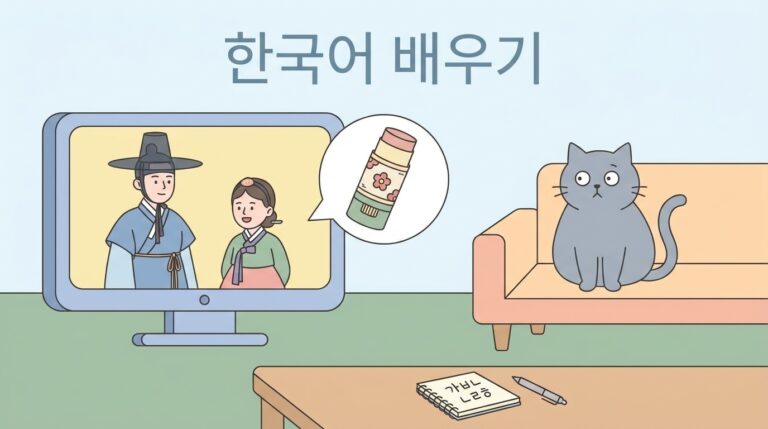
Master K-Drama PPL Critiques: Expressing Naturalness Like a Native Seoulite (C2)
Phase 1: Empathy (Welcome, K-Drama Lovers!)
안녕하세요! Welcome back to Daily Hangul, your ultimate cultural navigator and Korean bestie.
We’ve all been there: you are deeply immersed in a heart-wrenching, high-stakes K-Drama. The lead actor is about to confess their love, the music swells, and suddenly—they pull out an aggressively branded multi-balm stick and swipe it on their neck, or the entire cast inexplicably gathers at a Subway franchise.
Product Placement (PPL, or 간접 광고) is an inseparable part of the K-Drama ecosystem. For advanced learners, being able to critique the integration of these advertisements isn’t just about testing your vocabulary—it’s the ultimate test of cultural immersion. Evaluating whether a PPL is 자연스럽다 (natural) or 뜬금없다 (out-of-the-blue) requires nuanced, high-level Korean. Let’s master the art of sophisticated PPL critique today!
Phase 2: Deep-Dive into 3 Essential Expressions
1. 녹아들다 (Noka-deulda)
- Pronunciation: [Noka-deulda] (Sounds like “no-kah-deul-dah”, literally meaning “to melt into”)
- Meaning: To blend seamlessly; to dissolve into the narrative.
- K-Culture Moment: When a character’s job naturally aligns with the sponsored product (e.g., a barista protagonist using a specific espresso machine), making the PPL feel completely organic.
- Editor’s Insight: This verb goes beyond just ‘looking natural’. It implies that the brand has harmonized with the storyline so perfectly that it doesn’t disrupt the viewer’s emotional immersion.
- Situation Spectrum: Casual ✅ | Semi-formal ✅ | Formal ✅
- 🤔 Think About It: How does your culture view product placement? Is there a parallel concept to “melting into” a story in your native language?
2. 극의 흐름을 깨다 (Geuk-ui heoreum-eul kkaeda)
- Pronunciation: [Geugui heureumeul kkaeda] (Sounds like “guk-ee hur-um-ul kkae-dah”)
- Meaning: To disrupt the flow of the play/drama.
- K-Culture Moment: When a historical drama (사극) suddenly features a futuristic LED face mask.
- Editor’s Insight: 흐름 means flow or current. When a PPL “breaks the flow” (흐름을 깨다), it ruins the suspension of disbelief. Use this when the placement feels jarringly forced.
- Situation Spectrum: Casual ✅ | Semi-formal ✅ | Formal ✅
- 🤔 Think About It: Why do you think Korean viewers are particularly sensitive to things that “break the flow” of a narrative?
3. 뜬금없다 (Tteun-geum-eopda)
- Pronunciation: [Tteun-geum-eopda] (Sounds like “tteen-gum-up-dah”)
- Meaning: Out of nowhere; completely random; abrupt.
- K-Culture Moment: A sudden, passionate monologue about the health benefits of red ginseng extract in the middle of a high-speed car chase.
- Editor’s Insight: This is a highly colloquial yet widely used adjective. It describes something that lacks context or warning. Saying a PPL is 뜬금없다 is a sharp, witty critique.
- Situation Spectrum: Casual ✅ | Semi-formal ✅ | Formal ⚠️ (Use ‘개연성이 떨어지다’—lacking probability—in formal criticism)
- 🤔 Think About It: What is the most “뜬금없는” PPL you have ever witnessed in a Korean drama?
Phase 3: Textbook Korean vs. Real Conversational Korean
Let’s upgrade your expression from robotic textbook Korean to authentic C2-level critique.
Situation 1: Expressing that a PPL fits the scene well
- 📖 Textbook: 광고가 매우 자연스럽게 들어갔습니다. (The advertisement was placed very naturally.)
- 🗣️ Real Korean: PPL이 아주 물 흐르듯 자연스럽게 녹아들었네요. (The PPL melted in as naturally as water flows.)
- 💡 Why it’s different: Using the metaphor “물 흐르듯” (like flowing water) showcases a high-level command of idiomatic Korean, making your review sound incredibly poetic and native.
Situation 2: Expressing irritation at forced advertising
- 📖 Textbook: 광고 때문에 몰입이 안 됩니다. (I cannot immerse myself because of the advertisement.)
- 🗣️ Real Korean: 과도한 PPL 때문에 극의 몰입도가 완전히 와장창 깨지더라고요. (The excessive PPL completely shattered my immersion into pieces.)
- 💡 Why it’s different: “와장창” is an onomatopoeia for crashing or shattering. Using it here vividly conveys your frustration with the disrupted flow.
Phase 4: K-Culture Deep Dive & Non-Verbal Manners
4-1. The Art of the K-Drama Sigh (한숨)
When critiquing a poorly placed PPL with Korean friends, non-verbal cues speak volumes. A slight head shake accompanied by a light, dry chuckle or a deep sigh (한숨) conveys your disappointment in the production’s greed without needing to say a word.
4-2. The “Subway” Phenomenon: Capitalist Realism
Korean dramas are notoriously expensive to produce, especially blockbusters starring top-tier Hallyu stars. Viewers understand that PPL is a necessary evil. Therefore, the public discourse has evolved: instead of unconditionally hating PPL, Koreans praise “착한 PPL” (good/kind PPL) that is creative and self-aware, while roasting “선 넘는 PPL” (cross-the-line PPL) that insults the audience’s intelligence.
Phase 5: Live Roleplay Scenario
Setting: A cozy cafe in Hapjeong. You (Ji-won) and your Korean media researcher friend (Min-woo) are discussing the finale of a hit drama.
Characters:
* Min-woo (민우): A cynical but passionate TV critic who hates disrupted narratives.
* Ji-won (지원 – You): An analytical Hallyu enthusiast who loves analyzing drama structures.
The Dialogue
- 민우: (커피를 마시며 ☕) 야, 너 어제 그 드라마 마지막 회 봤어? 진짜 PPL 때문에 집중이 안 되더라.
(Ya, neo eo-je geu deu-ra-ma ma-ji-mak hoe bwas-seo? Jin-짜 PPL ttae-mu-ne jip-jung-i an doe-deo-ra.)
(Hey, did you watch the final episode of that drama yesterday? I really couldn’t focus because of the PPL.) -
지원: (고개를 끄덕이며 🤦♀️) 응, 나도 봤어. 사막에서 갑자기 홍삼을 짜 먹는 건 좀 뜬금없지 않았어?
(Eung, na-do bwas-seo. Sa-mak-e-seo gap-ja-gi hong-sam-eul jja meok-neun geon jom tteun-geum-eop-ji a-nas-seo?)
(Yeah, I watched it too. Wasn’t it a bit out-of-the-blue to suddenly squeeze and eat red ginseng in the middle of a desert?) -
민우: 그러니까 말이야! 아주 대놓고 브랜드를 밀어주더라고. 극의 흐름을 완전히 깨버렸어.
(Geu-reo-ni-kka mal-i-ya! A-ju dae-no-ko beu-raen-deu-reul mil-eo-ju-deo-ra. Geuk-ui heo-reum-eul wan-jeon-hi kkae-beo-ryeot-seo.)
(Exactly! They were openly pushing the brand. It completely broke the flow of the drama.) -
지원: 맞아. 주인공 감정선이 고조되는 타이밍이었는데, 거기서 뜬금없이 로봇 청소기가 돌아가는 건 선 넘었지.
(Ma-ja. Ju-in-gong gam-jeong-seon-i go-jo-doe-neun ta-i-ming-i-eot-neun-de, geo-gi-seo tteun-geum-eop-si ro-bot cheong-so-gi-ga dol-a-ga-neun geon seon neom-eot-ji.)
(Right. It was a climax for the character’s emotional arc, but having a robot vacuum run out of nowhere there was crossing the line.) -
민우: 반면에 지난주 법정 씬에서 나온 커피 PPL은 어땠어? 그건 좀 어울렸는데.
(Ban-myeon-e ji-nan-ju beop-jeong ssin-e-seo na-on keo-pi PPL-eun eo-ttaes-seo? Geu-geon jom eo-ul-ryeot-neun-de.)
(On the other hand, how about the coffee PPL in last week’s courtroom scene? That was somewhat fitting.) -
지원: 오, 맞아! 그건 야근하는 변호사 캐릭터에 물 흐르듯 자연스럽게 녹아들었더라고.
(O, ma-ja! Geu-geon ya-geun-ha-neun byeon-ho-sa kae-rik-teo-e mul heu-reu-deut ja-yeon-seu-rop-ge noka-deul-eot-deo-ra-go.)
(Oh, right! That melted into the night-working lawyer character as naturally as flowing water.) -
민우: 그렇지? 광고주도 살고 드라마 몰입도도 지키는 그런 자연스러운 연출이 진짜 연출력이지.
(Geu-reo-chi? Gwang-go-ju-do sal-go deu-ra-ma mor-ip-do-do ji-ki-neun geu-ron ja-yeon-seu-reoun yeon-chul-i jin-jja yeon-chul-ryeok-i-ji.)
(Right? Creative direction that satisfies the advertiser while keeping the drama’s immersion intact is what true directing is.) -
지원: 동감이야. 앞으로 그런 ‘착한 PPL’이 더 많아졌으면 좋겠어.
(Dong-gam-i-ya. Ap-eu-ro geu-ron ‘cha-kan PPL’-i deo man-a-jyeos-seu-myeon jo-ket-seo.)
(I agree. I hope we see more of those ‘good PPLs’ in the future.)
🔀 Choose Your Response!
Min-woo asks: “야, 솔직히 너라면 그런 대놓고 하는 광고 나오는 드라마 계속 볼 거야?” (Hey, honestly, would you keep watching a drama with such blatant ads?)
- Option A: “스토리가 좋으면 참고 보겠지만, 흐름이 자꾸 깨지면 채널 돌릴 것 같아.”
- Feedback (Best): Highly natural, native-like balance showing realistic compromise and clear boundaries.
- Option B: “나는 PPL을 아주 싫어해서 절대 안 봐요.”
- Feedback (Bad): Too rigid and grammatically stiff for a C2 conversation. Sounds like a textbook robot.
- Option C: “광고 보려고 드라마 보는 건 아니지만, 제작비 생각하면 어쩔 수 없지 않나 싶어.”
- Feedback (Risk/Good): Shows high cultural empathy and advanced structure (“~지 않나 싶어”), but slightly defensive of the production companies.
Phase 6: 10-Second Emotional Shadowing Drill
Let’s practice delivering these emotional critiques with native speed and rhythm.
- Drill 1 (Frustrated & Sighing)
- “사막에서 / 갑자기 홍삼이라니… / 진짜 뜬금없지 않아? 🤦♂️”
- [Sa-mak-e-seo / gap-ja-gi hong-sam-i-ra-ni… / jin-jja tteun-geum-eop-ji a-na?]
- Drill 2 (Impressed & Enthusiastic)
- “그 광고는 / 드라마 캐릭터에 / 물 흐르듯 / 자연스럽게 녹아들었어! ✨”
- [Geu gwang-go-neun / deu-ra-ma kae-rik-teo-e / mul heu-reu-deut / ja-yeon-seu-rop-ge noka-deul-eot-eo!]
Phase 7: K-Culture Mini-Dictionary
- 돈지랄 (Don-ji-ral) | Excessive spending / Overproduction | Used colloquially to describe dramas with massive budgets but terrible narrative execution (often filled with bad PPL).
- 정주행 (Jeong-ju-haeng) | Binge-watching | Literally “running in the correct direction.” Refers to watching a series from episode 1 to the end without stopping.
- 개연성 (Gae-yeon-seong) | Probability / Narrative Plausibility | A highly sophisticated term used in media reviews to describe if a plot twist or character action makes logical sense.
- 앞광고 (Ap-gwang-go) | Front-facing/Blatant Advertising | Contrast to ‘뒷광고’ (hidden ads). This is when a drama openly owns up to its PPL, often turning it into a self-aware comedic element.
Phase 8: Traveler’s Survival Kit
Are you traveling to Korea to visit K-Drama filming locations?
- Express 1: “여기 드라마 촬영지가 어디예요?” (Yeo-gi deu-ra-ma chwal-yeong-ji-ga eo-di-yeo-yo? / Where is the filming location of the drama here?)
- Express 2: “이거 드라마에 나왔던 그 제품 맞아요?” (I-geo deu-ra-ma-e na-wat-deon geu je-pum ma-ja-yo? / Is this the product that was featured in the drama?)
- Express 3: “PPL 때문에 이거 구매하러 왔어요!” (PPL ttae-mu-ne i-geo gu-mae-ha-reo was-seo-yo! / I came to buy this because of the PPL!)
Editor’s Travel Note: To locate actual K-Drama filming locations in Seoul, don’t use Google Maps. Use Naver Map (네이버 지도) which has localized tags and highly accurate street views of drama spots. (Disclaimer: Filming sites may change or close down without notice.)
Phase 9:
Frequently Asked Questions (FAQ)
Q: What does "녹아들다 (Noka-deulda)" mean in Korean and how do you pronounce it?
A: In Korean, "녹아들다 (Noka-deulda)" is pronounced [Noka-deulda] and means: To blend seamlessly; to dissolve into the narrative.
Q: What does "극의 흐름을 깨다 (Geuk-ui heoreum-eul kkaeda)" mean in Korean and how do you pronounce it?
A: In Korean, "극의 흐름을 깨다 (Geuk-ui heoreum-eul kkaeda)" is pronounced [Geugui heureumeul kkaeda] and means: To disrupt the flow of the play/drama.
Q: What does "뜬금없다 (Tteun-geum-eopda)" mean in Korean and how do you pronounce it?
A: In Korean, "뜬금없다 (Tteun-geum-eopda)" is pronounced [Tteun-geum-eopda] and means: Out of nowhere; completely random; abrupt.






