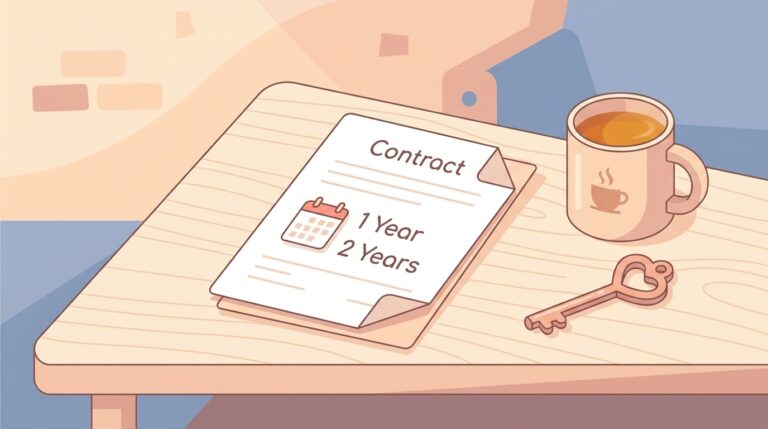
Signing a Korean Rental Contract: How to Talk About Your Lease Term Like a Pro!
Phase 1: Empathy (Welcome to the Real K-Life!)
안녕하세요! (An-nyeong-ha-se-yo!) Hello! I’m your Daily Hangul editor, your personal Korean culture navigator!
Imagine this: You’ve finally found your dream studio (officetel) in Seoul. The view of the city lights is perfect, and there is a 24-hour convenience store downstairs. You are sitting at the real estate agent’s office (budongsan), ready to sign your very first Korean rental contract. The agent points at a line on the paper and asks: “계약 기간은 어떻게 하실 거예요?” (How long would you like the contract period to be?)
Suddenly, your mind goes blank. How do you say “two years”? How do you negotiate for “one year”? Don’t worry! This is one of the most common pain points for expats in Korea. Today, we’ll make sure you can talk about your lease terms with confidence, even if you are an absolute beginner (A1). Let’s dive in!
Phase 2: Deep Dive into 3 Key Expressions
Let’s learn the three most important phrases you need when discussing your lease term.
1. 2년으로 하고 싶어요 (I’d like to do it for 2 years)
- Pronunciation: I-nyeon-eu-ro ha-go sip-eo-yo (Sounds like: “Ee-nyeon-oo-ro ha-go seep-uh-yo”)
- Meaning: I want [a contract for] 2 years.
- K-Culture Moment: In K-Dramas, when a character moves out of their parents’ house, they almost always sign a “2-year contract” (2년 계약) because it is the standard legal protection term for tenants in Korea.
- Editor’s Insight: The word 년 (nyeon) means “year.” To say “one year,” we say 1년 (il-nyeon). To say “two years,” we say 2년 (i-nyeon). The ending -고 싶어요 (-go sip-eo-yo) means “I want to.”
- Situation Spectrum: Casual (🚫) / Semi-formal (✅) / Formal (✅)
- 🤔 Think About It: In your home country, is a 1-year lease or a 2-year lease more common? Why do you think Korea defaults to 2 years?
2. 계약 기간 (Contract Period)
- Pronunciation: Gye-yak gi-gan (Sounds like: “Gyeh-yak ghee-gahn”)
- Meaning: Contract period / Lease term
- K-Culture Moment: You will see this bolded at the very top of your official rental contract document (imdaechayaksang).
- Editor’s Insight: 계약 (gye-yak) means “contract” and 기간 (gi-gan) means “period.” Together, they are the magic words you need to look for when reading your paper.
- Situation Spectrum: Casual (🚫) / Semi-formal (✅) / Formal (✅)
- 🤔 Think About It: “Gye-yak” sounds a bit heavy, but in Korea, even renting a water purifier has a “gye-yak gi-gan”!
3. 연장할 수 있어요? (Can I extend it?)
- Pronunciation: Yeon-jang-hal su iss-eo-yo? (Sounds like: “Yuhn-jahng-hal soo eet-suh-yo?”)
- Meaning: Can I extend [the contract]?
- K-Culture Moment: When a K-Drama lead loves their neighborhood and wants to stay longer without moving, they ask the landlord this polite question over a cup of warm tea.
- Editor’s Insight: 연장 (yeon-jang) means “extension.” The grammar pattern -(으)ㄹ 수 있어요? (-(eu)l su iss-eo-yo?) means “Can I…?”
- Situation Spectrum: Casual (⚠️ only with close friends) / Semi-formal (✅) / Formal (✅)
- 🤔 Think About It: Why is it important to ask about extensions early? (Hint: Korean landlords often need to know months in advance!)
Phase 3: Textbook Korean vs. Real Korean
Real-life Korean is much simpler and more direct than what you see in thick grammar books!
Situation 1: Saying you want a 1-year lease
- 📖 Textbook: “저는 임대차 계약 기간을 일 년으로 설정하기를 원합니다.” (I wish to set the lease contract period for one year.) – Too formal and robotic!
- 🗣️ Real Korean: “1년으로 해 주세요.” (Please do it for 1 year.)
- 💡 Why is it different? Koreans love efficiency! “~해 주세요 (Please do… for me)” is perfectly polite and gets straight to the point.
Situation 2: Asking if you can move out early
- 📖 Textbook: “만약 계약 기간 전에 이사를 가야 한다면 어떻게 합니까?” (What happens if I must move out before the contract period?) – Sounds like a law book!
- 🗣️ Real Korean: “일찍 나가면 어떻게 돼요?” (What happens if I leave early?)
- 💡 Why is it different? “일찍 나가다 (to leave early)” is the everyday conversational way to talk about breaking a lease term early.
Phase 4: K-Culture Deep Dive & Non-Verbal Manners
4-1. The “Polite Nod” and Eye Contact
When negotiating contract terms in Korea, nodding slowly while saying “아, 네~” (Ah, neh~ / Oh, yes/I see) shows you are listening respectfully. Avoid staring too intensely at the landlord; instead, keep your eyes on the contract paper when discussing numbers to show you are serious and detail-oriented.
4-2. The Korean Housing Culture: “Jeonse” vs. “Wolse”
In Korea, you will hear about 월세 (wol-se / monthly rent with a deposit) and 전세 (jeon-se / a huge deposit with zero monthly rent). If you are doing a “Wolse” (monthly rent), the standard “contract period” (gye-yak gi-gan) is typically 1 or 2 years.
Phase 5: Real-Life Roleplay Scenario
Let’s practice! You are talking to Mr. Kim, a friendly but business-like real estate agent (budongsan ajusshi).
Characters:
- Mr. Kim (Agent): Helpful, speaks with a warm but professional tone.
- You (Tenant): Polite, wanting a 1-year contract instead of 2 years.
- Mr. Kim: “계약 기간은 보통 2년이에요.”
(Gye-yak gi-gan-eun bo-tong i-nyeon-i-e-yo.)
“The contract period is usually 2 years.” -
You: “🎭 [Politely smiling] 저… 1년으로 하고 싶어요.”
(Jeo… il-nyeon-eu-ro ha-go sip-eo-yo.)
“Uh… I want to do it for 1 year.” -
Mr. Kim: “아, 1년이요? 왜요?”
(Ah, il-nyeon-i-yo? Wae-yo?)
“Ah, 1 year? Why?” -
You: “🎭 [Slightly apologetic] 회사 일 때문에 그래요.”
(Hwei-sa il ttae-mun-e geu-rae-yo.)
“It is because of my company work.” -
Mr. Kim: “그렇군요. 그럼 주인집에 물어볼게요.”
(Geu-reot-gun-yo. Geu-reom ju-in-jib-e mul-eo-bol-ge-yo.)
“I see. Then I will ask the landlord.” -
You: “🎭 [Hopeful] 네, 감사합니다!”
(Ne, gam-sa-ham-ni-da!)
“Yes, thank you!” -
Mr. Kim: “주인분이 괜찮다고 하네요. 1년으로 합시다!”
(Ju-in-bun-i gwaen-chan-da-go ha-ne-yo. Il-nyeon-eu-ro hap-si-da!)
“The landlord says it’s okay. Let’s do 1 year!” -
You: “🎭 [Relieved] 정말 감사합니다!”
(Jeong-mal gam-sa-ham-ni-da!)
“Thank you so much!”
🔀 Interactive Choice:
Mr. Kim asks you: “계약 연장도 하실 생각이에요?” (Are you thinking of extending the contract too?) How do you reply?
- A) “네, 연장할 수 있어요?” (Yes, can I extend it?)
- B) “싫어요. 안 해요.” (No. I won’t do it.)
- C) “몰라요.” (I don’t know.)
Feedback:
- If you chose A (Best): Perfect! It sounds extremely polite and shows you are interested in a long-term good relationship with the landlord.
- If you chose B (Bad): Too harsh! “싫어요” (I hate/dislike it) sounds rude in a business contract setting.
- If you chose C (Risk): Too blunt. It might make the agent think you are not serious about renting.
Phase 6: 10-Second Emotion Shadowing Drill
Practice speaking like a native by adding real feelings. Pay attention to the pauses (/)!
- [🥺 Shy and Polite]
저… / 1년으로 / 하고 싶어요.
(Jeo… / il-nyeon-eu-ro / ha-go sip-eo-yo.) -
[😊 Bright and Grateful]
네! / 연장할 수 / 있어요?
(Ne! / yeon-jang-hal su / iss-eo-yo?) -
[🙏 Super Thankful]
정말 / 감사합니다!
(Jeong-mal / gam-sa-ham-ni-da!)
Phase 7: K-Culture Mini Dictionary
- 부동산 (Bu-dong-san) | Real Estate Agent / Office | The local shop with yellow/red signs where you go to rent apartments.
- 집주인 (Jip-ju-in) | Landlord | Literally “house owner.” The person who owns your room.
- 보증금 (Bo-jeung-geum) | Deposit | The big safety money you pay at the start, which you get back when you move out.
- 월세 (Wol-se) | Monthly Rent | The money you pay every month to the landlord.
Phase 8: Survival Kit for Travelers & Expats
Survival Phrases TOP 3
- 계약서 보여주세요. (Gye-yak-seo bo-yeo-ju-se-yo.) – Please show me the contract paper. [Pro Tip: Use this to check the terms yourself!]
- 언제 이사해요? (Eon-je i-sa-hae-yo?) – When do I move in? [Pro Tip: Essential for planning your moving day.]
- 이거 맞아요? (I-geo ma-ja-yo?) – Is this correct? [Pro Tip: Great to ask when checking figures and dates on the paper.]
Editor’s Travel Note
When looking for rooms in Korea, apps like Dabang or Zigbang are incredibly useful for checking average prices. However, always visit a physical 부동산 (Budongsan) to sign the actual contract. Never send deposit money before signing the official paper in person!
Phase 9: “A Step Deeper” (Cultural Reflection)
In Korea, trust and “Jeong” (social warmth) still play a big role in business. While a lease is a legal document, having a polite, friendly relationship with your landlord (집주인) can make your life incredibly easy. Many landlords who like their tenants will offer to keep rent prices the same during a contract extension (연장) or help fix broken appliances quickly.
💬 Your Turn: Have you ever rented an apartment before? What is the most important thing you look for in a lease contract? Let us know in the comments below!
Phase 10: FAQ & Common Mistakes
Q: Can I sign a rental contract for just 6 months in Korea?
A: Yes, it is possible, but it is rare. Most standard apartments require at least a 1-year contract. Short-term rentals (called 단기임대) exist but usually have higher monthly rents.
Q: What happens if I want to break my contract early?
A: If you leave before your “계약 기간” (contract period) ends, you are usually responsible for finding the next tenant and paying the real estate agent’s commission fee.
Q: Is the deposit (보증금) safe in Korea?
A: Yes, but you must visit the local community center (주민센터) on your move-in day to get a 확정일자 (Hwak-jeong-il-ja / Official Date Stamp) to legally protect your deposit.
🚨 Common Mistakes Alert!
- Saying “2개 년” instead of “2년”: “개 (gae)” is for items. For years, always use Sino-Korean numbers directly with “년 (nyeon)” (e.g., 1년, 2년, 3년).
- Signing without checking dates: Make sure the start date and end date of the lease match what you verbally agreed on.
- Not asking for a receipt: Always ask for a receipt (영수증 / yeong-su-jeung) when you transfer the deposit.
Phase 11: Action Mission & Challenge
- Bronze Mission: Speak “1년으로 하고 싶어요” out loud 3 times in front of your mirror!
- Silver Mission: Write down “계약 기간” on a sticky note and stick it on your desk.
- Gold Mission: Share this post on your Instagram or Twitter and tag @DailyHangul with your favorite Korean word of the day!
🎮 K-Culture Mission: Next time you watch a modern K-Drama, listen closely when the characters talk about moving houses. Can you hear the word “계약” (gye-yak) or “이사” (i-sa)?
Phase 12: Interactive Quiz Challenge
Test your knowledge! Click on the toggle to see the answers.
1. What does “계약 기간” mean?
- A) Deposit money
- B) Contract period
- C) Monthly rent
2. How do you say “I want to do it for 2 years”?
- A) 2년으로 하고 싶어요.
- B) 2개년 하고 싶어요.
- C) 2월세 하고 싶어요.
3. True or False: In Korea, 2 years is the standard lease term.
- True / False
🎉 Click here to see the Answers & Explanations!
- Answer: B (Contract period). “계약” (gye-yak) is contract, and “기간” (gi-gan) is period!
- Answer: A (2년으로 하고 싶어요). We use “2년” (i-nyeon) for two years. “개년” is incorrect grammar!
- Answer: True. Yes, most housing laws and standards in Korea are based on a 2-year cycle.