

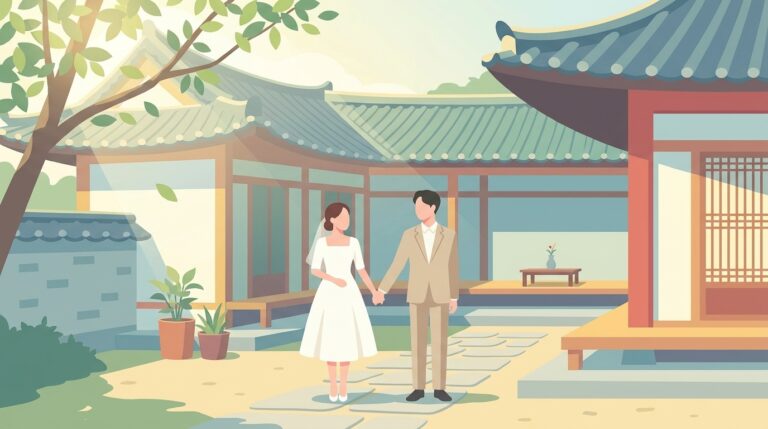
Going Minimal: Decoding South Korea’s Modern ‘Small Wedding’ Trend
Phase 1: Empathy (스토리 몰입형 오프닝)
안녕하세요! Welcome back to another edition of Daily Hangul, your premium Korean language and culture navigator!
Imagine this: You are watching a trendy K-Drama, and the main couple—instead of renting a massive, gold-gilded hotel ballroom with 500 bow-tied guests—decides to tie the knot in a quiet, sunlit forest with only 15 close friends. You hear them use terms like ‘스몰 웨딩’ (small wedding) and ‘셀프 웨딩’ (self-wedding).
But wait, if you’ve ever attended a traditional Korean wedding, you know it’s usually a fast-paced, 30-minute blitz where guests hand over white envelopes of ‘축의금’ (congratulatory money), grab a quick bite at the buffet, and leave.
Transitioning into the Korean wedding scene as an expat or an international partner can feel like navigating a complex social maze. How do you talk about these shifting trends without sounding outdated or overly casual? Why are young Koreans rejecting the grand halls for intimate, curated ceremonies? Today, we are diving deep into the sophisticated language of modern Korean wedding culture, tailored for our advanced C1 learners. Let’s master the subtle nuances that will make you sound like a true cultural insider!
Phase 2: Core Expressions Deep Dive (핵심 표현 3선 심층 분석)
1. 스몰 웨딩을 올리다 (seumol weding-eul ollida)
- Pronunciation: seumol we-ding-eul ol-li-da (Sounds like “sue-mole wed-ing-ool ole-lee-dah”)
- Meaning: To hold a small/intimate wedding (Literal: “To raise a small wedding”).
- K-Culture Moment: In the famous healing drama Our Blues or real-life celebrity couples like Lee Hyori & Lee Sang-soon, this phrase captures the romanticized shift toward private, meaningful ceremonies held in gardens, cafes, or pension houses.
- Editor’s Insight: In Korean, we “raise” (올리다) a wedding. It carries a formal, respectful nuance of completing a major life milestone. When combined with “스몰 웨딩,” it perfectly bridges modern minimalism with traditional gravity.
- Situation Spectrum: Casual (✅) | Semi-formal (✅) | Formal (✅)
- 🤔 Think About It: In many Western cultures, a “small wedding” is simply a logistical choice. In Korea, choosing a 스몰 웨딩 is often a conscious, socio-cultural statement against ostentatious displays of wealth (허례허식). How does your home culture view the scale of a wedding?
2. 스몰 웨딩이 대세다 (seumol weding-i daeseda)
- Pronunciation: seumol we-ding-ee dae-sae-dah (Sounds like “sue-mole wed-ing-ee-dae-sae-dah”)
- Meaning: Small weddings are the dominant trend / the ‘in’ thing.
- K-Culture Moment: You’ll hear this constantly on lifestyle variety shows like I Live Alone or in lifestyle magazine articles discussing the economic realities of Gen Z and Millennials.
- Editor’s Insight: 대세 (daese) combines “big” (대) and “trend/force” (세). Calling something 대세 means it’s not just a passing fad; it’s the current cultural tide that most people are riding.
- Situation Spectrum: Casual (✅) | Semi-formal (✅) | Formal (⚠️ – Use ‘주류를 이루다’ in strictly academic settings)
- 🤔 Think About It: Why do you think minimalism in life events becomes a 대세 during economic downturns or shifts in generational values?
3. 허례허식을 줄이다 (heoryeheosig-eul jurida)
- Pronunciation: huh-ryae-huh-shik-eul joo-ri-dah (Sounds like “her-yea-her-shik-ool joo-ree-dah”)
- Meaning: To cut down on empty formalities and vanity.
- K-Culture Moment: Used in serious discussions, podcasts, or editorial essays analyzing why young Koreans are moving away from traditional, highly expensive wedding procedures.
- Editor’s Insight: This is a classic C1-level hanja-based vocabulary. 허례 (empty courtesy) and 허식 (empty ornament) refer to useless, showy traditions. Using this term immediately elevates your Korean from conversational to intellectually sophisticated.
- Situation Spectrum: Casual (⚠️) | Semi-formal (✅) | Formal (✅)
- 🤔 Think About It: What is one wedding custom in your country that you consider 허례허식?
Phase 3: Textbook vs. Real-World Korean (교과서 한국어 vs 진짜 한국어)
Situation 1: Discussing wedding expenses with friends
- 📖 Textbook Korean: “결혼식 비용이 너무 비싸서 걱정입니다.” (I am worried because wedding costs are too expensive.)
- 🗣️ 진짜 한국어: “요즘 결혼식은 배보다 배꼽이 더 커서, 다들 가성비 있게 하려고 난리예요.” (Weddings these days have more auxiliary costs than the main event, so everyone is scrambling to make it cost-effective.)
- 💡 Why the difference? Idiomatic expressions like 배보다 배꼽이 더 크다 (the belly button is bigger than the belly) and trendy loanwords like 가성비 (cost-effectiveness) are much more natural in spontaneous conversations than flat adjectives.
Situation 2: Explaining a private ceremony
- 📖 Textbook Korean: “우리는 친척들만 초대해서 작게 결혼식을 할 것입니다.” (We will invite only relatives and do a small wedding.)
- 🗣️ 진짜 한국어: “저희는 허례허식 다 빼고, 정말 가까운 분들만 모셔서 스몰 웨딩으로 올리기로 했어요.” (We’re stripping away all the empty formalities and decided to hold an intimate ‘small wedding’ with only our nearest and dearest.)
- 💡 Why the difference? Real-world C1 Korean uses humble, sophisticated framing (“허례허식 다 빼고”, “모셔서”) to explain lifestyle choices elegantly.
Phase 4: K-Culture Deep Dive & Non-Verbal Manners
4-1. Eyes, Hands, and Attitude (눈치 & 제스처)
When discussing wedding plans in Korea, especially with older generations, balance is key.
* The Modest Nod: When stating you want a 스몰 웨딩, avoid sounding defensive or overly rebellious. Clasp your hands in front of you, tilt your head slightly, and explain that you want to focus on “the depth of relationships” rather than “showing off.” This shows high-level 눈치 (nunchi).
* 축의금 (Congratulatory Money) Etiquette: If attending a small wedding, the envelope matters even more. Ensure the bill is crisp and brand new. Present it with both hands, bowing slightly.
4-2. Cultural Insight: The Rise of ‘Self-Weddings’
In Korea, the wedding industry was traditionally monopolized by massive wedding halls offering package deals called 스드메 (Seu-Deu-Me): 스튜디오 (Studio photos), 드레스 (Dress rental), and 메이크업 (Makeup).
Today, C1 speakers should understand the term ‘셀프 웨딩’ (self-wedding). This doesn’t mean you marry yourself! It means the couple bypasses agencies to scout their own locations, take their own outdoor photos, and buy off-the-rack minimalist dresses. It is a rebellion against the assembly-line wedding culture of the past.
Phase 5: Real-World Roleplay Scenario (실전 롤플레이 시나리오)
Characters:
- 민우 (Min-woo): A trendy Korean groom-to-be planning an intimate outdoor ceremony.
- Sarah (C1 Learner): Min-woo’s close foreign colleague who is curious about modern Korean trends.
- Sarah: 민우 씨, 결혼 준비는 잘 돼 가요? 요즘 엄청 바쁘시겠어요.
(Min-woo, is wedding prep going well? You must be super busy lately.) - 민우: 🎭 (머리를 긁적이며) 아휴, 말도 마세요. 생각보다 챙길 게 많네요. 저희는 허례허식 다 빼고 스몰 웨딩으로 하기로 했는데도 그래요.
(Ah, don’t even get me started. There’s more to take care of than I thought. Even though we decided to ditch the empty formalities and do a small wedding, it’s still like this.) - Sarah: 와, 진짜요? 요즘 한국에서는 대형 웨딩홀 대신 소규모로 올리는 게 확실히 대세인가 봐요.
(Wow, really? I guess holding small-scale weddings instead of using massive wedding halls is definitely the big trend in Korea these days.) - 민우: 맞아요. 친구들도 처음엔 놀라더니 자기들도 그렇게 하고 싶다고 부러워하더라고요.
(Exactly. My friends were surprised at first, but now they say they’re jealous and want to do the same.) - Sarah: 🎭 (눈을 반짝이며) 보수적인 어르신들 설득하기가 쉽지 않았을 텐데, 대단하시네요! 양가 부모님 반응은 어떠셨어요?
(With eyes sparkling: It couldn’t have been easy to persuade conservative elders, you are amazing! How did both sets of parents react?) - 민우: 처음엔 서운해하셨죠. 손님 많이 초대해서 자랑하고 싶으셨을 테니까요. 그래도 진심을 담아 설득했어요.
(They were disappointed at first. They probably wanted to invite lots of guests and show off. But we persuaded them with sincere hearts.) - Sarah: 멋져요! 복잡한 결혼식보다 신랑 신부한테 온전히 집중할 수 있어서 하객들 입장에서도 훨씬 의미 깊을 것 같아요.
(Wonderful! Rather than a hectic wedding, being able to fully focus on the groom and bride seems way more meaningful from the guests’ perspective too.) - 민우: 그렇게 말씀해 주시니 큰 힘이 되네요. Sarah 씨도 꼭 오셔서 축하해 주세요!
(Hearing you say that gives me a lot of strength. Sarah, please make sure to come and celebrate with us!)
🔀 Choose Your Response (인터랙티브 선택지):
How should Sarah respond to Min-woo’s invitation to his highly exclusive small wedding?
- A) “스몰 웨딩이니까 축의금 안 내도 되죠?” (Since it’s a small wedding, I don’t need to give congratulatory money, right?)
- B) “초대해 주셔서 정말 영광이에요. 꼭 참석해서 두 분의 앞날을 축하해 드릴게요.” (I am truly honored to be invited. I’ll make sure to attend and congratulate you both on your future.)
- C) “사람도 적은데 부페 맛있는 데로 고르셨겠죠? 기대할게요!” (Since there are fewer people, I assume you picked a buffet with delicious food? I’m looking forward to it!)
💡 Feedback:
- Selection A (Bad): 🚫 Ouch! Even for a small wedding, 축의금 is still heavily expected in Korea to help cover venue costs. Asking this out loud sounds incredibly rude and tight-fisted.
- Selection B (Best): Perfect C1 Response! Elegant, polite, and acknowledges the honor of being invited to an intimate ceremony where guest count is strictly limited.
- Selection C (Risk): ⚠️ Too casual. While food is crucial in Korean weddings, focusing immediately on the buffet at an intimate event might make you seem like you’re only interested in the food rather than the couple.
Phase 6: 10-Second Emotion Shadowing Drill (10초 감정 섀도잉 드릴)
Practice speaking like a native by mimicking the natural pauses (/) and emotional inflections!
- [😊 Expressing admiration and trend-awareness]
“요즘 한국은 / 허례허식을 줄이고 / 스몰 웨딩을 올리는 게 / 완전 대세라면서요?”
(Yo-jeum Han-guk-eun / heo-rye-heo-shik-eul ju-ri-go / seumol weding-eul ol-li-neun ge / wan-jeon dae-sae-ra-myeon-seo-yo?)
(“I heard that cutting out vain formalities and having small weddings is completely the trend in Korea these days, right?”) -
[🥺 Showing gentle, respectful empathy]
“부모님 설득하시느라 / 마음고생 좀 하셨겠어요. / 그래도 두 분 뜻대로 / 잘 해결되어서 / 정말 다행이에요.”
(Bu-mo-nim seol-teuk-ha-si-neu-ra / ma-eum-go-saeng jom ha-shyeot-gess-eo-yo. / Geu-rae-do du bun tteut-dae-ro / jal hae-gyeol-doe-eo-seo / jeong-mal da-haeng-i-e-yo.)
(“You must have gone through some heartache trying to persuade your parents. But I’m so glad things worked out according to your wishes.”)
Phase 7: K-Culture Mini Dictionary (K-Culture 미니 사전)
- 스드메 (Seu-Deu-Me) | Studio, Dress, Makeup packages. The ultimate symbol of conventional, industrial-scale Korean weddings.
- 하객 (Hagaek) | Wedding guests. In Korea, having a high 하객 count historically symbolized the family’s social status and power.
- 축의금 (Chuguigeum) | Congratulatory cash gift. Typically given in clean, white envelopes at the reception desk before entering the hall.
- 식장 (Sikjang) | The wedding hall or venue. Modern trends lean toward outdoor yards, public galleries, or hanok (traditional houses) rather than dark, massive hotel 식장.
Phase 8: Traveler’s Survival Kit (여행자를 위한 생존 키트)
Survival Expressions for Wedding Guests:
- 결혼을 진심으로 축하드립니다. (Gyeol-hon-eul jin-sim-eu-ro chuk-ha-deur-im-ni-da.)
- Meaning: I sincerely congratulate you on your marriage. (Standard polite phrase for the guestbook or when meeting the parents).
- 두 분 너무 잘 어울려요! (Du bun neo-mu jal eo-ul-ryeo-yo!)
- Meaning: You two look so good together! (Great for casual chats with the bride and groom in the waiting room).
- 식사가 정말 맛있네요. (Sik-sa-ga jeong-mal mas-it-nae-yo.)
- Meaning: The food is delicious. (A major compliment in Korean wedding culture, where food quality reflects hospitality).
Editor’s Travel Note:
If you are traveling to Korea to attend a wedding, navigating the venue is a breeze with local navigation apps. Do not rely on global maps, which often lack accurate building names. Make sure to download the Naver Map App to find the exact wedding hall entrance and check real-time subway/bus schedules. Note: App interfaces and subway schedules are subject to change depending on local transit updates.
Phase 9: Deep Dive Essay –
Frequently Asked Questions (FAQ)
Q: What does "스몰 웨딩을 올리다 (seumol weding-eul ollida)" mean in Korean and how do you pronounce it?
A: In Korean, "스몰 웨딩을 올리다 (seumol weding-eul ollida)" is pronounced [seumol we-ding-eul ol-li-da (Sounds like "sue-mole wed-ing-ool ole-lee-dah"] and means: To hold a small/intimate wedding (Literal: "To raise a small wedding").
Q: What does "스몰 웨딩이 대세다 (seumol weding-i daeseda)" mean in Korean and how do you pronounce it?
A: In Korean, "스몰 웨딩이 대세다 (seumol weding-i daeseda)" is pronounced [seumol we-ding-ee dae-sae-dah (Sounds like "sue-mole wed-ing-ee-dae-sae-dah"] and means: Small weddings are the dominant trend / the 'in' thing.
Q: What does "허례허식을 줄이다 (heoryeheosig-eul jurida)" mean in Korean and how do you pronounce it?
A: In Korean, "허례허식을 줄이다 (heoryeheosig-eul jurida)" is pronounced [huh-ryae-huh-shik-eul joo-ri-dah (Sounds like "her-yea-her-shik-ool joo-ree-dah"] and means: To cut down on empty formalities and vanity.







