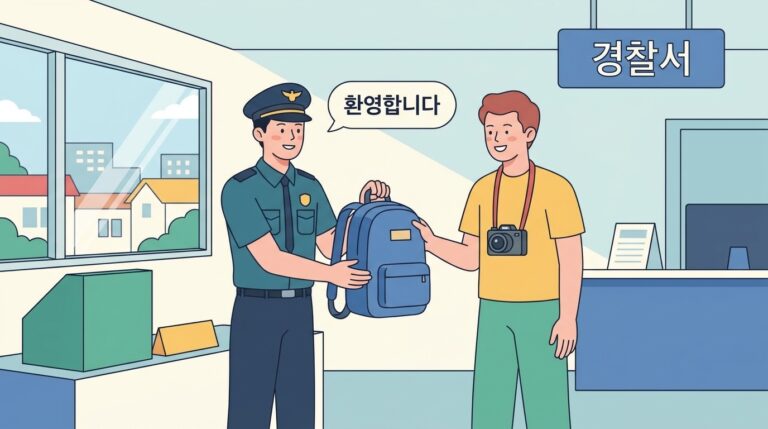
Lost in Translation? How to Report Lost Items at a Korean Police Station Like a Pro!
안녕하세요! (Annyeonghaseyo!) It’s your friendly Korean study bestie from Daily Hangul.
We’ve all been there: you are enjoying a beautiful night in Seoul, taking photos of the Han River, and suddenly… you realize your phone or wallet is gone. Your heart sinks. But don’t panic! Korea is famous for its safety, and there is a very high chance you will get your item back.
Today, we are going to learn exactly how to report a lost item at a Korean police station (경찰서 – Gyeongchalseo). Don’t worry about your Korean level; with these simple formulas, you will sound confident and get help in no time! Let’s dive in!
Phase 2: Top 3 Key Expressions
1. 물건을 잃어버렸어요. (Mul-geon-eul il-eo-beor-yeot-eo-yo.)
- Pronunciation: Mul-geon-eul eel-uh-buh-ryeot-uh-yo (Sounds like “Mul-gun-ool” + “ill-uh-buh-ryut-uh-yo”)
- Meaning: I lost my item/belongings.
- K-Culture Moment: You will hear this in almost every K-drama when a character frantically runs into a neighborhood service center after leaving their bag on the subway.
- Editor’s Insight: Mul-geon means “item” or “thing.” If you know the specific name of your lost item (like haen-deu-pon for phone), replace mul-geon with that word!
- Situation Spectrum: Casual: ⚠️ | Semi-formal: ✅ | Formal: ✅
- 🤔 Think About It: In English, we say “I lost my phone.” In Korean, we focus on the state of the object being lost (il-eo-beor-i-da). How does your language express losing something?
2. 가방을 두고 내렸어요. (Ga-bang-eul du-go nae-ryeot-eo-yo.)
- Pronunciation: Ga-bang-eul doo-go nae-ryut-uh-yo (Sounds like “Gah-bahng-ool doo-goh nay-ryut-uh-yo”)
- Meaning: I left my bag behind (when getting off a vehicle).
- K-Culture Moment: Extremely common when taking a late-night taxi back to Hongdae after enjoying delicious K-BBQ.
- Editor’s Insight: Du-go nae-ri-da literally means “to leave behind and get off.” It is the perfect phrase for subways, buses, and taxis.
- Situation Spectrum: Casual: ⚠️ | Semi-formal: ✅ | Formal: ✅
- 🤔 Think About It: Koreans use a specific verb combination for leaving items on public transport. Why do you think public transport safety is so highly emphasized in Korea?
3. 분실물 신고서 작성하고 싶어요. (Bun-sil-mul sin-go-seo jak-seong-ha-go sip-eo-yo.)
- Pronunciation: Bun-sil-mul shin-go-suh jak-sung-ha-goh ship-uh-yo
- Meaning: I want to fill out a lost property report.
- K-Culture Moment: What you say to the officer at the front desk of a local police box (파출소 – Pa-chul-so).
- Editor’s Insight: Bun-sil-mul means lost item, and sin-go-seo is the official report form. Saying ~go sip-eo-yo (I want to) keeps it polite and clear.
- Situation Spectrum: Casual: 🚫 | Semi-formal: ✅ | Formal: ✅
- 🤔 Think About It: Filing a report is the first step to getting your item listed on Korea’s amazing nationwide lost and found portal, LOST112.
Phase 3: Textbook Korean vs. Real Korean
Scenario 1: Telling someone you lost your phone
- 📖 Textbook Korean: 휴대전화를 분실하였습니다. (Hyu-dae-jeon-hwa-reul bun-sil-ha-yeot-seup-ni-da. – “I have lost my mobile telephone.”)
- 🗣️ Real Korean: 핸드폰 잃어버렸어요. (Haen-deu-pon il-eo-beor-yeot-eo-yo. – “I lost my phone.”)
- 💡 Why is it different? The textbook uses extremely formal, written Hanja words. Real Koreans use the loanword haen-deu-pon (handphone) and the friendly conversational ending ~어요.
Scenario 2: Asking where the lost and found is
- 📖 Textbook Korean: 분실물 센터가 어디에 존재합니까? (Bun-sil-mul sen-teo-ga eo-di-e jon-jae-hap-ni-kka? – “Where does the lost and found center exist?”)
- 🗣️ Real Korean: 분실물 센터 어디예요? (Bun-sil-mul sen-teo eo-di-yeo-yo? – “Where is the lost and found?”)
- 💡 Why is it different? Asking if something “exists” sounds like a philosophy class! Just use “eo-di-yeo-yo?” (Where is it?) for natural daily conversations.
Phase 4: K-Culture Deep Dive & Non-Verbal Manners
4-1. Nunchi & Gestures
When entering a Korean police station, make sure to bow slightly (about 15 degrees) and greet the officer with a polite Annyeonghaseyo. When handing over your ID card or passport, always use both hands. This is a crucial sign of respect in Korea!
4-2. Culture Code: The “Miracle” of Korean Honesty
You might have seen TikToks of people leaving their MacBooks on cafe tables in Seoul for hours. While Korea is exceptionally safe, things do still get lost. If you lose something on the subway, don’t panic! The Seoul Subway system has a systematic Lost & Found network linked directly to the police.
Phase 5: Real-Life Roleplay Scenario
Setting: A peaceful afternoon at a local police box (파출소) in Myeongdong.
Characters:
* You (Min-ji’s foreign friend): Panicked but trying to be polite.
* Officer Kim (경찰관): A helpful, warm neighborhood police officer.
- You: 저기요… 핸드폰을 잃어버렸어요.
(Jeo-gi-yo… haen-deu-pon-eul il-eo-beor-yeot-eo-yo.)
“Excuse me… I lost my phone.”
(🎭 Fidgeting nervously, holding your hands together) -
Officer Kim: 아, 그래요? 어디서 잃어버리셨어요?
(A, geu-rae-yo? Eo-di-seo il-eo-beor-i-syeot-eo-yo?)
“Oh, really? Where did you lose it?”
(🎭 Looking concerned, pulling out a notepad) -
You: 택시에 두고 내린 것 같아요.
(Taek-si-e du-go nae-rin geot gat-a-yo.)
“I think I left it in a taxi.” -
Officer Kim: 택시 번호나 결제 카드를 기억하세요?
(Taek-si beon-ho-na gyeol-je ka-deu-reul gi-eok-ha-se-yo?)
“Do you remember the taxi number or the payment card?” -
You: 카드로 계산했어요. 영수증도 있어요!
(Ka-deu-ro gye-san-haest-eo-yo. Yeong-su-jeung-do its-eo-yo!)
“I paid by card. I also have the receipt!”
(🎭 Handing over the paper receipt with both hands) -
Officer Kim: 다행이네요! 영수증에 택시 회사 전화번호가 있어요. 제가 전화해 볼게요.
(Da-haeng-i-ne-yo! Yeong-su-jeung-e taek-si hoe-sa jeon-hwa-beon-ho-ga its-eo-yo. Je-ga jeon-hwa-hae bol-ge-yo.)
“That’s a relief! The taxi company’s phone number is on the receipt. I will try calling them.” -
You: 정말 감사합니다!
(Jeong-mal gam-sa-hap-ni-da!)
“Thank you so much!”
(🎭 Bowing deeply) -
Officer Kim: 잠시만 여기서 기다려 주세요.
(Jam-si-man yeo-gi-seo gi-da-ryeo ju-se-yo.)
“Please wait here for a moment.”
🔀 Interactive Choice Point
What will you say to Officer Kim now?
* A) “빨리 찾으세요!” (Ppal-li chat-eu-se-yo! – Find it quickly!)
* B) “도와주셔서 정말 감사합니다.” (Do-wa-ju-syeo-seo jeong-mal gam-sa-hap-ni-da. – Thank you so much for helping me.)
* C) “핸드폰 비싸요.” (Haen-deu-pon bi-ssa-yo. – Phone is expensive.)
Feedback:
- A (Bad): Saying “find it quickly” sounds demanding and impatient. It might sound rude to the officer.
- B (Best!): Polite, showing appreciation, and uses correct double-handed gratitude manners.
- C (Risk): While true, stating the price of your phone might sound like you are accusing someone or complaining too much.
Phase 6: 10-Second Emotion Shadowing Drill
Let’s practice speaking with real emotions! Pay attention to the pauses marked by /.
[🥺 Worried & Sad]
핸드폰을 / 택시에 / 두고 내렸어요.
(Haen-deu-pon-eul / taek-si-e / du-go nae-ryeot-eo-yo.)[😊 Grateful & Relieved]
도와주셔서 / 진짜 / 감사합니다!
(Do-wa-ju-syeo-seo / jin-jja / gam-sa-hap-ni-da!)
Phase 7: K-Culture Mini Dictionary
- 지갑 (Ji-gap) | Wallet / Purse | “지갑을 잃어버렸어요” (I lost my wallet).
- 영수증 (Yeong-su-jeung) | Receipt | Always keep your taxi receipts! They have the driver’s contact info.
- 파출소 (Pa-chul-so) | Neighborhood Police Box | A smaller police station found in busy neighborhood areas.
- 로스트112 (LOST112) | Lost112 Portal | Korea’s official online lost and found database search engine.
Phase 8: Traveler’s Survival Kit
Survival Phrases TOP 3
- 제 번호는… 예요. (Je beon-ho-neun… ye-yo.)
- “My phone number is…” (Give this to the officer so they can call you when found).
- 여권 복사본 있어요. (Yeo-gwon bok-sa-bon its-eo-yo.)
- “I have a copy of my passport.”
- 여기 위치가 어디예요? (Yeo-gi wi-chi-ga eo-di-ye-yo?)
- “Where is this location?” (Use this if you are calling for help).
Editor’s Travel Note:
If you lose something on the subway, try to download the Seoul Subway App to check real-time carriage numbers. Knowing your train car number (found on the platform floor) makes finding your item 10 times faster!
Phase 9: “One Step Deeper” (Cultural Reflection)
In Korea, returning lost items is deeply tied to the cultural concept of 정 (Jeong) (social affection) and 양심 (Yang-sim) (conscience). Koreans believe that taking something that isn’t yours brings bad luck. This is why you will often see lost wallets placed neatly on top of subway ticket machines or public benches, waiting for the owner to return.
💬 Your Turn: What would happen in your country if you left your phone in a taxi? Let us know in the comments below!
Phase 10: FAQ & Common Mistakes
Q: Can I file a lost item report online in English?
A: Yes! You can use the official LOST112 website, which has English services. However, visiting a local pa-chul-so in person with a translator app is usually the fastest way to get immediate help.
Q: What should I do if I lost my passport?
A: You must report it to both the police station (to get a