

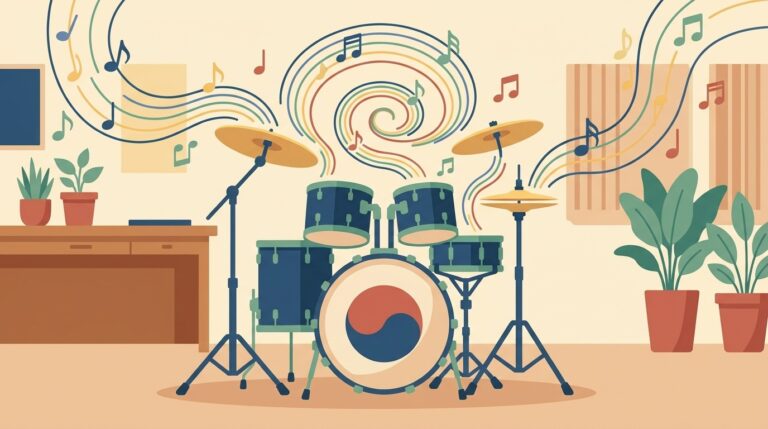
Master the K-Groove: Feeling the Drum Beat and Rhythm Like a Local
Phase 1: Empathy (An Invitation to the K-Beat)
안녕하세요! (Annyeonghaseyo!) It’s your favorite Daily Hangul editor and cultural navigator here!
Have you ever watched a behind-the-scenes video of a K-pop band practice or a passionate K-indie performance in Hongdae, and thought: “Wow, how do they lock into that rhythm so perfectly?”
When foreign learners join a local music club (동호회 – donghoe) or take drum lessons in Seoul, they often face a frustrating wall. It’s not just about reading sheet music; it’s about translating that visceral, heart-pounding sensation of a live beat into the unique linguistic vibe of Korean culture. You might know how to count “one, two, three, four,” but do you know how to describe that irresistible “groove” that makes everyone nod in unison?
Today, we’re diving deep into advanced-level (C1) Korean expressions used by real musicians and passionate hobbyists. This guide is built on real feedback from expats who stepped out of their comfort zones and into the rehearsal rooms of Seoul. Let’s get your rhythm synchronized!
Phase 2: Core Expressions Deep-Dive
1. 박자를 타다 (Bak-ja-reul ta-da)
- Pronunciation: Bahk-jah-reul tah-dah (Sounds like “park” without the ‘r’ + “ja” + “ruler” + “toddler”)
- Meaning: Literally “to ride the beat” (To groove, to stay perfectly in time with the music).
- K-Culture Moment: You’ll hear this constantly on music survival shows like Show Me The Money or Superband when a judge praises a performer’s natural flow: “저 친구는 진짜 박자를 잘 타네.” (That friend really knows how to ride the beat.)
- Editor’s Insight: Just like riding a wave (파도를 타다), Korean speakers view rhythm as an active wave of energy you flow with, rather than just a rigid grid of numbers to count.
- Situation Spectrum: Casual (✅) / Semi-formal (✅) / Formal (⚠️ – Used in casual interviews, but slightly informal for strict academic discussions)
- 🤔 Think About It: In English, we “keep” or “follow” the beat. Why do you think Korean culture conceptualizes this as “riding” (타다) the beat? How does this change your physical approach to playing the drums?
2. 엇박이 나다 (Eot-bahg-i na-da)
- Pronunciation: Uht-bahg-ee nah-dah (Sounds like “cut” with an ‘u’ + “bahg” + “ee” + “nah-dah”)
- Meaning: To be off-beat / To hit a syncopated beat incorrectly / (Figuratively) To be out of sync with someone.
- K-Culture Moment: In K-Dramas featuring office life, if two people constantly miscommunicate or miss each other’s timing, they’ll sigh and say: “우리는 왜 이렇게 맨날 엇박이 나지?” (Why are we always so out of sync?)
- Editor’s Insight: Eot (엇) denotes misalignment or crossing over. While eotbak (엇박) is a legitimate musical term for syncopated/off-beat rhythms, in everyday practice, “엇박이 나다” usually means someone is unintentionally lagging or rushing, breaking the collective groove.
- Situation Spectrum: Casual (✅) / Semi-formal (✅) / Formal (🚫)
- 🤔 Think About It: How does your native language describe being slightly out of sync with someone else’s rhythm, both musically and socially?
3. 칼박자 (Kal-bak-ja)
- Pronunciation: Kahl-bahk-jah (Sounds like “collar” + “bahk” + “jah”)
- Meaning: Razor-sharp timing / Flawless, metronomic rhythm (Literally “knife beat”).
- K-Culture Moment: Famously used to describe K-pop group dances that are synchronized down to the millisecond (칼군무 – kal-gunmu). In a drum setup, a drummer who plays like a human metronome is praised for having “칼박자.”
- Editor’s Insight: Kal (칼 – knife) is prefixed to words to denote extreme, razor-sharp precision. It’s a high compliment for technical mastery.
- Situation Spectrum: Casual (✅) / Semi-formal (✅) / Formal (🚫)
- 🤔 Think About It: What does the preference for “sharp, knife-like precision” in popular Korean slang tell you about the aesthetic standards of Korean performance art?
Phase 3: Textbook Korean vs. Real-Life Korean
Situation 1: Describing a drummer’s steady tempo
- 📖 Textbook Korean: “드럼 연주자가 템포를 정확하게 유지하고 있습니다.” (The drummer is maintaining the tempo accurately.)
- 🗣️ 진짜 Korean: “드럼 피지컬이 장난 아니라서 박자가 완전 칼이에요.” (The drummer’s physical technique is insane; their beat is absolutely razor-sharp.)
- 💡 Why the Difference?: While textbook phrases are grammatically flawless, real musicians use colorful colloquialisms like “칼이다” (to be like a knife) and “피지컬이 장난 아니다” (physicality/technique is no joke) to express genuine awe.
Situation 2: Asking someone to feel the music instead of overthinking
- 📖 Textbook Korean: “악보에 너무 집착하지 말고 리듬을 느끼세요.” (Do not obsess over the sheet music; feel the rhythm.)
- 🗣️ 진짜 Korean: “악보 보지 말고 그냥 머리로 몸으로 박자 타요!” (Stop looking at the sheet music, just let your body ride the beat!)
- 💡 Why the Difference?: To foster a tight-knit band dynamic, Korean musicians use immediate, active bodily verbs like “몸으로 박자 타다” (riding the beat with your body) rather than the passive “리듬을 느끼다” (feel the rhythm).
Phase 4: K-Culture Deep-Dive & Non-Verbal Manners
4-1. The Art of the “Head Nod” and Hand Gesture
When listening to a drum beat or jamming in Korea, do not stand completely still; it can be interpreted as boredom or disapproval.
* The Gesture: Close your eyes slightly, nod your head slightly behind the beat (on beats 2 and 4), and raise one hand with a relaxed claw-like shape as if grabbing the rhythm out of the air. This shows you are “getting into the groove” (흥을 돋우다).
* Eye Contact: Avoid staring intensely at a fellow band member’s hands. Instead, lock eyes during transition fills (필인) and give a brief, reassuring wink or smile to signal: “We are locked in.”
4-2. The “Heung” (흥) Culture in Korean Music
Korean music, from traditional Pungmulnori (풍물놀이) to modern K-indie rock, is deeply rooted in 흥 (Heung)—an untranslatable collective energy of joy, excitement, and release. In a drum circle or band, the drummer’s job isn’t just to keep time; it is to channel and elevate the Heung of the group. If you play with perfect technique but zero emotion, locals might remark that your playing has “soul-less precision” (영혼 없는 칼박).
Phase 5: Live Roleplay Scenario
Setting: A cozy indie band rehearsal studio in Hapjeong, filled with the smell of old guitar amps and acoustic foam.
Characters:
* Min-jun (민준): The seasoned indie band leader and bassist. Cool, supportive, but highly sensitive to rhythm.
* You (C1 Learner): The guest drummer joining the session.
민준: 🎭 (베이스를 메며 웃으며) 자, 새로 오신 드러머분! 준비되셨죠? 오늘 가볍게 잼(jam) 한번 가볼까요?

You: 🎭 (드럼스틱을 가볍게 부딪치며) 네, 준비됐습니다! 어떤 템포로 시작할까요?

민준: 음, 미디엄 템포로 갈게요. 제가 먼저 베이스 라인 던질 테니까, 거기에 맞춰서 스네어 얹어주세요.

You: 🎭 (베이스 비트에 귀를 기울이며) 좋습니다. 베이스 톤이 좋아서 벌써 박자가 타지네요.

민준: 🎭 (만족스러운 듯 고개를 끄덕이며) 오, 리듬감 좋으신데요? 그런데 후렴구(Chorus)로 넘어갈 때는 조금 더 고조시켜야 해요.

You: 후렴구 직전에 엇박으로 필인(fill-in)을 넣어서 텐션을 올려볼게요. 어때요?

민준: 🎭 (눈을 반짝이며) 대박! 그거 완전 좋은데요? 가끔 제가 엇박이 나도 잡아주셔야 해요. 아시죠?

You: 걱정 마세요! 제 드럼이 칼박자로 흔들리지 않게 버텨드릴게요.

민준: 🎭 (엄지를 치켜세우며) 크으, 역시 우리 밴드 구원 투수가 오셨네. 바로 갑시다!
🔀 Your Turn: Choose Your Next Move!
At the end of the song, Min-jun asks: “마지막 아웃트로(Outro) 부분에서 조금 더 펑키(Funky)하게 가고 싶은데, 어떤 리듬이 어울릴까요?”
- A) “그냥 메트로놈 소리에 맞춰서 기본 비트만 계속 칠게요.”
- Feedback (Bad): Too passive! This completely kills the creative Heung of a dynamic jam session.
- B) “싱코페이션을 섞어서 리듬을 조금 쪼개 볼까요? 맛깔나게 엇박을 타면서요!”
- Feedback (Best): Perfect! Using terms like “리듬을 쪼개다” (subdivide the rhythm) and “맛깔나게” (tastefully/flavorfully) shows high cultural fluency.
- C) “제가 화려한 더블 스트로크로 드럼 솔로를 엄청 세게 보여줄게요!”
- Feedback (Risk): While impressive, overplaying during a groove section can disrupt the band’s collective chemistry.
Phase 6: 10-Second Emotional Shadowing Drill
Read these out loud with the specified emotional nuance to master the prosody!
- [😊 Filled with excitement and confidence]
- “베이스 리듬이 좋아서 / 저절로 / 박자가 타지네요!”
- P-Rule: (Be-i-seu ri-deum-i jo-a-seo / jeo-jeol-lo / bak-ja-ga ta-ji-ne-yo!)
- [🥺 Worried and apologetic]
- “죄송해요, / 제가 필인 들어갈 때 / 자꾸 엇박이 나서 / 흐름을 끊네요.”
- P-Rule: (Joe-song-hae-yo, / je-ga pil-in deul-eo-gal ttae / ja-kku eot-bahg-i na-seo / heu-reum-eul kkeun-ne-yo.)
- [😎 Proud and reassuring]
- “걱정 마세요! / 제 드럼은 / 완전 칼박자니까 / 믿고 따라오세요!”
- P-Rule: (Geok-jeong ma-se-yo! / Je drum-eun / wan-jeon kal-bak-ja-ni-kka / mit-go tta-ra-o-se-yo!)
Phase 7: K-Culture Mini Dictionary
- 합주 (Hap-ju) | Ensemble/Band Practice
- Usage: Going beyond individual practice to play together as a band. Renting a “합주실” (practice room) in Hongdae is a staple of Korean college life.
- 리듬을 쪼개다 (Ri-deum-eul jjo-gae-da) | To subdivide the rhythm/beat
- Usage: Used when taking a simple 4/4 beat and adding 16th notes or syncopations to make it sound richer and more intricate.
- 합이 맞다 (Hap-i mat-da) | To have great chemistry/harmony
- Usage: Originating from martial arts choreography, it now describes when musicians or teammates play together with perfect, wordless coordination.
- 뒷박 (Dwit-bak) | Backbeat / Laying back
- Usage: Intentionally playing slightly behind the beat to create a relaxed, groovy, neo-soul or R&B vibe.
Phase 8: Traveler’s Survival Kit
Survival Phrases for Music Lovers
- “여기 드럼 채(스틱) 대여 가능한가요?” (Can I rent drumsticks here?)
- Pronunciation: Yeo-gi drum chae dae-yeo ga-neung-han-ga-yo?
- “드럼 모니터 스피커 볼륨 조금만 키워주실 수 있나요?” (Could you turn up the drum monitor speaker volume a bit?)
- Pronunciation: Drum mo-ni-teo seu-pi-keo bol-lyum jo-geum-man ki-wo-ju-sil su in-na-yo?
- “이 곡은 템포가 어떻게 되나요?” (What is the BPM/tempo of this song?)
- Pronunciation: I gok-eun tempo-ga eo-tteo-ke doe-na-yo?
Editor’s Travel Note:
If you want to jam with locals, download the Munto (문토) app or search for “합주 동호회” on Naver Cafe (네이버 카페). Make sure to book your practice rooms in advance using Space Cloud (스페이스클라우드)—it’s the go-to app for renting dynamic acoustic spaces in Seoul.
Phase 9: “A Step Deeper” (Sociolinguistic Insight)
In Korea, playing music is rarely a solo endeavor. The phrase “합을 맞추다” (perfecting the mutual harmony) extends far beyond the studio. It reflects the deeply embedded collectivistic value of Uri (우리 – We/Our). When playing the drums, you are not the soloist aiming to outshine others; you are the solid anchor of the Uri. A good Korean drummer is one who listens deeply to the bassist’s low notes and the vocalist’s breath, fitting their beats into the empty spaces of their teammates’ expressions. To play together is to share a heartbeat.
💬 Your Turn: Have you ever played in a group where you felt a silent connection with someone else? How did you communicate that feeling without speaking?
Phase 10: FAQ & Misconception Buster
Q: Is
Frequently Asked Questions (FAQ)
Q: What does "박자를 타다 (Bak-ja-reul ta-da)" mean in Korean and how do you pronounce it?
A: In Korean, "박자를 타다 (Bak-ja-reul ta-da)" is pronounced [Bahk-jah-reul tah-dah (Sounds like "park" without the 'r' + "ja" + "ruler" + "toddler"] and means: Literally "to ride the beat" (To groove, to stay perfectly in time with the music).
Q: What does "엇박이 나다 (Eot-bahg-i na-da)" mean in Korean and how do you pronounce it?
A: In Korean, "엇박이 나다 (Eot-bahg-i na-da)" is pronounced [Uht-bahg-ee nah-dah (Sounds like "cut" with an 'u' + "bahg" + "ee" + "nah-dah"] and means: To be off-beat / To hit a syncopated beat incorrectly / (Figuratively) To be out of sync with someone.
Q: What does "칼박자 (Kal-bak-ja)" mean in Korean and how do you pronounce it?
A: In Korean, "칼박자 (Kal-bak-ja)" is pronounced [Kahl-bahk-jah (Sounds like "collar" + "bahk" + "jah"] and means: Razor-sharp timing / Flawless, metronomic rhythm (Literally "knife beat").







