

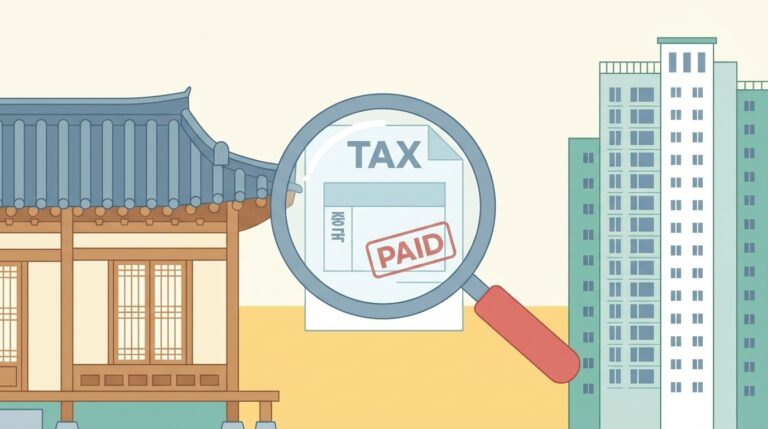
Master Korean Real Estate Taxes: How to Talk Acquisition and Capital Gains Taxes Like a Local
Phase 1: Empathy (Dive Into the K-Drama Reality of Korean Taxes!)
안녕하세요! (An-nyeong-ha-se-yo!) Hello there, fellow Korean learner! It’s your K-Culture Navigator and Daily Hangul Editor, back with another real-talk guide to living your best life in Korea.
Picture this: You’ve spent months binge-watching K-Dramas like Golden Spoon or Penthouse, dreaming of your own stylish officetel (오피스텔) in Gangnam or a cozy apartment near the Han River. You finally saved up, found the perfect place, and signed the contract. But just as you’re about to pop the champagne, your real estate agent (공인중개사) hand you a breakdown of costs, and there they are—two massive words staring back at you: 취득세 (Acquisition Tax) and 양도세 (Capital Gains Tax).
Suddenly, the romantic K-Drama soundtrack stops, and a record scratches. “Wait, how much tax do I owe? What is the deadline? Am I exempt?”
Navigating real estate taxes is stressful enough in your home country, but doing it in a second language? It’s a whole different level of anxiety. Many of our advanced (C1) learners tell us they feel confident ordering coffee or discussing movies, but completely freeze when words like “taxation base” or “heavy taxation” pop up.
Don’t worry! Today, we are going to demystify Korean property taxes. By the end of this guide, you won’t just understand these concepts—you’ll have the exact, natural Korean phrasing to discuss them confidently with realtors, tax accountants (세무사), and bank officers. Let’s dive in!
Phase 2: Deep Dive into Key Expressions (핵심 표현 3선)
Let’s unpack three high-level, essential expressions that will elevate your Korean from “conversational traveler” to “savvy property investor.”
1. 취득세가 어떻게 책정되나요? (chwi-deuk-se-ga eo-tteo-ke chaek-jeong-doe-na-yo?)
- Pronunciation: Chwee-deuk-seh-ga uh-ttuh-keh chaek-jung-doe-nah-yo? (Tip: Think of “chwee” like the sound of air escaping a balloon, and “chaek-jung” sounds a bit like “check-jung”.)
- Meaning: “How is the acquisition tax calculated/assessed?”
- K-Culture Moment: You will hear this in legal or business-themed K-Dramas like Stranger (비밀의 숲) or Reborn Rich (재벌집 막내아들) when characters discuss shifting assets or evaluating newly acquired properties.
- Editor’s Insight: The verb 책정되다 (to be assessed/budgeted) is a highly formal, precise term used in financial and official settings. While you could say “어떻게 계산돼요?” (How is it calculated?), using “책정되나요?” immediately signals to your realtor or accountant that you understand professional financial transactions.
- Situation Spectrum: Casual: 🚫 | Semi-formal: ⚠️ | Formal: ✅
- 🤔 Think About It: In many Western countries, property purchase taxes are called “Stamp Duty” or “Land Transfer Tax.” How does the Korean term 취득 (Acquisition/Obtaining) reflect the legal emphasis on the act of “taking ownership”?
2. 일시적 2주택자 비과세 혜택을 받을 수 있을까요? (il-si-jeok i-ju-taek-ja bi-gwa-se hye-taek-eul ba-deul su is-seul-kka-yo?)
- Pronunciation: Il-shee-jeok ee-joo-taek-jah bee-gwa-seh hyeh-taek-eul bah-deul soo eet-seul-kah-yo?
- Meaning: “Can I receive the tax exemption benefit for temporary owners of two residential properties?”
- K-Culture Moment: This is a hot topic on Korean talk shows and economic YouTube channels. Due to fluctuating housing regulations, many Koreans strategicially time their home sales to qualify for this exact tax loophole.
- Editor’s Insight: This is a powerhouse sentence for C1 learners. Let’s break down the compound nouns: 일시적 (temporary) + 2주택자 (owner of two housing units) + 비과세 (tax exemption/non-taxable) + 혜택 (benefit). In Korea, if you buy a new house before selling your old one, you are temporarily a “2-house owner.” If you sell the old one within a specific timeframe (usually 2 to 3 years), the government treats you as a 1-house owner for tax purposes. Asking about this shows supreme cultural and legal literacy.
- Situation Spectrum: Casual: 🚫 | Semi-formal: ⚠️ | Formal: ✅
- 🤔 Think About It: Why do you think governments offer temporary relief for owning two homes? How does this compare to tax rollover structures in your home country?
3. 양도세 폭탄을 맞지 않으려면 어떻게 해야 하죠? (yang-do-se pok-tan-eul mat-ji an-eu-ryeo-myeon eo-tteo-ke hae-ya ha-jyo?)
- Pronunciation: Yang-do-seh poke-tahn-eul maht-jee ahn-oo-ryuh-myun uh-ttuh-keh hae-yah ha-jyo?
- Meaning: “What should I do to avoid getting hit with a capital gains tax bomb?”
- K-Culture Moment: This expression is used constantly in everyday Korean conversations, news headlines, and online property forums (e.g., Naver Land cafes).
- Editor’s Insight: 양도세 (Capital Gains Tax) is legally called 양도소득세. The word 폭탄 (bomb) is used metaphorically in Korean to describe an unexpectedly massive financial bill (e.g., 세금 폭탄 = tax bomb, 요금 폭탄 = utility bill bomb). Using “폭탄을 맞다” (to get hit by a bomb) adds a very natural, colloquial, yet native-level dramatic flare to your financial worries.
- Situation Spectrum: Casual: ✅ | Semi-formal: ✅ | Formal: ⚠️ (Use cautiously in very strict legal letters, but perfectly fine in verbal consultations with accountants!)
- 🤔 Think About It: Using natural metaphors like “bomb” shows a deep integration into the way Koreans express financial anxiety. What is the equivalent metaphor in your native language?
Phase 3: Textbook Korean vs. Real-World Korean
| Situation | 📖 Textbook Korean | 🗣️ Real-World Korean |
|---|---|---|
| 1. Asking about tax calculation | 취득세율은 얼마입니까? (What is the acquisition tax rate?) |
혹시 제가 살 때는 취득세율이 몇 프로나 적용돼요? (By the way, what percentage of acquisition tax applies when I buy?) |
| 2. Expressing concern about high taxes | 세금이 많이 나와서 걱정이 됩니다. (I am worried because the tax is high.) |
이러다 양도세 폭탄 맞을까 봐 조마조마하네요. (I’m on pins and needles thinking I might get hit with a capital gains tax bomb.) |
- 💡 Why the difference? Textbook Korean often uses rigid passive patterns and strictly formal endings. In reality, even during professional consultations, Koreans use conversational softening terms like ‘혹시’ (by any chance), refer to percentages as ‘프로’ (pro) instead of ‘퍼센트’ (percent), and use emotional idioms like ‘조마조마하다’ (to be on pins and needles/nervous) to build rapport with the professional helping them.
Phase 4: K-Culture Deep Dive & Non-Verbal Manners
4-1. The Art of “Tax Consultation” Etiquette
- The “Pleading” Smile & Deep Nod: When discussing taxes with a 세무사 (tax accountant) or 공인중개사 (realtor), maintaining slightly lowered eyes while nodding deeply shows that you are listening intently to their complex explanation. If they deliver bad news (a high tax rate), do not get angry. Instead, let out a soft sigh, touch your forehead slightly, and say, “아… 생각보다 세네요.” (Ah… it’s a bit heavier/stronger than I thought.) This soft vulnerability often prompts them to search harder for legal deductions (공제) or loopholes for you!
4-2. K-Drama Property Fever
Property taxes in Korea are incredibly dynamic, sometimes changing multiple times a year based on government policy to curb real estate speculation (투기). This intense social backdrop is why K-Dramas like Sky Castle or The Penthouse: War in Life depict characters obsessing over property ownership. Owning a “single home in a prime Seoul area” (똘똘한 한 채) is considered the ultimate wealth-protection strategy due to favorable tax exemptions.
Phase 5: Real-Life Roleplay Scenario
Setting: A professional Tax Accountant’s Office (세무사 사무실) in Yeouido, Seoul.
Characters:
* 민우 (Min-woo): A seasoned tax accountant who specializes in expat property acquisitions.
* Jason (You): An advanced Korean learner who has lived in Korea for 5 years and is planning to buy his second apartment.
민우: 어서 오세요, 제이슨 씨. 새로 매수하시려는 아파트 때문에 세금 걱정이 많으시다고 들었어요.
      (Welcome, Jason. I heard you have a lot of tax worries regarding the new apartment you are looking to buy.)

Jason: 🎭 (Sighing slightly and nodding) 네, 세무사님. 기존 아파트를 아직 안 팔았는데 새 집을 사게 되어서, 혹시 '취득세 중과' 대상이 될까 봐 잠을 못 잤어요.
      (Yes, Mr. Tax Accountant. I haven't sold my existing apartment yet but ended up buying a new one, so I couldn't sleep worrying I might be subject to the 'heavy acquisition tax'.)

민우: 아, '일시적 2주택' 상황이시군요. 취득세율이 일반 세율로 적용되려면 조건이 있습니다.
      (Ah, you are in a 'temporary two-home owner' situation. There are specific conditions for the standard tax rate to apply.)

Jason: 🎭 (Leaning forward with focus) 그렇군요. 제가 듣기로는 일정 기간 내에 기존 주택을 처분하면 비과세 혜택을 받을 수 있다고 하던데요?
      (I see. I heard that if I dispose of my existing house within a certain period, I can receive tax exemption benefits?)

민우: 맞습니다! 보통 신규 주택 취득일로부터 3년 이내에 처분하시면 일시적 2주택으로 인정받아 일반 세율로 적용받으실 수 있어요.
      (Exactly! Usually, if you dispose of it within 3 years from the acquisition date of the new home, it is recognized as temporary dual-ownership, and the standard tax rate applies.)

Jason: 아, 정말 다행이네요. 그럼 나중에 그 집을 팔 때 양도세 계산은 어떻게 되나요?
      (Ah, what a relief. Then, how will the capital gains tax be calculated when I sell that house later?)

민우: 양도세도 비과세 요건을 맞추시면 세금을 거의 안 내실 수 있어요. 거주 기간과 보유 기간을 체크해 봐야 합니다.
      (For capital gains tax as well, if you meet the exemption requirements, you might pay almost nothing. We need to check your period of residence and ownership.)

Jason: 🎭 (Writing down notes diligently) 그렇군요. 세무사님 덕분에 정말 든든합니다. 하나씩 꼼꼼히 확인해 봐야겠어요.
      (I see. Thanks to you, Accountant, I feel so reassured. I will need to check everything step-by-step diligently.)
🔀 Interactive Choice Point
How would you respond to Min-woo’s advice to check your residency duration?
* A. “귀찮은데 대충 계산해 주시면 안 돼요?” (It’s a hassle, can’t you just calculate it roughly?)
* B. “혹시 제가 외국인이라서 추가적으로 불이익을 받거나 주의해야 할 세법 조항이 있을까요?” (By any chance, since I am a foreigner, are there any additional disadvantages or tax laws I should be careful of?)
* C. “세금 안 내는 편법이 있을까요?” (Is there a tax-evasion trick to avoid paying taxes?)
Feedback:
- Selection A (Bad): Highly unprofessional. Asking a licensed Korean accountant to do “rough” work on legally binding taxes makes you look irresponsible and might strain your business relationship.
- Selection B (Best): Fantastic! Foreign property buyers in Korea are subject to specific reporting laws (e.g., Foreign Exchange Transactions Act). Asking this shows top-tier cultural and legal awareness. Highly recommended!
- Selection C (Risk): Dangerous. Koreans take tax laws seriously, and suggesting illegal tax evasion (편법/탈세) to a professional accountant is a major cultural and ethical taboo.
Phase 6: 10-Second Emotional Shadowing Drill
Practice saying these lines with the exact emotional pitch of a native speaker. The slashes / represent natural pausing points.
- [🥺 Anxious and worried about high bills]
이러다가 / 진짜 / 양도세 폭탄 / 맞는 거 / 아니에요?
(Ee-ruh-dah-ga / jin-jja / yang-do-seh poke-tahn / mahn-neun guh / ah-nee-eh-yo?)
“At this rate, / am I really / going to get hit / with a capital gains tax / bomb?” -
[😊 Deeply relieved and grateful]
비과세 혜택이 / 가능하다니 / 정말 / 십년감수했네요!
(Bee-gwa-seh hyeh-taek-ee / gah-neung-hah-dah-nee / jung-mahl / ship-nyun-gahm-soo-haet-neh-yo!)
“To hear that / tax exemption is possible, / I feel like / I just escaped a near-death experience!” (십년감수하다: idiom meaning to feel immense relief after anxiety)
Phase 7: K-Culture Mini Dictionary
- 취득세 (Chwi-deuk-se) | Acquisition Tax
- The tax paid to the local government when you acquire real estate, vehicles, or heavy equipment.
- 양도소득세 (Yang-do-so-deuk-se) | Capital Gains Tax
- Often shortened to 양도세. It is the tax levied on profits made from selling real estate, shares, or other rights.
- 비과세 (Bi-gwa-se) | Non-taxable / Tax Exemption
- The holy grail of property owners. Situations where the government waives tax collection entirely under specific legal conditions.
- 세무사 (Se-mu-sa) | Licensed Tax Accountant
- Unlike general accountants (회계사), a 세무사 specializes strictly in tax laws, filings, and optimizations. They are highly respected professionals in Korea.
Phase 8: Survivor Kit for Expats in Korea
Survival Expressions TOP 3
- “세금 신고 기한이 언제까지예요?” (When is the tax filing deadline?)
- Pro Tip: Missing a tax filing deadline leads to a penalty tax (가산세), so always double-check this!
- “필요 경비 처리가 가능한 영수증인가요?” (Is this a receipt that can be processed as necessary expenses?)
- Pro Tip: Property remodeling costs can lower your capital gains tax later. Keep all receipts!
- “세무 대리 비용은 얼마인가요?” (How much is the fee for tax representation services?)
- Pro Tip: Ask this beforehand so you can prepare the accountant’s commission fee.
📝 Editor’s Travel & Life Note
To get a clear estimation of your property value and potential taxes, check the Korean Ministry of Land, Infrastructure and Transport (국토교통부 실거래가 공개시스템) for actual transaction prices. For calculating estimated taxes, many Koreans download and use the 국세청 홈택스 (National Tax Service HomeTax) app. Note that tax laws change frequently, so always consult a registered professional before making major payments.
Phase 9: “Going One Step Deeper” (Cultural Reflection)
In Korea, property ownership is not just about having a roof over your head; it is highly tied to family security, social status, and educational opportunities for children. Because real estate is the primary wealth-building tool for most Koreans, the government heavily regulates it through taxes to prevent the rich from buying up multiple homes and driving up prices for average families.
This is why words like “다주택자” (multi-homeowner) carry a slightly controversial social nuance in the media. Knowing these tax structures helps you understand why your Korean colleagues talk about housing policy with such passion.
💬 Your Turn: How does the real estate tax system in your home country compare to Korea’s? Do you think heavy taxation on multi-home owners is a good way to keep housing affordable? Tell us in the comments below!
Phase 10: FAQ & Avoiding Common Mistakes
Q: Can foreigners get the same tax exemptions (비과세) as Korean citizens?
A: Yes, in principle, tax residency (거주자) matters more than nationality. If you have a registered domicile and have lived in Korea for more than 183 days a year, you are generally treated as a resident tax-payer and can qualify for standard exemptions, provided you meet the housing ownership periods.
Q: What happens if I fail to report my acquisition tax?
A: You must file and pay your acquisition tax within 60 days of signing the transfer of ownership. If you miss this window, you will be hit with a non-filing penalty tax (무신고가산세) of 20% plus daily interest penalties!
Q: Can I deduct apartment remodeling fees from my Capital Gains Tax (양도세)?
A: Yes, but only “capital expenditures” (자본적 지출) like expanding balconies, replacing boilers, or installing system air conditioners qualify. Minor cosmetic repairs like wallpapering or painting are not deductible.
🚨 The “Expat Beware” Warning Board: Common Mistakes
- Mistake 1: Assuming your tax status is “Non-resident” just because you have a foreign passport.
- Correct Action: Check your visa type and length of stay; you are likely a domestic tax resident.
- Mistake 2: Throwing away remodeling receipts.
- Correct Action: Ask for a tax invoice (세금계산서) or cash receipt (현금영수증) for any home renovations.
- Mistake 3: Thinking the realtor (부동산) handles tax filings.
- Correct Action: Realtors only guide you; you must hire a 세무사 (tax accountant) or file the paperwork yourself.
Phase 11: Action Missions
- 🥉 Bronze Mission: Write the words 취득세 and 양도세 on a sticky note and place it near your desk. Say them out loud three times!
- 🥈 Silver Mission: Share this post on your SNS or save it, tagging
@DailyHangulwith your answer to our “Your Turn” question in Phase 9! - 🥇 Gold Mission: Next time you pass by a local real estate office (부동산), peek at the posters outside. Can you spot terms like “비과세”, “매매”, or “세무상담”? Take a picture and try translating the context!
Phase 12: Interactive Quiz Challenge
Test your knowledge! Click the boxes below to reveal the answers.
Q1. Which term refers to the tax you pay when selling a property and making a profit?
Click to reveal the answer!
Answer: 양도소득세 (or 양도세) – Capital Gains Tax
* Explanation: ‘양도’ means transfer of rights/property, and ‘소득’ means income or profit. Hence, tax on the income from transferring property.
Q2. Fill in the blank: If you get hit with an unexpectedly massive tax bill, Koreans colloquially call it a “tax ______” (세금 _____).
Click to reveal the answer!
Answer: 폭탄 (pok-tan / Bomb)
* Explanation: “세금 폭탄” (tax bomb) is the extremely common native metaphor for heavy, unexpected tax bills.
Q3. True or False: Foreigners can never qualify for tax exemptions on housing in Korea.
Click to reveal the answer!
Answer: False
* Explanation: If a foreigner qualifies as a tax resident of Korea and meets the ownership/residence criteria for a single home, they can receive the same tax exemption benefits as a Korean citizen.
Disclaimer: Tax regulations in South Korea change frequently. This guide is for educational purposes. For official property transactions, always consult with a certified Korean Tax Accountant (세무사).
See you in the next lesson! 다음에 또 만나요!







