

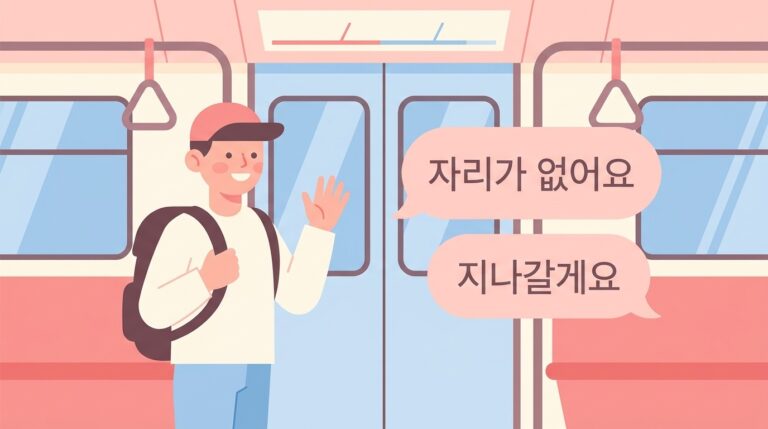
Everyday Hangul: What to Do When the Seoul Subway is Packed!
Phase 1: Empathy & Storytelling
안녕하세요! (An-nyeong-ha-se-yo!) Hello, my lovely friends! It’s your K-culture navigator and Daily Hangul editor.
Imagine this: You’ve just finished an amazing shopping spree in Myeongdong or a lovely walk around Han River. You step into the sleek, super-fast Seoul Subway. You are exhausted, your legs are heavy, and you’re dreaming of resting your feet. But as the sliding doors open… gasp!
It is 지옥철 (Ji-ok-cheol)—a blend of “Ji-ok” (hell) and “Subway” (Ji-ha-cheol)—the infamous rush-hour subway! There is not a single empty seat in sight. Everyone is standing shoulder-to-shoulder, holding onto straps.
Don’t panic! As an A1 beginner, you don’t need a paragraph of complex grammar to survive this. Today, we will learn how to politely say “There are no seats,” ask if someone is getting off, and navigate the cozy crowd of the Korean subway with absolute confidence and ultimate Korean manners!
Phase 2: Key Expressions Analysis
Let’s learn 3 simple, life-saving phrases for a crowded subway ride.
1. 자리가 없어요 (Ja-ri-ga eop-seo-yo)
- Pronunciation: Jah-ree-gah up-suh-yo (Sounds like “Jah-ree” + “up” + “seoyo”)
- Meaning: “There are no seats” (Literally: Seat + exists not)
- K-Culture Moment: You will hear friends whispering this to each other the moment they step into a subway car and look left and right.
- Editor’s Insight: “자리” (jari) means space or seat. “없어요” (eopseoyo) is the magical Korean word for “I don’t have” or “There is none.” Use this to explain to your friend why you have to stand.
- Situation Spectrum: Casual (자리가 없어 ⚠️) / Semi-formal (자리가 없어요 ✅) / Formal (자리가 없습니다 ✅)
- 🤔 Think About It: In your country, do you usually search for a seat actively, or do you prefer to stand if it’s crowded?
2. 내리실래요? (Nae-ri-sil-lae-yo?)
- Pronunciation: Neh-ree-sheel-leh-yo? (Sounds like “Neh-ree” + “shield” without the ‘d’ + “leh-yo”)
- Meaning: “Are you getting off?” (Polite)
- K-Culture Moment: If you are blocked by someone standing near the door and your station is next, you gently ask this to see if you can swap places.
- Editor’s Insight: This is polite but direct. By adding “~실래요?” (~sillae-yo), you are showing deep respect to the stranger’s intentions.
- Situation Spectrum: Casual (내릴래? ⚠️) / Semi-formal (내리실래요? ✅) / Formal (내리십니까? 🚫 – too stiff!)
- 🤔 Think About It: Koreans value smooth transitions near subway doors. Asking before pushing is a gold-standard manner!
3. 지나갈게요 (Ji-na-gal-ge-yo)
- Pronunciation: Jee-nah-gahl-geh-yo (Sounds like “Jee-nah” + “gahl” + “geh-yo”)
- Meaning: “Passing through” (Literally: I will pass by)
- K-Culture Moment: When the train stops, and you need to squeeze through a wall of people to exit before the doors close!
- Editor’s Insight: This is much friendlier and softer than just saying “Excuse me!” It lets people know your trajectory so they can step aside.
- Situation Spectrum: Casual (지나갈게 ⚠️) / Semi-formal (지나갈게요 ✅) / Formal (지나가겠습니다 ✅)
- 🤔 Think About It: In Korea, saying your action (“I am passing”) is often preferred over just saying “Sorry” when navigating crowds.
Phase 3: Textbook Korean vs. Real Korean
Let’s compare stiff textbook phrases with what Koreans actually say!
Situation A: Telling your friend there’s no seat
- 📖 Textbook: “좌석이 존재하지 않습니다.” (Jwa-seog-i jon-jae-ha-ji ans-seub-ni-da. – “Seats do not exist.”)
- 🗣️ Real Korean: “아, 자리 없다!” (Ah, ja-ri eop-da! – “Ah, no seats!”)
- 💡 Why the difference? Nobody speaks like a science manual on the subway! To a friend, simply drop the polite ending and sigh with a cute “Ah, ja-ri eop-da!”
Situation B: Squeezing past someone politely
- 📖 Textbook: “실례합니다, 비켜주세요.” (Sil-lye-hap-ni-da, bi-kyeo-ju-se-yo. – “Excuse me, please move.”)
- 🗣️ Real Korean: “잠시만요~” (Jam-si-man-yo~ – “Just a moment, please~”) or “지나갈게요~” (Ji-na-gal-ge-yo) with a soft tone.
- 💡 Why the difference? “비켜주세요” can sound a bit demanding (like “Move out of my way!”). Saying “Jam-si-man-yo” (Just a second) is the ultimate, polite Korean cheat code for subway crowds.
Phase 4: K-Culture Deep Dive & Non-Verbal Etiquette
4-1. Subway Nunchi (눈치) & Gestures
- The Soft Shoulder Tap: If it is too loud and you need to get off, make eye contact, bow your head slightly, and gently say “Jam-si-man-yo” while gesturing towards the door with both hands held close to your body.
- The Phone Tilt: Koreans respect privacy. On a packed train, it is common etiquette to hold your phone close and tilt it down so people standing right next to you can’t see your screen!
4-2. The Pink Seats (임산부 배려석)
If you see a bright pink seat at the end of a row, even if the subway is completely packed and there are no seats (자리가 없어요), leave it empty! This is the Im-san-bu Bae-ryeo-seok (Pregnant Women’s Reserved Seat). Keeping it empty is a beautiful unspoken rule of Seoul transit.
Phase 5: Real-Life Roleplay Scenario
Setting: Line 2 Green Line subway heading towards Hongdae during rush hour. You are standing near the door with your friend, Minjun. The train is packed.
Characters:
- You (Excited A1 Learner)
- Minjun (Your sweet Korean friend)
- Passerby (A commuter trying to exit)
Dialogue:
- You: (Looking left and right) Minjun-ah, 자리가 없어요. (Ja-ri-ga eop-seo-yo.)
(🎭 Disappointed, holding the handrail) - Minjun: 괜찮아, 금방 도착해. 서서 가자! (Gwen-cha-na, geum-bang do-chak-hae. Seo-seo ga-ja! / It’s okay, we’ll arrive soon. Let’s stand!)
- You: (Nodding) Okay! 지하철에 사람이 정말 많네요. (Ji-ha-cheol-e sa-ram-i jeong-mal man-ne-yo. / Wow, there are really so many people in the subway.)
- Passerby: (Approaching from behind) 저기… 내리실래요? (Jeo-gi… Nae-ri-sil-lae-yo? / Excuse me… are you getting off?)
- You: (Surprised) 아! 아니요, 안 내려요! (Ah! An-i-yo, an nae-ryeo-yo! / Ah! No, I am not getting off!)
(🎭 Shaking head and making space) - Passerby: 아, 네. 지나갈게요. (Ah, ne. Ji-na-gal-ge-yo. / Ah, okay. I will pass through.)
- You: (Stepping aside) 잠시만요! 이쪽으로 오세요. (Jam-si-man-yo! I-jjog-eu-ro o-se-yo. / Just a moment! Come this way.)
- Minjun: (Smiling) 와, 한국어 진짜 잘하네! (Wa, han-gug-eo jin-jja jal-ha-ne! / Wow, you really speak Korean well!)
🔀 Interactive Choice:
The train is stopping at Hongdae, and you need to get off, but a group of students is blocking the door. What do you say?
* A) “비켜!” (Bi-kyeo! / Move!)
* B) “잠시만요, 지나갈게요~” (Jam-si-man-yo, ji-na-gal-ge-yo~ / Just a moment, passing through~)
* C) “자리가 없어요!” (Ja-ri-ga eop-seo-yo! / There are no seats!)
Feedback:
- Choice A (Bad): 🚫 Oh no! “Bi-kyeo” is very rude and informal. People will be shocked!
- Choice B (Best): ✅ Perfect! You combined “Just a moment” with “Passing through.” People will happily step aside for you with a smile.
- Choice C (Risk): ⚠️ Saying “There are no seats” when you want to exit will just confuse everyone!
Phase 6: 10-Second Emotion Shadowing Drill
Practice saying these with the exact emotion to sound like a native speaker! The / represents a tiny pause.
[🥺 Disappointed & Tired]
“아… / 자리가 / 없어요…”
(Ah… / ja-ri-ga / eop-seo-yo…)-
[😊 Super Polite & Soft]
“잠시만요, / 지나갈게요~”
(Jam-si-man-yo, / ji-na-gal-ge-yo~) -
[😮 Quick & Helpful]
“아! / 내리실래요?”
(Ah! / nae-ri-sil-lae-yo?)
Phase 7: K-Culture Mini Dictionary
- 지옥철 (Ji-ok-cheol) | Hell-way | A funny slang combining “Ji-ok” (Hell) and “Ji-ha-cheol” (Subway). Used to describe extremely crowded rush-hour trains.
- 환승 (Hwan-seung) | Transfer | The system of transferring lines or from subway to bus. Extremely cheap and convenient in Korea!
- 노약자석 (No-yak-ja-seok) | Elderly Reserved Seats | Seats at the far ends of each cabin reserved strictly for the elderly, disabled, or injured. Keep these empty too!
- 막차 (Mak-cha) | The Last Train | The final subway of the night. Missing the mak-cha means you might have to take a taxi!
Phase 8: Traveler’s Survival Kit
Survival Phrases TOP 3
- 카드 찍어주세요 (Ka-deu jjik-eo-ju-se-yo) | “Please tap your card.” (If your transit card error occurs at the gate)
- 몇 번 출구예요? (Myeot beon chul-gu-yeo-yo?) | “Which exit is it?”
- 반대편이에요? (Ban-dae-pyeon-i-e-yo?) | “Is it on the opposite side?”
📝 Editor’s Travel Note
Before stepping foot in Seoul, make sure to download Naver Map (네이버 지도) or KakaoMap (카카오맵) for real-time subway schedules. Disclaimer: Subway fares and schedules may change over time; please verify with official station information during your trip.
Phase 9: “A Step Deeper” (Reflections on Korean Society)
In Korea, the subway is not just transportation; it is a shared social space. Even on a packed train, you will notice it is incredibly quiet. People whisper or don’t talk at all. This silence is a sign of respect for others’ personal bubble in a very crowded city.
💬 Your Turn: How does this compare to your hometown’s subway or bus ride? Let us know in the comments below!
Phase 10: FAQ & Common Mistakes
Q: Can I sit in the elderly seats (노약자석) if the subway is totally empty?
A: It is highly recommended to leave them empty even if the train is deserted. In Korean culture, saving these seats is a sign of deep respect for elders.
Q: What is the difference between “실례합니다” and “잠시만요”?
A: “실례합니다” (Excuse me) is grammatically perfect but sounds a bit formal. “잠시만요” (Just a moment) is much more natural and commonly used in daily life.
Q: How do I know which side the doors will open?
A: Listen to the subway announcement or look at the digital screens above the doors. It will say “내리실 문은 왼쪽입니다” (The exit door is on the left).
🚨 Common Mistakes Alert!
- Calling a stranger “너” (Neo – You): Never say “너 내릴래?” to a stranger. Always use the polite “내리실래요?”
- Squeezing without saying anything: Pushing through silently can feel rude. Always drop a soft “지나갈게요” (Passing through).
- Sitting on Pink Seats: Even if your feet hurt terribly, keep the pregnant seats empty!
Phase 11: Action Missions
- 🥉 Bronze: Say “자리가 없어요” out loud 3 times in front of your mirror with a sad sigh.
- 🥈 Silver: Next time you watch a K-Drama scene on a subway, listen closely to see if they say “지나갈게요” or “잠시만요.”
- 🥇 Gold: When you travel to Korea, successfully use “지나갈게요” to navigate through a crowded station!
Phase 12: Interactive Quiz Challenge
Test your skills! Click the boxes below to check the answers.
Q1. How do you say “There are no seats” in Korean politely?
👉 Click to reveal Answer & Explanation
Answer: 자리가 없어요 (Ja-ri-ga eop-seo-yo).
Explanation: “자리” (jari) means seat, and “없어요” (eopseoyo) means there isn’t any!
Q2. Which of these seats should you keep empty even if the train is fully packed?
👉 Click to reveal Answer & Explanation
Answer: The Pink Seats (임산부 배려석) and the Elderly Seats (노약자석).
Explanation: These are highly respected designated spots in Korean culture.
Q3. True or False: Saying “비켜주세요” (Bi-kyeo-ju-se-yo) is the friendliest way to pass people.
👉 Click to reveal Answer & Explanation
Answer: False!
Explanation: It can sound like “Move out of my way!” Instead, use the warmer “지나갈게요~” (Passing through) or “잠시만요~” (Just a second).







