

안녕하세요! Welcome to Daily Hangul!
Hi there, my lovely K-culture lovers! It’s your favorite Korean bestie and Daily Hangul Editor, here to guide you through the dazzling, caffeine-fueled streets of Seoul.
Have you ever finished a hearty meal of Korean BBQ or spicy Kimchi Jjigae, only to look around and find the restaurant suddenly empty? Where did everyone go? If you step outside and look towards the nearest cafe, you’ll see them: a massive crowd of locals, holding plastic cups of iced Americano like Olympic torches.
Today, we are diving deep into one of Korea’s most sacred daily rituals: 식후경 (Sik-hu-gyeong – Sightseeing after eating)? No, in modern Korea, it’s all about 식후땡 커피 (Sik-hu-ttaeng keopi – The post-meal cigarette-like coffee craving)! Let’s master the real-life Korean phrases you need to join this daily migration to the cafe.
Phase 2: Deep Dive into the Top 3 “Post-Meal” Expressions
1. 식후땡 커피 (Sik-hu-ttaeng keopi)
- Pronunciation: Sheek-hoo-ttaeng keo-pee (Sounds like “Sheek-who” + “tang” with a sharp T + “coffee”)
- Meaning: Post-meal coffee (slang/casual)
- K-Culture Moment: You will hear this in office-life K-Dramas when coworkers finished their lunch and immediately look at each other with tired eyes, saying, “Shall we go for a Sik-hu-ttaeng?”
- Editor’s Insight: Originally, “식후땡” (Sik-hu-ttaeng) was a slang term used by smokers for the cigarette they smoked immediately after a meal. Today, as coffee has virtually replaced smoking for many young Koreans, it refers to that absolutely mandatory cup of iced coffee right after eating to wash down the grease.
- Situation Spectrum: Casual ✅ | Semi-formal ⚠️ | Formal 🚫
- 🤔 Think About It: Does your culture have a specific, almost sacred “ritual” immediately after lunch, or do people usually just go straight back to work?
2. 입가심 (Ipgasim)
- Pronunciation: Eep-gah-sheem (Sounds like “Leap” without the L + “gah-sheem”)
- Meaning: Palate cleanser / Washing down the taste
- K-Culture Moment: In food vlogs or dramas, after eating something heavy or spicy like Tteokbokki, characters will say they need something sweet for “입가심”.
- Editor’s Insight: While “식후땡” is very casual, “입가심” is a beautifully expressive, standard Korean word meaning “to rinse or refresh one’s mouth.” It explains why Koreans must drink coffee after a meal—to clean the palate!
- Situation Spectrum: Casual ✅ | Semi-formal ✅ | Formal ⚠️
- 🤔 Think About It: How does your native language describe the act of eating something sweet to “wash away” the savory taste of dinner?
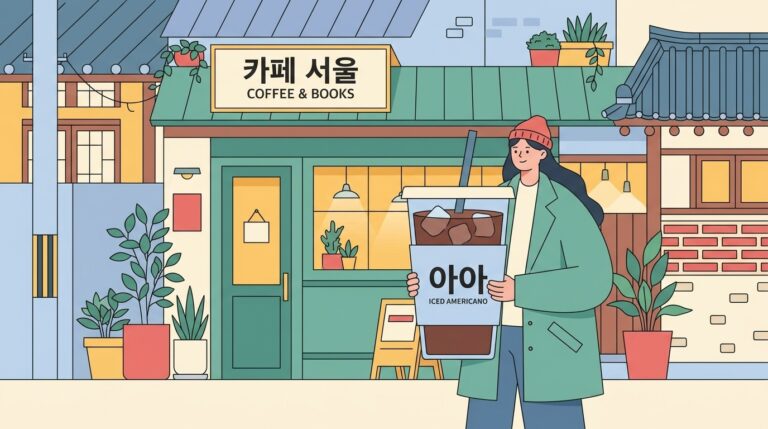
3. 아아 (Ah-Ah)
- Pronunciation: Ah-Ah (Short and crisp, like saying “Ah” twice)
- Meaning: Iced Americano (Ice Americano -> 아메리카노 -> 아아)
- K-Culture Moment: The ultimate anthem of Korean modern life: “얼죽아” (Eol-juk-ah – Freezing to death, but still Iced Americano). Even in winter, you’ll see Koreans holding an “아아” (Ah-Ah).
- Editor’s Insight: If you order a hot coffee after lunch, your Korean friends might look at you with concern. To truly blend in during the post-lunch rush, you must order “아아” to quickly cool down your mouth and get that instant caffeine kick.
- Situation Spectrum: Casual ✅ | Semi-formal ✅ | Formal 🚫
- 🤔 Think About It: Why do you think iced coffee is so much more popular than hot coffee among busy Korean workers?
Phase 3: Textbook Korean vs. Real-Life Korean
Let’s compare what you learn in dusty textbooks versus how we actually talk on the streets of Seoul!
Scenario 1: Suggesting a coffee after lunch
- 📖 Textbook: “점심을 먹었으니 커피를 마시러 갑시다.” (Jeomsimeul meogeosseuni keopireul masireo gapsida. – “Since we ate lunch, let us go drink coffee.”)
- 🗣️ Real-Life: “커피로 입가심하러 가요!” (Keopiro ipgasim-hareo gayo! – “Let’s go refresh our mouths with some coffee!”)
- 💡 Why the difference? The textbook sentence is grammatically flawless but sounds incredibly robotic. Real Koreans focus on the purpose—refreshing the mouth (입가심) after spicy or salty Korean food.
Scenario 2: Expressing the desperate need for caffeine
- 📖 Textbook: “저는 지금 커피를 매우 마시고 싶습니다.” (Jeoneun jigeum keopireul maeu masigo sipseumnida. – “I want to drink coffee very much right now.”)
- 🗣️ Real-Life: “지금 식후땡 커피가 완전 당겨요!” (Jigeum sik-hu-ttaeng keopi-ga wanjeon dang-gyeo-yo! – “I am totally craving my post-meal coffee right now!”)
- 💡 Why the difference? The verb “당기다” (dang-gi-da – literally “to pull”) is the natural slang used when you are strongly craving a specific food or drink.
Phase 4: K-Culture Deep Dive & Non-Verbal Manners
4-1. The “Lunch Payment” Dance (눈치 Nunchi & Gestures)
When going for a post-meal coffee with Korean colleagues or friends, you will witness the delicate dance of Nunchi (tact/social reading).
* The Golden Rule: Usually, whoever bought lunch does not buy the coffee. If a senior colleague paid for your heavy lunch, it is your cue to quickly run to the counter and say, “커피는 제가 살게요!” (Keopi-neun jega salgeyo! – “Coffee is on me!”).
* The Gesture: When offering to pay, gently wave your hand or card toward the kiosk/cashier while making soft eye contact with your group, signaling “I’ve got this, don’t worry!”
4-2. The “Ppalli-Ppalli” (빨리빨리) Coffee Culture
Why is “아아” (Iced Americano) the king of Sik-hu-ttaeng? Because of Korea’s famous Ppalli-Ppalli (hurry-hurry) culture. A hot latte takes time to cool down and sip, but an iced Americano can be chugged in 30 seconds on the walk back to the office. It’s not just a drink; it’s high-octane fuel for survival!
Phase 5: Practical Roleplay Scenario
Meet Ji-su (지수), a friendly Korean coworker who just treated you to a delicious Kimchi Jjigae lunch. Now, you both are walking out of the restaurant.
The Conversation
- 지수: 아, 배부르다! 오늘 김치찌개 진짜 맛있었죠?
(Ah, bae-bu-reu-da! Oneul Kimchi-jjigae jin-jja mas-is-eot-jyo?)
“Ah, I’m stuffed! The Kimchi Jjigae was amazing today, right?” - You (🎭 Patting your stomach): 네, 최고였어요! 근데 입이 좀 맵네요.
(Ne, choe-go-yeos-seo-yo! Geun-de ip-i jom maep-nae-yo.)
“Yes, it was the best! But my mouth is a bit spicy.” - 지수: 맞아요. 매운 거 먹었으니까 시원한 걸로 입가심 해야죠!
(Maj-a-yo. Mae-un geo meog-eoss-eu-ni-kka si-won-han geol-ro ip-ga-sim hae-ya-jyo!)
“Exactly. Since we ate something spicy, we need to refresh our mouths with something cool!” - You: 역시 한국인은 식후땡 커피네요. 제가 살게요!
(Yeog-si Han-guk-in-eun sik-hu-ttaeng keo-pi-nae-yo. Je-ga sal-ge-yo!)
“As expected, Koreans need that post-meal coffee. It’s on me!” - 지수 (🎭 Smiling warmly): 와, 정말요? 감동이에요! 뭐 마실래요?
(Wa, jeong-mal-yo? Gam-dong-i-e-yo! Mwo ma-sil-lae-yo?)
“Wow, really? I’m touched! What do you want to drink?” - You: 저는 무조건 ‘아아’요!
(Jeo-neun mu-jo-geon ‘Ah-Ah’-yo!)
“For me, definitely ‘Ah-Ah’ (Iced Americano)!” - 지수: 저도 ‘아아’로 할게요. 저기 메가커피로 가요!
(Jeo-do ‘Ah-Ah’-ro hal-ge-yo. Jeo-gi Mega Coffee-ro ga-yo!)
“I’ll have ‘Ah-Ah’ too. Let’s go to that Mega Coffee over there!” - You (🎭 Pulling out your card): 네, 제가 얼른 결제할게요!
(Ne, je-ga eol-leun gyeol-je-hal-ge-yo!)
“Yes, I’ll pay quickly!”
🔀 Interactive Choice Point
Ji-su asks: “내일 점심 먹고 또 커피 마실래요?” (Should we grab coffee after lunch again tomorrow?)
* A. “좋아요! 내일도 식후땡 해요!” (Great! Let’s do a post-meal coffee tomorrow too!)
* B. “아니요, 내일은 피곤해서 안 돼요.” (No, I can’t tomorrow because I’m tired.)
* C. “돈이 없어서 커피 못 사요.” (I have no money, so I can’t buy coffee.)
Feedback:
- Choice A (Best): Perfect! It shows you understand the social slang “식후땡” and eagerly want to continue the daily ritual. Ji-su will love your energy!
- Choice B (Bad): Too direct. In Korean culture, saying a flat “no” due to tiredness sounds a bit cold. A warmer alternative would be: “내일은 제가 조금 바빠서요, 다음에 꼭 마셔요!” (I’m a bit busy tomorrow, let’s definitely drink next time!)
- Choice C (Risk): While honest, it makes the situation awkward and makes Ji-su feel guilty for letting you pay today.
Phase 6: 10-Second Emotion Shadowing Drill
Let’s practice speaking with the exact emotional delivery of a native! Pay attention to the pause markers / and the emotional cues.
- [😊 Excited & Cheerful]
“역시 / 한국인은 / 식후땡 커피네요!”
(Yeog-si / Han-guk-in-eun / sheek-who-tang keo-pee-nae-yo!)
“As expected, Koreans / need that / post-meal coffee!” -
[🔥 Desperate for Caffeine – Mid-afternoon slump]
“지금 / 아아가 / 진짜 / 당겨요…”
(Jee-geum / Ah-Ah-ga / jin-jja / dang-gyeo-yo…)
“Right now / Iced Americano / really / pulls (craves) me…”
Phase 7: K-Culture Mini Dictionary
- 얼죽아 (Eol-Juk-Ah) | “Freeze to death, but Iced Americano.” | The cultural phenomenon of drinking cold coffee even in sub-zero winter temperatures.
- 입가심 (Ipgasim) | “Mouth refreshing / Palate cleanser” | Washing away a strong taste with something light, sweet, or refreshing.
- 당기다 (Dang-gi-da) | “To pull / To crave” | Used casually when your body suddenly demands a specific food (e.g., “단 게 당긴다” – I crave sweets).
- 소확행 (So-hwak-haeng) | “Small but certain happiness” | The exact emotion Koreans feel when holding a cheap, massive iced coffee after a stressful morning of work.
Phase 8: Survivor’s Travel Kit
Survival Phrases TOP 3
- “아아 두 잔 주세요.” (Ah-Ah du jan ju-se-yo.)
- Meaning: “Two Iced Americanos, please.”
- Pro Tip: If you are ordering at a kiosk (which is almost mandatory in budget cafes), look for the tab labeled 커피(Coffee) and tap ICE 아메리카노.
- “테이크아웃으로 할게요.” (Take-out-eu-ro hal-ge-yo.)
- Meaning: “I’ll take it to go.”
- Pro Tip: In Korea, due to environmental laws, you cannot drink from plastic single-use cups if you sit inside the cafe. You must specify if you want it to go!
- “연하게 해주세요.” (Yeon-ha-ge hae-ju-se-yo.)
- Meaning: “Make it weak, please.”
- Pro Tip: Korean franchise coffee can be extremely strong (often 2-3 shots of espresso). If you are sensitive to caffeine, use this phrase.
Editor’s Travel Note
When navigating Seoul’s busy business districts (like Yeouido or Gangnam) between 12:00 PM and 1:30 PM, cafes will be packed. Download the Naver Map App to find hidden local cafes, or use the “Smart Order” functions inside popular franchise apps to order ahead and skip the massive line!
Phase 9: “One Step Deeper” (Cultural Essay)
In many Western cultures, a coffee break is a slow, meditative solo time or a sit-down catch-up. In Korea, however, “식후땡 커피” represents a communal bonding ritual. Eating lunch together and immediately moving to a cafe as a group reinforces the sense of “우리의 정” (Jeong – shared affection and community bonding). By sharing a cheap, quick cup of iced coffee, Koreans show care for one another, relieve work stress together, and mentally prepare for the rest of the day as a team.
💬 Your Turn: Have you ever experienced this fast-paced cafe culture in Korea or watched it in dramas? Drop a comment below and let me know your favorite Korean cafe menu!
Phase 10: FAQ & Common Mistakes
Q: Can I use “식후땡” in a job interview or with my boss?
A: Absolutely not! “식후땡” is highly casual slang rooted in smoking culture. With your boss or in formal settings, use: “식사 후에 커피 한잔하시겠습니까?” (Would you like to have a cup of coffee after the meal?).
Q: Why does the cashier ask me if I want to drink inside or take out every single time?
A: Korean law strictly bans single-use plastic cups inside cafe dining areas to reduce plastic waste. If you say you want “take-out” but sit at a table, the cafe can face heavy fines!
🚨 Common Mistakes Alert!
- Mistake 1: Ordering “아이스 커피” (Ice Coffee) expecting an Iced Americano.
- Correction: In Korea, “아이스 커피” often refers to sweet instant drip coffee or sweet mix coffee. If you want espresso-based iced coffee, always say “아이스 아메리카노” or simply “아아”.
- Mistake 2: Forgetting to offer to buy coffee after someone bought you lunch.
- Correction: This is a minor social faux pas. Always say “커피는 제가 살게요!” (I’ll buy the coffee!) to show good manners.
Phase 11: Action Mission!
- 🥉 Bronze Mission: Go to your local cafe, order an iced coffee, and quietly say to yourself: “오늘 식후땡 커피 완전 당긴다!”
- 🥈 Silver Mission: Take a photo of your coffee, upload it to your Instagram Stories, tag us, and write: “점심 먹고 아아로 입가심 중! ☕️”
- 🥇 Gold Mission: Next time you eat with a Korean friend, pay for the coffee and confidently say: “커피는 제가 살게요!”
Phase 12: Interactive Quiz Challenge
1. Situation Quiz
Your Korean boss bought you lunch. What is the most polite and natural way to suggest coffee next?
* A) “부장님, 식후땡 하러 갑시다!”
* B) “부장님, 제가 커피 대접하고 싶습니다. 커피 드시러 갈까요?”
* C) “커피 사주세요!”
Click for the Answer & Explanation!
Correct Answer: B
Explanation: A uses slang (







