

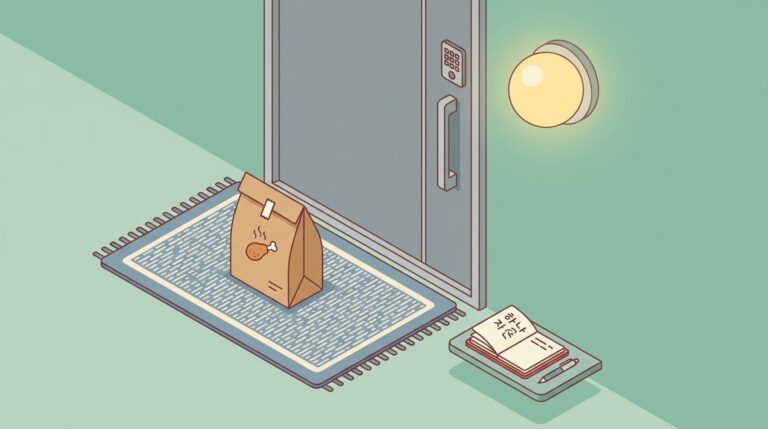
안녕하세요! Welcome to Daily Hangul!
Hi there, my dearest Hangul friend! It’s your favorite Chief Editor and Local Culture Navigator from Daily Hangul.
Have you ever ordered food through a Korean delivery app like Baemin (배달의 민족) or Coupang Eats (쿠팡이츠) to your Airbnb, only to panic when the delivery rider rings your doorbell? You might still be in your pajamas, or maybe you just want to avoid the awkwardness of speaking Korean on the spot.
I’ve heard so many of our intermediate (B1) students say, “I love Korean delivery, but my heart races whenever the doorbell rings!” Don’t worry. Today, we are mastering the art of ** contactless delivery requests** so you can grab your delicious fried chicken or tteokbokki in total peace. Let’s dive right in!
Phase 2: Top 3 Must-Know Expressions
1. 문 앞에 놓고 가 주세요. (Mun ap-e noko ga juseyo.)
- Pronunciation: “Moon ap-e no-ko gah joo-seh-yo” (Say “no-ko” like the English word no-code but faster)
- Meaning: Please leave it in front of the door and go.
- K-Culture Moment: You will see this exact phrase as a default option in 99% of Korean delivery apps. It’s the golden standard of contactless life in modern Seoul.
- Editor’s Insight: This is the most polite, standard, and widely used expression. It balances respect for the rider’s hard work while clearly stating your boundary.
- Situation Spectrum: Casual (⚠️ – too formal for close friends, but OK) / Semi-formal (✅ – Perfect) / Formal (✅ – Excellent)
- 🤔 Think About It: In your home country, is it common to leave food on the ground in front of the door? In Korea, high public safety makes this the ultimate convenience!
2. 벨 누르지 말고 문 앞에 두세요. (Bel nureuji malgo mun ap-e duseyo.)
- Pronunciation: “Bel noo-reu-ji mal-go moon ap-e doo-seh-yo” (Say “bel” like the English word bell)
- Meaning: Please don’t ring the bell, just leave it in front of the door.
- K-Culture Moment: Crucial for people living in studio apartments (원룸) with sensitive pets, sleeping babies, or for those enjoying late-night K-drama binge eating.
- Editor’s Insight: “~지 말고” (ji mal-go) means “Don’t do X, but do Y.” It sounds polite but firm.
- Situation Spectrum: Casual (⚠️) / Semi-formal (✅) / Formal (✅)
- 🤔 Think About It: Why is noise sensitivity so high in Korean residential areas? High-density apartment living makes quiet delivery a form of neighborly respect.
3. 도착하면 문자 남겨 주세요. (Dochakhamyeon munja namgyeo juseyo.)
- Pronunciation: “Do-chak-ha-myeon moon-ja nam-gyeo joo-seh-yo”
- Meaning: Please leave a text message when you arrive.
- K-Culture Moment: When you choose this, riders will often send a quick snap of the food sitting safely in front of your doorstep.
- Editor’s Insight: “~하면” (hamyeon) means “when/if”. This is a great way to ensure your hot food doesn’t get cold outside without you knowing.
- Situation Spectrum: Casual (⚠️) / Semi-formal (✅) / Formal (✅)
Phase 3: Textbook Korean vs. Real-Life Korean
Situation 1: Asking the rider to leave the food
- 📖 Textbook Korean: 음식물을 현관문 앞에 배치해 주시기를 바랍니다. (Eumsikmureul hyeongwanmun ape baechihae jusigireul baramnida. – “I hope you arrange the food products in front of the entrance door.”)
- 🗣️ 진짜 Korean: 문 앞에 두고 가 주세요. (Mun ape dugo ga juseyo. – “Please leave it at the door and go.”)
- 💡 Why the difference? Textbook phrases are often overly passive and use stiff Hanja (Sino-Korean) vocabulary like “배치” (arrangement) which sounds like a military operation. Real Koreans prefer simple, active verbs like “두다” (to leave/put).
Situation 2: Asking not to knock or ring the bell
- 📖 Textbook Korean: 노크나 벨 소리를 내지 마십시오. (Nokeuna bel sorireul naeji masipsio. – “Do not make knocking or bell sounds.”)
- 🗣️ 진짜 Korean: 벨 누르지 말아 주세요. (Bel nureuji mara juseyo. – “Please don’t ring the bell.”)
- 💡 Why the difference? Saying “하지 마십시오” sounds like a cold warning sign on a high-security facility. Adding “~해 주세요” softens the request into a polite, natural favor.
Phase 4: K-Culture Deep Dive & Non-Verbal Manners
4-1. The “Mute” Delivery Etiquette (눈치 – Nunchi)
In Korea, delivery speed is incredibly fast. Riders are always on a tight schedule. The ultimate etiquette is actually not interacting face-to-face if you can avoid it. It saves time for both you and the rider. If you happen to make eye contact or meet them:
* Gesture: Lightly bow your head (about 15 degrees) and say “감사합니다!” (Gam-sa-ham-ni-da) quickly.
* Avoid: Trying to hold a long conversation. Let them run to their next destination!
4-2. The Evolution of “Baedal” (배달)
Did you know that delivery in Korea isn’t just for pizza or chicken? You can get single cups of coffee, convenience store ice creams, and even fresh grocery packages delivered to your doorstep within 30 minutes. This “Ppalli-Ppalli” (빨리빨리 – Hurry, Hurry) culture is supported by detailed app request systems where you can save your default “doorstep” preferences.
Phase 5: Real-Life Roleplay Scenario
Meet Ji-hoon (지훈), a busy delivery rider in Hongdae who has 5 more orders to deliver in the next hour, and Sophia (소피아), a tired exchange student.
- Setting: Sophia’s studio apartment hallway. Ji-hoon has just arrived.
- 지훈 (Rider): (배달 가방을 열며) 배달 오셨습니다! 벨 누를까요?
(Baedal osyeotseumnida! Bel nureulkkayo?)
“Delivery is here! Shall I ring the bell?” - 소피아 (Sophia): 🎭 (Talking through the door or intercom) 아니요, 그냥 문 앞에 놓아 주세요!
(Aniyo, geunyang mun ape noah juseyo!)
“No, please just leave it in front of the door!” - 지훈 (Rider): 네, 알겠습니다. 결제는 앱으로 하셨죠?
(Ne, algetseumnida. Gyeoljeneun aebeuro hasyeotjyo?)
“Yes, understood. You paid through the app, right?” - 소피아 (Sophia): 🎭 (Nodding behind the door) 네, 선결제 했어요. 두고 가시면 돼요.
(Ne, seongyeolje haesseoyo. Dugo gasimyeon dwaeyo.)
“Yes, I pre-paid. You can just leave it.” - 지훈 (Rider): 네, 문 앞에 놓고 갑니다! 맛있게 드세요.
(Ne, mun ape noko gamnida! Masitge deuseyo.)
“Okay, leaving it in front of the door! Enjoy your meal.” - 소피아 (Sophia): 감사합니다! 수고하세요!
(Gamsahamnida! Sugohaseyo!)
“Thank you! Keep up the good work!” - 지훈 (Rider): (Scurrying away to the elevator) 네~ 감사합니다!
(Ne~ gamsahamnida!)
“Yes~ thank you!” - 소피아 (Sophia): 🎭 (Waiting 10 seconds, then opening the door quietly) 휴, 다행이다! 맛있겠다!
(Hyu, dahaengida! Masitgetda!)
“Phew, thank goodness! Looks delicious!”
🔀 Choose Your Path!
What would you say if you wanted to make sure they send a photo text after dropping it off?
- A) 그냥 가세요. (Gyunyang gaseyo.)
- Feedback: Bad. This sounds like “Just go away.” It can sound quite rude to Korean ears.
- B) 도착하면 문자 주세요. (Dochakhamyeon munja juseyo.)
- Feedback: Best! Direct, polite, and very natural.
- C) 사진을 찍어서 저에게 전송해 주십시오. (Sajineul jjigeoseo jeoege jeonsonghae jusipsio.)
- Feedback: Risk. Grammatically correct, but sounds like a strict command from a boss. Too robotic.
Phase 6: 10-Second Emotion Shadowing Drill
Try speaking these like a real Korean! Follow the slash / for natural pauses.
- [😊 Friendly & Quick]
문 앞에 / 두고 가 주세요!
(Mun ap-e / du-go ga ju-se-yo!)
“Please leave it / at the door and go!” -
[🥺 Slightly apologetic yet clear]
아기가 자고 있어서 / 벨은 누르지 말아 주세요.
(A-gi-ga ja-go i-sseo-seo / be-reun nu-reu-ji ma-ra ju-se-yo.)
“The baby is sleeping, / so please don’t ring the bell.”
Phase 7: K-Culture Mini Dictionary
- 선결제 (Seon-gyeol-je) | Pre-payment / Paid Online
- Essential for contactless delivery. You pay on the app so the rider doesn’t have to wait for your card.
- 문자 (Mun-ja) | Text Message
- Although KakaoTalk is popular, official automated delivery notifications still arrive as standard SMS (문자).
- 공동현관 비밀번호 (Gong-dong-hyeon-gwan bi-mil-beon-ho) | Main Entrance Password
- If you live in an apartment with a shared security door, you must leave this password in the delivery notes so the rider can enter the building.
- 수고하세요 (Su-go-ha-se-yo) | “Keep up the good work”
- A warm, idiomatic way to say goodbye to working professionals in Korea.
Phase 8: Survivor Kit for Travelers
Survival Phrases TOP 3
- 벨 누르고 문 앞에 놔주세요. (Bel nureugo mun ape nwajuseyo.)
- Pro Tip: “Ring the bell, then leave it at the door.” Use this if you want to know the exact moment the food arrives without meeting the rider.
- 조심히 오세요. (Joshimi oseyo.)
- Pro Tip: “Please come safely.” Leaving this in the rider memo is a lovely way to show warm Korean affection (정 – Jeong).
- 초인종 고장났습니다. (Choinjong gojangnatseumnida.)
- Pro Tip: “The doorbell is broken.” Use this if your bell actually doesn’t work, so they will knock instead.
📝 Editor’s Travel Note
When ordering in Korea, you will need local maps and food apps. To navigate your delivery address perfectly, search for your building using Naver Map App (네이버 지도). Copy the “Road Name Address” (도로명주소) directly into your food app to avoid delivery mistakes! Note: App interfaces may change without notice.
Phase 9: Deepening Your Thoughts
In some cultures, leaving valuable food on the floor outside is considered risky or unhygienic. However, in Korea, the high level of social trust (신뢰) and apartment-based lifestyle made “doorstep delivery” the norm even before the pandemic. It reflects a mutual respect for time and personal space in a fast-paced society.
💬 Your Turn: Would you feel safe leaving your food outside your door in your home country? Let me know in the comments below!
Phase 10: FAQ & Common Mistakes
Q: Can I use “문 앞에 놓아라” to a delivery rider?
A: No! “놓아라” (no-a-ra) is a low-form command (해라체). Always use “놓아 주세요” (no-ah juseyo) or “놓아주세요” to show proper respect to the rider.
Q: What if my apartment has a main gate password but I forgot to write it down?
A: The rider will likely call you. If you get a call from an unknown mobile number starting with 010, answer it! You can say: “일층 문 비밀번호는 1234번이에요” (Il-cheung mun bi-mil-beon-ho-neun il-i-sam-sa-beon-i-e-yo – “The first-floor door password is 1234”).
Q: Is there a polite way to ask them to knock instead of ringing the bell?
A: Yes! You can say: “벨 누르지 말고 노크해 주세요.” (Bel nureuji malgo nokeuhae juseyo.)
🚨 Common Mistakes Alert!
- Mistake 1: Writing “문 뒤에 놓아주세요” (Leave it behind the door).
- Correction: Use “문 앞에” (in front of the door). If they put it behind the door, they are inside your house!
- Mistake 2: Forgetting to do “선결제” (pre-payment) but asking them to leave it.
- Correction: If you choose “pay on delivery” (만나서 결제), you must open the door to hand over your card.
Phase 11: Action Mission!
- Bronze Level: Say “문 앞에 놓고 가 주세요” out loud 3 times in front of your mirror with a smile.
- Silver Level: Next time you use a Korean app, manually type “벨 누르지 마세요” in the rider request box.
- Gold Level: Spot a delivery motorcycle in a K-drama and identify what brand/app they are delivering for!
Phase 12: Interactive Quiz Challenge
Q1. Which phrase means “Please do NOT ring the bell, just leave it”?
- A) 벨 누르고 가세요.
- B) 벨 누르지 말고 두고 가세요.
- C) 문 앞에 던져 주세요.
Click here for the Answer & Explanation!
Correct Answer: B
* Explanation: “벨 누르지 말고” means “Don’t ring the bell and…” A means “Ring the bell and go,” and C means “Please throw it in front of the door” (which would ruin your delicious soup!).
Q2. True or False: In Korea, it is considered rude to ask a rider to leave food on the floor.
Click here for the Answer & Explanation!
Correct Answer: False
* Explanation: Contactless delivery (비대면 배달) is highly respected and preferred by both riders and customers for speed and convenience!







