

Rest in Korean Style: How to Say ‘I’m Melting My Fatigue’ in a Korean Jjimjilbang!
Phase 1: Empathy (Welcome to the Warmth! 😊)
안녕하세요! (Annyeonghaseyo!) I’m your Daily Hangul editor, your personal Korean culture navigator!
Imagine this: You’ve been walking all day around Myeongdong, shopping, taking photos, and your feet are absolutely aching. Your shoulders feel heavy, and you just want to collapse. In your home country, you might look for a quick hot shower or a massage. But in Korea, there is a magical, cultural oasis called 찜질방 (Jjimjilbang – Korean Sauna).
Many of my foreign friends tell me they feel a bit nervous before going to a Korean sauna for the first time. “Will I be naked? What do I say when I want a scrub? How do I express how amazing the hot water feels?” Don’t worry at all! Today, we are going to learn the most natural, native-approved expressions to help you talk about washing away your fatigue. By the end of this guide, you’ll sound exactly like a local relaxing in a warm tub of water! Let’s dive in!
Phase 2: Deep Dive into 3 Essential Expressions
Let’s look at three essential expressions you will hear and use to talk about getting rid of tiredness.
1. 피로가 풀려요 (Piro-ga pullyeoyo)
- Pronunciation: Pee-ro-gah pool-ryuh-yo (Sounds like “pee-row-gah” + “pool-yuh-yo”)
- Meaning: My fatigue is being released / I feel my tiredness melting away.
- K-Culture Moment: You will see characters in K-Dramas dipping their feet into a hot foot bath after a long, dramatic day of work, sighing deeply and saying, “아, 피로가 풀린다!” (Ah, my fatigue is melting!)
- Editor’s Insight: The word 피로 (Piro) means “fatigue,” and 풀리다 (Pullida) means “to be untied or loosened.” Imagine your stressed body as a tight knot. Dipping into hot water unties that knot!
- Situation Spectrum:
- Casual (to friends): 피로가 풀려 (Piro-ga pullyeo) ✅
- Semi-formal (polite): 피로가 풀려요 (Piro-ga pullyeoyo) ✅
- Formal (business/polite): 피로가 풀립니다 (Piro-ga pullimnida) ⚠️
- 🤔 Think About It: How does your culture view resting? In Korea, “loosening” a knot is the image of relaxation. What is the image in your language?
2. 시원하다! (Siwonhada!)
- Pronunciation: She-won-ha-da! (Sounds like “she-one-hah-dah”)
- Meaning: It’s so refreshing! / (Literally) It is cool!
- K-Culture Moment: You might see an old Korean grandfather dip into a boiling hot, steaming water tub and shout, “아, 시원하다!” This confuses many foreigners. Why does he say “cool” when the water is hot?
- Editor’s Insight: In Korean, 시원하다 (Siwonhada) doesn’t just mean cold temperature. It describes the feeling of chest-opening, muscle-relaxing relief. When hot soup or hot water makes your body go “Ahhhh,” that is 시원하다!
- Situation Spectrum:
- Casual (as an exclamation): 시원하다! (Siwonhada!) ✅
- Semi-formal: 시원해요 (Siwonhaeyo) ✅
- Formal: 시원합니다 (Siwonhamnida) ⚠️
- 🤔 Think About It: Is there a word in your language that means both “physically hot/cold” and “deeply satisfying physical relief”?
3. 몸이 가벼워졌어요 (Momi gabyeowojyeosseoyo)
- Pronunciation: Mom-ee gah-byuh-wuh-jyuh-ssuh-yo
- Meaning: My body has become lighter.
- K-Culture Moment: After getting a professional body scrub (세신 – Sesin) at a bathhouse, you walk out feeling like you are floating. You say this to your friend as you drink sweet sikhye (rice drink).
- Editor’s Insight: 몸 (Mom) means body, and 가벼워지다 (Gabyeowojida) means “to become light.” It means you lost all the heavy weight of stress.
- Situation Spectrum:
- Casual: 몸이 가벼워졌어 (Momi gabyeowojyeosseo) ✅
- Semi-formal: 몸이 가벼워졌어요 (Momi gabyeowojyeosseoyo) ✅
- Formal: 몸이 가벼워졌습니다 (Momi gabyeowojyeotseumnida) ✅
- 🤔 Think About It: When you feel relaxed, do you feel “light” or do you feel “heavy like a log”? Korean people love the feeling of being light after a bath!
Phase 3: Textbook Korean vs. Real-Life Korean
Let’s compare what textbooks teach with what Koreans actually say when they want to relax.
Situation 1: Telling someone you are tired and want to rest
- 📖 Textbook: 저는 피곤해서 쉬고 싶습니다. (Jeoneun pigonhaeseo swigo sipseumnida. – I am tired, so I want to rest.) – Very stiff and robotic!
- 🗣️ Real Life: 아, 피로 풀고 싶다. (Ah, piro pulgo sipda. – Ah, I want to melt away my fatigue.)
- 💡 Why is it different? Real Korean focuses on the action of actively releasing the accumulated stress rather than just stating a cold fact of being tired.
Situation 2: Reacting to hot water or a nice massage
- 📖 Textbook: 따뜻해서 기분이 좋습니다. (Tatteuthaeseo gibuni joseumnida. – It is warm, so I feel good.)
- 🗣️ Real Life: 어우, 너무 시원해요! (Eou, neomu siwonhaeyo! – Oh, it’s so refreshing/relieving!)
- 💡 Why is it different? Koreans use emotional exclamations like “어우 (Eou)” and the magical word “시원하다” to show deep physical satisfaction.
Phase 4: K-Culture Deep Dive & Non-Verbal Manners
4-1. Nunchi (눈치) & Body Language at the Jjimjilbang
- The “Ah~” Sigh: When you enter a warm pool (탕 – Tang), don’t stay silent! Let out a soft, low sigh: “아~ (Ah~)”. It shows you are respecting the power of the water and fully relaxing.
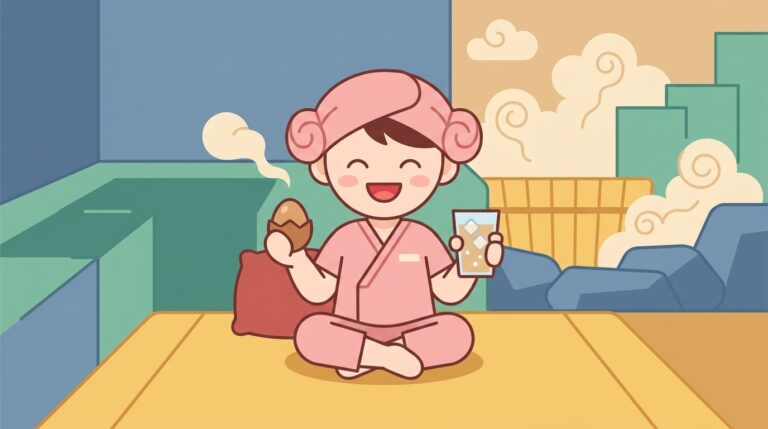
- The Head Towel (Yangmeori – 양머리): Fold your pink Jjimjilbang towel into three layers, roll the ends like sleeves, and wear it like “lamb ears.” It keeps your hair dry and looks incredibly cute for photos!
- Shower first! Before entering any communal hot tub, you must thoroughly wash your body at the sit-down shower stations. Going straight into the pool without washing is a big cultural no-no.
4-2. The Healing Menu of Jjimjilbang
To truly melt your fatigue, you need the legendary Jjimjilbang duo: 식혜 (Sikhye – sweet fermented rice punch) and 맥반석 계란 (Maekbanseok gyeran – baked eggs). The sweet, icy drink balances the hot sweat of the sauna chambers perfectly!
Phase 5: Real-Life Roleplay Scenario
Setting: You are at a beautiful modern Hanok Jjimjilbang in Seoul with your Korean friend, Minjun. You both just came out of the hot charcoal room (숯가마).
Characters:
* Minjun (민준): Your warm-hearted Korean friend who loves saunas.
* You (learner): Feeling incredibly relaxed but sweaty.
Minjun: (🎭 Wiping sweat with a towel) 아, 진짜 덥네요! 괜찮아요?
        Ah, jinjja deopneyo! Gwaenchanhayo?
        (Wow, it's really hot! Are you okay?)

You: (🎭 Smiling widely) 네, 아주 시원해요! 전혀 안 더워요.
     Ne, aju siwonhaeyo! Jeonhyeo an deowoyo.
     (Yes, it's so refreshing! I'm not hot at all.)

Minjun: (🎭 Laughing) 와, 한국 사람 다 됐네요! 이제 뜨거운 탕에 갈까요?
        Wa, Hanguk saram da dwaetneyo! Ije tteugeoun tang-e galkkayo?
        (Wow, you've become completely Korean! Shall we go to the hot tub now?)

You: (🎭 Stepping into the warm water slowly) 아... 피로가 다 풀려요.
     Ah... piro-ga da pullyeoyo.
     (Ah... all my fatigue is melting away.)

Minjun: (🎭 Leaning back in the tub) 맞아요. 몸이 정말 가벼워지죠?
        Majayo. Momi jeongmal gabyeowojijyo?
        (Exactly. Your body feels really light, right?)

You: (🎭 Nodding) 네, 진짜 몸이 가벼워졌어요. 날아갈 것 같아요!
     Ne, jinjja momi gabyeowojyeosseoyo. Naragal geot gatayo!
     (Yes, my body really became light. I feel like I could fly!)

Minjun: (🎭 Getting up) 그러면 이제 식혜랑 구운 계란 먹을래요?
        Geureomyeon ije sikhye-rang guun gyeran meogeullaeyo?
        (Then, shall we go eat sweet rice punch and baked eggs now?)

You: (🎭 Clapping hands happily) 네, 좋아요! 제가 살게요!
     Ne, johayo! Jega salgeyo!
     (Yes, great! My treat!)
🔀 Interactive Choice Point
After eating eggs, Minjun asks: “더 뜨거운 방에 또 갈래요? (Do you want to go to a hotter room?)” How do you respond?
- A) “아니요, 저 이제 죽을 것 같아요.” (Aniyo, jeo ije jugeul geot gatayo. – No, I think I’m going to die now.)
- 💖 Editor’s Feedback: Best! Highly natural! Koreans love using dramatic expressions like “죽을 것 같다” (feels like dying) in a humorous, friendly way. Minjun will laugh and take you to the ice room.
- B) “네, 괜찮습니다. 가십시오.” (Ne, gwaenchanhseumnida. Gasipsio. – Yes, it is fine. Please go.)
- ⚠️ Editor’s Feedback: Too formal. This sounds like a soldier talking to a general! It ruins the cozy Jjimjilbang vibe.
- C) “싫어, 안 가.” (Sireo, an ga. – No, not going.)
- 🚫 Editor’s Feedback: Too rude! Even though you are close, flatly saying “싫어” without a soft ending sound can sound cold and aggressive.
Phase 6: 10-Second Emotion Shadowing Drill
Let’s practice speaking with real Korean emotion! Notice the pauses (/) and follow the emotional guides.
[😊 Deep sigh of pure relief]- 아~ / 진짜 / 시원하다!
- Ah~ / jinjja / siwonhada!
- (Ah… this is so refreshing!)
[🥺 Exhausted but happy]- 오늘 / 피로가 / 싹 / 풀려요.
- Oneul / piro-ga / ssak / pullyeoyo.
- (Today, all my fatigue is completely washed away.)
[😆 Energetic & excited]- 와! / 몸이 / 너무 / 가벼워졌어요!
- Wa! / Momi / neomu / gabyeowojyeosseoyo!
- (Wow! My body became so light!)
Phase 7: K-Culture Mini Dictionary
- 찜질방 (Jjimjilbang): A large, 24-hour public bathhouse and sauna facility equipped with hot tubs, massage tables, sleeping areas, and snack bars.
- 식혜 (Sikhye): A traditional sweet Korean drink made from fermented malt and rice. Served ice-cold at saunas.
- 세신 (Sesin): The service of professional body scrubbing done by a professional (called Se-sin-sa). It removes all dead skin, leaving you feeling incredibly soft.
- 한증막 (Hanjeungmak): A traditional high-temperature dome sauna dome built with stone or clay, heated by pine wood burning.
Phase 8: Travel Survival Kit
Survival Phrases TOP 3
- 수건 더 주세요 (Su-geon deo ju-se-yo): “Please give me more towels.”
- 식혜 하나 주세요 (Sik-hye ha-na ju-se-yo): “One sweet rice punch, please.”
- 덜 맵게 해주세요 (Deol maep-ge hae-ju-se-yo): “Please make the food less spicy (at the snack restaurant).”
💡 Editor’s Travel Note:
To find the best jjimjilbangs near you, use Naver Map (네이버 지도). Simply search “찜질방” (Jjimjilbang) to find locations with high ratings near your subway station! Note: Operating hours and entry prices of individual saunas may vary based on local conditions.
Phase 9: A Step Deeper (Culture Essay)
In western countries, bathing is a private, solitary activity. However, in Korea, going to the bathhouse is a communal, bonding experience. Friends, families, and even business colleagues go to the sauna together to sweat, wash, and talk.
There is a special Korean phrase: “살을 맞대다” (Sareul matdaeda), which means “to rub skin against skin.” It represents ultimate intimacy and trust. By being completely naked together in the warm waters, Koreans break down social barriers, hierarchy, and formalities. It is a space where everyone is equal, warm, and relaxed.
💬 Your Turn: Would you be brave enough to visit a Korean communal bathhouse with your friends? What is your favorite way to release stress in your country? Let me know in the comments below!
Phase 10: FAQ & Common Mistakes
Q: Can I wear my swimsuit in the hot baths?
A: No. In the single-sex bath areas (the tubs), no clothing or swimsuits are allowed. Everyone enters completely naked. However, in the shared unisex sauna rooms, you must wear the t-shirt and shorts provided by the Jjimjilbang reception.
Q: Is it okay to jump or splash in the hot water pools?
A: Absolutely not. The hot tubs are places for quiet relaxation. Splashing water or swimming like it is a pool will get you angry looks from locals.
Q: How do I pay for food and services inside the Jjimjilbang?
A: When you enter, you will get an electronic wristband key. You tap this key to buy food, get massages, or pay for body scrubs. You pay the total bill at the front desk when you leave.
🚨 Common Mistake Alert!
- Mistake: Going into the hot tubs with dry hair or not tied up.
- Correct Action: If you have long hair, you must tie it up or wear a shower cap so your hair does not touch the communal pool water. It is considered basic hygiene!
Phase 11: Action Mission!
- 🥉 Bronze Mission: Say “아, 시원하다!” (Ah, siwonhada!) out loud next time you take a hot shower or drink a cold glass of water today!
- 🥈 Silver Mission: Share a picture of a Korean Jjimjilbang or a boiled egg on your Instagram and tag us with the caption: “피로가 풀려요!” (My fatigue is melting!)
- 🥇 Gold Mission: Walk into a real Korean sauna, order a 식혜 (Sikhye) at the snack bar, and use the phrase: “식혜 하나 주세요!”
Phase 12: Interactive Quiz Challenge
Test your knowledge of Korean sauna culture and language!
1. Which expression means “My body has become light”?
- A) 피로가 풀려요
- B) 몸이 가벼워졌어요
- C) 시원해요
See Answer & Explanation
Correct Answer: B
* Explanation: 몸이 가벼워졌어요 means “My body has become light.” It is perfect to use after a relaxing massage or bath!
2. True or False: In Korea, hot soup or boiling hot water can be described as “시원하다” (cool/refreshing).
- A) True
- B) False
See Answer & Explanation
Correct Answer: A (True)
* Explanation: Yes! 시원하다 is used to describe physical relief and satisfying warmth that loosens your muscles.







