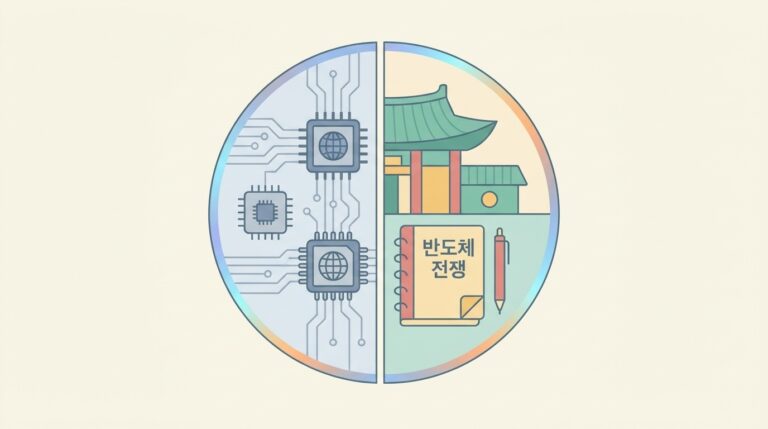
Semiconductor War: How South Korea Navigates the “Sandwich Crisis” (샌드위치 위기)
Phase 1: Empathy (공감 – Connection & Storytelling)
안녕하세요! Welcome back to another Masterclass with Daily Hangul. I’m your lead editor and culture navigator.
Imagine standing in the middle of a high-stakes tug-of-war. To your left, a global superpower is pulling with immense force, demanding your absolute allegiance. To your right, another economic giant is pulling just as hard, threatening to cut off your access to the world’s biggest consumer market.
This is not a scene from a blockbuster espionage movie; this is the reality of South Korea’s semiconductor industry today. As a C2-level learner, you are already comfortable with everyday Korean. But to truly understand Korean business, politics, and the national psyche, you must grasp how Koreans talk about the “Semiconductor War” (반도체 전쟁) and the country’s delicate position, often described as a “Sandwich Crisis” (샌드위치 위기).
Our advanced students often tell us, “I can read Korean news, but I don’t know how to discuss high-level geopolitics naturally with my Korean colleagues.” Today, we are going to bridge that gap. Let’s master the vocabulary of high-stakes tech diplomacy.
Phase 2: Key Expressions (핵심 표현 3선 심층 분석)
1. 샌드위치 신세 (Sandwich Sin-se)
- Pronunciation: Saendewichi sin-se (Sounds like “Sand-wi-chi” + “seen-seh”)
- Meaning: Being caught in the middle / Stuck in a sandwich situation.
- K-Culture Moment: This term is ubiquitous in Korean economic news and K-Dramas dealing with corporate struggle (such as Misaeng or Reborn Rich). It describes a smaller, highly developed entity squeezed between cheaper competitors on one side and more advanced ones on the other, or politically squeezed between superpowers.
- Editor’s Insight: 신세 (sin-se) refers to one’s plight or circumstance. Calling yourself a “sandwich sin-se” implies a feeling of vulnerability and helplessness despite your high capabilities.
- Situation Spectrum: Casual (⚠️) | Semi-formal (✅) | Formal (✅)
- 🤔 Think About It: Does your native country ever find itself in a 샌드위치 신세 between larger political or economic forces? How does that shape public sentiment?
2. 고래 싸움에 새우 등 터진다 (Gorae ssa-um-e sae-u deung teo-jin-da)
- Pronunciation: Go-rae ssa-um-e sae-u deung teo-jin-da (Sounds like “Go-reh ssah-um-eh seh-oo deung tuh-jin-da”)
- Meaning: “A shrimp’s back breaks when whales fight.” (Innocent bystanders get hurt in a clash of giants).
- K-Culture Moment: This is a classic Korean proverb (속담). In modern political discourse, South Korea is often metaphorically cast as the “shrimp” (새우) caught between the “whales” (고래) of the US and China.
- Editor’s Insight: At the C2 level, using this proverb appropriately during a strategic business meeting demonstrates a profound grasp of both Korean culture and natural linguistic flow.
- Situation Spectrum: Casual (✅) | Semi-formal (✅) | Formal (✅)
- 🤔 Think About It: How does this oceanic metaphor capture the historically precarious geopolitical position of the Korean Peninsula?
3. 초격차 기술 (Cho-gyeok-cha Gi-sul)
- Pronunciation: Cho-gyeok-cha gee-sul (Sounds like “Cho-gyuck-cha Gee-sool”)
- Meaning: “Super-gap technology” (An insurmountable technological lead over competitors).
- K-Culture Moment: Originally coined by Samsung executives, this term has become a national slogan. It represents Korea’s strategy to survive the semiconductor war: stay so far ahead that neither the US nor China can afford to exclude you.
- Editor’s Insight: 초 (cho) means “super/ultra,” and 격차 (gyeok-cha) means “gap/difference.” This is the ultimate defensive-offensive strategy.
- Situation Spectrum: Casual (⚠️) | Semi-formal (✅) | Formal (✅)
- 🤔 Think About It: Is “super-gap technology” a sustainable defense strategy in the face of massive state subsidies from other nations?
Phase 3: Textbook vs. Real Korean (교과서 한국어 vs 진짜 한국어)
Situation 1: Expressing being stuck in a difficult political position
- 📖 Textbook Korean: “한국은 미국과 중국 사이에서 어려운 상황에 처해 있습니다.” (Korea is in a difficult situation between the US and China.)
- 🗣️ Real Korean: “한국이 미중 갈등 사이에 끼여서 그야말로 진퇴양난의 샌드위치 신세가 되었네요.” (Korea is stuck between US-China conflicts, literally in a dilemma and caught in a sandwich.)
- 💡 Why the difference? Real Korean political discourse heavily utilizes four-character idioms (사자성어) like 진퇴양난 (Jintyangnan – Dilemma/No way out) and vivid metaphors to capture the intensity of the situation.
Situation 2: Describing the need to maintain a technological lead
- 📖 Textbook Korean: “우리는 기술을 계속 발전시켜서 경쟁에서 이겨야 합니다.” (We must keep developing technology to win the competition.)
- 🗣️ Real Korean: “후발 주자들이 바짝 추격해오는 상황에서, 결국 살아남는 길은 초격차를 유지하는 것뿐입니다.” (With latecomers chasing us closely, the only way to survive is to maintain the super-gap.)
- 💡 Why the difference? Terms like 후발 주자 (latecomer/follower) and 바짝 추격하다 (to chase closely) are standard corporate vocabulary in Korean boardrooms.
Phase 4: K-Culture Deep Dive (K-Culture 딥다이브 & 비언어적 매너)
4-1. The Art of
Frequently Asked Questions (FAQ)
Q: What does "샌드위치 신세 (Sandwich Sin-se)" mean in Korean and how do you pronounce it?
A: In Korean, "샌드위치 신세 (Sandwich Sin-se)" is pronounced [Saendewichi sin-se (Sounds like "Sand-wi-chi" + "seen-seh"] and means: Being caught in the middle / Stuck in a sandwich situation.
Q: What does "고래 싸움에 새우 등 터진다 (Gorae ssa-um-e sae-u deung teo-jin-da)" mean in Korean and how do you pronounce it?
A: In Korean, "고래 싸움에 새우 등 터진다 (Gorae ssa-um-e sae-u deung teo-jin-da)" is pronounced [Go-rae ssa-um-e sae-u deung teo-jin-da (Sounds like "Go-reh ssah-um-eh seh-oo deung tuh-jin-da"] and means: "A shrimp's back breaks when whales fight." (Innocent bystanders get hurt in a clash of giants).
Q: What does "초격차 기술 (Cho-gyeok-cha Gi-sul)" mean in Korean and how do you pronounce it?
A: In Korean, "초격차 기술 (Cho-gyeok-cha Gi-sul)" is pronounced [Cho-gyeok-cha gee-sul (Sounds like "Cho-gyuck-cha Gee-sool"] and means: "Super-gap technology" (An insurmountable technological lead over competitors).