

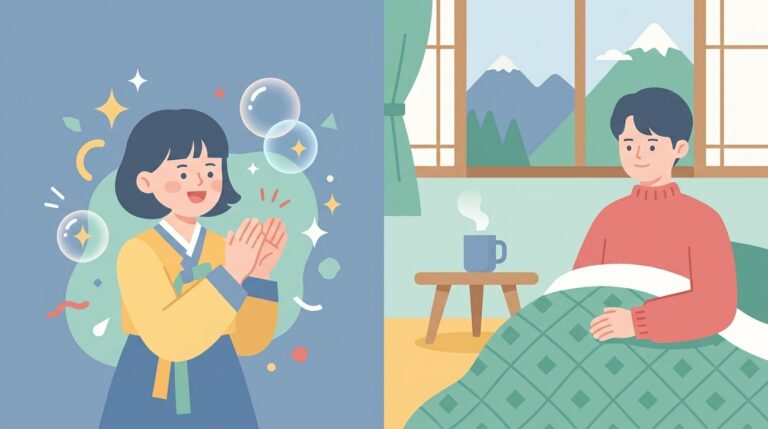
Are You an ‘E’ or an ‘I’? Navigating Korea’s Obsession with MBTI
Phase 1: Empathy (스토리 몰입형 오프닝)
안녕하세요! Daily Hangul editor here, your personal cultural navigator.
Picture this: You are sitting at a trendy cafe in Hongdae with some new Korean friends. The coffee is iced-Americano-perfect, the vibe is cozy, and suddenly, someone leans in and asks with sparkling eyes: “혹시 MBTI가 어떻게 되세요?” (What is your MBTI, by the way?)
If you answer “I think I am an INFJ,” the whole table erupts in understanding nods. “Ah, no wonder you are so thoughtful!” In Korea, MBTI (Myers-Briggs Type Indicator) isn’t just a psychology test; it’s the ultimate social icebreaker, a cultural shorthand, and practically a modern ID card.
If you’ve ever felt a bit lost when Koreans passionately debate whether someone is an ‘E’ (외향형 – Extravert) or an ‘I’ (내향형 – Introvert), you are not alone. Many intermediate learners know the basic words but struggle to express the nuanced ways Koreans talk about social batteries, energy draining, or being a homebody. Today, we’re going to dive into the real, living Korean expressions that will make you sound like a local ‘E’ or ‘I’!
Phase 2: Deep Dive into 3 Essential Expressions (핵심 표현 3선 심층 분석)
1. 기가 빨려요 (Gi-ga ppal-lyeo-yo)
- Pronunciation: Gee-gah ppahl-lyuh-yo (Sounds like “Gee!” + “got” without the ‘t’ + “pullyuh-yo”)
- Meaning: My energy is being sucked dry / My “Gi” (vital energy) is being drained.
- K-Culture Moment: You often hear this in K-Dramas when an Introvert character returns from a massive, noisy company dinner (회식 – hoesik) and collapses onto their sofa.
- Editor’s Insight: Gi (기/氣) means vital energy or life force. 빨리다 means to be sucked/drained. Unlike the English “I’m tired,” which is purely physical, “기가 빨린다” specifically refers to your social battery being aggressively depleted by high-energy environments or overbearing people. It is the ultimate ‘I’ slogan!
- Situation Spectrum:
- Casual: 기 빨려 (✅)
- Semi-formal: 기가 빨려요 (✅)
- Formal: 기가 많이 빠집니다 (⚠️ – A bit too casual for formal boardrooms, but fine with friendly colleagues)
- 🤔 Think About It: In many Western cultures, leaving a party early might be seen as antisocial. In Korea, saying “기가 빨려서 먼저 들어갈게요” (I’m socially drained, so I’m heading out) is a widely understood and empathetic excuse. How does your culture view social burnout?
2. 낯가림이 심해요 (Nat-ga-rim-i sim-hae-yo)
- Pronunciation: Naht-gah-rim-ee sheem-hae-yo (Rhymes with “hot” + “gah-reem”)
- Meaning: I am very shy around strangers (literally, “shunning of unfamiliar faces is severe”).
- K-Culture Moment: K-Pop idols often use this on variety shows to explain why they looked quiet or awkward during their first meeting with other groups.
- Editor’s Insight: 낯 means face, and 가리다 means to sort/avoid. It is different from just being “shy” (부끄럽다). 낯가림 means you need time to warm up to new people. Koreans respect this trait; it implies you are careful and respectful rather than cold.
- Situation Spectrum:
- Casual: 나 낯가림 진짜 심해 (✅)
- Semi-formal: 제가 낯가림이 좀 심해요 (✅)
- Formal: 저는 낯가림이 있는 편입니다 (✅)
- 🤔 Think About It: Is being reserved seen as a weakness or a strength in your country? In Korea, having a bit of 낯가림 is often associated with being thoughtful and polite.
3. 집순이 / 집돌이 (Jip-sun-i / Jip-dol-i)
- Pronunciation: Jeep-soon-ee (for females) / Jeep-dole-ee (for males)
- Meaning: A homebody; someone who loves staying at home.
- K-Culture Moment: On lifestyle reality shows like I Live Alone (나 혼자 산다), celebrities show off their cozy “homebody” routines, making 집순이 culture incredibly trendy.
- Editor’s Insight: This word is incredibly affectionate. -sun-i and -dol-i are traditional cute naming suffixes. Calling yourself a 집순이 or 집돌이 means you find absolute peace at home and don’t need constant social stimulation.
- Situation Spectrum:
- Casual: 나 완전 집순이야 (✅)
- Semi-formal: 저는 완전 집돌이예요 (✅)
- Formal: 저는 쉬는 날 주로 집에 있는 편입니다 (⚠️ – Use this refined version in interviews instead of the slang)
- 🤔 Think About It: Why do you think modern society has embraced terms like “homebody” so warmly? Is it a reaction to our hyper-connected lives?
Phase 3: Textbook Korean vs. Real Korean (교과서 한국어 vs. 진짜 한국어)
Situation 1: Declining an invitation because you are socially tired
- 📖 Textbook Korean: “저는 내성적인 성격이라서 오늘 모임에 갈 수 없습니다.” (I cannot go to the gathering today because I have an introverted personality.)
- 🗣️ Real Korean: “아, 저 오늘 기가 좀 빨려서 집에서 쉬어야 할 것 같아요!” (Ah, I’m feeling a bit socially drained today, so I think I should just rest at home!)
- 💡 Why the difference? The textbook sentence sounds like a clinical self-diagnosis. Real Koreans express their energy state (기) dynamically to make the refusal sound natural and less personal to the host.
Situation 2: Describing someone who loves socializing and meeting new people
- 📖 Textbook Korean: “그 사람은 외향적인 사람이라 사람들과 잘 어울립니다.” (That person is an extroverted person, so they get along well with people.)
- 🗣️ Real Korean: “그 친구 완전 ‘핵인싸’에다가 파워 E예요!” (That friend is a total super-insider and a power ‘E’!)
- 💡 Why the difference? “핵인싸” (haek-in-ssa – super insider/extremely popular person) and “파워 E” (power E – extreme extrovert) are the actual modern slang terms used daily in Korea to describe social butterflies.
Phase 4: K-Culture Deep Dive & Non-verbal Manners (K-Culture 딥다이브)
4-1. The Body Language of ‘I’ and ‘E’
In Korea, non-verbal cues speak volumes. If you are an ‘I’ (introvert) who is feeling 기가 빨려요, you don’t need to loudly complain. Simply lowering your eye contact slightly, offering a polite but quiet nod, and gently holding your cup with both hands signals that you are in “listening and recharging mode.”
On the flip side, ‘E’s (extroverts) show enthusiasm through active, rhythmic reactions known as 리액션 (Re-action). Leaning forward, clapping your hands while laughing, and making high-pitched sounds like “아~ 진짜요?!” (Ah~ really?!) are the classic hallmarks of an energetic Korean ‘E’.
4-2. The MBTI Trend in Korean Society
Why is Korea so obsessed with MBTI? It stems from a deeply collectivist culture where understanding “where I fit in” and “how to relate to others” is crucial. MBTI acts as a safe, polite label. Instead of saying “I find you annoying,” a Korean might think, “Ah, they are a ‘T’ (Thinking type), and I am an ‘F’ (Feeling type), that’s why we see things differently.” It reduces friction and fosters harmony!
Phase 5: Real-Life Roleplay Scenario (실전 롤플레이 시나리오)
Character & Setting
- Ji-a (지아): A cheerful, bubbly “Power E” coworker who loves team lunches.
- You (B2 Learner): An “I” coworker who had a very long week of meetings.
- Setting: Friday afternoon at the office pantry.
지아: 오늘 불금인데, 퇴근하고 다 같이 삼겹살에 소주 한잔 어때요?
Ji-a: Oneul bul-geum-in-de, toe-geun-ha-go da gat-i sam-gyeop-sal-e so-ju han-jan eo-ttae-yo?
(🎭 Clapping her hands excitedly) Today is Fire Friday! How about we all grab samgyeopsal and soju after work?

유 (You): 아, 정말 가고 싶지만... 이번 주에 미팅이 너무 많았어서요.
You: Ah, jeong-mal ga-go sip-ji-man... i-beon ju-e mi-ting-i neo-mu man-at-seo-seo-yo.
(🎭 Smiling apologetically, rubbing the back of your neck) Ah, I really want to go, but... I had so many meetings this week.

지아: 에이~ 맛있는 거 먹으면 스트레스 다 풀려요! 같이 가요!
Ji-a: E-i~ mas-it-neun geo meog-eu-myeon seu-tre-seu da pul-lyeo-yo! Gat-i ga-yo!
(🎭 Nudging your shoulder playfully) Come on~ eating delicious food relieves all stress! Let's go together!

유 (You): 사실 제가 기가 좀 잘 빨리는 편이라, 오늘은 집에 가서 쉬어야 할 것 같아요.
You: Sa-sil je-ga gi-ga jom jal ppal-ri-neun pyeon-i-ra, o-neul-eun jip-e ga-seo swi-eo-ya hal geot gat-a-yo.
(🎭 Softly smiling, showing sincere exhaustion) Actually, I tend to get my energy drained pretty easily, so I think I need to go home and rest today.

지아: 아, 맞다! 대리님 완전 'I'였죠? 제가 깜빡했네요.
Ji-a: Ah, mat-da! Dae-ri-nim wan-jeon 'I'yeot-jyo? Je-ga kkam-ppak-haet-ne-yeo.
(🎭 Gasps lightly, realizing) Ah, that's right! You're a total 'I', aren't you? I completely forgot.

유 (You): 네, 맞아요. 평일에 에너지를 다 써서 주말에는 집돌이/집순이 모드예요.
You: Ne, maj-a-yo. Pyeong-il-e e-neo-ji-reul da sseo-seo ju-mal-e-neun jip-dol-i/jip-sun-i mo-deu-yeo-yo.
(🎭 Chuckling warmly) Yes, exactly. I used up all my energy during the week, so on weekends, I am in homebody mode.

지아: 아쉽지만 인정! 그럼 주말 동안 충전 잘 하고 월요일에 봐요!
Ji-a: A-swip-ji-man in-jeong! Geu-reom ju-mal dong-an chung-jeon jal ha-go wol-yo-il-e bwa-yo!
(🎭 Waving cheerfully) Sad, but I respect that! Well, recharge well over the weekend and see you on Monday!

유 (You): 네, 감사해요! 주말 잘 보내시고 월요일에 활기차게 만나요!
You: Ne, gam-sa-hae-yo! Ju-mal jal bo-nae-si-go wol-yo-il-e hwal-gi-cha-ge man-na-yo!
(🎭 Bowing slightly with a relieved smile) Yes, thank you! Have a great weekend and let's meet with full energy on Monday!
🔀 Interactive Branching Points (인터랙티브 선택지)
How would you respond if Ji-a asks: “내일은 집에서 하루 종일 뭐 할 거예요?” (What are you going to do at home all day tomorrow?)
* Option A: “그냥 아무것도 안 하고 뒹굴뒹굴할 거예요.” (I’m just going to roll around doing nothing.)
* Feedback: Best! Perfect use of “뒹굴뒹굴” (dwing-gul-dwing-gul – rolling around, being lazy). It perfectly describes a homebody’s paradise and sounds highly natural.
* Option B: “집에서 책을 읽으며 공부할 생각입니다.” (I plan to study while reading books at home.)
* Feedback: Bad. While grammatically correct, it sounds way too formal (-할 생각입니다) and like you are preparing for a job interview instead of talking to a friendly coworker.
* Option C: “밖은 위험하니까 나가지 않을 거예요.” (Since the outside is dangerous, I won’t go out.)
* Feedback: Risk. This is a common internet meme joke in Korea (“이불 밖은 위험해” – It’s dangerous outside the blankets). However, if delivered without a joking tone, Ji-a might think you genuinely think your neighborhood is unsafe!
Phase 6: 10-Second Emotion Shadowing Drill (10초 감정 섀도잉)
To sound like a natural Korean speaker, you must master the emotional rhythm of these sentences. Try speaking these out loud with the designated pauses (/) and emotions!
[🥺 Exhausted and apologetic]
“아, / 진짜 가고 싶었는데요… / 오늘 제가 / 기가 너무 빨려서요…”
(Ah, / jin-jja ga-go sip-eot-neun-de-yo… / o-neul je-ga / gi-ga neo-mu ppal-lyeo-seo-yo…)[😊 Proud and cute]
“저 완전 / 집순이잖아요! / 주말에는 / 무조건 / 홈캉스예요!”
(Jeo wan-jeon / jip-sun-i-ja-na-yo! / Ju-mal-e-neun / mu-jo-geon / hom-kang-seu-yeo-yo!)
Phase 7: K-Culture Mini Dictionary (K-Culture 미니 사전)
- 인싸 (In-ssa) | Insider
- A social butterfly who gets along with everyone, knows all the trends, and is always invited to parties.
- 아싸 (Ah-ssa) | Outsider
- A loner or introvert who prefers solitary activities over group gatherings. Used playfully and without negative stigma.
- 홈캉스 (Hom-kang-seu) | Home + Vacance
- A staycation. Spending your vacation or weekend relaxing at home with delicious food, Netflix, and cozy blankets.
- 스몰 토크 (Seu-mol to-keu) | Small Talk
- Light conversation. ‘I’s generally find Korean 스몰 토크 (like discussing the weather or what you ate for lunch) taxing, while ‘E’s thrive on it.
Phase 8: Survivor Kit for Travelers (여행자를 위한 생존 키트)
Survival Expressions for Introverts in Korea
- “조용한 자리로 부탁드려요.” (Jo-yong-han ja-ri-ro bu-tak-deu-ryeo-yo.)
- Pro Tip: Use this when entering a busy restaurant or cafe to request a quiet, secluded seat.
- “혼자서 조용히 보고 싶어요.” (Hon-ja-seo jo-yong-hi bo-go sip-eo-yo.)
- Pro Tip: If a shop assistant in Olive Young follows you around trying to help, say this politely with a gentle smile to browse in peace.
- “배달 주소로 문 앞에 놓아주세요.” (Bae-dal ju-so-ro mun ap-e noh-a-ju-se-yo.)
- Pro Tip: When ordering food via apps, select this option to avoid face-to-face interaction with the delivery driver.
Editor’s Travel Note
If you are an ‘I’ traveling in Korea, download the Kakao T App for taxis and Baemin App (Baedal Minjeok) for food delivery. Both allow you to pay digitally in advance and choose “non-face-to-face” options, saving precious social energy! Disclaimer: App interfaces and local payment policies may change over time; please verify setup steps before traveling.
Phase 9: A Step Deeper (한 발 더 깊이)
In the West, individualism often encourages people to speak up and occupy social space. In Korea, however, historically rooted Confucian values place a high value on ‘체면’ (Che-myeon – saving face/reputation) and ‘눈치’ (Nunchi – the art of reading the room).
Because of this, being an ‘I’ (introverted, quiet, observing) is traditionally seen as a highly respectful trait. However, with the rise of modern corporate culture, ‘E’ traits have become highly sought-after for networking. This tension is why MBTI is so beloved—it allows Koreans to proudly claim their introversion (“I’m not rude, I’m just an I!”) while acknowledging the social demands of an ‘E’ world.
💬 Your Turn: Are you an ‘E’ or an ‘I’? How do you handle social battery depletion in your own culture? Let us know in the comments below!
Phase 10: FAQ & Avoiding Common Mistakes
Q: Can I use the word
Frequently Asked Questions (FAQ)
Q: What does "기가 빨려요 (Gi-ga ppal-lyeo-yo)" mean in Korean and how do you pronounce it?
A: In Korean, "기가 빨려요 (Gi-ga ppal-lyeo-yo)" is pronounced [Gee-gah ppahl-lyuh-yo (Sounds like "Gee!" + "got" without the 't' + "pullyuh-yo"] and means: My energy is being sucked dry / My "Gi" (vital energy) is being drained.
Q: What does "낯가림이 심해요 (Nat-ga-rim-i sim-hae-yo)" mean in Korean and how do you pronounce it?
A: In Korean, "낯가림이 심해요 (Nat-ga-rim-i sim-hae-yo)" is pronounced [Naht-gah-rim-ee sheem-hae-yo (Rhymes with "hot" + "gah-reem"] and means: I am very shy around strangers (literally, "shunning of unfamiliar faces is severe").
Q: What does "집순이 / 집돌이 (Jip-sun-i / Jip-dol-i)" mean in Korean and how do you pronounce it?
A: In Korean, "집순이 / 집돌이 (Jip-sun-i / Jip-dol-i)" is pronounced [Jeep-soon-ee (for females] and means: A homebody; someone who loves staying at home.







