

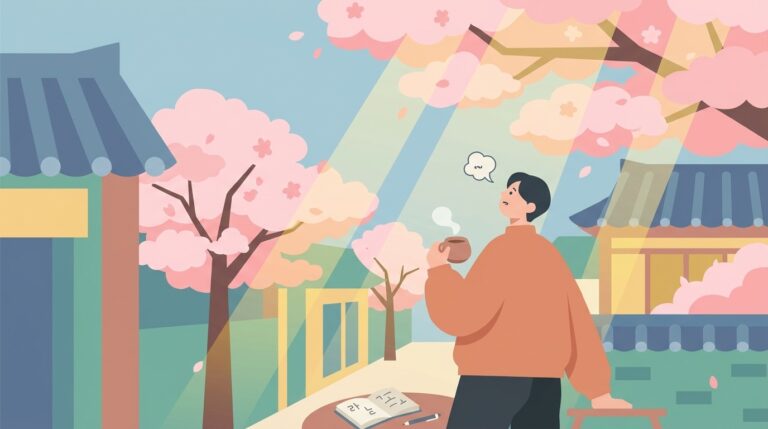
Feeling the Spring Blues? Unlocking the Magic of “봄 타나 봐 (Bom Tana Bwa)”
Phase 1: Empathy (안녕하세요! Hello, Bestie!)
안녕하세요! It’s your K-culture companion and Daily Hangul Editor! 🌸
Picture this: The chilly winter wind has finally subsided. Warm sunshine kisses your face, cherry blossoms are starting to flurry like pink snow, and couples are walking hand-in-hand along the Han River. But instead of feeling thrilled, you feel… a little empty. A bit lonely. You find yourself staring out the window, listening to melancholic K-indie songs, and wondering why on earth you feel so blue when the weather is so beautiful.
Don’t worry, you aren’t weird! You are just “봄 타나 봐” (Bom tana bwa)—literally experiencing the “spring fever” or the spring blues. In Korea, this unique emotional shift is a very real, culturally recognized phenomenon. Today, we will dive into why spring makes us lonely, explore the exact expressions Koreans use to describe this mood, and learn how to talk about your feelings like a true native. Let’s get cozy and talk about our feelings!
Phase 2: Core Expressions (핵심 표현 3선)
1. 봄 타나 봐 (Bom tana bwa)
- Pronunciation: Bom tana bwa (Sounds like “Bohm tah-nah bwah”)
- Meaning: “I guess I’m riding the spring” / “I must have spring fever” (Feeling lonely or melancholic due to spring)
- K-Culture Moment: This is the exact title of a famous hit song by K-ballad king Seo In-guk (서인국). It’s played everywhere in Korea as soon as the cherry blossoms bloom.
- Editor’s Insight: The verb 타다 (tada) usually means “to ride” (a bus, a bike). But when paired with seasons, it means your emotions are highly sensitive to that seasonal change. If you feel lonely in spring, you “ride spring” (봄을 타다). If you get lonely in autumn, you “ride autumn” (가을을 타다).
- Situation Spectrum: Casual (✅) | Semi-formal (✅) | Formal (⚠️ – use ‘봄을 타는 것 같습니다’)
- 🤔 Think About It: In your culture, do people associate spring with happiness, or is there a word for feeling lonely when the seasons change?
2. 싱숭생숭하다 (Singsung-saengsunghada)
- Pronunciation: Sing-sung-saeng-sung-ha-da (Sounds like “Sing-soong-saeng-soong-hah-dah”)
- Meaning: To feel restless, fluttery yet distracted, or slightly uneasy in a dreamy way.
- K-Culture Moment: You will hear K-drama main characters say this when they can’t focus on studying or working because the weather is too nice, or because they are starting to develop feelings for someone.
- Editor’s Insight: This is a beautiful onomatopoeic-like word representing a mind that is floating around. It’s not necessarily a bad feeling; it’s that ticklish, restless feeling when your heart is fluttering but you also feel a bit lonely.
- Situation Spectrum: Casual (✅) | Semi-formal (✅) | Formal (🚫)
- 🤔 Think About It: Is there a single word in English that captures both “distracted” and “emotionally fluttery”? The uniqueness of Korean emotional vocabulary is truly fascinating!
3. 옆구리가 시리다 (Yeopguri-ga sirida)
- Pronunciation: Yeob-gu-ri-ga shi-ri-da (Sounds like “Yup-goo-ree-gah shee-ree-dah”)
- Meaning: “My side feels chilly” (Humorous/dramatic way to say “I feel lonely because I don’t have a partner”)
- K-Culture Moment: Commonly used by single friends in comedy shows or reality dating programs (like I Am Solo or Heart Signal) when they see couples holding hands in the spring warmth.
- Editor’s Insight: Literally, 옆구리 (yeopguri) is your flank/side, and 시리다 (sirida) is a cold sensation in your bones. When you don’t have someone to walk beside you holding your hand, that empty “side” feels cold!
- Situation Spectrum: Casual (✅) | Semi-formal (⚠️) | Formal (🚫)
- 🤔 Think About It: Why do you think Koreans use physical sensations (cold sides, burning stomachs) to describe emotional states?
Phase 3: Textbook vs. Real Korean (교과서 vs. 진짜 한국어)
Situation 1: Expressing that you feel lonely because of the weather
- 📖 Textbook Korean: “날씨가 좋아서 외롭습니다.” (Nalssiga joaseo oeropseumnida. / I am lonely because the weather is good.)
- 🗣️ Real Korean: “날씨는 좋은데 왜 이렇게 쓸쓸하지? 봄 타나 봐.”
- Pronunciation: “Nalssineun joeunde wae ireoke sseulsseulhaji? Bom tana bwa.”
- Translation: “The weather is so nice, but why do I feel so lonely? I must be getting the spring blues.”
- 💡 Why is it different? Koreans rarely use the plain adjective 외롭다 (lonely) directly to acquaintances; it can sound too heavy. Using 봄 타나 봐 (spring blues) softens the mood with a touch of poetic seasonal romance.
Situation 2: Explaining why you can’t focus on work/study today
- 📖 Textbook Korean: “마음이 불안해서 집중이 안 됩니다.” (Maeumi buranhaeseo jipjungi an deomnida. / I cannot concentrate because my mind is anxious.)
- 🗣️ Real Korean: “날씨가 봄이라 마음이 싱숭생숭해.”
- Pronunciation: “Nalssiga bomira maeumi singsung-saengsung-hae.”
- Translation: “My mind is all fluttery and restless because it’s spring.”
- 💡 Why is it different? 싱숭생숭하다 perfectly captures that spring-induced distraction without making you sound deeply troubled or clinically anxious.
Phase 4: K-Culture Deep Dive & Non-Verbal Manners
4-1. Gestures & Body Language
When expressing 싱숭생숭하다 or 봄 타나 봐, Koreans often hold their face with both hands, sigh softly while looking at the sky, or gently touch their side (옆구리) while joking about being single. A soft, playful sigh is the ultimate non-verbal cue that you are “riding the spring.”
4-2. The Han River Couple Culture
Spring in Korea is synonymous with Yeouido Cherry Blossom Festival (여의도 벚꽃축제). Thousands of couples wear matching outfits (matching pastel coats are a must!). Seeing this flood of lovey-dovey couples is the primary trigger for 옆구리가 시리다 (chilly sides) among singles. This has even birthed K-pop anthems like Busker Busker’s “Cherry Blossom Ending”—often playfully dubbed the “Spring Carol” or “the zombie song” because it rises back up the music charts every single spring!
Phase 5: Real-Life Roleplay Scenario
Meet Minho (민호), your friendly Korean coworker, as you both look out the office window during lunch break on a beautiful April afternoon.
- Minho: 날씨 진짜 좋네요. 벌써 벚꽃이 다 폈어요!
(Nalssi jinjja jonneyo. Beolsseo beotkkoci da pyeosseoyo!)- 🎭 Minho smiles warmly, pointing out the window at the cherry blossoms.
- You: 맞아요. 그런데 날씨가 좋으니까 왠지 마음이 싱숭생숭해요.
(Majayo. Geureonde nalssiga joeunikka waenji maeumi singsung-saengsung-haeyo.)- 🎭 You sigh playfully, resting your chin on your hand.
- Minho: 아, 혹시 봄 타시는 거 아니에요?
(Ah, hoksi bom tasineun geo anieyo?)- 🎭 Minho giggles, teasing you gently.
- You: 그런가 봐요. 커플들을 보니까 옆구리가 시리네요.
(Geureon-ga bwayo. Keopeuldeureul bonikka yeopguriga sirineyo.)- 🎭 You wrap your arms around yourself as if feeling cold.
- Minho: 하하, 저도 그래요. 우리 오늘 퇴근하고 매운 떡볶이나 먹으러 갈까요?
(Haha, jeodo geuraeyo. Uri oneul toegeunhago maeun tteokbokki-na meogeureo galkkayo?)- 🎭 Minho claps his hands, trying to cheer you up.
- You: 정말요? 매운 거 먹으면 기분이 좋아질 것 같아요!
(Jeongmalyo? Maeun geo meogeuryeon gibuni joajil geot gatayo!)- 🎭 Your eyes light up with excitement.
- Minho: 좋아요! 그럼 칼퇴근하고 떡볶이 맛집으로 고고!
(Joayo! Geureom kal-toegeunhago tteokbokki matjibeuro go-go!)- 🎭 Minho gives you a thumbs-up.
- You: 신난다! 떡볶이 메이트가 있어서 다행이에요.
(Sinnanda! Tteokbokki meiteuga isseoseo dahaengieyo.)- 🎭 You laugh, feeling your loneliness melt away.
🔀 Choose Your Response! (인터랙티브 분기점)
When Minho asks: “아, 혹시 봄 타시는 거 아니에요? (Are you perhaps riding the spring/having spring blues?)” How do you respond?
- Option A: “네, 저는 자전거 타는 것을 좋아해요.” (Yes, I like riding bicycles.)
- Option B: “맞아요. 봄 타나 봐요. 자꾸 쓸쓸한 기분이 드네요.” (That’s right. I guess I’m riding the spring. I keep feeling lonely.)
- Option C: “네, 봄이 너무 싫어요! 우울해요.” (Yes, I hate spring! I am depressed.)
🧐 Feedback on Your Choice:
- Option A (Bad/Mistake): Oh no! You took the verb 타다 (to ride) too literally! Minho might get confused thinking you want to go cycling instead of sharing your emotional state.
- Option B (Best/Perfect!): Excellent! You used the grammatical pattern correctly and showed B1 level emotional expression with 쓸쓸하다 (lonely/melancholic).
- Option C (Risk/Awkward): While grammatically correct, it sounds too intense and negative for a casual chat. It might make Minho feel awkward and unsure of how to comfort you.
Phase 6: 10-Second Emotion Shadowing Drill
Let’s practice speaking with the exact emotional intonation of a Korean native!
- “날씨는 좋은데 / 왜 이렇게 / 쓸쓸하지?” 🥺
- Pause at the slashes. Say it with a soft, trailing-off sigh at the end.
- “봄 타나 봐… / 옆구리가 시리네.” 🍂
- Rub your arm playfully as you say “시리네” (shirine) to add that touch of drama.
Phase 7: K-Culture Mini-Dictionary
- 칼퇴근 (Kal-toegeun) | Sharp/Knife-like leaving of work | Leaving the office exactly on time (on the dot) without any delays.
- 쓸쓸하다 (Sseulsseulhada) | Melancholic/Lonesome | A softer, more poetic feeling of loneliness than the heavy 외롭다.
- 꽃샘추위 (Kkotsaem-chuwi) | Flower-jealous cold | The sudden cold snaps in early spring, metaphorically described as the winter being jealous of the spring flowers blooming.
- 솔로 (Sollo) | Solo | Korean slang for a single person who is currently not in a relationship.
Phase 8: Survivor’s Kit for Travelers
Survival Expressions TOP 3
- 인생샷 찍어주세요! (Insaeng-syat jjigeo-juseyo!)
- Pro Tip: “Please take a once-in-a-lifetime photo of me!” Use this when asking someone to take your photo under the cherry blossoms.
- 여기 돗자리 빌릴 수 있나요? (Yeogi dotjari billil su innayo?)
- Pro Tip: “Can I rent a picnic mat here?” Vital for enjoying the Han River park like a local.
- 따뜻한 아메리카노 주세요. (Ttatteutan amerikanoh juseyo.)
- Pro Tip: “Warm Americano, please.” For when the 꽃샘추위 (cold snap) hits unexpectedly!
Editor’s Travel Note
If you are visiting Seoul in spring, downloading the KakaoMap App is a lifesaver to locate hidden cherry blossom spots like Seokchon Lake or Seoul Forest. Disclaimer: Cherry blossom blooming dates vary slightly every year depending on temperature fluctuations.
Phase 9:
Frequently Asked Questions (FAQ)
Q: What does "봄 타나 봐 (Bom tana bwa)" mean in Korean and how do you pronounce it?
A: In Korean, "봄 타나 봐 (Bom tana bwa)" is pronounced [Bom tana bwa (Sounds like "Bohm tah-nah bwah"] and means: "I guess I'm riding the spring" / "I must have spring fever" (Feeling lonely or melancholic due to spring)
Q: What does "싱숭생숭하다 (Singsung-saengsunghada)" mean in Korean and how do you pronounce it?
A: In Korean, "싱숭생숭하다 (Singsung-saengsunghada)" is pronounced [Sing-sung-saeng-sung-ha-da (Sounds like "Sing-soong-saeng-soong-hah-dah"] and means: To feel restless, fluttery yet distracted, or slightly uneasy in a dreamy way.
Q: What does "옆구리가 시리다 (Yeopguri-ga sirida)" mean in Korean and how do you pronounce it?
A: In Korean, "옆구리가 시리다 (Yeopguri-ga sirida)" is pronounced [Yeob-gu-ri-ga shi-ri-da (Sounds like "Yup-goo-ree-gah shee-ree-dah"] and means: "My side feels chilly" (Humorous/dramatic way to say "I feel lonely because I don't have a partner")







