

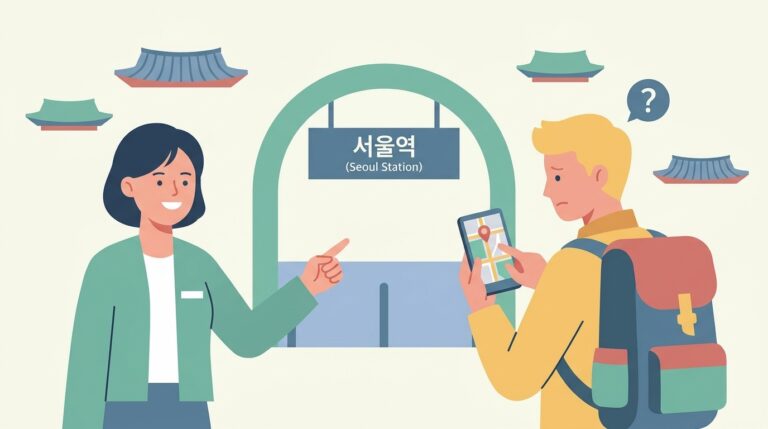
Help Me! How to Ask for Help in Korean Like a True Local
Phase 1: Empathy (Your Korean Bestie is Here!)
안녕하세요! (An-nyeong-ha-se-yo!) I’m your lead editor and culture navigator from Daily Hangul.
Imagine this: You’ve just landed in Seoul. The neon signs are dazzling, the smell of delicious street food is in the air, but suddenly, you find yourself completely lost in the maze-like corridors of Myeongdong Station. Your phone battery is at 2%, and the offline map isn’t loading. You feel a wave of panic. You want to ask for help, but you’re terrified of saying the wrong thing.
Don’t worry, my friend! We have all been there. Today, we are mastering the absolute survival phrase of Korean: “도와주세요” (Do-wa-ju-se-yo / Help me). Based on feedback from hundreds of our A1 learners, knowing how to ask for help politely can turn a stressful travel nightmare into a heartwarming moment of human connection. Let’s learn how to do it with confidence!
Phase 2: Deep-Dive into the Top 3 Survival Phrases
1. 도와주세요 (Do-wa-ju-se-yo)
- Pronunciation: Doh-wah-joo-seh-yo (Sounds like “Do-wah” + the jewel “ju” + “say-yo”)
- Meaning: Please help me (Literal: “Give me help”)
- K-Culture Moment: You hear this constantly in K-Dramas when the main lead is in a pinch, or when someone drops their groceries and friendly passersby rush to help.
- Editor’s Insight: This is the ultimate, universally understood SOS phrase. Adding “yo” at the end makes it polite and safe to use with strangers of any age.
- Situation Spectrum: Casual: ⚠️ (Too formal for close friends) | Semi-formal: ✅ (Perfect for strangers) | Formal: ✅
- 🤔 Think About It: In Korean culture, helping others is tied to the concept of 정 (Jeong)—a warm, emotional bond. When you say “도와주세요,” locals will genuinely try their best to assist you.
2. 저기요 (Jeo-gi-yo)
- Pronunciation: Juh-gee-yo (Sounds like “Juh” + “gee” + “yo”)
- Meaning: Excuse me (Literal: “Over there, please”)
- K-Culture Moment: The magic word used to call a waiter in a busy Korean BBQ restaurant, or to catch someone’s attention on the street before asking for directions.
- Editor’s Insight: Never yell “Hey!” in Korea. “저기요” is the polite way to say “Excuse me” to get someone’s attention before you ask for help.
- Situation Spectrum: Casual: ⚠️ | Semi-formal: ✅ | Formal: 🚫
- 🤔 Think About It: Why do Koreans point “over there” (저기) to call someone? It’s a polite linguistic cushion to avoid directly pointing at the person, which can feel aggressive.
3. 길을 잃었어요 (Gil-eul il-eot-eo-yo)
- Pronunciation: Gheel-eul eel-ut-uh-yo
- Meaning: I am lost (Literal: “I lost the road/way”)
- K-Culture Moment: The classic scene in romantic K-Dramas where the protagonist gets lost in a beautiful, snow-covered village and asks for directions.
- Editor’s Insight: Pair this with “도와주세요” to immediately let locals know you need navigation help.
- Situation Spectrum: Casual: ⚠️ | Semi-formal: ✅ | Formal: ✅
- 🤔 Think About It: Korean addresses can be incredibly confusing even for locals because of the transition from old land-lot systems to street-name systems. Don’t feel bad about getting lost!
Phase 3: Textbook Korean vs. Real Korean
Let’s compare what dusty old textbooks teach you versus how real Koreans actually talk!
Situation A: Getting someone’s attention on the street
- 📖 Textbook Korean: “실례합니다” (Sil-lye-hap-ni-da – Excuse me)
- 🗣️ Real Korean: “저기요, 죄송한데…” (Jeo-gi-yo, joe-song-han-de… – Excuse me, I’m sorry but…)
- 💡 Why the difference? While “실례합니다” is grammatically perfect, it can sound a bit like a robot or a news anchor. “저기요, 죄송한데…” sounds much softer and more natural to local ears.
Situation B: Needing immediate help
- 📖 Textbook Korean: “나를 도우세요” (Na-reul do-u-se-yo – Help me)
- 🗣️ Real Korean: “잠시만 도와주실 수 있으세요?” (Jam-si-man do-wa-ju-sil su is-seu-se-yo? – Could you help me for just a moment?)
- 💡 Why the difference? “나를 도우세요” is a literal translation of “Help me” that sounds like a command. Real Koreans use indirect, polite questions to show respect for the other person’s time.
Phase 4: K-Culture Deep-Dive & Non-Verbal Manners
4-1. The “Polite Angle” Gesture
When approaching someone for help in Korea, body language speaks louder than words:
* The Head Tilt: A slight, respectful 15-degree bow of your head as you say “저기요” immediately signals that you are polite and respectful.
* The Hand Placement: Keep your hands gently clasped in front of you. Pointing or waving your hands wildly can scare people away!
4-2. The “Jeong” (정) Culture
Koreans might look busy and glued to their smartphones, but they possess a deep sense of communal warmth called 정 (Jeong). If you approach them politely using Korean, they will often go out of their way—sometimes even walking you directly to your destination!
Phase 5: Real-Life Roleplay Scenario
Setting: You are at a subway exit in Hongdae, holding a map with a confused face. A friendly college student (Minjun) walks past.
- Minjun: (Noticing your confused face) 🎭 Looking at you warmly 혹시 도움이 필요하세요? (Hok-si do-um-i pil-yo-ha-se-yo? / Do you perhaps need help?)
- You: 🎭 Politely bowing head slightly 아, 네! 저기요, 길을 잃었어요. (Ah, ne! Jeo-gi-yo, gil-eul il-eot-eo-yo. / Oh, yes! Excuse me, I am lost.)
- Minjun: 어디 찾으세요? (Eo-di chat-eu-se-yo? / Where are you looking for?)
- You: 홍대역 9번 출구 어디예요? (Hong-dae-yeok gu-beon chul-gu eo-di-ye-yo? / Where is Hongdae Station Exit 9?)
- Minjun: 아! 저쪽으로 쭉 가시면 돼요. (Ah! Jeo-jjok-eu-ro jjuk ga-si-myeon dway-yo. / Oh! You just have to go straight that way.)
- You: 아, 진짜요? 감사합니다! (Ah, jin-jja-yo? Gam-sa-ham-ni-da! / Oh, really? Thank you!)
- Minjun: 아니에요. 조심히 가세요! (An-i-e-yo. Jo-sim-hi ga-se-yo! / No problem. Go safely!)
- You: 네! 도와주셔서 감사합니다. (Ne! Do-wa-ju-syeo-seo gam-sa-ham-ni-da. / Yes! Thank you for helping me.)
🔀 Choose Your Path!
If Minjun speaks too fast, what do you say?
* A) “한국어 못해요!” (Han-guk-eo mot-hae-yo! / I can’t speak Korean!)
* Feedback (Risk): It gets the point across, but it abruptly cuts off the interaction and might make them feel awkward.
* B) “천천히 말씀해 주세요.” (Cheon-cheon-hi mal-saem-hae ju-se-yo. / Please speak slowly.)
* Feedback (Best!): Extremely polite and encourages the local to keep helping you at a comfortable speed.
* C) “영어 하세요?” (Yeong-eo ha-se-yo? / Do you speak English?)
* Feedback (Bad): Asking this bluntly right away can make some shy Koreans nervous and run away!
Phase 6: 10-Second Emotion Shadowing Drill
Practice saying these with the correct rhythm and emotional markers!
[🥺 Urgent & Polite]
저기요… / 도와주세요.
(Jeo-gi-yo… / do-wa-ju-se-yo.)
Stop for 1 second after ‘저기요’ to grab attention.-
[😭 Lost & Sad]
길을 / 잃었어요… / 어떡해요?
(Gil-eul / il-eot-eo-yo… / eo-tteok-hae-yo?)
Sigh gently at ‘어떡해요’ (What should I do?). -
[😊 Super Grateful]
와! / 진짜 / 감사합니다!
(Wa! / jin-jja / gam-sa-ham-ni-da!)
Put energy and a bright smile on ‘진짜’ (really).
Phase 7: K-Culture Mini-Dictionary
- 도움 (Do-um) | Help / Assistance | The noun form of “to help”. Often used in “도움이 필요해요” (I need help).
- 출구 (Chul-gu) | Exit | Crucial for subway navigation. You will see signs like “1번 출구” (Exit 1) everywhere.
- 길 (Gil) | Road / Street / Way | Used in phrases like “길을 물어보다” (to ask for directions).
- 지도 (Ji-do) | Map | Extremely useful when showing someone your destination on your phone.
Phase 8: Survivor’s Travel Kit
Survival Phrases TOP 3
- 화장실 어디예요? (Hwa-jang-sil eo-di-ye-yo?)
- Pro Tip: “Where is the restroom?” – A true emergency phrase!
- 이거 어떻게 해요? (I-geo eo-tteok-hae-yo?)
- Pro Tip: “How do I do this?” – Perfect for ticket machines or ordering kiosks.
- 영어 메뉴판 있어요? (Yeong-eo me-nyu-pan is-seo-yo?)
- Pro Tip: “Do you have an English menu?” – A lifesaver in local restaurants.
🗺️ Editor’s Travel Note
Google Maps does not work well for walking navigation in Korea due to security laws. Before you land, make sure to download the Naver Map App or KakaoMap for perfect real-time directions!
Phase 9: A Step Deeper (Insight)
In western cultures, calling out to a stranger with “Excuse me” is very individualistic. In Korea, asking for help taps into a deep sense of collective responsibility. Because Korea was rebuilt through tight-knit community efforts after the war, helping a stranger in need is seen as a basic social duty. When you ask a Korean for help, you aren’t bothering them—you are inviting them to show hospitality!
💬 Your Turn: Have you ever asked for help in a foreign language? How did it feel? Let me know in the comments below!
Phase 10: FAQ & Common Mistakes
Q: Can I use “도와줘” (Do-wa-jwo) to strangers?
A: Absolutely not! “도와줘” is informal (반말). Using it with strangers can sound very rude, like you are commanding them. Always stick to the polite “도와주세요” (Do-wa-ju-se-yo).
Q: What if they don’t understand my pronunciation?
A: Show them your screen! Type your destination in Korean on your phone and say: “여기 어떻게 가요?” (Yeo-gi eo-tteok-hae ga-yo? / How do I go here?).
Q: Is it okay to touch someone’s shoulder to get attention?
A: Avoid physical contact with strangers in Korea. A polite “저기요” (Jeo-gi-yo) or a slight wave is much more appropriate.
🚨 Common Mistakes Alert!
- Mistake: Yelling “Help!” in English loudly in a quiet subway.
- Correct Action: Approach one person gently, bow slightly, and say “저기요, 죄송한데 도와주세요.”
- Mistake: Bowing 90 degrees just to ask for directions.
- Correct Action: Keep it casual! A small 15-degree head nod is perfect.
Phase 11: Action Missions
- 🥉 Bronze Mission: Practice saying “도와주세요” 5 times in front of the mirror with a polite head tilt.
- 🥈 Silver Mission: Write down “저기요, 길을 잃었어요” in your phone’s memo app so you can use it anytime.
- 🥇 Gold Mission: Next time you watch a K-Drama, actively listen and find the exact moment a character says “도와주세요”!
Phase 12: Interactive Quiz Challenge
Q1. Which phrase is the most natural way to get a stranger’s attention before asking for help?
1) 야! (Ya!)
2) 실례합니다만 (Sil-lye-hap-ni-da-man)
3) 저기요 (Jeo-gi-yo)
Reveal Answer & Explanation
Correct Answer: 3) 저기요
Explanation: While ‘야’ is rude and ‘실례합니다만’ is extremely stiff/formal, ‘저기요’ is the gold standard for naturally starting a polite conversation in daily life!
Q2. Fill in the blank: “I am lost” in Korean is “길을 __________”.
Reveal Answer & Explanation
Correct Answer: 잃었어요 (il-eot-eo-yo)
Explanation: “길을 잃었어요” literally translates to “I lost the way”.







