

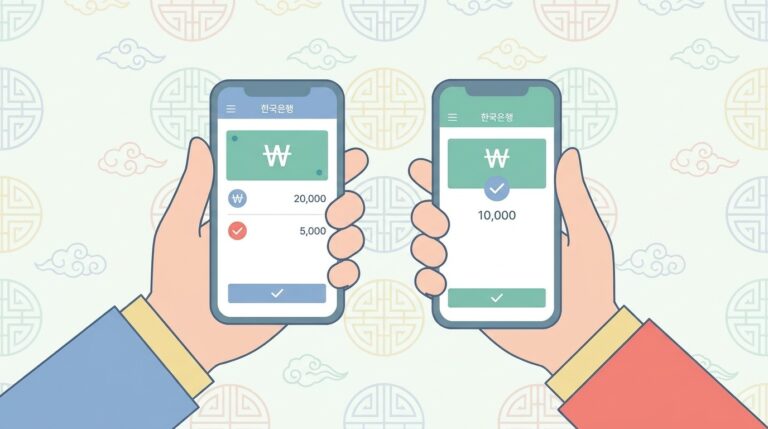
We Need to Settle the Bill! How to Talk About Splitting the Cost in Korea Like a Local
Phase 1: Empathy (Your Korean Bestie’s Intro) 👋
안녕하세요! (Annyeonghaseyo!) It’s your favorite Korean editor from Daily Hangul, your cultural navigator in Korea! 🌟
Picture this: You just had an amazing, sizzling K-BBQ dinner with your new Korean friends in Hongdae. The table is stacked with empty plates, everyone is happy, and then… the bill arrives. A heavy silence falls for a split second. You want to pay your share, but you aren’t sure how to say “Let’s split it” without sounding too transactional or cold. Should you transfer the money via bank app? Do they even do Dutch pay here?
If you’ve felt that awkward sweat breaking out when settling travel expenses in Korea, you are not alone! Many of my intermediate B2 learners tell me, “I know how to say ‘money’ (돈 – don), but I don’t know how to negotiate the bill naturally without spoiling the warm vibe!”
Don’t worry! Sponsoring the bill or splitting it down to the last won is a huge part of modern Korean social culture (especially among the MZ generation). Today, we’ll unlock the exact phrases, cultural nuances, and digital-era habits so you can handle travel expenses like a true Seoulite!
Phase 2: Deep Dive into 3 Essential Expressions 💎
1. 엔분의 일 (N-bun-ui il)
- Pronunciation: N-boon-wee-il (Think of the letter ‘N’, then “boon-we-il”)
- Meaning: Dividing by N (splitting the bill equally among ‘N’ number of people).
- K-Culture Moment: Often heard in K-Dramas when colleagues go out for lunch and one person says, “Let’s not make it complicated, let’s just do N-bun-ui il!”
- Editor’s Insight: This is the ultimate mathematical and social term for a fair split. “N” represents the number of people, and “분 (bun)” means share/division. It’s highly casual and very common.
- Situation Spectrum: Casual ✅ | Semi-formal ✅ | Formal ⚠️
- 🤔 Think About It: In your country, do you calculate down to the exact penny of what you ate, or do you prefer an even split (N-bun-ui il) regardless of who ordered what?
2. 정산해 주세요 (Jeongsan-hae juseyo)
- Pronunciation: Jung-sahn-hae joo-seh-yo (Sounds like “Jung-san” as in a name, then “hae ju-se-yo”)
- Meaning: Please calculate the final settlement / Let’s settle the expenses.
- K-Culture Moment: You will see this all over Korean travel reality shows (like New Journey to the West or Castaway Rx) when cast members look at their travel ledger at the end of the day.
- Editor’s Insight: “정산 (jeongsan)” means settlement or clear up accounts. Use this when one person paid for group tickets or accommodation beforehand, and now it’s time to tally up the total so everyone can transfer their share.
- Situation Spectrum: Casual ✅ | Semi-formal ✅ | Formal ✅
- 🤔 Think About It: Why does Korea prefer digital bank transfers (송금 – songgeum) over cash when settling group travel expenses?
3. 제가 일시불로 결제할게요 (Jega ilsibul-lo gyeolje-halgeyo)
- Pronunciation: Jeh-gah eel-shee-bool-lo gyul-jeh-hal-geh-yo (Break it down: eel-shee-bool = one-time payment / gyuol-jeh = payment)
- Meaning: I’ll pay in full (on one card) first.
- K-Culture Moment: In K-Foods spots, separate card swipes at the register during rush hour can make the owner a bit stressed. This is when a savvy friend steps up to pay in full first to save time.
- Editor’s Insight: Korean restaurants prefer one card transaction rather than swiping five different cards. Saying this shows you have great social awareness (눈치 – nunchi). You pay first, then send the total “정산 (settlement)” to the group chat!
- Situation Spectrum: Casual ✅ | Semi-formal ✅ | Formal ✅
- 🤔 Think About It: How does this group-first paying style contrast with western individual card payments?
Phase 3: Textbook Korean vs. Real-Life Korean 🗣️
Let’s upgrade your Korean from “classroom stiff” to “street-smart natural”!
Situation 1: Suggesting to split the bill
- 📖 Textbook: “각자 내요.” (Gak-ja nae-yo. – “Let’s pay individually.”)
- Why it’s stiff: While grammatically correct, it can sound a bit cold, distant, or even slightly stingy to Korean ears.
- 🗣️ Real Life: “우리 그냥 엔분의 일(N분의 1) 할까요?” (Uri geunyang N-bun-ui-il halkkayo? – “Shall we just do an N-way split?”)
- 💡 Why it’s better: It sounds friendly and cooperative, emphasizing that you are doing it together as a group (우리 – uri).
Situation 2: Asking for bank details to send your share
- 📖 Textbook: “당신의 은행 계좌 번호를 주세요.” (Dangsin-ui eunhaeng gyejwa beonho-reul juseyo. – “Give me your bank account number.”)
- Why it’s stiff: Using “당신 (dangsin)” is unnatural and sounds like a poorly translated textbook or a legal interrogation.
- 🗣️ Real Life: “계좌번호 보내주시면 바로 돈 보낼게요!” (Gyejwa-beonho bonae-jusmyeon baro don bonaelgeyo! – “Send me your account number and I’ll send the money right away!”)
- 💡 Why it’s better: It is polite, enthusiastic, and flows naturally in text messages.
Phase 4: K-Culture Deep Dive & Non-Verbal Manners 🥢
4-1. The Art of
Frequently Asked Questions (FAQ)
Q: What does "엔분의 일 (N-bun-ui il)" mean in Korean and how do you pronounce it?
A: In Korean, "엔분의 일 (N-bun-ui il)" is pronounced [N-boon-wee-il (Think of the letter 'N', then "boon-we-il"] and means: Dividing by N (splitting the bill equally among 'N' number of people).
Q: What does "정산해 주세요 (Jeongsan-hae juseyo)" mean in Korean and how do you pronounce it?
A: In Korean, "정산해 주세요 (Jeongsan-hae juseyo)" is pronounced [Jung-sahn-hae joo-seh-yo (Sounds like "Jung-san" as in a name, then "hae ju-se-yo"] and means: Please calculate the final settlement / Let's settle the expenses.
Q: What does "제가 일시불로 결제할게요 (Jega ilsibul-lo gyeolje-halgeyo)" mean in Korean and how do you pronounce it?
A: In Korean, "제가 일시불로 결제할게요 (Jega ilsibul-lo gyeolje-halgeyo)" is pronounced [Jeh-gah eel-shee-bool-lo gyul-jeh-hal-geh-yo (Break it down: eel-shee-bool = one-time payment / gyuol-jeh = payment] and means: I'll pay in full (on one card) first.







