

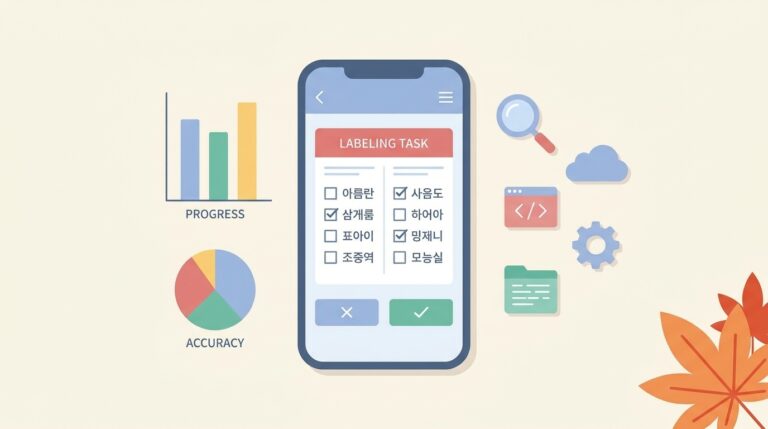
C2 Korean Masterclass: High-Precision Data Labeling and AI Ethics
Phase 1: Empathy (Dive into the Data Labeling Hustle)
안녕하세요! It’s your trusty Korean culture navigator and Daily Hangul Editor! Let’s paint a picture of modern Seoul. You are sitting in a hip cafe in Seongsu-dong, sipping an iced Americano (아아), with your laptop open. You’ve snagged a lucrative remote gig: AI Data Labeling (데이터 라벨링 알바) for a top-tier Korean tech startup.
But wait, you open the guidelines and your eyes glaze over. Words like “정제 (refinement),” “편향 (bias),” and “일관성 (consistency)” are thrown around with intense corporate pressure. In Korea’s ultra-competitive tech landscape, “AI 학습 데이터 품질” (AI training data quality) is the ultimate battleground. If your labeled data is sloppy, the system automatically flags it, and you might get “반려” (rejected/returned).
Don’t panic! Today, we are unlocking the exact, sophisticated vocabulary that Korean project managers (PMs) use to assess data, discuss statistics, and maintain quality. This is C2-level Korean designed to make you sound like an elite AI specialist, not just a casual app user. Let’s dive deep!
Phase 2: Deep-Dive into the Top 3 Elite Expressions
1. 정제하다 (jeong-je-ha-da)
- Pronunciation: [jeong-jeh-hah-dah] (Sounds like “jung-jeh” followed by “ha-da”)
- Meaning: To refine, purify, or clean (raw data).
- K-Culture Moment: In tech dramas like Start-Up (스타트업), you’ll hear engineers desperately yelling about “raw data” needing to be refined before the machine learning model crashes.
- Editor’s Insight: While in chemistry it means to purify liquids, in modern tech, “데이터를 정제하다” means to filter out noise, delete duplicates, and prepare clean data for AI training.
- Situation Spectrum: Casual (⚠️ – too formal for everyday chatter) | Semi-formal (✅) | Formal (✅)
- 🤔 Think About It: How does your native language differentiate between “cleaning” data and “refining” it? Why do you think Koreans prefer the chemical metaphor of “refining (정제)”?
2. 편향을 배제하다 (pyeon-hyang-eul bae-je-ha-da)
- Pronunciation: [pyeon-hyang-eul bae-jeh-hah-dah] (Think of “pyon-hyang” like the wind direction, and “bae-jeh” as exclusion)
- Meaning: To eliminate/exclude bias.
- K-Culture Moment: Think of discussions around algorithms in social media apps. When users complain about the algorithm showing only certain content, PMs emphasize “알고리즘의 편향을 배제해야 합니다” (We must eliminate algorithmic bias).
- Editor’s Insight: This is a combination of 편향 (bias/leaning) and 배제하다 (to exclude/rule out). It represents a deliberate, active effort to ensure objectivity.
- Situation Spectrum: Casual (🚫) | Semi-formal (✅) | Formal (✅)
- 🤔 Think About It: In Korean corporate culture, objectivity is highly prized. How does “배제하다” sound more resolute than just “없애다” (to remove)?
3. 일관성을 유지하다 (il-gwan-seong-eul yu-ji-ha-da)
- Pronunciation: [il-gwan-seong-eul yoo-jee-hah-dah] (“il-gwan” sounds like ‘one-pipe’ conceptually, meaning continuous)
- Meaning: To maintain consistency.
- K-Culture Moment: When multiple labeling workers tag the same dataset differently, the PM will step in and say, “라벨러 간의 일관성 유지가 시급합니다” (Maintaining consistency between labelers is urgent).
- Editor’s Insight: Consistency (일관성) is the backbone of statistical reliability. If your labeling standards shift mid-project, the AI becomes confused.
- Situation Spectrum: Casual (⚠️) | Semi-formal (✅) | Formal (✅)
- 🤔 Think About It: Consistency in Korea is often tied to trust and professionalism. Why is consistency considered a communal duty in collaborative Korean tech projects?
Phase 3: Textbook Korean vs. Real-World Tech Korean
Scenario 1: Rejecting inaccurate data
- 📖 Textbook: “이 데이터는 틀렸으므로 다시 하세요.” (This data is wrong, so do it again.)
- 🗣️ 진짜 한국어: “가이드라인 미숙지로 인해 데이터가 대거 반려되었습니다. 재작업 요청드릴게요.” (Due to unfamiliarity with the guidelines, a large amount of data has been rejected/returned. Requesting a rework.)
- 💡 Why the difference? Directly telling someone they are “wrong” (틀렸다) is considered overly blunt in Korean office culture. Using “반려” (formal rejection/return of documents) depersonalizes the error.
Scenario 2: Explaining a skewed dataset
- 📖 Textbook: “데이터가 한쪽으로 쏠려 있어요.” (The data is leaning to one side.)
- 🗣️ 진짜 한국어: “샘플링 과정에서 데이터 편향(bias)이 발생해 모형의 신뢰도가 떨어집니다.” (Data bias occurred during sampling, lowering the model’s reliability.)
- 💡 Why the difference? C2 professionals use “신뢰도” (reliability) and “데이터 편향” rather than casual spatial descriptions like “한쪽으로 쏠리다” to sound authoritative and precise.
Phase 4: Cultural Deep-Dive & Non-Verbal Manners
4-1. The Subtle
Frequently Asked Questions (FAQ)
Q: What does "정제하다 (jeong-je-ha-da)" mean in Korean and how do you pronounce it?
A: In Korean, "정제하다 (jeong-je-ha-da)" is pronounced [jeong-jeh-hah-dah] and means: To refine, purify, or clean (raw data).
Q: What does "편향을 배제하다 (pyeon-hyang-eul bae-je-ha-da)" mean in Korean and how do you pronounce it?
A: In Korean, "편향을 배제하다 (pyeon-hyang-eul bae-je-ha-da)" is pronounced [pyeon-hyang-eul bae-jeh-hah-dah] and means: To eliminate/exclude bias.
Q: What does "일관성을 유지하다 (il-gwan-seong-eul yu-ji-ha-da)" mean in Korean and how do you pronounce it?
A: In Korean, "일관성을 유지하다 (il-gwan-seong-eul yu-ji-ha-da)" is pronounced [il-gwan-seong-eul yoo-jee-hah-dah] and means: To maintain consistency.







