

Master the Korean Table Trick: The Hidden ‘Pali-Pali’ Cutlery Setup Ritual
Phase 1: Empathy (Welcome to the Fast Lane of Korean Dining!)
안녕하세요! (Annyeonghaseyo!) I’m your Daily Hangul senior editor and your 10-year local culture navigator.
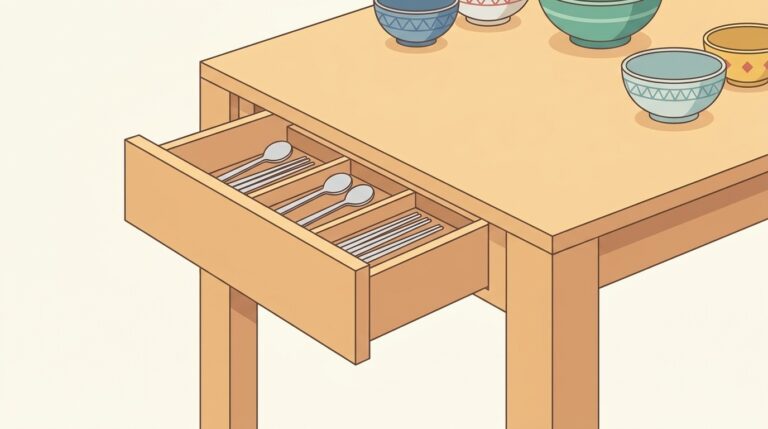
Have you ever sat down at a bustling restaurant in Seoul, ready to enjoy a delicious meal, only to notice your Korean friends instantly spring into action? Before the food even arrives, they wipe down the table, lay out neat paper napkins, and slide open a mysterious drawer hidden right under the table edge to pull out spoons and chopsticks. Meanwhile, you’re left holding your hands, wondering, “Wait, is the food even here yet? Why the rush?”
This high-speed, proactive pre-meal ritual is a classic introduction to Korea’s famous Pali-Pali (빨리빨리 – hurry-hurry) culture. If you’ve ever felt frozen or slightly awkward during this frantic table setup phase, don’t worry! Today, we are going to transform you from a bewildered observer into a smooth, proactive dining partner who knows how to navigate the ‘Sujeo’ setup like a true native. Let’s dive in!
Phase 2: Deep Dive into 3 Key Expressions
1. 수저 좀 놔 줄래? (Sujeo jom nwa jullae?)
- Pronunciation: Soo-jeo jom nwah jool-lae? (Rhymes with sue-juh jam no-ah jool-lay)
- Meaning: “Can you lay out the cutlery?” (Literal: “Can you put down the sujeo?”)
- K-Culture Moment: You’ve likely seen this casual request in cozy dining scenes in K-dramas like Weightlifting Fairy Kim Bok-joo or Reply 1988, where close friends instantly delegate table setup duties.
- Editor’s Insight: 수저 (Sujeo) is a clever blend of 숟가락 (Sutgarak – spoon) and 젓가락 (Jeotgarak – chopsticks). Asking a friend to lay these out signals a comfortable, close relationship.
- Situation Spectrum: Casual ✅ | Semi-formal ⚠️ (수저 좀 놓아 주시겠어요?) | Formal 🚫
- 🤔 Think About It: Why do you think Koreans prioritize having their dining tools ready before the food arrives? How does this reflect the collective, proactive nature of Korean dining compared to your home country?
2. 세팅 완료! (Set-ting wan-ryo!)
- Pronunciation: Seh-ting wan-ryoh! (Sounds like English “setting” + “whan-ryoh”)
- Meaning: “Setup complete!” / “All ready to eat!”
- K-Culture Moment: Frequently used by K-Pop idols in casual vlogs or food variety shows like Tasty Guys (맛있는 녀석들) to playfully declare they are ready to dig in.
- Editor’s Insight: This phrase blends the English loanword “Setting” with the Hanja-based 완료 (Wan-ryo – completion). It’s a satisfying, upbeat way to show you’re ready to eat.
- Situation Spectrum: Casual ✅ | Semi-formal ✅ | Formal ⚠️
- 🤔 Think About It: Does your native language have hybrid terms that blend English with local words to show readiness?
3. 수저통 어디 있어? (Sujeo-tong eodi isseo?)
- Pronunciation: Soo-jeo-tong uh-dee eet-suh? (Rhymes with sue-juh-tong uh-dee ees-suh)
- Meaning: “Where is the cutlery container?”
- K-Culture Moment: That classic moment of confusion for foreigners looking at a bare tabletop, right before a local friend smirks and pulls open the hidden drawer.
- Editor’s Insight: 수저통 (Sujeo-tong) refers to the utensil container. In modern Korean restaurants, these are built as slide-out drawers under the table to save space and speed up service.
- Situation Spectrum: Casual ✅ | Semi-formal ⚠️ (수저통 어디 있어요?) | Formal 🚫
- 🤔 Think About It: How does restaurant furniture design reflect cultural values like space efficiency and speed in modern, crowded Seoul?
Phase 3: Textbook Korean vs. Real Korean
Situation 1: Setting up the dining table
- 📖 Textbook: “테이블 위에 숟가락과 젓가락을 놓아주세요.” (Please place the spoon and chopsticks on the table.) — Sounds like a sterile user manual.
- 🗣️ Real: “수저 세팅 좀 해줘~” (Do the sujeo setup~) or “수저 좀 놔줘.” (Lay out the cutlery.)
- 💡 Why the difference?: Real-life Korean thrives on speed and conversational shortcuts. Combining the nouns into “수저” and using “세팅” matches the natural rhythm of everyday life.
Situation 2: Finding the cutlery drawer
- 📖 Textbook: “수저통이 테이블 밑에 있습니까?” (Is the cutlery box under the table?) — Way too stiff, like a detective questioning a suspect.
- 🗣️ Real: “여기 옆에 서랍 있네!” (Ah, there’s a drawer on the side here!)
- 💡 Why the difference?: Koreans prefer shared observations and immediate actions over formal, direct questions at the dining table.
Phase 4: K-Culture Deep Dive & Non-verbal Manners
4-1. Nunchi & Table Gestures
Setting the table is a high-level game of Nunchi (눈치 – social reading).
* The Slide Action: As soon as you sit down, look at the side edges of the wooden table. If you spot a little handle, slide it open!
* The Napkin Barrier: Before laying down the utensils, pull out a clean paper napkin (휴지) and place it on the table first, then rest the cutlery on top of it. This demonstrates excellent manners, keeping the utensils hygienic.
4-2. The Cultural Code of Pali-Pali Prep
The Pali-Pali spirit isn’t just about rushing; it’s about mutual care (정 – Jeong). Setting up the table for everyone else before preparing your own space shows that you value the group’s dining experience. It’s an unspoken bond of dining together.
Phase 5: Real-Life Roleplay Scenario
Setting: A popular, smoky K-BBQ restaurant in the heart of Hongdae. You are dining with your energetic Korean friend, Minho.
- Minho: 🎭 (Sitting down, rubbing his hands together in anticipation) 아, 배고프다! 고기 나오기 전에 얼른 세팅하자.
(Ah, I’m hungry! Let’s get set up quickly before the meat comes out.) - You: 🎭 (Looking around the empty wooden tabletop) 그래! 근데 수저가 어디 있지? 테이블 위에 안 보이는데?
(Sure! But where is the sujeo? I don’t see it on the table.) - Minho: 🎭 (Winking and pointing underneath the tabletop) 하하, 테이블 아래 옆면을 봐봐. 서랍이 있어!
(Haha, look at the side under the table. There’s a drawer!) - You: 🎭 (Pulling the drawer open with surprise) 와, 대박! 진짜네! 수저통이 여기 숨어 있구나.
(Wow, amazing! It really is! The sujeo box was hiding here.) - Minho: 🎭 (Handing you some paper napkins) 응, 한국 식당은 공간을 넓게 쓰려고 보통 이래. 거기 휴지 깔고 수저 좀 놔 줄래?
(Yeah, Korean restaurants build them like this to save space. Can you lay down a tissue and set the sujeo?) - You: 🎭 (Neatly placing napkins and aligning the silver spoons and chopsticks) 오케이, 휴지 깔고… 수저 세팅 완료!
(Okay, putting down tissues… Sujeo setup complete!) - Minho: 🎭 (Smiling warmly, impressed) 와, 역시 센스 넘친다! 이제 고기만 나오면 바로 흡입하자.
(Wow, you’ve got great sense! Now let’s dive in as soon as the meat arrives.) - You: 🎭 (Laughing) 좋아, 역시 빨리빨리가 최고야!
(Awesome, indeed pali-pali is the best!)
🔀 Interactive Choice
- Choice A: You wait patiently for the waiter to bring cutlery to your table.
- Feedback: Bad. You might wait forever! The staff expects you to find the hidden drawer, and your local friends might think you lack Nunchi.
- Choice B: You slide open the drawer, lay down clean napkins, and set up cutlery for everyone.
- Feedback: Best! Master-level social points! Your Korean friends will be deeply impressed by your local manners.
- Choice C: You grab the cutlery and place it directly onto the bare table without a napkin.
- Feedback: Risk. While not a crime, some hygiene-conscious friends might cringe slightly at placing utensils directly on the table surface.
Phase 6: 10-Second Emotional Shadowing Drill
Practice these natural pauses (/) and emotional cues to sound incredibly natural:
- “테이블 밑에 / 서랍 열어봐!”
- Pronunciation: Te-i-beul mi-te / seo-rab yeo-reo-bwa!
- Empathy Cue:
[😊 Excitedly pointing out the secret drawer]
- “휴지 한 장 깔고 / 수저 좀 놔 줄래?”
- Pronunciation: Hyu-ji han jang kkal-go / sujeo jom nwa jullae?
- Empathy Cue:
[🥺 Asking nicely as a cozy request]
- “와, 역시 / 세팅 완료!”
- Pronunciation: Wa, yeok-si / set-ting wan-ryo!
- Empathy Cue:
[😎 Proudly announcing readiness to eat]
Phase 7: K-Culture Mini Dictionary
- 수저 (Sujeo): Spoon and chopsticks combo. Essential tools for any authentic Korean meal.
- 빨리빨리 (Pali-Pali): The fast-paced, highly efficient lifestyle and mindset of modern Korea.
- 눈치 (Nunchi): The intuitive ability to read the room, anticipate needs, and act quickly.
- 세팅 (Set-ting): A highly common loanword used for preparing tables or arranging items.
Phase 8: Survival Kit for Travelers
survival-kit-for-travelers
- Expression 1: “물티슈 좀 주세요.” (Mul-ti-syu jom ju-se-yo.) — “Can I get some wet wipes, please?” (Pro Tip: Essential for washing your hands before setting the table!)
- Expression 2: “서랍에 수저 있어요?” (Seo-rab-e sujeo isseo-yo?) — “Is the cutlery in the drawer?” (Pro Tip: Use this if you can’t find the table drawer.)
- Expression 3: “여기 주문이요!” (Yeo-gi ju-mun-i-yo!) — “Excuse me, we are ready to order!” (Pro Tip: Raise your hand slightly and say this confidently to get fast service.)
📌 Editor’s Travel Note:
To practice your dining skills like a pro, download the popular local app Naver Map App Download to track down highly-rated local restaurants. (Note: Restaurant layouts, operating hours, and utensil placement may vary by location.)
Phase 9: “한 발 더 깊이” (Think Deeper)
Setting the table in Korea is a collective dance of courtesy. It’s a physical manifestation of a society that values group harmony over individual comfort. By taking the initiative to set up utensils for your companions before grabbing your own, you show respect and build Jeong (정) at the dinner table. It proves that even within the lightning-fast rush of ‘Pali-Pali’, there is always room for mutual care.
💬 Your Turn: Have you ever encountered a hidden cutlery drawer at a Korean restaurant? How did you react? Let us know in the comments below!
Phase 10: FAQ & Common Mistakes
Q: Why do Koreans place paper napkins under the cutlery?
A: Even though restaurant tables are wiped down regularly, many Koreans feel that placing utensils directly on the communal wood surface is unhygienic. A clean paper napkin acts as a protective sanitary barrier.
Q: Is it considered rude if I only set up my own cutlery?
A: While not an offensive insult, it is considered slightly selfish or lacking in social awareness (Nunchi). It is always best to set the utensils for everyone at your table.
Q: What if there is no drawer under the table?
A: If there’s no drawer, check the top of the table for a vertical cylinder box containing the utensils, or look for individually wrapped cutlery packages brought by the servers.
🚨 Common Mistakes Warning Board
- Mistake: Waiting passively for the waiter to bring cutlery.
- Correct Action: Scan the sides of the table first to locate the hidden drawer!
- Mistake: Setting up cutlery only for yourself.
- Correct Action: Always set up utensils for everyone at the table, starting with the oldest or most senior person first.
- Mistake: Crossing the spoon and chopsticks on the table.
- Correct Action: Place the spoon on the left and the chopsticks on the right, perfectly aligned and neat.
Phase 11: Action Missions
- Bronze Mission: Spot a table cutlery drawer in the next K-drama dining scene you watch.
- Silver Mission: Take a photo of your dining table setup, post it on social media with the hashtag
#DailyHangul, and caption it “수저 세팅 완료!” - Gold Mission: Next time you go out to eat with Korean friends, proactively pull out the drawer and set up the cutlery before they do!
Phase 12: Interactive Quiz Challenge
1. What does the portmanteau “수저” (Sujeo) stand for?
Click to reveal the answer!
Answer: It stands for 숟가락 (Spoon) + 젓가락 (Chopsticks).
2. Where should you place the cutlery on the table to show excellent manners?
Click to reveal the answer!
Answer: Neatly aligned on top of a clean paper napkin (휴지) to ensure proper hygiene.
3. True or False: You should wait for the restaurant staff to bring cutlery in all Korean restaurants.
Click to reveal the answer!
Answer: False! Most modern casual dining spots in Korea utilize space-saving side drawers under the tables for self-service.







