

Stand and Eat Like a Local: Your Ultimate Korean Street Food Guide
Phase 1: Welcome to the Warmth of Korean Street Food!
안녕하세요! (Annyeonghaseyo!) It is your Korean best friend and Daily Hangul’s Lead Editor here!
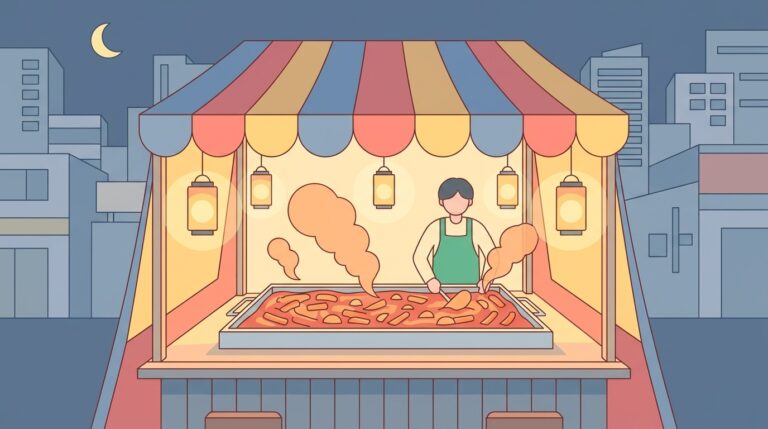
Imagine this: It’s a chilly evening in Seoul. You are walking down a bustling street in Myeongdong, and a warm, steamy cloud of delicious aroma hits your nose. You follow the scent and find a bright orange tent (Pojangmacha) packed with locals. They are all standing closely together, laughing, chatting, dipping spicy rice cakes (Tteokbokki) into sauce, and sipping hot fish cake (Eomuk) broth from tiny paper cups.
You want to join so badly! But suddenly, you freeze. “Wait, do I just walk up and grab a stick?” “How do I order standing up?” “Is there a special etiquette?”
Don’t worry! Standing and eating (서서 먹기 – Seoseo meogki) is one of the most soul-warming, authentic cultural experiences in Korea, but it can feel intimidating for beginners. Today, based on real feedback from hundreds of our basic-level students, we’re going to master the exact words and manners you need to eat like a true Seoulite. Grab your virtual chopsticks, and let’s dive in!
Phase 2: Core Expressions for Standing and Eating
Let’s learn the three most powerful phrases you’ll need at any street food stall.
1. 서서 먹어도 돼요? (Seoseo meogyeodo dwaeyo?)
- Pronunciation: Suh-suh muhg-uh-doh dway-yo? (Sounds like: “Suh-suh” as in “subway”, “dway-yo” like “dwell-yo” without the ‘l’)
- Meaning: “Can I eat standing here?”
- K-Culture Moment: This is the perfect polite icebreaker when you walk up to a busy street cart. You are showing respect by checking if there’s enough space for you to stand.
- Editor’s Insight: Even if it’s obviously a standing stall, asking this shows wonderful manners. The owner (Imo or Auntie) will instantly smile and clear a spot for you!
- Situation Spectrum: Casual ✅ | Semi-formal ✅ | Formal ⚠️
- 🤔 Think About It: In your home country, is it common to eat food while standing right in front of the shop? How does this quick, shared eating space feel different to you?
2. 국물 좀 더 주실 수 있어요? (Gungmul jom deo jusil su isseoyo?)
- Pronunciation: Goong-mool jom duh joo-shil soo ee-suh-yo?
- Meaning: “Could I have a little more soup, please?”
- K-Culture Moment: In Korea, when you buy fish cake (Eomuk), the delicious hot broth is free and unlimited! Locals love sipping this comforting soup while eating.
- Editor’s Insight: Gungmul (soup) is the ultimate comfort food. Don’t be shy to ask for a refill, especially on a cold day!
- Situation Spectrum: Casual ✅ | Semi-formal ✅ | Formal 🚫
- 🤔 Think About It: Free, unlimited warm soup is a unique staple of Korean hospitality. What does this tell you about the warm, sharing culture (Jeong) of Korea?
3. 얼마예요? (Eolmayeyo?)
- Pronunciation: Uhl-mah-yay-yo?
- Meaning: “How much is it?”
- K-Culture Moment: Street food stalls don’t always have English menus or clear price tags. Asking this politely will ensure you pay the correct amount.
- Editor’s Insight: While many modern stalls accept cards, some smaller, traditional stalls prefer cash or bank transfers. It’s always great to have a few 1,000 won bills ready!
- Situation Spectrum: Casual ✅ | Semi-formal ✅ | Formal ✅
- 🤔 Think About It: Why do you think cash is still loved in small, traditional street markets around the world?
Phase 3: Textbook Korean vs. Real-Life Korean
Let’s look at the difference between stiff classroom Korean and the lively, natural phrases locals actually use!
Situation 1: Deciding to eat at the stall
- 📖 Textbook Style: 여기서 드시겠습니까? (Yeogiseo deushigessumnika? – “Will you eat here?”)
- 🗣️ Real-Life Local Style: 서서 먹고 갈게요! (Seoseo meoggo galgeyo! – “I’ll eat standing and then go!”)
- 💡 Why the difference? Textbook phrases can sound too formal, like a luxury hotel. Saying “서서 먹고 갈게요!” sounds natural, breezy, and shows you understand the casual street-food vibe!
Situation 2: Asking for more soup
- 📖 Textbook Style: 육수를 더 많이 주십시오. (Yuksu-reul deo mani jusipsio. – “Please provide more broth.”)
- 🗣️ Real-Life Local Style: 국물 좀 더 주세요~ (Gungmul jom deo juseyo~ – “A bit more soup, please~”)
- 💡 Why the difference? Yuksu (broth) is a culinary term. Gungmul (soup) is what everyone actually says! Adding “좀 (jom)” softens the request, making you sound incredibly polite and sweet.
Phase 4: K-Culture Deep Dive & Non-Verbal Manners
4-1. The Art of “Nunchi” (Eye-measure) & Gestures
When eating street food in Korea, non-verbal etiquette is just as important as speaking!
* The Standing Shoulder Dance: Space is tight. Keep your backpack in front of you or between your feet so you don’t accidentally bump into the person behind you.
* The Sauce Etiquette (Crucial!): You will see a communal brush or container for soy sauce. Never double-dip! If you want sauce, brush it onto your fish cake before you take a bite, or ladle some onto a small paper cup. Double-dipping is a major social crime!
* The Paper Cup Shield: Always hold a small paper cup under your chin or your skewer to catch any dripping sauce or soup. This keeps your clothes and the counter clean!
4-2. Pop-Culture Connection
Have you watched K-Dramas like Hospital Playlist or Weightlifting Fairy Kim Bok-joo? You often see the main characters standing at a street cart, passionately talking about their day while eating skewers of fish cake. Eating standing up isn’t just about quick food; it is a therapeutic space where Koreans let down their guard, share comfort, and warm their souls after a long day.
Phase 5: Real-Life Roleplay Scenario
Welcome to Myeongdong Imo’s Street Food Stall! Let’s practice ordering. Your character is Jisoo (a friendly traveler), and the NPC is Imo (the warm, energetic owner).
- Setting: A steamy street food stall at night. The smell of sweet and spicy Tteokbokki fills the air.
1. Imo: 어서 와요! 뭐 줄까요?
   (Eoseo wayo! Mwo julkayo?)
   "Welcome! What can I get you?"

2. Jisoo: 🎭 (Politely bowing) 안녕하세요! 서서 먹어도 돼요?
   (Annyeonghaseyo! Seoseo meogyeodo dwaeyo?)
   "Hello! Can I eat standing here?"

3. Imo: 🎭 (Smiling warmly, wiping a spot on the metal counter) 그럼요! 여기 서요. 날씨가 춥죠?
   (Geureomyo! Yeogi seoyo. Nalssiga chupjyo?)
   "Of course! Stand right here. Cold weather, isn't it?"

4. Jisoo: 🎭 (Rubbing hands together) 네, 조금 추워요. 떡볶이 일 인분 주세요!
   (Ne, jogeum chuwoyo. Tteokbokki il-inbun juseyo!)
   "Yes, it's a bit cold. One serving of tteokbokki, please!"

5. Imo: 🎭 (Scooping glowing red tteokbokki onto a plate) 여기요! 어묵 국물은 저기 종이컵에 셀프로 떠서 마셔요!
   (Yeogiyo! Eomuk gungmureun jeogi jongicope selpeuro tteoseo masyeoyo!)
   "Here you go! For the fish cake soup, scoop it into a paper cup over there yourself!"

6. Jisoo: 🎭 (Carefully ladling soup into a cup) 와, 국물 진짜 따뜻해요! 얼마예요?
   (Wa, gungmul jinjja ttatteuthaeyo! Eolmayeyo?)
   "Wow, the soup is really warm! How much is it?"

7. Imo: 떡볶이 사천 원이에요. 맛있게 먹어요!
   (Tteokbokki sacheon-won ieyo. Masitge meogoyo!)
   "The tteokbokki is 4,000 won. Enjoy!"

8. Jisoo: 🎭 (Taking a happy bite) 와! 정말 맛있어요. 잘 먹겠습니다!
   (Wa! Jeongmal masisseoyo. Jal meoggetseumnida!)
   "Wow! It's really delicious. Thank you for the meal!"
🔀 Interactive Choice Point
Now, you finished your spicy Tteokbokki and want to wash it down with a bit more of that delicious warm soup. What do you say to Imo?
- Option A: “이모! 국물 더 주세요!” (Imo! Gungmul deo juseyo!)
- Option B: “여기요, 물 더 주세요.” (Yeogiyo, mul deo juseyo.)
- Option C: (Quietly walk over and take the ladle to scoop more soup without asking.)
Feedback:
- Best Choice (A): Excellent! Calling the female owner “Imo” (Auntie) is super friendly and warm. Asking for gungmul (soup) is exactly what locals do. She might even offer you a free fish cake piece!
- Risk (B): Not bad, but incorrect. Mul means water. If you ask for mul, she will point you to the water purifier, not the delicious warm fish cake broth!
- Bad Choice (C): Oh no! Self-service is common, but it’s always polite to make eye contact, smile, or say a quick word before reaching over the hot, boiling broth container. Safety first!
Phase 6: 10-Second Emotion Shadowing Drill
Let’s practice speaking with real Korean feelings! Pay attention to the pauses (/) and the emotional guidance.
- [😊 Politely and expectantly]
서서 / 먹어도 / 돼요?
(Suh-suh / muhg-uh-doh / dway-yo?) -
[🥺 Cold, hungry, and cute]
국물 좀 / 더 주세요~
(Goong-mool jom / duh joo-say-yo~) -
[😋 Excited and grateful]
잘 먹겠습니다!
(Jal / muhg-get-seum-nee-da!)
Phase 7: K-Culture Mini Dictionary
- 떡볶이 (Tteokbokki): Spicy rice cakes. The undisputed king of Korean street food. Chewy, sweet, and spicy!
- 어묵 (Eomuk): Fish cake skewers boiled in a savory broth. Perfect for warming up your hands and stomach.
- 포장마차 (Pojangmacha): Literally “wheeled tent.” These are the iconic orange or red street food stalls.
- 꼬치 (Kkochi): Skewered food (like chicken skewers, Dak-kkochi). Fun and easy to eat while standing!
Phase 8: The Traveler’s Survival Kit
Survival Expressions Top 3:
- 이거 매워요? (Igeo maewoyo?): “Is this spicy?” (Perfect if you can’t handle too much heat!)
- 카드 돼요? (Kadeu dwaeyo?): “Do you take cards?”
- 따뜻한 국물 고맙습니다! (Ttatteuthan gungmul gomapsumnida!): “Thank you for the warm soup!”
Editor’s Travel Note:
When looking for the best street food hubs in Seoul, use the Naver Map App (highly recommended over Google Maps in Korea) and search for “서울 길거리 음식” (Seoul Street Food) or visit famous markets like Gwangjang Market or Namdaemun Market. Note: Most street stalls open from late afternoon (around 4:00 PM) until late at night. Prices typically range from 1,000 to 5,000 KRW per item.
Phase 9: One Step Deeper (Think Deeper)
In many Western cultures, eating while standing up is seen as a rushed, low-quality meal. However, in Korea, standing at a Pojangmacha is a beloved cultural equalizer. From busy office workers in expensive suits to university students on a budget, everyone stands shoulder-to-shoulder, sharing the same hot steam and communal broth. It reflects the Korean value of 정 (Jeong)—a feeling of warm attachment, community, and shared humanity.
💬 Your Turn: Would you feel comfortable standing and eating with strangers in your city? Why or why not? Let me know in the comments below!
Phase 10: FAQ & Common Mistakes
Q: Can I sit down if there are plastic stools around the Pojangmacha?
A: Yes! Some bigger tents have colorful plastic stools. However, these seats are usually reserved for customers ordering larger dishes (like stir-fried pork or alcohol). If you are just having a quick skewer of fish cake, it is polite to stand.
Q: Is it okay to ask for a soup refill multiple times?
A: Absolutely! It is totally normal to drink 2 or 3 cups of broth. Just make sure to say “국물 정말 맛있어요!” (The soup is delicious!) to show your appreciation.
Q: Do I need to clean up my spot when I’m done?
A: Yes. Since space is limited, put your used paper cups and wooden skewers in the designated trash bin right next to the stall. Don’t leave them on the counter.
🚨 Common Mistakes Alert!
- Mistake 1: Double-dipping your bitten fish cake into the shared soy sauce container.
- Correct Action: Use the brush or spoon provided to drizzle sauce onto your food once, before biting.
- Mistake 2: Standing right in front of the cash register or blocking the path of other customers.
- Correct Action: Take a slight step back or stand to the side once you receive your food.
- Mistake 3: Assuming they take credit cards at very old, rural stalls.
- Correct Action: Keep a small amount of cash (10,000 won is plenty) just in case!
Phase 11: Action Mission for You!
- 🥉 Bronze Mission: Practice saying “서서 먹고 갈게요!” (I’ll eat standing and then go!) out loud 5 times in front of the mirror.
- 🥈 Silver Mission: Share this post on your social media and tag your favorite street food spot!
- 🥇 Gold Mission: Next time you visit a Korean market, order Tteokbokki and ask for gungmul (soup) entirely in Korean!
🎮 K-Culture Mission: Watch a K-Drama episode today and spot a scene where characters are eating street food. Did they stand or sit? Tell us in the comments!
Phase 12: Interactive Quiz Challenge
Test your street food survival skills!
1. What does “서서 먹어도 돼요?” mean?
a) Is this spicy?
b) Can I eat standing here?
c) How much is it?
2. Fill in the blank: “국물 ___ 더 주세요.” (Can I have a little more soup, please?)
a) 많이 (mani)
b) 좀 (jom)
c) 아주 (aju)
3. True or False: It is perfectly polite to double-dip your food into the shared soy sauce pot if you are hungry.
👀 Click here to reveal the Answers & Explanations!
- Answer: b) Can I eat standing here?
- Explanation: “서서” (seoseo) means standing, and “먹어도 돼요?” (meogyeodo dwaeyo) means “Is it okay to eat?”
- Answer: b) 좀 (jom)
- Explanation: “좀” means “a little bit” and acts as a magic word to make your request sound polite and sweet in Korean!
- Answer: False!
- Explanation: Double-dipping is a big hygiene concern. Always brush or pour the sauce onto your food beforehand!
- Explanation: Double-dipping is a big hygiene concern. Always brush or pour the sauce onto your food beforehand!







