

Don’t Waste Your Money on Bad Views! The Ultimate Guide to Korean Concert & Theater Seating
Phase 1: Empathy (Welcome to the Ticketing Battlefield!)
안녕하세요! (An-nyeong-ha-se-yo!) I’m your lead editor at Daily Hangul, your personal cultural navigator.
Imagine this: After weeks of waiting, the ticket window for your favorite K-pop idol’s concert or a blockbuster Korean musical (like Jekyll & Hyde or Rebecca) finally opens. Your heart is pounding. You brace yourself for the brutal ticketing war—known in Korea as 피케팅 (pi-ke-ting, a mix of ‘blood’ and ‘ticketing’). You frantically click, and somehow, you score a seat!
But wait… the seat is labeled “OP석” (OP-seok) or “시야제한석” (si-ya-je-han-seok). Is that good? Will you be staring at a giant concrete pillar instead of your choeae (최애 – bias)?
In Korea, seat pricing and viewing angles are a science. Many foreign fans buy premium tickets only to realize they can’t see the stage due to structural obstructions, or they get scolded by local fans for leaning forward! Today, we’re going to master the real-world terms and unspoken manners of Korean venues so you can book like a local pro and enjoy a flawless show. Let’s dive in!
Phase 2: Deep-Dive into 3 Core Expressions
1. 시야가 트이다 (si-ya-ga teu-i-da)
- Pronunciation: She-yah-gah tew-ee-dah (Sounds like “She-ya” + “twee-dah”)
- Meaning: The view is wide open / completely unobstructed.
- K-Culture Moment: You will see this constantly on Naver blogs and Twitter when fans review seats. If a fan posts, “2층 3열 시야 트였어요!” it means “The view from Row 3 on the 2nd floor is completely clear!”
- Editor’s Insight: 시야 (si-ya) means “vision” or “view,” and 트이다 (teu-i-da) means “to be opened up/cleared.” In Korean performance culture, having a “clear view” is often valued even more than acoustics.
- Situation Spectrum: Casual (✅) / Semi-formal (✅) / Formal (✅)
- 🤔 Think About It: In your home country, what is the most important factor when choosing a seat? Is it the distance, the sound quality, or the visual angle?
2. 포도알을 잡다 (po-do-al-eul jap-da)
- Pronunciation: Poh-doh-ahl-eul jahp-dah (Think of “poh-doh” like the fruit grape, and “ahl” like a pill)
- Meaning: To grab a seat during online ticketing (literally: “to grab a purple grape grape-grain”).
- K-Culture Moment: On major Korean ticketing websites like Interpark or Yes24, available seats are represented by tiny purple squares. Because they look like a bunch of grapes, Koreans call them 포도알 (po-do-al). Successfully booking a seat is called “grabbing a grape.”
- Editor’s Insight: This is highly casual slang, but absolutely essential if you talk to any Korean fan. If you fail, you might hear people complain about “하얀 눈밭만 봤다” (ha-yan nun-bat-man bwat-da – “I only saw a white snowfield,” meaning all seats were already gone/white).
- Situation Spectrum: Casual (✅) / Semi-formal (⚠️) / Formal (🚫)
- 🤔 Think About It: Why do you think Korean internet culture created such playful, visual metaphors for ticketing stress?
3. 덕통사고를 당하다 (deok-tong-sa-go-reul dang-ha-da)
- Pronunciation: Deok-tong-sah-go-reul dang-hah-dah
- Meaning: To suddenly and deeply fall in love with a performer (literally: “to get hit by a fan-traffic accident”).
- K-Culture Moment: This happens when you get an amazing front-row seat (like the OP seat or VIP row 1) and make direct eye contact with the actor or idol. You walked in as a casual viewer and left as a die-hard fan.
- Editor’s Insight: This word combines 덕후 (deok-hu – geek/fan, from Japanese otaku) and 교통사고 (gyo-tong-sa-go – traffic accident). It perfectly describes the sudden, violent impact of falling for an artist’s charm up close.
- Situation Spectrum: Casual (✅) / Semi-formal (⚠️) / Formal (🚫)
- 🤔 Think About It: Have you ever experienced a deok-tong-sa-go? Who was the artist?
Phase 3: Textbook Korean vs. Real Korean
Let’s compare the stiff expressions found in standard textbooks with what native speakers actually say when talking about seat views.
Scenario 1: Asking if there are obstructions
- 📖 Textbook Korean: “이 좌석은 무대가 잘 보입니까?” (I jwa-seok-eun mu-dae-ga jal bo-im-ni-ka? / “Is the stage well visible from this seat?”)
- 🗣️ Real Korean: “여기 시야 방해 없어요?” (Yeo-gi si-ya bang-hae eop-seo-yo? / “Is there any view obstruction here?”)
- 💡 Why the difference? Native speakers prefer the noun 시야 방해 (view obstruction) over the generic verb 보이다 (to be seen). It gets straight to the point of whether pillars, railings, or cameras are in the way.
Scenario 2: Describing a seat that is way too far
- 📖 Textbook Korean: “좌석이 무대와 아주 멀리 떨어져 있습니다.” (Jwa-seok-i mu-dae-wa a-ju meol-li tteo-reo-jyeo is-sim-ni-da. / “The seat is located very far from the stage.”)
- 🗣️ Real Korean: “완전 하느님석이에요.” (Wan-jeon ha-neu-nim-seok-i-e-yo. / “It’s totally the God’s seat.”)
- 💡 Why the difference? 하느님석 (God’s seat) is the Korean equivalent of the “nosebleed section.” It humorously implies you are so high up in the rafters of the stadium or theater that you are closer to God than to the stage!
Phase 4: K-Culture Deep-Dive & Non-Verbal Manners
4-1. The Concept of “Deung-But-I-Gi” (Keep Your Back Glued!)
In Korean theater culture (especially musicals and plays), there is an incredibly strict, unspoken rule called 등붙이기 (deung-but-i-gi – literally, “back-gluing”).
When you sit in a tiered theater, leaning forward even slightly blocks the view of the person sitting behind you. If you lean forward to get a closer look, you will likely hear a polite but firm whisper from behind: “죄송한데 등 좀 붙여주세요” (Excuse me, please lean back).
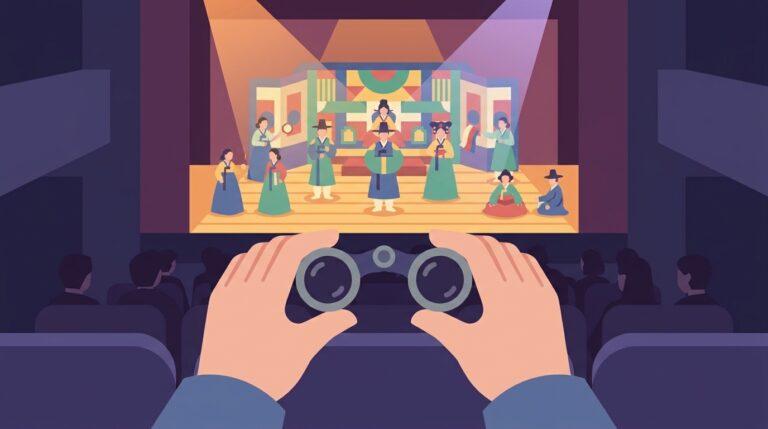
* Action Tip: Keep your back completely flat against your seat’s backrest at all times. If you want to see closer, rent a pair of opera glasses (오페라글라스) instead of leaning forward!
4-2. The “Nunchi” of Concert Fanlights (Slogan Manners)
At K-pop concerts, holding up slogans or banners is common, but holding them above your head is a major social crime. Use your 눈치 (nunchi – situational quick-wittedness). Keep your banner at chest level so you don’t ruin the “시야” of the person behind you.
Phase 5: Real-World Roleplay Scenario
Meet 민호 (Minho), a seasoned Korean musical enthusiast, and 사라 (Sarah), an international fan who just bought her very first ticket at the Charlotte Theater in Seoul.
🎭 Setting: A cozy cafe near Jamsil Station, looking at a seating chart on Sarah's phone.
- 사라: 민호 씨! 저 드디어 뮤지컬 티켓팅 성공했어요! 근데 자리가 OP석이에요. (Minho! I finally succeeded in ticketing! But my seat is the OP seat.)
- 민호: 와, 대박! 포도알을 잡으셨네요! Charlotte Theater OP석은 무대랑 진짜 가까워요. (Wow, amazing! You grabbed a grape! The OP seats at Charlotte Theater are super close to the stage.)
- 사라: 근데 OP석이 정확히 뭐예요? 시야는 어때요? (But what exactly is an OP seat? How is the view?)
- 민호: 원래 ‘Orchestra Pit’ 좌석이라서 무대 바로 앞 단상 아래에 있어요. 배우들 표정은 정말 생생하게 보이지만, 무대가 높아서 고개를 계속 들고 있어야 해요. (Originally it stands for ‘Orchestra Pit’ seats, so it’s right in front of the stage below the platform. You can see the actors’ expressions so vividly, but because the stage is high, you have to keep your neck tilted up.)
- 사라: 아, 약간 목이 아플 수도 있겠네요. (Ah, so my neck might hurt a bit.)
- 민호: 네, 그리고 전체적인 동선이나 무대 효과는 한눈에 안 들어올 수 있어요. 완전히 배우 밀착형 자리죠! (Yes, and you might not capture the overall stage blocking or special effects at a glance. It’s a seat purely focused on the actors!)
- 사라: 그럼 혹시 배우가 바로 앞에 오면 덕통사고 당하는 자리인가요? (Then, is it a seat where I might get hit by a ‘fan-crash’ if the actor comes right in front of me?)
- 민호: 하하, 맞아요! 거의 100% 입덕각이죠. 혹시 전체적인 무대 시야를 원하시면 뒤쪽 중블로 가는 게 나을 수도 있어요. (Haha, exactly! It’s almost 100% guaranteed you’ll fall deeper. If you want a full view of the stage, going to the center block further back might be better.)
🔀 Your Turn: Choose Sarah’s Next Move!
Option A: “목이 아파도 무조건 가까이서 볼래요! OP석 고!”
- Editor’s Feedback (Best): Perfect choice if you want to experience the raw acting! You will see the sweat and tears of the actors. Just do some neck stretches before the show.
Option B: “시야 방해받기 싫어요. 뒤쪽 구석자리로 바꿀래요.”
- Editor’s Feedback (Bad): Going to the far side back corner (사이드 블록) might give you a worse angle than the OP seat. Be careful, or you’ll see only the side profile of the actors!
Option C: “그럼 취소하고 다음에 다시 예매할게요.”
- Editor’s Feedback (Risk): Dangerous! Tickets for popular shows sell out instantly. If you let go of your “포도알,” you might not get another chance this season.
Phase 6: 10-Second Emotion Shadowing Drill
To sound natural, you need to match your intonation to your feelings. Practice these sentences aloud, paying attention to the pauses (/) and emotional cues!
- [🤩 Thrilled & Gasping for Air]
- “헐, / 대박! / 나 1열 / 포도알 잡았어!”
- Heol, / dae-bak! / Na il-yeol / po-do-al jab-at-seo!
- (OMG, / no way! / I grabbed a / 1st-row grape!)
- [🥺 Disappointed & Pouting]
- “하느님석이라 / 배우 얼굴이 / 손톱만 하게 보여요.”
- Ha-neu-nim-seok-i-ra / bae-u eol-gul-i / son-top-man-ha-ge bo-yeo-yo.
- (Since it’s the ‘God’s seat’ / the actor’s face / looks as tiny as a fingernail.)
- [😊 Polite but firm – Theater etiquette]
- “저기 죄송한데, / 앞사람 때문에 / 시야가 가려서요. / 등 좀 붙여주시겠어요?”
- Jeo-gi joe-song-han-de, / ap-sa-ram ttae-mun-e / si-ya-ga ga-ryeo-seo-yo. / Deung jom but-yeo-ju-si-ges-seo-yo?
- (Excuse me, / because the person in front is blocking my / view is obstructed. / Could you please lean back?)
Phase 7: K-Culture Mini Dictionary
| Word (Korean) | Romanization | English Translation | Context & How to Use |
|---|---|---|---|
| 중블 | Jung-beul | Center Block | Short for ‘중앙 블록’. The holy grail of seating blocks for balanced sound and view. |
| 왼블 / 오블 | Oen-beul / O-beul | Left Block / Right Block | Short for ‘왼쪽 블록’ and ‘오른쪽 블록’. Good for spotting actors who stand on specific sides. |
| 시야제한석 | Si-ya-je-han-seok | Obstructed View Seat | Seats sold at a discount because a speaker, handrail, or pole partially blocks the stage. |
| 전석 매진 | Jeon-seok mae-jin | Entirely Sold Out | The tragic phrase you see when you log in 5 seconds too late to a ticketing site. |
Phase 8: Survivor’s Travel Kit
Top 3 Survival Phrases
- “현장 수령으로 할게요.” (Hyeon-jang su-ryeong-eu-ro hal-gae-yo.)
- Translation: “I will pick up my ticket at the venue box office.”
- Pro Tip: Foreigners usually cannot receive tickets by mail. Bring your printed confirmation and passport!
- “여기 시야 제한석인가요?” (Yeo-gi si-ya je-han-seok-in-ga-yo?)
- Translation: “Is this seat an obstructed view seat?”
- Pro Tip: Use this at the ticket booth if you are unsure about the seat upgrade options.
- “오페라글라스 대여 어디서 해요?” (O-pe-ra-geul-la-seu dae-yeo eo-di-seo hae-yo?)
- Translation: “Where can I rent opera glasses?”
- Pro Tip: They run out extremely fast. Arrive at least 1 hour before showtime to secure one!
Editor’s Travel Note
Before booking, always use Interpark Ticket Global to secure tickets without needing a Korean phone number or resident ID. Once you book, search for the venue on Naver Map to find the nearest subway exit, as major venues like the Seoul Arts Center are quite a walk from the station! (Disclaimer: Seating policies and rental fees may change; please check the venue website before visiting.)
Phase 9: “One Step Deeper” (Cultural Reflection)
In Korea, concert-going is not just a passive viewing experience; it is an active, communal ritual. This is why ticketing and seat locations carry so much weight. In the high-demand “Floor” (플로어) area of K-Pop concerts, fans are expected to participate in synchronized 떼창 (tte-chang – group sing-alongs) and hold lightsticks at specific tempos.
Conversely, the theater crowd (musicals and plays) demands absolute silence and stillness to respect the actors’ concentration. This extreme contrast between “explosive energy” at concerts and “monastic silence” in theaters showcases how deeply Koreans value collective harmony (우리 – uri/we-culture). Depending on the seat you choose, you are signing up for a completely different social contract.
💬 Your Turn: Have you ever attended a show in Korea? What surprised you the most about the audience’s behavior? Share your stories in the comments below!
Phase 10: FAQ & Avoiding Misunderstandings
Q: Can I buy tickets on-site if they are sold out online?
A: Generally, no. Popular shows in Korea sell out completely during the online booking phase. However, sometimes “취소표” (chwi-so-pyo – canceled tickets) are released online at midnight. It is much safer to look for these rather than waiting at the venue.
Q: What should I do if the person in front of me is blocking my view?
A: Avoid tapping their shoulder aggressively. During the intermission or right before the show starts, tap gently and politely say, “죄송한데 등 좀 붙여주시겠어요? 무대가 안 보여서요.” (Excuse me, could you please lean back? I can’t see the stage.) Most Koreans will apologize immediately and adjust.
Q: Is the front row of the 2nd floor better than the back row of the 1st floor?
A: Yes! In most modern Korean theaters, the first few rows of the 2nd floor offer a beautifully clear, unobstructed view without any heads in your way. Back rows of the 1st floor are often covered by the 2nd-floor overhang, which can muffle the sound.
🚨 Common Mistakes Alert!
- Leaning forward in a tiered theater: This is a major faux pas. Keep your back glued (등붙이기)!
- Taking photos during the curtain call without permission: In Korean musicals, taking photos is strictly banned even during the curtain call, unless it is a designated “Curtain Call Day” (커튼콜 데이).
- Forgetting your physical ID: Ticket booths in Korea are very strict. If you booked via a global site, you must present your physical passport. Mobile screenshots are rarely accepted.
Phase 11: Action Missions
- 🥉 Bronze Medal Mission: Next time you watch a live K-Pop clip, point to the crowd and say aloud: “저기 완전 하느님석이다!” (That is totally the God’s seat!)
- 🥈 Silver Medal Mission: Go to Twitter or Instagram and search the hashtag
#시야후기(view review) along with your favorite Korean concert venue (e.g.,#체조경기장시야). Comment below one new venue name you discovered! - 🥇 Gold Medal Mission: Try mock-ticketing on a Korean ticket website. See if you can spot the “purple grapes” (포도알) before they disappear!
Phase 12: Interactive Quiz Challenge
Q1. What does “하느님석” mean in Korean performance culture?
- A) VIP seats reserved for VIP guests
- B) Seats near the front where you make eye contact with actors
- C) Seats high up in the back (nosebleed section)
👉 Click to see the answer & explanation!
Correct Answer: C
It humorously refers to seats so high up that you are closer to God (하느님) than the stage!
Q2. True or False: Leaning forward to see the stage better is encouraged in Korean musical theaters.
- A) True
- B) False
👉 Click to see the answer & explanation!
Correct Answer: B (False)
It is actually a major faux pas because it blocks the view of the person sitting behind you. You must keep your back glued to the seat (등붙이기)!
Q3. Fill in the blank: If you successfully booked a purple seat during a ticketing war, you “grabbed a _______” (______을 잡았다).
- A) 사과 (Apple)
- B) 포도알 (Grape grain)
- C) 수박 (Watermelon)
👉 Click to see the answer & explanation!
Correct Answer: B (포도알)
The available seats on ticketing screens look like purple grapes, hence the slang ‘포도알을 잡다’!







