

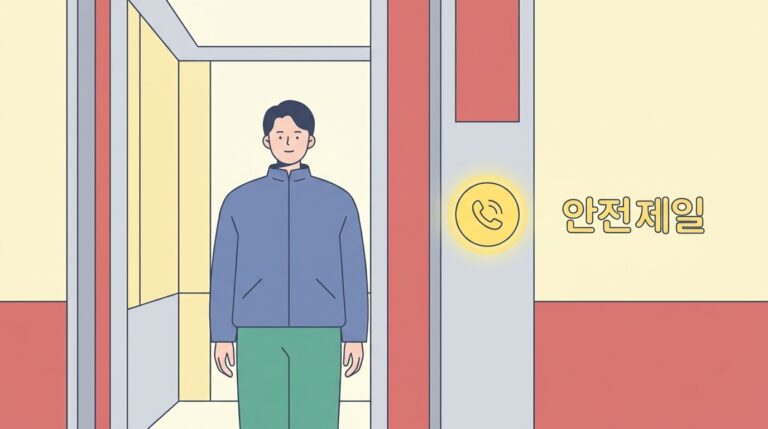
Stuck in a Korean Elevator? Speak Up Like a Pro and Get Rescued Safely!
Phase 1: Empathy (A Heart-Stopping Moment in Seoul)
Annyeonghaseyo! It’s your favorite Korean study buddy and Chief Editor of Daily Hangul.
Imagine this: You’re in a sleek, trendy building in Seongsu-dong after enjoying a perfect matcha latte. You step into the elevator, the doors slide shut, and suddenly—clunk. The lights flicker, the elevator jolts to a halt, and you are stuck between floors. Your heart races. You see the yellow emergency button, but your mind goes blank. “What is ‘trapped’ in Korean? How do I explain which building I am in?”
In emergency situations, panic can scramble even a B2-level learner’s vocabulary. That is why we created this guide based on real feedback from expats in Korea. Today, we’ll equip you with the exact, natural Korean phrases needed to handle an elevator emergency calmly, clearly, and like a local. Let’s dive in!
Phase 2: Core Expressions Deep Dive
1. 엘리베이터에 갇혔어요. 도와주세요! (I am trapped in the elevator. Please help!)
- Pronunciation: El-li-be-i-teo-e gat-hyeot-eo-yo. Do-wa-ju-se-yo! (Sounds like: el-lee-beh-ee-tuh-eh gat-hyut-uh-yo. doh-wah-joo-seh-yo!)
- Meaning: “I’m trapped in the elevator. Please help!”
- K-Culture Moment: You have likely seen this dramatic moment in K-dramas when the main lead gets stuck in an elevator, triggering a panic attack or a moment of bonding. In real life, saying gat-hyeot-eo-yo (from 갇히다, to be trapped) immediately signals to the operator that you cannot exit.
- Editor’s Insight: 갇혔어요 is a passive verb. In Korean, using the passive form here emphasizes that you are a victim of the circumstance, urging immediate action without sounding rude.
- Situation Spectrum: Casual: ⚠️ | Semi-formal: ✅ | Formal: ✅
- 🤔 Think About It: How does expressing helplessness passive-voice style (gat-hyeot-eo-yo) differ from simply saying “The elevator isn’t working” in your native language?
2. 호수나 층수를 잘 모르겠는데, 건물 이름은 [이름]이에요. (I’m not sure of the room or floor, but the building name is…)
- Pronunciation: Ho-su-na cheung-su-reul jal mo-reu-get-neun-de, geon-mul i-reum-eun [i-reum]-i-e-yo.
- Meaning: “I don’t really know the room number or floor, but the building name is [Name].”
- K-Culture Moment: Finding hidden cafes on the 4th floor of a nameless building in Euljiro is a classic Seoul adventure. But when emergency strikes, knowing the building name (geon-mul i-reum) is your golden ticket.
- Editor’s Insight: In Korea’s dense urban centers, dispatchers can find your location instantly with just a building name or a nearby landmark.
- Situation Spectrum: Casual: 🚫 | Semi-formal: ✅ | Formal: ✅
- 🤔 Think About It: Why is sharing local landmarks often faster than giving a street address in bustling cities like Seoul?
3. 갑자기 멈췄고 움직이지 않아요. 비상벨을 눌렀어요. (It stopped suddenly and isn’t moving. I pressed the emergency button.)
- Pronunciation: Gap-ja-gi meom-chwot-go um-jik-i-ji an-ha-yo. Bi-sang-bel-eul nul-reot-eo-yo.
- Meaning: “It suddenly stopped and won’t move. I have pressed the emergency bell.”
- K-Culture Moment: The iconic yellow emergency phone button is labeled “비상호출” (Emergency Call) or “비상통화” (Emergency Communication).
- Editor’s Insight: 비상벨 (emergency bell) is universally understood. Confirming you pressed it tells the dispatcher you are actively seeking help.
- Situation Spectrum: Casual: 🚫 | Semi-formal: ✅ | Formal: ✅
- 🤔 Think About It: How does giving a chronological breakdown of the situation (stopped -> not moving -> pressed bell) help calm your own nerves during an emergency?
Phase 3: Textbook Korean vs. Real-Life Korean
Scenario 1: Describing the Trap
- 📖 Textbook Korean: 승강기가 고장 나서 안에 있습니다. (Seung-gang-gi-ga go-jang na-seo an-e it-seup-ni-da.)
- Translation: “The elevator is broken, so I am inside.”
- 🗣️ Real-Life Korean: 엘리베이터가 갑자기 멈춰서 갇혔어요! (El-li-be-i-teo-ga gap-ja-gi meom-chwer-seo gat-hyeot-eo-yo!)
- Translation: “The elevator suddenly stopped and I’m stuck!”
- 💡 Why it matters: 승강기 (seung-gang-gi) is the official/hanja word for elevator, but everyone in daily life says 엘리베이터. Say 갇혔어요 to sound urgent and natural.
Scenario 2: Asking for Arrival Time
- 📖 Textbook Korean: 구조대원은 언제 도착합니까? (Gu-jo-dae-won-eun eon-je do-chak-hap-ni-ka?)
- Translation: “When will the rescue team arrive?”
- 🗣️ Real-Life Korean: 기사님 언제쯤 오실 수 있나요? (Gi-sa-nim eon-je-jjeum o-sil su in-na-yo?)
- Translation: “Roughly when will the technician/engineer be able to get here?”
- 💡 Why it matters: In Korea, elevator maintenance crew members are respectfully called 기사님 (gi-sa-nim). Asking with 언제쯤 (around when) and ending with -나요 is polite yet expresses timely urgency.
Phase 4: K-Culture Deep Dive & Non-verbal Manners
4-1. Nunchi & Elevator Etiquette
If you get stuck, do not panic or try to pry the doors open. In Korea, elevators are heavily monitored. Press the yellow 비상통화 (Emergency Call) button. Speak clearly toward the speaker grid, which is usually right next to the buttons. Keep your voice level, show Nunchi (situational awareness) by listening carefully to the dispatcher’s instructions, and do not scream.
4-2. The Magic 7-Digit Key: 승강기 번호 (Elevator ID)
Look near the buttons or above the door. You will see a yellow sticker with a 7-digit number (e.g., 1234-567). This is the 승강기 번호 (Elevator ID Number). If you read this number to 119 or the operator, they will know your exact building, floor, and shaft location instantly without you needing to explain where you are!
Phase 5: Real-Life Roleplay Scenario
Setting: A hip multi-use building in Seongsu-dong. Min-ji (an intermediate expat) is stuck inside the elevator. She presses the emergency button.
- Dispatcher: 네, 관리실입니다. 무슨 일이신가요?
(Ne, gwan-ri-sil-im-ni-da. Mu-seun il-i-sin-ga-yo?)
Dispatcher: Yes, management office. What is the issue? -
Min-ji: 🎭 (Anxiously looking around) 저기요, 엘리베이터가 갑자기 멈췄어요! 갇혔어요.
(Jeo-gi-yo, el-li-be-i-teo-ga gap-ja-gi meom-chwot-eo-yo! Gat-hyeot-eo-yo.)
Min-ji: Excuse me, the elevator suddenly stopped! I’m trapped. -
Dispatcher: 아, 네! 다치신 데는 없으시고요? 위치가 어디쯤인가요?
(Ah, ne! Da-chi-sin de-neun eop-seu-si-go-yo? Wi-chi-ga eo-di-jjeum-in-ga-yo?)
Dispatcher: Oh, dear! Are you hurt anywhere? Roughly where are you located? -
Min-ji: 🎭 (Looking for the yellow sticker) 성수역 근처 테라스 빌딩인데요, 몇 층인지는 안 보여요.
(Seong-su-yeok geun-cheo Te-ra-seu bil-ding-in-de-yo, myeot cheung-in-ji-neun an bo-yeo-yo.)
Min-ji: I’m in the Terrace Building near Seongsu Station, but I can’t see what floor I’m on. -
Dispatcher: 빌딩 안쪽에 승강기 번호 일곱 자리 적힌 노란색 스티커 보이시나요?
(Bil-ding an-jjok-e seung-gang-gi beon-ho il-gop ja-ri jeok-hin no-ran-saek seu-ti-keo bo-i-si-na-yo?)
Dispatcher: Do you see a yellow sticker with a 7-digit elevator number inside? -
Min-ji: 🎭 (Squinting to read) 아, 찾았어요! 일공삼사-오육칠 이에요.
(Ah, cha-jat-eo-yo! Il-gong-sam-sa o-yuk-chil i-e-yo.)
Min-ji: Ah, found it! It’s 1-0-3-4-5-6-7. -
Dispatcher: 네, 확인되었습니다. 3층 근처네요. 기사님 바로 보내드릴 테니 대기해 주세요.
(Ne, hwa-gin-doe-eot-seup-ni-da. Sam-cheung geun-cheo-ne-yo. Gi-sa-nim ba-ro bo-nae-deu-ril te-ni dae-gi-hae ju-se-yo.)
Dispatcher: Yes, confirmed. You are near the 3rd floor. We will send a technician immediately, so please wait. -
Min-ji: 🎭 (Sighing with relief) 네, 감사합니다. 빨리 부탁드려요!
(Ne, gam-sa-hap-ni-da. Ppal-li bu-tak-deu-ryeo-yo!)
Min-ji: Yes, thank you. Please hurry!
🔀 Interactive Choice Point
What would you do next if the air feels stuffy?
* Option A: Pounce on the door and try to pull it open.
* Option B: Press the emergency button again and say: “공기가 너무 답답한데 환풍기 좀 켜주세요.” (It feels stuffy, please turn on the ventilation fan.)
* Option C: Sit on the floor, complain loudly in English, and stream it on Instagram.
Feedback on Your Choice:
- Option A (Dangerous/Bad): 🚫 Never try to force elevator doors open! It can trigger safety drops or pose a fall risk.
- Option B (Best Choice): Asking politely to turn on the fan (hwan-pung-gi) helps circulate air and keeps you calm.
- Option C (Risk): ⚠️ Streaming might relieve stress, but saving your phone battery is critical in an emergency!
Phase 6: 10-Second Shadowing Drill
Practice these with natural pacing and emotion! The / represents a natural pause.
엘리베이터가 / 갑자기 멈췄어요! / 도와주세요!- (El-li-be-i-teo-ga / gap-ja-gi meom-chwot-eo-yo! / Do-wa-ju-se-yo!)
- [🥺 Urgent and pleading]
승강기 번호 / 일곱 자리를 / 불러드릴게요.- (Seung-gang-gi beon-ho / il-gop ja-ri-reul / bul-reo-deu-ril-ge-yo.)
- [😰 Tense but trying to be precise]
Phase 7: K-Culture Mini Dictionary
- 비상통화 (Bi-sang-tong-hwa): Emergency communication. The system that connects you directly to safety guards.
- 승강기 번호 (Seung-gang-gi beon-ho): Elevator ID. A 7-digit life-saving registration number.
- 점검 중 (Jeom-geom jung): Under maintenance. If you see this sign outside, do not board!
- 닫힘 방지 (Dat-him bang-ji): Door-reversing sensor/anti-closing mechanism.
Phase 8: Traveler’s Survival Kit
Top 3 Emergency Sayings
- “문이 안 열려요!” (Mun-i an yeol-ryeo-yo!) – The doors won’t open!
- “숨쉬기 답답해요.” (Sum-swi-gi dap-dap-hae-yo.) – It is hard to breathe/stuffy.
- “금방 오시나요?” (Geum-bang o-si-na-yo?) – Will you be here soon?
💡 Editor’s Travel Note:
Always download the 안전디딤돌 Emergency Ready App before traveling to Korea. It provides English guides for emergency shelters, fires, and safety protocols. Calling 119 (Rescue) or 112 (Police) is free on all networks, even without a active SIM plan.
Phase 9: “One Step Deeper” (Cultural Reflection)
Korea is famous for its Palli-Palli (빨리빨리 – hurry, hurry) culture. While this speed makes life incredibly convenient, safety procedures in high-rise buildings are meticulously organized. Rescuers will act fast, but they expect you to remain calm and systematic. By knowing how to locate the Seung-gang-gi beon-ho (elevator ID), you participate in a highly organized civic safety network.
💬 Your Turn: Have you ever been stuck in an elevator before? How do you think you’d react in Korea? Let us know in the comments below!
Phase 10: FAQ & Common Mistakes
Q: What should I do if the dispatcher does not speak English?
A: Keep calm and recite: “Seung-gang-gi beon-ho [Numbers in Korean/English]” and “Gat-hyeot-eo-yo!” They will instantly locate you and send a rescue team even without a full conversation.
Q: Is there a fee for emergency elevator rescues in Korea?
A: Absolutely not. Government emergency services (119 rescue) and building maintenance rescues are entirely free.
Q: Can I call 119 directly from inside the elevator?
A: Yes, if you have mobile reception, dialing 119 is highly effective. However, pressing the elevator’s built-in intercom button first connects you directly to the building’s specific security office.
🚨 Common Mistakes Board
- Mistake 1: Screaming “살려주세요” (Sal-ryeo-ju-se-yo – Save my life!) for a minor glitch.
- Correct Action: Use “도와주세요” (Do-wa-ju-se-yo – Please help) unless it is a life-threatening disaster.
- Mistake 2: Saying “갇혀졌어요” (Gat-hyeo-jyeot-eo-yo).
- Correct Action: Grammatically incorrect double-passive. Simply say 갇혔어요 (gat-hyeot-eo-yo).
- Mistake 3: Forgetting to mention the floor.
- Correct Action: Look at the digital panel. If it’s dead, say “몇 층인지 모르겠어요” (I don’t know which floor).
Phase 11: Action Missions
- Bronze Mission: Read “엘리베이터에 갇혔어요” out loud 5 times with a dramatic, breathless expression.
- Silver Mission: When you use an elevator today, locate the 7-digit yellow ID sticker and practice saying those numbers in Korean.
- Gold Mission (K-Culture Mission): Spot an elevator scene in a K-drama and identify whether they pressed the Bi-sang-bell!
Phase 12: Interactive Quiz Challenge
1. Which number is most helpful to rescuers when you are trapped?
- A) Your phone number
- B) The 7-digit 승강기 번호 (Elevator ID)
- C) The building zip code
Reveal Answer & Explanation
Correct Answer: B! The 7-digit Elevator ID gives dispatchers the exact physical address and even the specific shaft location in seconds.
2. Translate to Korean: “It stopped suddenly.”
- A) 천천히 가요. (Cheon-cheon-hi ga-yo.)
- B) 갑자기 멈췄어요. (Gap-ja-gi meom-chwot-eo-yo.)
- C) 너무 빨라요. (Neo-mu ppal-la-yo.)
Reveal Answer & Explanation
Correct Answer: B! ‘갑자기’ means ‘suddenly’ and ‘멈췄어요’ means ‘stopped’.
3. True or False: You must pay a fine if 119 rescues you from an elevator.
- A) True
- B) False
Reveal Answer & Explanation
Correct Answer: B (False)! Emergency rescue services in Korea are free of charge for safety and public protection.







