

Saving Electricity: Mastering the Coolest Korean Expressions for AC and Eco-friendly Living
Phase 1: Empathy (Welcome to the Eco-Friendly K-Life!)
안녕하세요! It’s your best Korean friend and Senior Editor at Daily Hangul (매일한글).
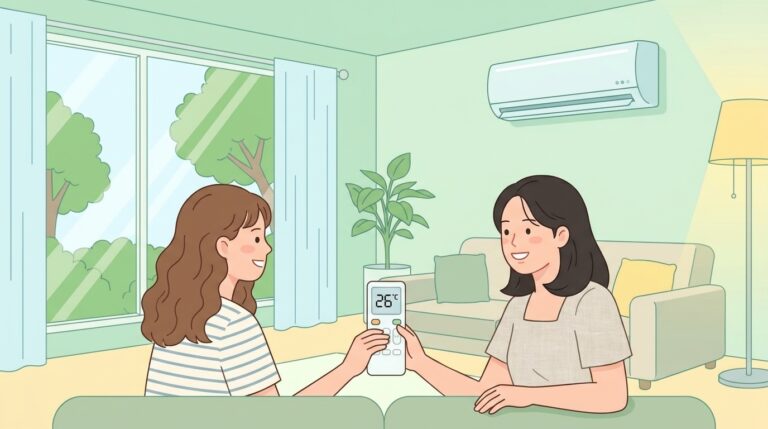
We’ve all been there: It’s a scorching mid-August afternoon in Seoul. You walk into your shared flat or a cozy Airbnb in Hongdae, and the air is so thick and humid you can practically swim in it. Your first instinct? Grab the remote control (리모컨 – ri-mo-keon), set the air conditioner to a freezing 18°C (64°F), and let it blast.
But wait! If you’re living with Korean flatmates or staying with a host family, you might notice them gently stepping in to adjust the temperature up to a comfortable 26°C. In Korea, saving electricity isn’t just about cutting down the utility bill; it’s a deeply ingrained social value closely tied to collective environmental responsibility (and avoiding the dreaded “electricity bill bomb” or 전기세 폭탄!).
Today, we’re going to master the exact, natural-sounding B1 Korean phrases you need to talk about adjusting the AC, saving energy, and showing your flatmates that you are a culturally savvy, eco-conscious roommate! Let’s dive in!
Phase 2: Deep-Dive into 3 Essential Expressions
1. 에어컨 온도 좀 올릴까요? (Should we turn up the AC temperature a bit?)
- Pronunciation: E-eo-keon on-do jom ol-ril-kka-yo? (Sounds like: “Eh-uh-keun on-do jom ol-reel-gga-yo?”)
- Meaning: Should we raise the AC temperature a bit?
- K-Culture Moment: You will hear this constantly in Korean offices or shared houses. It’s the polite way to suggest saving energy without sounding demanding, using the softening word 좀 (jom – a little/please).
- Editor’s Insight: Instead of saying “It’s too cold!” (추워요!), proposing to raise the temperature shows you care about both comfort and saving energy.
- Situation Spectrum: Casual (⚠️ – needs modification to 올릴까?), Semi-formal (✅), Formal (✅ – 올릴까요? or 올리는 게 좋을까요?)
- 🤔 Think About It: In your home country, do people freely change the AC temperature in public or shared spaces, or is there a “silent agreement” like in Korea?
2. 적정 온도로 맞춰 놓을게요. (I’ll set it to the recommended temperature.)
- Pronunciation: Jeok-jeong on-do-ro mat-chwo no-eul-ge-yo. (Sounds like: “Jeok-jung on-do-ro maht-chwo noh-eul-geh-yo.”)
- Meaning: I will set it and leave it at the optimal/recommended temperature.
- K-Culture Moment: Government campaigns in Korea constantly promote the “적정 온도” (typically 26°C – 28°C in summer) to prevent blackouts. Saying this shows you are highly civilized and eco-aware!
- Editor’s Insight: The grammar pattern -아/어 놓다 means to do something and keep it in that state. It shows initiative!
- Situation Spectrum: Casual (⚠️ – 맞춰 놓을게), Semi-formal (✅), Formal (✅)
- 🤔 Think About It: How does your culture view the balance between personal comfort (freezing AC) and social environmental responsibility?
3. 전기 아끼게 코드 좀 뽑아 주세요. (Please unplug the cord to save electricity.)
- Pronunciation: Jeon-gi a-kki-ge ko-deu jom ppo-ba ju-se-yo. (Sounds like: “Jeon-ghee ah-ghee-geh koh-deu jom ppo-bah joo-seh-yo.”)
- Meaning: Please unplug the power cord so we can save electricity.
- K-Culture Moment: Koreans are very mindful of “standby power” (대기전력). Unplugging unused appliances is a standard household rule in Korea.
- Editor’s Insight: 아끼게 combines 아끼다 (to save/cherish) with -게 (so that/in order to). It gives a gentle, logical reason before asking for a favor.
- Situation Spectrum: Casual (⚠️ – 코드 좀 뽑아 줘), Semi-formal (✅), Formal (✅)
- 🤔 Think About It: Does your household unplug appliances when leaving for vacation, or is this a new eco-habit for you?
Phase 3: Textbook Korean vs. Real-Life Korean
Situation 1: Suggesting to turn off the AC because it’s cool enough.
- 📖 Textbook: “에어컨을 끄고 창문을 열어 주세요.” (Please turn off the air conditioner and open the window.)
- 🗣️ Real Life: “이제 안 더운데 에어컨 끄고 환기시킬까요?” (It’s not hot anymore, should we turn off the AC and let some fresh air in?)
- 💡 Why the difference? Koreans prefer soft suggestions rather than direct commands. Mentioning “환기” (ventilation/fresh air) makes the request sound refreshing and proactive.
Situation 2: Complaining about the freezing office/room temperature.
- 📖 Textbook: “방이 너무 춥습니다. 에어컨을 조절해 주십시오.” (The room is too cold. Please adjust the air conditioner.)
- 🗣️ Real Life: “여기 완전 냉동고 같아요! 온도 좀 올리면 안 될까요?” (It feels like a complete freezer in here! Can we turn the temperature up a bit?)
- 💡 Why the difference? Using the hyperbolic word 냉동고 (freezer) adds a bit of friendly humor to complain about the icy AC without sounding genuinely angry.
Phase 4: K-Culture Deep-Dive & Non-Verbal Manners
4-1. The
Frequently Asked Questions (FAQ)
Q: What does "에어컨 온도 좀 올릴까요? (Should we turn up the AC temperature a bit?)" mean in Korean and how do you pronounce it?
A: In Korean, "에어컨 온도 좀 올릴까요? (Should we turn up the AC temperature a bit?)" is pronounced [E-eo-keon on-do jom ol-ril-kka-yo? (Sounds like: "Eh-uh-keun on-do jom ol-reel-gga-yo?"] and means: Should we raise the AC temperature a bit?
Q: What does "적정 온도로 맞춰 놓을게요. (I'll set it to the recommended temperature.)" mean in Korean and how do you pronounce it?
A: In Korean, "적정 온도로 맞춰 놓을게요. (I'll set it to the recommended temperature.)" is pronounced [Jeok-jeong on-do-ro mat-chwo no-eul-ge-yo. (Sounds like: "Jeok-jung on-do-ro maht-chwo noh-eul-geh-yo."] and means: I will set it and leave it at the optimal/recommended temperature.
Q: What does "전기 아끼게 코드 좀 뽑아 주세요. (Please unplug the cord to save electricity.)" mean in Korean and how do you pronounce it?
A: In Korean, "전기 아끼게 코드 좀 뽑아 주세요. (Please unplug the cord to save electricity.)" is pronounced [Jeon-gi a-kki-ge ko-deu jom ppo-ba ju-se-yo. (Sounds like: "Jeon-ghee ah-ghee-geh koh-deu jom ppo-bah joo-seh-yo."] and means: Please unplug the power cord so we can save electricity.







