

Phase 1: Welcome to the Ultimate Jjimjilbang Adventure! 🧖♂️🧖♀️
안녕하세요! (An-nyeong-ha-se-yo!) I’m your Daily Hangul editor and your personal cultural navigator!
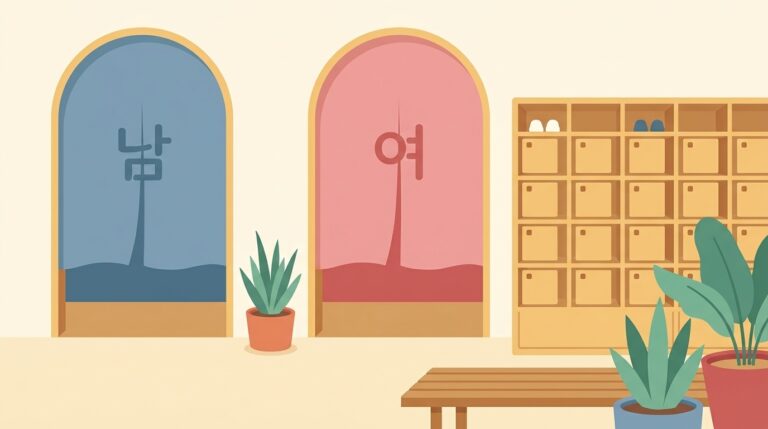
Imagine this: You’ve walked into a cozy, warm Korean sauna (Jjimjilbang / 찜질방) after a long, exhausting day of sightseeing in Seoul. Your feet are sore, and you can already smell the relaxing aroma of cypress wood. But suddenly, you reach the front desk, receive your key and uniform, and point toward the baths.
Wait, which door do I enter?
One sign says 남 (Nam) and the other says 여 (Yeo). In Korea, entering the wrong bathhouse is not just embarrassing; it’s a major social mishap! Many of our learners have confessed they felt their hearts race at this exact moment. Don’t worry, my friend. Today, we are going to master the key words and essential manners so you can stride into the correct bath area with 100% confidence. Let’s dive in!
Phase 2: 3 Essential Expressions to Guide Your Steps
Let’s break down the absolute must-know words before you open those curtained doors.
1. 남탕 (Nam-tang)
- Pronunciation: Nam-tang (Sounds like “Nam” as in Namaste + “tang” as in tangy)
- Meaning: Men’s Bath / Men’s Locker Room
- K-Culture Moment: In K-Dramas, you often see fathers and sons bonding in the Nam-tang (남탕), scrubbing each other’s backs with bright green towels.
- Editor’s Insight: “남” (Nam) means male, and “탕” (Tang) means bath or hot spring. If you identify as male, this is your zone!
- Situation Spectrum: Casual ✅ | Semi-formal ✅ | Formal ✅ (This is a standard noun used everywhere)
- 🤔 Think About It: In your home country, do public baths have specific historical terms like “탕” (Tang)? How does your culture view communal bathing?
2. 여탕 (Yeo-tang)
- Pronunciation: Yeo-tang (Sounds like “Yo” in yo-yo + “tang” as in tangy)
- Meaning: Women’s Bath / Women’s Locker Room
- K-Culture Moment: In Korean family dramas, female characters head to the Yeo-tang (여탕) to share neighborhood gossip while soaking in green tea-infused waters.
- Editor’s Insight: “여” (Yeo) means female. Just like Nam-tang, you’ll see this written clearly on the entrance curtain or sign.
- Situation Spectrum: Casual ✅ | Semi-formal ✅ | Formal ✅
- 🤔 Think About It: How do gender-segregated spaces in Korea differ from those in your country?
3. 신발장 (Sin-bal-jang)
- Pronunciation: Sin-bal-jang (Sounds like “Seen” + “bal” as in ball + “jang” as in jungle but with an ‘ah’ sound)
- Meaning: Shoe Locker
- K-Culture Moment: As soon as you pay at the counter, the staff gives you a key with a number. That number corresponds to your Sin-bal-jang (신발장), where your shoes must go before you even touch the clean floors inside.
- Editor’s Insight: In Korea, outdoor shoes are strictly forbidden indoors. Putting your shoes in the correct Sin-bal-jang is your very first step to Jjimjilbang success!
- Situation Spectrum: Casual ✅ | Semi-formal ✅ | Formal ✅
Phase 3: Textbook Korean vs. Real-Life Korean
Let’s compare what textbooks teach you versus how real Koreans actually talk when navigating the Jjimjilbang!
Situation 1: Asking where to go
- 📖 Textbook Korean: “남성 전용 목욕탕은 어디에 있습니까?” (Nam-seong jeon-yong mog-yog-tang-eun eo-di-e is-seub-ni-ka?) – “Where is the bathhouse exclusive for men?” (Too formal, sounds like a robot guide!)
- 🗣️ Real-Life Korean: “남탕 어디로 가요?” (Nam-tang eo-di-ro ga-yo?) – “Which way to the men’s bath?”
- 💡 Why the difference? Real Koreans prefer short, active verbs. Using “어디로 가요?” (Which way do I go?) is polite, natural, and efficient.
Situation 2: Asking where to put your shoes
- 📖 Textbook Korean: “구두를 신발 수납장에 넣으십시오.” (Gu-du-reul sin-bal su-nap-jang-e neo-eu-sip-si-o.) – “Please place your dress shoes into the shoe storage cabinet.”
- 🗣️ Real-Life Korean: “신발 여기에 넣어요?” (Sin-bal yeo-gi-e neo-heo-yo?) – “Do I put my shoes here?”
- 💡 Why the difference? When talking to the desk clerk, pointing to the locker and asking “여기에 넣어요?” (Do I put it here?) is much more natural and easier for an A2 learner to master on the spot!
Phase 4: K-Culture Deep Dive & Non-Verbal Manners
4-1. Nunchi (눈치) & Gestures
- The Key-Card Tap: When you receive your key, it is often an electronic band. Don’t try to pull the locker doors with force! Simply tap the black sensor with your key band. Watch how others do it—use your Nunchi (quick situational awareness)!
- Barefoot Etiquette: The moment you step past the entrance counter, your shoes must be off. Walking on the indoor floor with shoes on is a huge taboo. Walk softly barefoot or in the provided socks.
4-2. The Jjimjilbang Culture Code
In Korea, going to the Nam-tang or Yeo-tang naked is completely normal. It represents equality—everyone sheds their societal status, expensive clothes, and worries, entering the water as equals. It might feel intimidating at first, but remember: no one is looking at you! Everyone is focused on their own relaxation.
Phase 5: Live Roleplay Scenario
Setting: The front desk of “Silla Spa” in downtown Seoul. You have just paid, and the friendly receptionist, Hana, is handing you a key and a set of cotton pajamas.
- Hana (Receptionist): “어서 오세요! 키 여기 있습니다.”
(Eo-seo o-se-yo! Ki yeo-gi is-seub-ni-da.)
“Welcome! Here is your key.” - You: “감사합니다. 신발 여기에 넣어요?”
(Gam-sa-ham-ni-da. Sin-bal yeo-gi-e neo-heo-yo?)
“Thank you. Do I put my shoes here?” - Hana: “네, 105번 신발장에 넣으세요.”
(Ne, baek-o-beon sin-bal-jang-e neo-eu-se-yo.)
“Yes, please put them in shoe locker number 105.” - You: “아, 확인했습니다. 옷은 어디서 갈아입나요?”
(Ah, hwa-gin-haet-seub-ni-da. Ot-eun eo-di-seo gal-a-im-na-yo?)
“Ah, got it. Where do I change my clothes?” - Hana: “여성분이시니까 여탕으로 들어가세요.”
(Yeo-seong-bun-i-si-ni-ka yeo-tang-eu-ro deul-eo-ga-se-yo.)
“Since you are female, please go into the Women’s Bath area.” - You: “여탕은 왼쪽인가요?”
(Yeo-tang-eun oen-jjog-in-ga-yo?)
“Is the Women’s Bath on the left?” - Hana: “네, 저기 빨간색 커튼 있는 곳이 여탕입니다.”
(Ne, jeo-gi ppal-gan-saek keo-teun in-neun gos-i yeo-tang-im-ni-da.)
“Yes, over there where the red curtain is, that’s the Women’s Bath.” - You: “네, 감사합니다! 잘 쉴게요.”
(Ne, gam-sa-ham-ni-da! Jal swil-ge-yo.)
“Yes, thank you! I’ll enjoy my rest.”
🔀 Choose Your Next Move!
What will you say next to find your locker inside the changing room?
- A) “제 라커 어디예요?” (Je ra-keo eo-di-yeo-yo?)
- B) “남탕으로 가겠습니다.” (Nam-tang-eu-ro ga-get-seub-ni-da.)
- C) “여기서 옷 벗어요?” (Yeo-gi-seo ot beot-eo-yo?)
📌 Choice Feedback
- A (Best): Perfect! It’s polite, clear, and gets you straight to your locker.
- B (Bad): Uh-oh! If you are female and say you are going to the Nam-tang (Men’s Bath), Hana will look very shocked!
- C (Risk): Too direct! While accurate (you do undress there), asking it out loud right at the entrance might make the staff giggle.
Phase 6: 10-Second Emotion Shadowing Drill
Let’s practice speaking with real Korean emotion. Pronounce the sentences with the indicated feeling and pause at the slashes /!
- [😊 Confident & Polite]
“남탕은 / 어디로 / 가요?”
(Nam-tang-eun / eo-di-ro / ga-yo?)
“Which way / do I go / for the Men’s Bath?” -
[🤔 Slightly Confused but Friendly]
“신발은 / 여기에 / 넣어요?”
(Sin-bal-eun / yeo-gi-e / neo-heo-yo?)
“Do the shoes / go in / here?”
Phase 7: Jjimjilbang Mini-Dictionary
- 남탕 (Nam-tang) | Men’s Bathing Area. Look for blue signs or curtains.
- 여탕 (Yeo-tang) | Women’s Bathing Area. Look for red/pink signs or curtains.
- 신발장 (Sin-bal-jang) | Shoe locker. Always located near the entrance counter.
- 옷장 (Ot-jang) | Clothes locker inside the bathhouse where you store your clothes and bags.
Phase 8: Traveler’s Survival Kit
Survival Phrases TOP 3
- “수건 더 주세요.” (Su-geon deo ju-se-yo.) | “Please give me more towels.” (Pro Tip: Yeo-tang often has a towel limit, so you might need to ask for extra!)
- “식혜 하나 주세요.” (Sik-hye ha-na ju-se-yo.) | “One sweet rice punch, please.” (The ultimate Jjimjilbang drink!)
- “여기가 여탕 맞아요?” (Yeo-gi-ga yeo-tang maj-a-yo?) | “Is this the Women’s Bath?” (Double check before entering!)
🗺️ Editor’s Travel Note
Before heading out, make sure to download the Naver Map App to find highly-rated traditional Jjimjilbangs near you. Note: Prices and operating hours of saunas can change without prior notice, so it’s always wise to check Naver Maps for real-time updates!
Phase 9: A Step Deeper (Reflection)
In Western cultures, privacy is highly guarded, and communal naked bathing can feel like a shock. In Korea, however, bathing together in the Nam-tang or Yeo-tang is seen as a way of stripping away pretenses and forming deep, honest connections (Jeong / 정). It is a space of pure comfort and community.
💬 Your Turn: Would you feel comfortable going to a Korean Jjimjilbang? Which bath area are you heading to? Let us know in the comments below!
Phase 10: FAQ & Common Mistakes
Q: Can I wear my swimsuit in the Nam-tang or Yeo-tang?
A: No! Wearing swimsuits or undergarments in the bath tubs is strictly prohibited for hygiene reasons. Everyone enters completely naked. Don’t worry, it’s natural!
Q: Why doesn’t my key open the locker?
A: Ensure you are at the correct locker number and gender zone. Also, make sure you put your shoes in the Sin-bal-jang first, as some smart systems won’t activate your clothes locker until your shoes are locked away!
Q: Can I take my phone into the baths?
A: Absolutely not! Cameras and phones are strictly banned inside the Nam-tang and Yeo-tang areas to protect privacy.
🚨 Common Mistakes Alert!
- Walking in with shoes: Taking off your shoes too late. Correct Action: Remove shoes immediately at the entryway floor boundary.
- Mixing up the doors: Walking toward the blue curtain when you should go to the red one. Correct Action: Remember 남 (Nam) = Blue/Men and 여 (Yeo) = Red/Women.
- Entering the tub without showering: Jumping straight into the hot water. Correct Action: You must thoroughly wash your body at the sit-down showers before stepping into the communal tubs.
Phase 11: Action Mission!
- 🥉 Bronze Mission: Practice saying “남탕” and “여탕” 5 times in front of the mirror.
- 🥈 Silver Mission: Share this post on your social media and tag a friend you want to visit a Jjimjilbang with!
- 🥇 Gold Mission: Next time you watch a K-Drama featuring a sauna scene, try to spot the words “남탕” (Nam-tang) or “여탕” (Yeo-tang) on the walls!
Phase 12: Interactive Quiz Challenge
Test your knowledge before you soak!
1. What does the word “여탕” (Yeo-tang) mean?
- A) Shoe Locker
- B) Men’s Bath
- C) Women’s Bath
👉 Click here to reveal the answer!
Correct Answer: C
Explanation: “여” (Yeo) means female/women, and “탕” (Tang) means bath. So, 여탕 is the Women’s Bath!
2. True or False: You should put your shoes in the “신발장” (Sin-bal-jang) after you change into your Jjimjilbang uniform.
👉 Click here to reveal the answer!
Correct Answer: False
Explanation: You must put your shoes in the 신발장 (Sin-bal-jang) first, right after entering, before you do anything else!







