

Master the Jjimjilbang Entrance: Pay Like a Local!
Phase 1: Empathy (Your Korean Bathhouse Adventure Starts Here!)
안녕하세요! (An-nyeong-ha-se-yo!) Hello, my lovely language learners! It’s your favorite Daily Hangul editor and your personal cultural navigator here!
Imagine this: You’ve just finished a long, exciting day walking around Seoul. Your feet are aching, and you’re dreaming of soaking in hot mineral waters, eating soft-boiled clay-oven eggs, and wearing those cute “sheep head” towel hats. You finally stand in front of a cozy Jjimjilbang (찜질방 – Korean Bathhouse).
But suddenly, your heart beats fast. The counter staff looks at you, and your mind goes blank. “Do I pay for the bath and the sauna separately? How do I ask for the uniform?”
Don’t worry, chingu (friend)! Many of our student cases show that paying at the front desk is actually the most nerve-wracking part of the Jjimjilbang experience for beginners. Today, we are going to master exactly what to say so you can walk in with 100% confidence, get your comfy clothes, and start relaxing! Let’s dive in!
Phase 2: Deep Dive into 3 Essential Expressions
1. 성인 두 명이요. (Seong-in du myeong-i-yo.)
- Pronunciation: Sung-in doo myung-ee-yo (Sounds like “Sung” as in sung a song, “in” as in inside, “doo” like the number 2, “myung” like the name Myung, “ee-yo”).
- Meaning: “Two adults, please.”
- K-Culture Moment: In K-Dramas, you often see friends or couples arriving at a Jjimjilbang late at night after a long day of dramatic events, casually holding up two fingers and saying this phrase to the counter staff.
- Editor’s Insight: To say a different number, just change “두 (du – 2)” to “한 (han – 1)”, “세 (se – 3)”, or “네 (ne – 4)”. Adding “-이요 (-i-yo)” at the end is a super friendly and natural way to make your request polite without sounding too stiff.
- Situation Spectrum: Casual ✅ | Semi-formal ✅ | Formal ⚠️
- 🤔 Think About It: In English, we often say “Two adults, please.” In Korean, we use specific counters like “명 (myeong)” for people. How does your native language count people?
2. 찜질복도 주세요. (Jjimjilbok-do juseyo.)
- Pronunciation: Jeem-jeel-bok-doh joo-seh-yo (Sounds like “Jeem” as in gym, “jeel” as in reel with a J, “bok” like bok choy, “doh” like cookie dough, “joo-seh-yo”).
- Meaning: “Please give me the Jjimjilbang clothes/uniform too.”
- K-Culture Moment: At some local bathhouses, the basic ticket only covers the public bath (Sanyok). If you want to go to the unisex hot stone sauna rooms (where the real food and lounging happen!), you must wear the designated t-shirt and shorts called Jjimjilbok (찜질복). Saying this guarantees you get your uniform!
- Editor’s Insight: The magic particle “-도 (-do)” means “too” or “also”. By saying “Jjimjilbok-do,” you are smoothly asking to add the clothing rental to your entry fee.
- Situation Spectrum: Casual ✅ | Semi-formal ✅ | Formal ⚠️
- 🤔 Think About It: Why do you think Korean saunas require everyone to wear the exact same uniform? (Hint: It promotes equality and comfort!)
3. 카드로 할게요. (Kadeu-ro halgeyo.)
- Pronunciation: Kah-deu-roh hal-geh-yo (Sounds like “Kah” as in car, “deu” like the ‘the’ in English but softer, “roh” like road, “hal” like Hal in Halloween, “geh-yo”).
- Meaning: “I will pay by card.”
- K-Culture Moment: South Korea is almost entirely cashless. Even at a tiny neighborhood bathhouse, paying with your credit/debit card or a mobile pay app is the absolute norm.
- Editor’s Insight: “-로/-으로 (-ro/-euro)” is a direction/method particle. Here, it means “by means of card.” The ending “-할게요 (-halgeyo)” shows your polite intention to do something.
- Situation Spectrum: Casual ✅ | Semi-formal ✅ | Formal ✅
- 🤔 Think About It: How do you usually pay for services in your country? Is cash still king, or is card payment more common?
Phase 3: Textbook Korean vs. Real-Life Korean
Situation 1: Choosing what to pay for
- 📖 Textbook: “찜질방 이용 요금은 얼마입니까?” (Jjimjilbang iyong yogeumeun eolmaimnikka? – “How much is the usage fee for the Jjimjilbang?”)
- 🗣️ Real-Life: “찜질방도 같이 할게요.” (Jjimjilbang-do gachi halgeyo. – “I’ll do the sauna/Jjimjilbang option too.”)
- 💡 Why the difference? Textbooks teach very formal, long questions. In reality, most reception desks have the price list clearly displayed. Locals just point and say they want to include the “sauna (Jjimjil)” option alongside the basic bath.
Situation 2: Asking for a receipt or locker key
- 📖 Textbook: “영수증과 열쇠를 주십시오.” (Yeongsujeung-gwa yeolsoereul jusipsio. – “Please give me the receipt and the key.”)
- 🗣️ Real-Life: “감사합니다!” (Gamsahabnida! – “Thank you!”) while reaching for the wristband key they automatically hand you.
- 💡 Why the difference? The staff will naturally hand you your locker key (which acts as your electronic wallet inside the venue) without you needing to ask. A simple “Gamsahabnida!” is all you need!
Phase 4: K-Culture Deep Dive & Non-verbal Manners
4-1. Nunchi & Gestures: Handing Over the Card
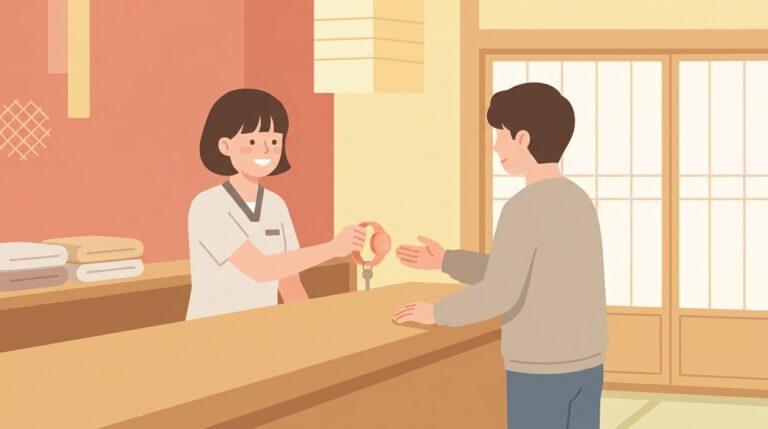
In Korea, showing respect through body language is just as important as speaking the language! When you hand your credit card to the counter clerk, always use two hands, or support your right elbow/forearm with your left hand. It shows great manners (ye-ui) and will instantly make the clerk smile! Avoid tossing the card on the counter.
4-2. Culture Code: The Magic Key Wristband
Once you pay, you’ll receive a wristband with a number. This is your Locker Key (열쇠 – yeolsoe). Inside, you don’t need your physical wallet. If you want to buy sweet rice punch (Sikhye) or boiled eggs, you simply tap this wristband at the snack bar, and you pay the total bill when you leave!
Phase 5: Real-Life Roleplay Scenario
Setting: The brightly lit lobby of “Silloam Jjimjilbang” in Seoul. You are standing in front of a kind older receptionist (Imo-nim / Auntie).
Characters:
* Staff (Imo-nim): Friendly, quick-moving, wears a neat uniform.
* You: A relaxed traveler looking forward to a hot bath.
Dialogue (8 Turns)
- Staff: 어서 오세요! 몇 분이세요?
(Eoseo oseyo! Myeot bun-iseyo?)
“Welcome! How many people?” -
You: 🎭 (Smiling warmly) 안녕하세요. 성인 한 명이요.
(An-nyeong-ha-se-yo. Seong-in han myeong-i-yo.)
“Hello. One adult, please.” -
Staff: 목욕만 하세요? 아니면 찜질방도 하세요?
(Mogyong-man haseyo? Animyeon jjimjilbang-do haseyo?)
“Just the bath? Or the Jjimjilbang (sauna) too?” -
You: 🎭 (Nodding eagerly) 찜질방도 같이 할게요. 찜질복 주세요.
(Jjimjilbang-do gachi halgeyo. Jjimjilbok juseyo.)
“I’ll do the Jjimjilbang too. Please give me the uniform.” -
Staff: 네, 만 오천 원입니다. 결제 어떻게 하세요?
(Ne, man o-cheon won-imnida. Gyeolje eotteoke haseyo?)
“Okay, that’s 15,000 KRW. How would you like to pay?” -
You: 🎭 (Handing over your card with both hands) 카드로 할게요.
(Kadeu-ro halgeyo.)
“I’ll pay by card.” -
Staff: 여기 카드하고 신발장 키요. 들어가서 신발 넣으세요.
(Yeogi kadeu-hago sinbaljang ki-yo. Deureogaseo sinbal neouseyo.)
“Here is your card and shoe locker key. Go in and put your shoes inside.” -
You: 🎭 (Taking the key with both hands) 감사합니다! 안녕히 계세요.
(Gamsahabnida! An-nyeong-hi gyeseyo.)
“Thank you! Goodbye.”
🔀 Interactive Choice Point
The staff asks if you want to rent extra towels. What do you do?
* A. Say: “아니요, 괜찮아요.” (Aniyo, gwenchanayo. – “No, it’s okay. I have a tiny towel.”)
* B. Say: “수건 하나 더 주세요.” (Sugeon hana deo juseyo. – “Please give me one more towel.”)
* C. Say: “수건은 공짜 아니에요?” (Sugeoneun gongjja anieyo? – “Aren’t towels free?”)
Feedback:
- Choice A (Risk ⚠️): Most places give men unlimited towels inside, but women are strictly given exactly two towels at the counter. If you need more, A is risky because once inside, you cannot get more without paying extra!
- Choice B (Best ✅): Perfect! It’s polite and ensures you have enough towels to dry off and make your “sheep head” towel hat.
- Choice C (Bad 🚫): While asking if they are free is not rude, using the word “공짜 (gongjja – completely free dirt cheap)” sounds a bit too blunt for a beginner.
Phase 6: 10-Second Emotion Shadowing Drill
Let’s practice saying our key sentences with the perfect emotion and natural pauses (/)!
- [😊 Friendly & Clear]
- Korean: 성인 / 두 명이요.
- Pronunciation: Seong-in / du myeong-i-yo.
- Map: “Adults… / …two people, please!”
- [🥺 Eager & Polite]
- Korean: 찜질복도 / 주세요!
- Pronunciation: Jjim-jil-bok-do / ju-se-yo!
- Map: “Sauna clothes too… / …please give me!”
- [💳 Quick & Respectful]
- Korean: 카드로 / 할게요.
- Pronunciation: Ka-deu-ro / hal-ge-yo.
- Map: “By credit card… / …I will do.”
Phase 7: K-Culture Mini Dictionary
- 찜질복 (Jjimjilbok) | Sauna Uniform | The oversized, super comfy t-shirt and shorts (usually orange, gray, or blue) given to you at the entrance.
- 신발장 (Sinbaljang) | Shoe Locker | The first locker you use right after entering. You must take off your shoes here before entering the changing rooms.
- 목욕탕 (Mogyoktang) | Public Bathhouse | The gender-segregated area with hot/cold pools and shower stations where you bathe completely naked.
- 식혜 (Sikhye) | Sweet Rice Punch | The ultimate traditional sweet drink served ice-cold in a giant plastic bottle. It is the perfect reward after sweating in the sauna!
Phase 8: Traveler’s Survival Kit
Survival Phrases TOP 3
- 남탕 어디예요? (Namtang eodiyeyo?) – “Where is the men’s bath?” (Pro Tip: Look for Blue signs!)
- 여탕 어디예요? (Yeotang eodiyeyo?) – “Where is the women’s bath?” (Pro Tip: Look for Red/Pink signs!)
- 이거 어떻게 써요? (Igeo eotteoke sseoyo?) – “How do I use this?” (Useful for electronic lockers!)
Editor’s Travel Note
Before you go, make sure you download Naver Map (네이버 지도 App) to search for highly rated “Jjimjilbang (찜질방)” near you. Note that some local bathhouses charge a slightly higher fee after 8:00 PM for overnight stays. Disclaimer: Prices and hours of bathhouses may vary depending on local municipal regulations.
Phase 9: “A Step Deeper” (Cultural Reflection)
In Western countries, bathing is a deeply private activity. However, in Korea, going to the Mogyoktang (bathhouse) together with family or close friends is a bonding experience. Scrubbing each other’s backs (Ttemiri) is a sign of deep affection and care. It teaches us that vulnerability and community are highly valued in Korean society.
💬 Your Turn: Would you feel comfortable visiting a public bathhouse with your friends? Let us know in the comments below!
Phase 10: FAQ & Avoiding Mistakes
Q: Can I pay with cash at the counter?
A: Yes, cash is accepted at almost all Jjimjilbang ticket booths. However, using a card is much quicker and highly preferred by the staff.
Q: Do I have to pay for the Jjimjilbok if I only want to take a quick shower?
A: No! If you only want to use the bath and showers, you can pay a cheaper price and skip the uniform. Just tell them “목욕만 할게요” (Mogyog-man halgeyo – “Only bathing”).
Q: Can children enter the Jjimjilbang?
A: Yes! Children are welcome, but there are special discounted tickets for kids. You can ask for “소인” (Soin – Child) tickets.
🚨 Common Mistakes Alert!
- Mistake: Wearing shoes past the lobby threshold.
- Correct Action: Take off your shoes immediately at the entrance and put them in the shoe locker (sinbaljang).
- Mistake: Bringing your luggage into the bath area.
- Correct Action: Leave large suitcases with the front desk clerk. They will safely keep them behind the counter for you.
- Mistake: Trying to wear your own clothes inside the unisex sauna zone.
- Correct Action: You must wear the provided Jjimjilbok uniform. No outside clothing is allowed in the lounging area.
Phase 11: Action Missions
- Bronze Mission: Practice saying “성인 한 명이요” out loud three times in front of the mirror with a big friendly smile!
- Silver Mission: Save this post or write down “카드로 할게요” on your phone’s notepad so you can easily reference it during your next trip.
- Gold Mission: Find a K-Drama scene set in a Jjimjilbang (like in Crash Landing on You or Legend of the Blue Sea) and try to spot the characters wearing their uniforms and eating eggs!
Phase 12: Interactive Quiz Challenge
1. Situation Quiz
If you want to enter the Jjimjilbang with your best friend, what should you say to the receptionist?
* A) 성인 두 명이요. (Seong-in du myeong-i-yo.)
* B) 수건 주세요. (Sugeon juseyo.)
👉 Click to view the correct answer & explanation!
Correct Answer: A
“성인 두 명이요” means “Two adults, please.” B means “Please give me a towel.”
2. Fill-in-the-Blank
Complete the sentence to pay with your credit card:
* “_______(으)로 할게요.” (I will pay by _______.)
👉 Click to view the correct answer & explanation!
Correct Answer: 카드 (Kadeu)
“카드로 할게요” (Kadeu-ro halgeyo) translates to “I will pay by card.”
3. True/False Culture Quiz
True or False: You can wear your shoes inside the changing room locker area.
👉 Click to view the correct answer & explanation!
Correct Answer: False
Shoes must be locked away in the shoe locker (sinbaljang) right at the entrance before you walk onto the clean indoor floors.






